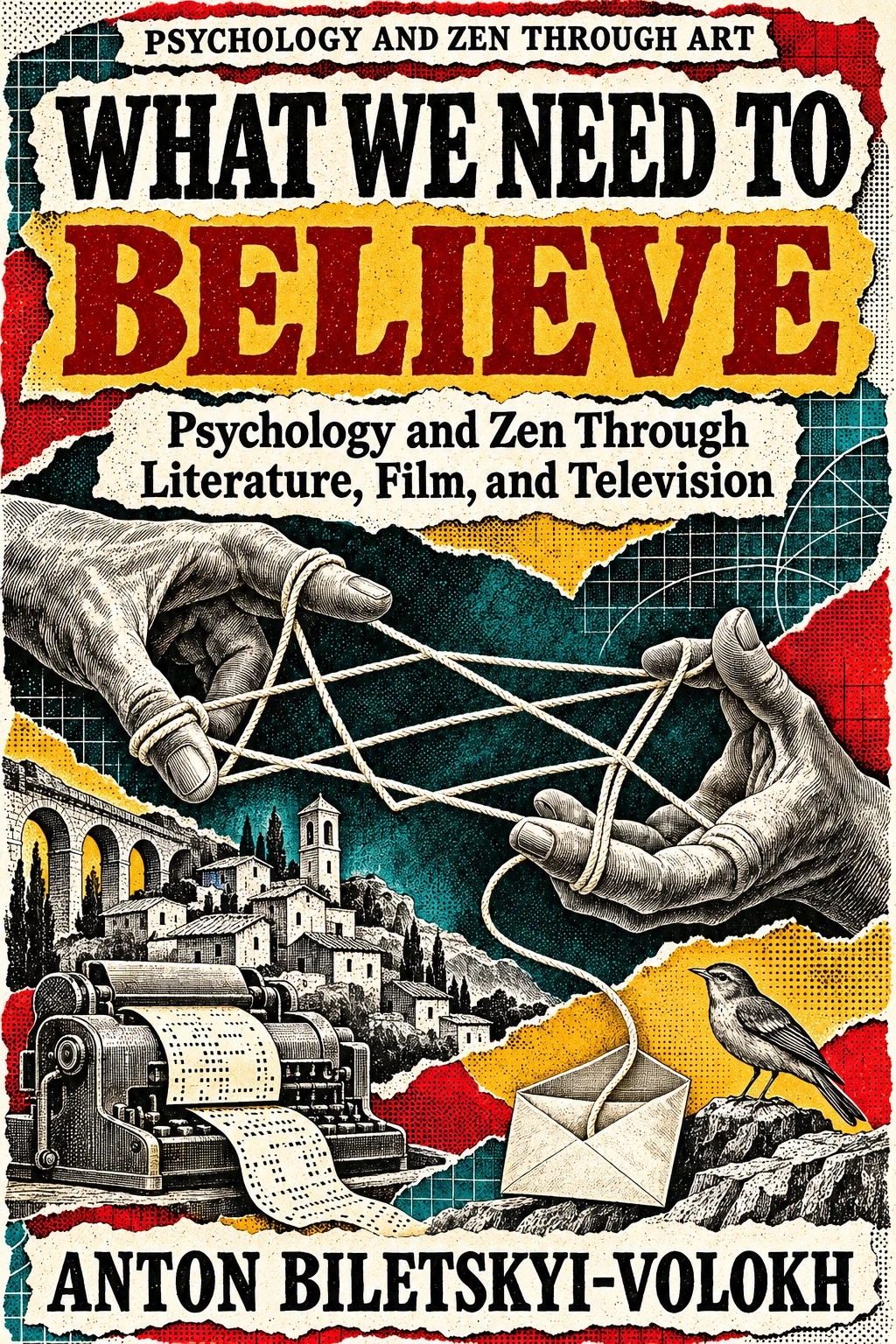
What We Need to Believe
Psychology and Zen Through Literature, Film, and Television
Thirteen illustrated essays on belief, conformity, and doubt, reading Cat’s Cradle, Life of Brian, and other works through psychology and Zen.
Available formats: Kindle, paperback.
About this book
In Cat’s Cradle, an invented religion gives people a way to belong. In Life of Brian, a crowd agrees in perfect unison that everyone should think for themselves. In The Hitchhiker’s Guide to the Galaxy, a computer produces a precise answer to a question nobody can specify. Each work finds a different reason to want a convincing answer.
What We Need to Believe is the second volume of Anton Biletskyi-Volokh’s Psychology and Zen Through Art series. Its thirteen illustrated essays examine belief, doubt, and the appeal of certainty through novels, films, and television. The book moves from the comfort of agreeing with a group to questions about meaning, death, and grief. In Slaughterhouse-Five, Billy Pilgrim’s account of time offers a way to live with the dead. Bernard Werber’s afterlife novels imagine what happens when even death comes with procedures.
Belief also plays out in public. 99 Francs follows an advertiser who knows how desire is manufactured and still feels its pull. In The Hunger Games, a rebellion needs an audience, and Katniss has to decide how much of herself she will let it use. The Simpsons brings the problem down to the scale of a workplace and a classroom, where being right and being understood carry different stakes.
Psychology gives the essays a vocabulary for conformity, persuasion, and the need for closure. Zen brings them back to what a person can see or do while uncertainty remains. Short reflections from Psychology Notebook connect the readings to ordinary decisions. The book can be read independently within the series.
Essays available on the blog
- Cat's Cradle: The Lies We Choose to Live By
- Life of Brian: Tell Us How to Think for Ourselves
- Dogma: When Being Right Becomes the End of the World
- The Meaning of Life: The Answer Is Not in the Envelope
- The Afterlife Has a User Manual
- Slaughterhouse-Five: The Dangerous Comfort of “So It Goes”
- 99 Francs: Knowing the Trick Doesn't Break the Spell
- Underground: The Party That Never Ends
- The Cost of Being Right: The Simpsons and the Tyranny of Being Understood
- The Trouble With Being Too Clever
Same shelf, nearby systems.