
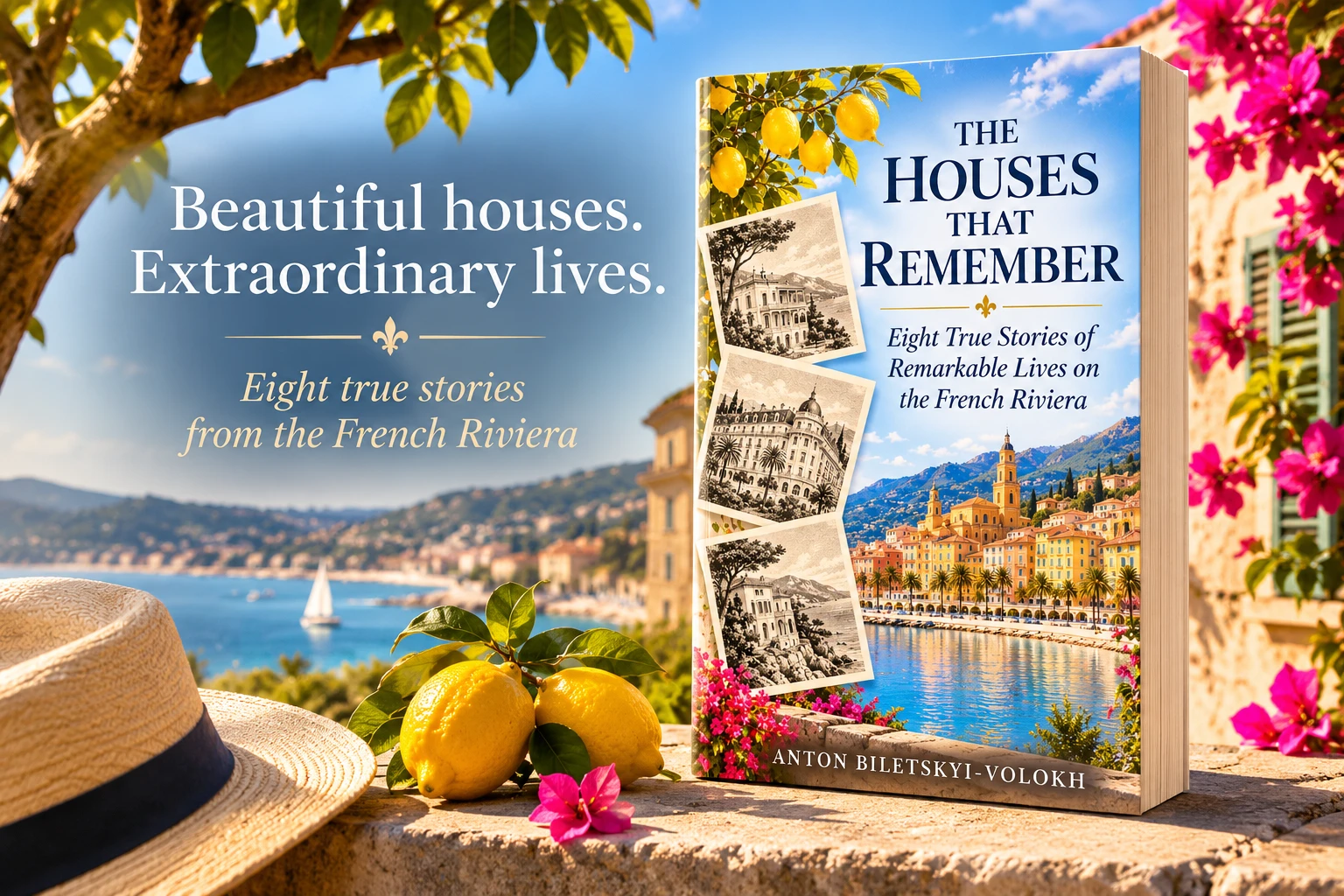
My new AzurBooks title tells eight true stories of extraordinary people, remarkable houses, and the complicated things that happen when buildings outlive the people who made them special.
The French Riviera is very good at making you look at houses.
Beautiful villas above the sea.
Terraces hidden behind gardens.
Extraordinary old hotels.
Buildings with impressive gates, elegant façades, and the sort of views that make you wonder whether their original owners ever managed to get any work done.
But I've always been more interested in something else.
What actually happened inside?
Not the usual list of architects, construction dates and architectural styles.
I mean the people.
Who lived there?
Why did they come?
What were they trying to accomplish?
What went wrong?
And what happened to the place after they were gone?
These questions eventually became the starting point for my new book.
The Houses That Remember: Eight True Stories of Remarkable Lives on the French Riviera is now available on Amazon in Kindle and paperback editions.
It's the latest book in my AzurBooks series, connected to my ongoing work on AzurMenton.
And this time, rather than writing fiction set on the Riviera, I've been exploring its real history.
Eight houses. Eight very different lives.
The book begins in Menton.
At Villa Isola Bella, Katherine Mansfield was trying to continue her literary work while living with a serious illness. Her time there left behind letters, photographs and manuscripts, along with the story of Ida Baker, whose role in Mansfield's life deserves considerably more attention than it usually receives.
There's also a curious problem with the room now associated with Mansfield.
It isn't actually the room where she wrote.
Which is a useful reminder that preserving a writer's memory and preserving the exact circumstances of their life aren't necessarily the same thing.
A short distance away, the story of Villa Val Rahmeh follows a remarkable woman named Maybud Sherwood Campbell.
A former opera singer and passionate botanist, she helped transform the property into an extraordinary garden.
Then financial difficulties forced her to give it up.
The garden survived.
But what does it mean for someone's greatest creation to survive after they can no longer keep it?
At Fontana Rosa, the Spanish novelist Vicente Blasco Ibáñez went considerably further than planting a pleasant garden around his home.
He created a garden dedicated to the writers he admired.
An entire landscape celebrating literature, complete with ceramic portraits and architectural references.
Apparently, simply keeping books on shelves wasn't ambitious enough.
And these are only the first three stories.
A house is never quite what its creator intended
Further west, Eileen Gray's E-1027 presents another problem entirely.
Here was a designer who thought deeply about how people actually live.
Windows.
Furniture.
Privacy.
Comfort.
The small details that make a house genuinely useful rather than merely impressive in photographs.
Yet the building's subsequent history raised difficult questions about artistic authorship, alterations and preservation.
At Les Colombières, Ferdinand Bac and his friends Émile and Jeanne Ladan-Bockairy created an extraordinarily personal Mediterranean world.
Even a mausoleum was part of their plans.
But the eventual story of the house and its inhabitants didn't unfold quite as neatly as they had imagined.
On Cap Ferrat, Béatrice Ephrussi de Rothschild constructed a private world around her artistic collections.
At Villa Kérylos, Théodore Reinach's fascination with ancient Greece met the rather practical requirements of modern domestic life.
Including a piano.
The ancient Greeks, inconveniently, hadn't left behind an ideal design for one.
And finally, in Nice, Henri Matisse transformed a room in the former Hôtel Régina into a spectacular composition of blue paper cut-outs.
His Swimming Pool was created for that particular space.
But preserving the artwork eventually meant separating it from the room where it had come into existence.
Eight stories.
Eight very different ideas of what a home should be.
And eight reminders that buildings have a habit of developing histories their creators never anticipated.
This isn't really a book about architecture
Of course, there's plenty of architecture in it.
It would be rather difficult to write a book about eight remarkable houses without discussing the buildings themselves.
But I was more interested in the relationship between the houses and the people who inhabited them.
A beautiful villa doesn't guarantee a happy life.
An extraordinary garden doesn't guarantee financial security.
A carefully designed home doesn't guarantee that everyone who lives there will agree about how it should be used.
And preserving a building doesn't mean we can preserve the life once lived inside it.
That distinction became one of the central themes of the book.
I also wanted to avoid turning historical figures into the simplified versions of themselves that we tend to encounter on plaques and museum labels.
We usually know how their stories ended.
They didn't.
They had unfinished projects.
Problems with money.
Illnesses.
Arguments.
Visitors.
Letters to answer.
Daily inconveniences.
And occasionally, rather absurd problems involving furniture or windows.
For me, these details make history much more interesting.
They bring remarkable people back into the ordinary world.
Researching the people behind the places
The Houses That Remember is narrative nonfiction.
The stories are based on historical correspondence, manuscripts, photographs, institutional archives and published research.
That doesn't mean every question has a perfect answer.
Quite the opposite.
History is full of gaps, conflicting recollections and stories that have become more polished through repetition.
I've tried to distinguish what can be documented from what remains uncertain.
No invented private conversations passed off as historical fact.
No imaginary thoughts attributed to people who died a century ago.
And no need to turn every interesting anecdote into an unquestionable truth.
The real stories are quite interesting enough.
The book includes illustrations and follows the eight locations geographically, beginning in Menton and continuing west towards Nice.
But it isn't intended to be a conventional guidebook.
You don't need to be travelling to the Riviera to enjoy it.
You don't even need to be particularly interested in architecture.
If you enjoy history, biography, literature, art, gardens, or simply the surprising ways people's ambitions collide with reality, there's plenty to discover.
And if you do visit the region, perhaps the book will change what you notice.
Another chapter for AzurBooks
This is also an important step in the development of AzurBooks.
My earlier book, A Week in Menton, approached the town through fiction: a story shaped by the atmosphere and everyday life of the Mediterranean coast. Its companion AzurMenton walking route connects that story with places around town.
The Houses That Remember takes another direction.
Real people.
Real buildings.
Documented lives.
The two books are different, but they share something I want to develop further through both AzurBooks and AzurMenton.
The Riviera is far more interesting than its familiar postcard image.
There's the sea, of course.
The sunshine.
The gardens.
The lovely old streets.
But behind the scenery are countless stories that deserve to be told.
Some are famous.
Others are almost forgotten.
And sometimes the most interesting detail isn't the spectacular thing a person achieved.
It's the rather ordinary problem they had to solve along the way.
The book is now available
The Houses That Remember: Eight True Stories of Remarkable Lives on the French Riviera
By Anton Biletskyi-Volokh
Published as part of the AzurBooks series.
Explore the AzurBooks series on Amazon
I'll also continue developing complementary material on AzurMenton, where the historical stories can be connected to the actual geography of Menton and the surrounding Riviera.
Because after reading about a house, it's rather satisfying to know where it stands.
And sometimes even more satisfying to stand outside it and remember the people who once called it home.
Houses remember things.
We just have to learn how to listen.