
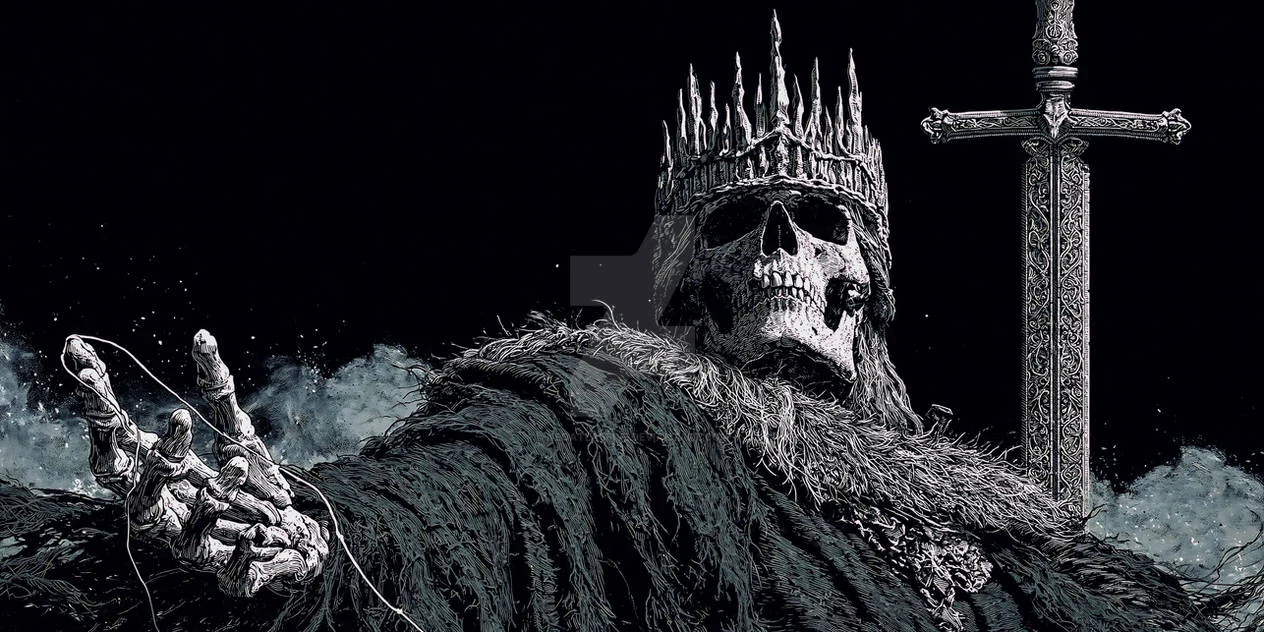
Cover image supplied from the owner-authorized Psychology Notebook reserve.
Bernard Werber, the psychology of death anxiety, and our need to turn the ultimate unknown into an understandable system.
There is one serious administrative problem with dying.
Nobody can explain the procedure with any confidence.
We have instructions for practically everything else.
How to buy a house.
How to apply for citizenship.
How to operate a washing machine.
How to optimize our sleep, nutrition, productivity, relationships, and chances of professional success.
Even assembling a piece of furniture comes with diagrams.
Then we reach the most consequential event of our existence.
And the documentation becomes remarkably unreliable.
Religions offer different explanations. Philosophers disagree. Scientists can investigate the biological processes of dying, but they cannot simply provide a verified tourist guide to what, if anything, follows the end of life.
There is no official website.
No customer service department.
No reliable way to check whether the information is current.
Bernard Werber finds this arrangement rather unsatisfactory.
In Les Thanatonautes (1994), he imagines a group of explorers who decide to investigate death as though it were another undiscovered continent.
In L'Empire des anges (2000), he goes further.
The afterlife becomes an organized system complete with rules, evaluations, career opportunities, and responsibility for the development of other souls.
Death, previously the ultimate mystery, acquires something resembling an organizational chart.
It is an enormously entertaining idea.
It also raises a psychological question.
If we could turn death into something predictable, would we finally stop being afraid of it? Or would we simply discover an entirely new collection of things to worry about?
The Last Unexplored Continent
Werber begins Les Thanatonautes with a familiar human ambition.
We have explored the oceans.
Crossed continents.
Traveled into space.
Investigated the depths of the Earth.
And yet one territory remains unavailable.
Death.
Michael Pinson and Raoul Razorbak decide that this situation requires correction.
Their undertaking combines scientific exploration, technological experimentation, and the study of religious and mythological traditions.
The explorers become thanatonauts, navigators of death.
The name is wonderfully reassuring.
Death is no longer an incomprehensible ending.
It is a destination.
And a destination can be investigated.
You can organize an expedition.
Develop instruments.
Identify routes.
Compare reports.
Map regions.
Improve procedures.
Eventually, perhaps, publish a guidebook.
The psychological transformation is almost immediate.
An unknown condition becomes a geographical problem.
And geographical problems are at least conceptually manageable.
Nobody knows what lies beyond the final boundary.
But we can imagine a team of competent researchers preparing to find out.
This is one of Werber's most appealing narrative strategies.
He takes something enormous, frightening, and abstract, then gives it the structure of a practical investigation.
The reader does not have to remain alone with an existential question.
There is now a project.
And projects are considerably easier to think about than mortality.
The Difference Between a Mystery and a Problem
There is an important psychological distinction between uncertainty and a problem that appears solvable.
Imagine worrying about your financial situation.
The circumstances may be unpleasant.
But at least certain actions are possible.
Review expenses.
Seek additional income.
Ask for assistance.
Change plans.
The result is not guaranteed, but there are things to investigate and decisions to make.
Now consider the question of what happens to subjective experience after death.
We can study dying.
Investigate consciousness.
Examine philosophical arguments.
Compare religious beliefs.
But the ultimate question is not currently available for investigation in the same straightforward way as a bank statement.
For many people, that lack of control is profoundly uncomfortable.
The problem has no obvious action plan.
And the mind is not particularly fond of problems without action plans.
One response is to develop a belief that supplies an explanation.
Another is to distract ourselves from the question.
Another is to accept some degree of uncertainty.
Werber imagines a fourth possibility.
Turn the question into an engineering challenge.
What if the unknown can be explored?
What if the problem is not that death lies beyond knowledge, but that nobody has developed the correct research method?
The idea transforms existential helplessness into practical curiosity.
And curiosity can be an excellent response to fear.
It directs attention toward investigation rather than passive anticipation.
But curiosity can also become a way of avoiding the emotional implications of what we are investigating.
Sometimes we want to understand something because understanding is valuable.
Sometimes we want to understand because we cannot tolerate not knowing.
And those motives may coexist.
The thanatonauts are explorers.
They are also human beings attempting to make mortality less frightening by turning it into a territory with recognizable boundaries.
The project promises knowledge.
But perhaps what makes the promise so attractive is the possibility of control.
The Map That Makes the Unknown Familiar
As the expeditions advance, the afterlife acquires increasingly detailed geography.
There are regions.
Passages.
Obstacles.
Different stages of the journey.
The travelers compare their discoveries with descriptions drawn from religious traditions.
The Tibetan Book of the Dead, Egyptian funerary texts, and other mythological accounts become resources for interpreting the fictional territory.
This produces a fascinating reversal.
Religious descriptions of the afterlife are no longer simply matters of belief.
Within the story, they can be treated as competing travel reports.
Perhaps different cultures have described the same destination through different symbolic languages.
Perhaps their accounts contain fragments of a larger reality.
It is a compelling speculative idea.
And it gives the reader the pleasure of watching separate explanations converge into a single system.
But the convergence itself deserves scrutiny.
There is an important difference between discovering that two traditions describe similar motifs and establishing that both describe the same independently verified phenomenon.
Human cultures share many concerns.
Death.
Loss.
Judgment.
Transformation.
The possibility of continuing existence.
It is not surprising that their stories sometimes resemble one another.
But resemblance is not proof that they possess a common factual reference.
Werber is writing speculative fiction, not demonstrating the existence of an afterlife.
Near-death experiences are real experiences reported by people who survive critical medical events. Their interpretation remains a subject of research and philosophical debate. They do not establish the elaborate geography described in the novels.
The distinction matters because the books derive much of their pleasure from blurring the familiar boundaries between scientific investigation, religious imagery, and imaginative invention.
The reader enjoys the possibility that all these fragments might finally fit together.
An extraordinary puzzle.
A hidden structure.
An answer.
And perhaps this is precisely what we want from the unknown.
Not merely information.
A coherent picture in which nothing important remains unexplained.
When Exploration Becomes Tourism
There is a wonderful irony in Les Thanatonautes.
The explorers begin by treating death as the ultimate mystery.
But as their knowledge expands, the extraordinary becomes increasingly ordinary.
Procedures are developed.
The journey becomes repeatable within the novel's fictional rules.
What initially required immense courage and experimental ingenuity begins acquiring the familiar features of an organized activity.
Eventually, the afterlife can even become a destination for visitors.
Humanity has discovered a new world.
And almost immediately begins treating it like an industry.
This is one of Werber's most effective jokes.
We imagine that discovering what lies beyond death would permanently transform human existence.
Perhaps it would.
But human beings are remarkably talented at normalizing extraordinary circumstances.
Yesterday's miracle becomes today's infrastructure.
The impossible journey becomes a service.
The mysterious territory becomes a route.
And a route eventually produces people complaining about the arrangements.
There is a psychological principle underneath the comedy.
Familiarity often reduces the novelty of an experience.
An achievement that once seemed extraordinary can become part of the normal background of life.
The new world does not remain new forever.
And if our deepest expectation was that discovering it would provide permanent reassurance, we may discover that knowledge has not eliminated our ability to worry.
Now we know that death is a journey.
Excellent.
What if we take the wrong route?
What if the destination is unpleasant?
What if there are rules we do not understand?
What if the journey goes badly?
We have not necessarily eliminated uncertainty.
We have made it more specific.
The unknown has acquired a map.
And the map has created an entirely new set of questions.
Death Anxiety Has Excellent Reasons to Exist
Modern psychology offers several ways of understanding why human beings develop explanations for mortality.
One influential framework is terror management theory.
It proposes that awareness of our own mortality creates a potential for existential anxiety, which can be moderated through cultural worldviews, self-esteem, relationships, and beliefs about meaning or continuity.
Religion is one possible source of such protection.
But secular identities and commitments can serve related functions.
A person may seek continuity through children.
Work.
Art.
Scientific achievement.
Community.
The idea that their contribution will remain after they are gone.
Some people are comforted by the possibility of literal life after death.
Others by the prospect that something they created will outlast them.
Research has found associations between reminders of mortality and the defense of meaningful worldviews, although the magnitude, reliability, and interpretation of particular findings remain contested.
The central psychological insight is nevertheless worth considering.
Human beings do not respond to death only as a future biological event.
They also respond to what death means for their identities, relationships, ambitions, and understanding of the world.
A belief that life belongs to a larger structure can reduce uncertainty.
A story that promises continuity can make finality less threatening.
And an explanation of mortality can help people tolerate experiences that would otherwise feel overwhelming.
But this creates an important question.
If a belief helps regulate death anxiety, does that tell us whether the belief is true?
No.
Psychological usefulness and factual accuracy are different questions.
A belief can be comforting and correct.
Comforting and incorrect.
Frightening and correct.
Or frightening and incorrect.
Understanding the emotional function of a worldview does not establish its truth value.
Nor does it make the people who hold it irrational.
It simply reminds us that our explanations are not always chosen for intellectual reasons alone.
Sometimes an explanation provides something we need.
And once it provides that reassurance, questioning it becomes emotionally expensive.
Six Hundred Points to Eternity
Then comes L'Empire des anges.
Michael Pinson, the explorer of death, finally dies.
Having spent a previous novel investigating the afterlife, he now experiences it from an entirely different position.
He is no longer a visitor returning with observations.
He has become one of its permanent inhabitants.
And there is a procedure.
His soul undergoes evaluation.
He accumulates the necessary 600 points to avoid reincarnation and qualify for a higher form of existence.
He can return to Earth as a great initiate or become an angel.
He chooses the angelic career.
There is something magnificently human about the arrangement.
We have finally discovered paradise.
And it has a scoring system.
The mysteries of existence have been reduced, at least in part, to performance evaluation.
Apparently, even death does not release us from the possibility of failing an examination.
It is difficult not to smile at the bureaucratic structure.
But the psychological implications are revealing.
Uncertainty about death has been replaced by uncertainty about merit.
What happens after death?
Now we know.
How do we qualify for the desirable outcome?
There are rules.
Have I performed sufficiently well?
Someone will evaluate me.
And suddenly we are back in a familiar emotional position.
We must become good enough.
The unknown no longer threatens us because it has no explanation.
It threatens us because the explanation contains standards we may fail to meet.
The cosmic mystery has become a personal report card.
The Comfort of Cosmic Accounting
A scoring system provides something psychologically valuable.
It creates a relationship between actions and outcomes.
Do well.
Receive a favorable result.
Do badly.
Face consequences.
The universe becomes morally intelligible.
There is something attractive about this.
Our ordinary world contains enormous amounts of undeserved suffering.
Good people become ill.
Cruel people prosper.
Careful decisions sometimes produce terrible outcomes.
Luck, biology, geography, social conditions, and countless other factors influence lives in ways that do not correspond neatly to moral deservingness.
A cosmic evaluation system can restore the sense that everything will eventually be accounted for.
Even if the earthly world appears unjust, a larger system will correct the balance.
This can provide genuine consolation.
But it also introduces serious ethical difficulties.
If every life is ultimately assessed according to a hidden moral scale, how do we understand the suffering of someone whose circumstances were never under their control?
If a soul's situation reflects a cosmic developmental process, do we risk treating misfortune as something the person somehow needed or deserved?
If progress can be measured in points, what exactly is being measured?
Obedience?
Kindness?
Courage?
Wisdom?
Success under the conditions a person happened to receive?
Werber's system is a fictional device designed to provoke reflection, not a validated moral theory.
But it exposes a recognizable human wish.
We would like the universe to contain a reliable method of evaluation.
Preferably one in which the scores are fair, the rules are available, and nobody can manipulate the examiner.
The attraction is understandable.
The danger appears when the imagined fairness of the system becomes more important than the actual lives being evaluated.
A person is not necessarily morally superior because their circumstances allowed them to appear successful.
And a difficult life is not evidence of a defective soul.
Cosmic accounting can offer reassurance.
But it can also make us considerably less curious about the particular causes of human suffering.
Paradise Turns Out to Be Another Job
Michael becomes an angel.
This should be the point where everything finally becomes simple.
He has crossed the ultimate boundary.
Survived death.
Passed the examination.
And reached a condition that countless human traditions have imagined as the fulfillment of existence.
Surely he can now relax.
Unfortunately, paradise has responsibilities.
Michael is assigned three human beings.
He must guide them through their lives.
Help them develop.
Support their search for happiness.
And attempt to influence events without violating their free will.
His possible channels of communication include dreams, intuitions, signs, and other indirect interventions.
It is a fascinating arrangement.
A supernatural guardian with responsibilities, limited tools, and clients who are not particularly cooperative.
Michael can observe their lives.
He can attempt to help.
But he cannot simply dictate what they must do.
In other words, he has achieved a higher form of existence and discovered the frustrations of being a consultant.
He understands what might help.
His clients remain free to ignore him.
A familiar professional experience, merely relocated to heaven.
The irony is especially sharp because Michael now confronts the reverse of his former ambition.
In Les Thanatonautes, he wanted knowledge that would allow human beings to understand the world beyond death.
In L'Empire des anges, he possesses an extraordinary position of observation but cannot turn that position into complete control.
He can see more.
He cannot necessarily make other people choose better.
The ultimate explorer has become a guardian whose knowledge exceeds his authority.
And perhaps this is the more interesting limit.
Not the boundary of death.
The boundary between understanding another life and being entitled to direct it.
The Angel Who Knows What's Best
Imagine having access to a much wider perspective on another person's life.
You can see the patterns they repeat.
Recognize their destructive relationships.
Understand the opportunities they overlook.
Anticipate some of the consequences of their choices.
You know what they should do.
At least, you believe you do.
Then you discover that you are not permitted to make their decisions.
An infuriating arrangement.
Especially for someone who has become convinced that a better understanding should produce greater control.
Michael's angelic role raises a question familiar from psychology, education, parenting, and therapy.
When does helping another person become an attempt to make them follow the life we consider best?
The distinction is not always easy.
A teacher may recognize a student's potential.
A therapist may understand a patient's recurring difficulties.
A parent may identify risks that a child cannot yet appreciate.
Knowledge can create legitimate responsibilities.
But it does not automatically provide unlimited authority.
The person receiving help remains a participant in their own life.
And sometimes their choices will disappoint us.
Michael's predicament makes this unavoidable.
He can offer guidance.
He cannot simply take over.
His task therefore requires more than superior knowledge.
It requires some capacity to tolerate the difference between what he wants for his human charges and what they actually choose.
That is a difficult form of care.
And an interesting reversal of the original thanatonautic project.
The first novel asks whether the unknown can be conquered through understanding.
The second asks whether understanding can coexist with the limits of our power.
The angel has a better vantage point.
But the people below are still living their own lives.
A Heaven With No Restaurants
One of the most charming details in L'Empire des anges concerns the peculiar limitations of paradise.
The place may be spiritually impressive.
But it lacks certain ordinary pleasures.
Restaurants.
Cinema.
Music.
The familiar activities through which people occupy and enjoy their earthly lives.
This is an unexpectedly interesting joke.
Human beings spend centuries imagining an existence beyond suffering, limitation, and mortality.
Then discover that the condition of being alive included many small pleasures they had barely considered important.
A meal.
A film.
A conversation in a noisy room.
The ordinary textures of embodied existence.
Paradise has solved the major problem.
You no longer have to live as a mortal human being.
Unfortunately, you may begin missing some of the advantages of being one.
This touches on a paradox of human desire.
We often imagine fulfillment as the removal of everything that troubles us.
No pain.
No uncertainty.
No loss.
No bodily limitations.
But our experience of pleasure and meaning is also bound to the conditions of ordinary life.
We enjoy food because we have bodies capable of tasting it.
We value encounters partly because they occur in time.
We look forward to things because they have not yet happened.
We remember experiences because they have ended.
Eliminate all limitation and we may also alter the conditions under which particular pleasures acquire meaning.
This does not prove that mortality is desirable or that suffering is necessary for happiness.
It simply complicates the fantasy that a perfected existence would automatically contain everything we value in our current one.
Michael has crossed the ultimate threshold.
But heaven does not make the ordinary world irrelevant.
Perhaps some of what mattered most was never particularly heavenly.
Knowing Where the Dead Go Doesn't Mean You Stop Missing Them
There is another problem with the fantasy of a completely mapped afterlife.
Suppose we knew exactly what happened after death.
Suppose we possessed a reliable description of every stage.
Suppose we knew the rules, understood the destinations, and could explain the process without contradiction.
Would grief disappear?
Not necessarily.
Grief concerns more than uncertainty about the fate of the dead.
It also concerns the absence of someone from our present life.
The person who used to sit across from us at breakfast is no longer there.
The conversation cannot continue in its familiar form.
The shared routine has ended.
The future we imagined together has changed.
Even complete certainty that a loved person continues existing elsewhere would not automatically restore their place in our daily world.
The map might offer consolation.
But it would not necessarily eliminate separation.
This is an important distinction because explanations of death often promise relief from questions that are not entirely questions about death.
We want to know where someone has gone.
But we also want them back.
We want to believe that their existence has not vanished.
But we also want another ordinary afternoon with them.
We want an explanation that makes the loss comprehensible.
But the explanation does not change the fact that our lives have been altered.
Knowledge may reduce one kind of distress while leaving another untouched.
A map can tell us where something is.
It cannot guarantee that we can return to the relationship we had with it.
Perhaps this is one of the limits of Werber's fictional conquest of death.
The unknown may become familiar.
But love and loss do not automatically become administrative problems with administrative solutions.
The Buddhist Sources and the Buddhist Difference
Werber's books draw extensively on religious traditions, including Tibetan Buddhist accounts of death and rebirth.
This makes a comparison with Buddhism appropriate.
But it also requires precision.
Tibetan Buddhist teachings concerning intermediate states, rebirth, and liberation belong to specific religious and philosophical traditions.
They should not simply be treated as identical with Japanese Zen.
And the elaborate geographical and administrative afterlife in Werber's fiction is not a faithful presentation of any one Buddhist doctrine.
Werber combines elements from multiple traditions into his own speculative cosmology.
That freedom is part of what makes the books entertaining.
It also means their fictional system cannot be used as evidence for the actual teachings of Buddhism, Christianity, ancient Egyptian religion, or any other tradition from which the author borrows imagery.
For a comparative Zen reading, I think the more interesting question lies elsewhere.
Zen emphasizes practice and the transformation of our relationship with immediate experience.
Its philosophical traditions are concerned with impermanence, interdependence, attachment, and the limitations of conceptual thinking.
This does not mean Zen practitioners must hold no religious views about death or rebirth.
Nor does it imply that Buddhism has no cosmology.
But it does provide a different emphasis from the ambition to construct a complete map of the afterlife.
Werber's explorers ask:
What exactly happens after death?
A Zen-inspired question might be:
What is happening to my life now because I cannot tolerate not knowing?
The two questions are not mutually exclusive.
One concerns the possible structure of reality.
The other concerns our relationship to uncertainty.
But the distinction is important.
A person could possess an elaborate explanation of death and remain terrified of losing everything they love.
Another person might remain uncertain about what follows death while becoming more capable of living with that uncertainty.
The amount of cosmological information is not necessarily the measure of psychological freedom.
The Desire to Know Can Become Another Attachment
There is a temptation to treat every expansion of knowledge as a form of liberation.
And often it is.
Understanding disease can improve treatment.
Understanding ecosystems can support conservation.
Understanding human behavior can help us make better decisions.
Knowledge is not the enemy.
But the psychological relationship to knowledge can become problematic.
We may begin believing that we cannot live well until every important question has received an answer.
I must understand why that person rejected me.
Why my childhood happened as it did.
What my life is supposed to mean.
Whether every important choice was correct.
And, ultimately, what happens when I die.
Some questions can be investigated productively.
Others may remain unresolved.
The difficulty begins when uncertainty itself becomes unacceptable.
The search for understanding changes from curiosity into compulsion.
A new explanation appears.
It provides relief.
Then another question emerges.
More information is required.
Another theory.
Another model.
Another system that promises to integrate everything into a coherent whole.
The person becomes increasingly sophisticated.
But not necessarily less dependent on the need for certainty.
This is the paradox I find especially interesting in Werber.
His fiction expands the reader's imagination.
It makes unfamiliar possibilities available.
Challenges ordinary assumptions.
And invites us to consider reality from perspectives we might never otherwise adopt.
But it also offers the extraordinary pleasure of a world that becomes explainable.
The mysteries have rules.
The invisible realm has geography.
The afterlife has a hierarchy.
Human actions have measurable consequences.
Even angels have job descriptions.
The unknown has become a system.
And systems are wonderfully reassuring.
Until we begin treating the system as something reality must obey.
What If the Map Is Wrong?
Imagine that the thanatonauts have produced a magnificent map.
Every zone identified.
Every passage described.
Every significant danger recorded.
Travelers now possess a guide to the ultimate destination.
The map has become authoritative.
People organize their beliefs and expectations around it.
Then something appears that does not fit.
An experience the map cannot explain.
A contradictory observation.
An entirely unfamiliar region.
What happens?
In a healthy process of inquiry, the model must remain open to revision.
A useful explanation can be accurate within limits and incomplete beyond them.
Its value does not depend on its being the final explanation of everything.
But psychologically, revising a worldview can be difficult.
Especially when the worldview provides emotional security.
If a belief makes death bearable, evidence that challenges it may feel like more than an intellectual inconvenience.
It may threaten the foundation on which someone has organized their relationship with mortality.
The problem becomes even more complicated when the explanation is connected with identity.
I am someone who knows.
Someone who has understood the larger pattern.
Someone who has finally seen what ordinary people cannot see.
The map provides knowledge.
But it also provides a position from which the person can feel secure and perhaps superior.
Questioning the map now threatens two things.
The explanation.
And the self-image of the person who possesses it.
This is where intellectual curiosity can turn into dogmatism.
We no longer use the explanation to investigate reality.
We use reality selectively to defend the explanation.
And the most dangerous moment may be the one in which we stop recognizing that our model is a model.
The Angel Who Still Has to Learn
There is a particularly revealing continuity between Michael's two fictional careers.
First, he explores the unknown.
Then he becomes a guide.
Both positions promise a degree of superiority.
The explorer knows what ordinary people do not.
The angel sees aspects of human life that human beings themselves cannot see.
The perspective expands.
But the expansion does not eliminate the need for humility.
The explorer must recognize that a map is not the territory.
The angel must recognize that a human life is not a project whose results he can guarantee.
And both must learn that greater knowledge does not necessarily make the world more obedient.
This is where I think the two novels become more interesting when read together.
Les Thanatonautes is about the extraordinary ambition to turn mystery into knowledge.
L'Empire des anges is about the frustration of discovering that knowledge still does not provide unlimited control.
Michael has reached a higher perspective.
But he remains concerned with the lives of others.
He still needs to interpret.
Choose.
Intervene.
And accept consequences he cannot fully determine.
Paradise has not abolished the central difficulty of human relationships.
It has merely given that difficulty a better vantage point.
Perhaps this is the most useful limit of Werber's explanatory system.
It can describe the machinery of the universe in astonishing detail.
But it cannot make living beings completely predictable.
And it cannot remove the moral difficulty of deciding how to act when another person remains free.
The Ultimate Unknown Is Not a Personal Insult
There is something profoundly human about wanting to know what happens after death.
It is not foolish.
Not necessarily pathological.
And not a failure of spiritual maturity.
Curiosity about mortality has shaped philosophy, religion, art, science, and human culture for millennia.
The difficulty arises when we treat not knowing as an unacceptable condition that must be eliminated before life can become bearable.
Because some uncertainty may remain.
We can investigate death biologically.
Reflect on its philosophical implications.
Study the different ways cultures understand it.
Find comfort in traditions that speak meaningfully to us.
And remain open about what has not been established.
There is no need to pretend that all explanations are equally supported by evidence.
Nor is there a need to ridicule the emotional comfort people receive from beliefs that cannot be scientifically verified.
The psychological function of a belief and its factual status should be examined separately.
But perhaps we can also ask a more personal question.
What would become possible if I stopped requiring a final answer before allowing myself to live?
Would I become less concerned with mortality?
Perhaps not.
Would grief become painless?
Certainly not.
Would uncertainty disappear?
No.
But perhaps the demand for complete certainty would no longer organize so much of the present.
I could care for people whose lives I cannot guarantee.
Make decisions without knowing their final consequences.
Invest in work that may remain unfinished.
Enjoy an ordinary afternoon without requiring it to fit inside a cosmic explanation.
And recognize that the lack of a complete map does not automatically make every step meaningless.
The mystery would remain.
Its authority over my daily life might change.
The Afterlife Is Organized. Life Still Isn't.
I think this is the final joke of Werber's two novels.
Humanity discovers the realm of death.
Explores it.
Maps it.
Develops procedures.
Learns about its laws.
And eventually discovers a world in which souls are evaluated and angels supervise human development.
The universe appears wonderfully organized.
Yet individual lives remain messy.
People misunderstand one another.
Make decisions that disappoint their protectors.
Pursue happiness in ways that produce unhappiness.
Repeat familiar mistakes.
And continue behaving as though they have not read the instructions.
Even with supernatural supervision, life refuses to become a perfectly managed project.
The original ambition was to conquer the ultimate unknown.
The result is an elaborate new perspective from which the uncertainty of living remains visible.
Perhaps that is not a failure.
Perhaps it is the more interesting discovery.
Knowing more about the world need not eliminate mystery.
And perhaps it should not.
The difficulty is not the existence of explanations.
We need them.
They help us investigate, cooperate, communicate, and make decisions.
The difficulty begins when we demand that explanation become a substitute for experience.
We want the map before taking the journey.
The guarantee before entering the relationship.
The final meaning before living the life.
The certainty of what comes after before accepting what is happening now.
Werber's fictional universe is delightful because it grants us the fantasy that even death could become comprehensible.
But read through psychology and a contrasting Zen perspective, the books leave a question that no cosmic administrative system can answer on our behalf.
What happens when the explanation is complete, but we still have to live?
The angel may know more than the human.
The explorer may know more than the tourist.
The theologian may possess a more elaborate account than the skeptic.
But none of those positions automatically resolves the difficulty of responding to another living being, accepting limits, or inhabiting a moment that will not remain.
A map of the afterlife might tell us where we go when life ends.
It cannot tell us how to stop postponing life until the mystery has been solved.

Illustration supplied from the owner-authorized Psychology Notebook reserve.