
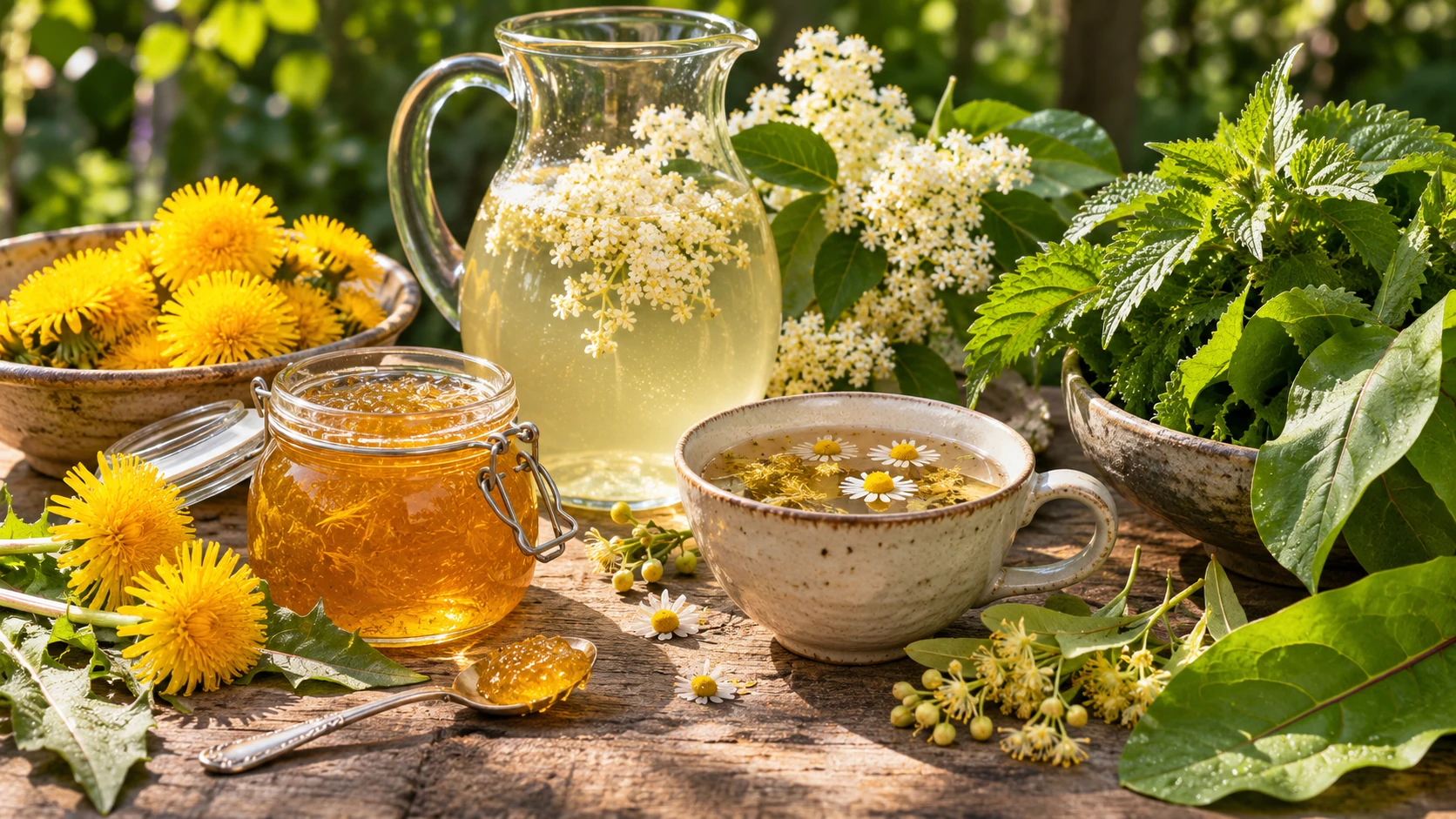
Dandelion wine, elderflower kvass, my grandmother's jasmine tea, flower-scented cakes, and why I eventually stopped fighting nettles and started putting them in borscht.
In my previous Kitchen Note, I wrote about eating flowers.
Magnolias in Nantes.
Rose-petal jam from my childhood.
Black locust blossoms eaten straight from the trees in Mykolaiv.
And the time we sold zucchini flowers stuffed with ricotta at a Ukrainian street-food festival.
Naturally, once I'd finished writing, I remembered several more stories.
This happens to me constantly.
One memory opens another.
Then another.
And before you know it, a short story about a flower has become an inventory of things I've eaten from trees, bushes, gardens and places where most people would never think to look for lunch.
But this particular collection of memories began with a very simple question from my son.
“Dad, can you eat dandelions?”
The yellow flowers nobody takes seriously
We were walking in a park near home.
There were dandelions everywhere.
The familiar bright yellow flowers that gardeners spend a remarkable amount of time trying to eliminate.
My son pointed at them and asked whether they were edible.
He knows that I have a fairly relaxed attitude towards conventional definitions of food.
Not that I eat absolutely everything.
That would be an unfortunate lifestyle choice.
But I've always been interested in ingredients that people overlook or dismiss.
So I told him that dandelions were actually rather versatile.
You can use the flowers.
The young leaves.
Even the roots.
And, rather wonderfully, you can make wine from them.
Ray Bradbury was onto something
There's a famous novel by Ray Bradbury called Dandelion Wine.
Published in 1957.
I couldn't immediately remember whether it was a novel or a short story when I was telling my son about it.
It turns out to be a novel, developed partly from earlier short fiction.
And the title refers to a real drink.
Dandelion wine.
I made it myself years ago.
The idea is to use dandelion flowers as the basis of a sweet, floral fermented drink.
Sugar provides the fermentable material, while the flowers contribute their character.
The result is wonderfully associated with summer.
Which is precisely why Bradbury made such good literary use of it.
In his novel, dandelion wine becomes a way of preserving the memories of summer in bottles.
A beautiful idea.
And a rather practical one if you're also interested in fermentation.
Of course, real wine production requires an appropriate fermentation process. Simply leaving sugared flowers somewhere warm isn't a reliable method for producing a predictable or safe drink.
But I remember the pleasure of working with such an ordinary ingredient.
A flower considered a weed.
Turned into wine.
I find that satisfying.
Or forget the wine. Make jam.
Dandelions can also become a lovely sweet preserve.
I've made dandelion confiture myself.
The bright yellow flowers provide a delicate floral character, and the finished preparation can be quite enjoyable.
I particularly like the idea of combining that flavour with citrus.
Lemon would be the obvious choice.
Lime could be interesting.
But I suspect a little orange might work especially well.
Something slightly sweeter and more aromatic.
That last variation is an idea rather than a precise recipe I've tested.
But the principle is familiar.
Take an ingredient that seems too delicate to be important.
Give it a suitable preparation.
And suddenly it becomes the central flavour of something you actually want to eat.
Then there are the leaves.
Young dandelion leaves make an excellent addition to salads, with a pleasant bitterness.
Older leaves can be cooked.
And the roots have their own culinary applications, including roasting them for a coffee-like drink.
So the humble dandelion is rather more useful than its reputation suggests.
Gardeners may regard it as a nuisance.
I tend to regard it as a plant with an unusually extensive menu.
Igor's elderflower kvass
Another memory takes me back to Ukraine.
And to my friend Igor Shchukin.
I've written about Igor before, particularly our work involving the Savin Product sausage brand and some rather extraordinary culinary experiments.
He's a man who appreciates good food.
And he used to treat me to his homemade elderflower kvass.
Now, this is an interesting drink.
In Ukraine, fermented beverages made with elderflowers are part of certain regional and family traditions.
The basic idea involves fragrant elderflower blossoms, water and sugar, followed by fermentation.
It's the sort of drink that can be wonderfully refreshing.
Floral.
Light.
And quite different from commercial lemonade.
Igor made his own version, and I enjoyed it.
We called it kvass, which generally suggests a drink containing little alcohol.
But there's an important technical detail.
A homemade drink that undergoes fermentation isn't automatically alcohol-free.
Its alcohol content depends on the ingredients, microorganisms, temperature and duration of fermentation.
So I wouldn't promise that every homemade elderflower kvass contains no alcohol.
Nor would I treat an improvised fermentation as a guaranteed safe recipe.
Still, the culinary tradition is interesting.
And the aroma of elderflower makes an excellent foundation for drinks.
It's another example of an ingredient that might look like nothing more than a cluster of pretty white blossoms until somebody tells you what can be done with it.
One important qualification: the species and plant parts matter. European elderflower, Sambucus nigra, is used in food and drink, but leaves, stems and other parts of elder plants can contain harmful compounds.
Which is a good reason not to interpret “the flowers are edible” as permission to put an entire unidentified shrub into a pot.
My grandmother's jasmine tea
Now we move to Belarus.
My grandmother had a flowering shrub in her garden that we called jasmine.
And she regularly made me tea with its fragrant flowers.
I loved it.
The aroma was wonderful.
Delicate.
Floral.
The sort of drink that makes an ordinary afternoon feel slightly more interesting.
But looking back, I need to make a botanical distinction.
What people in Belarus and other parts of Eastern Europe frequently call garden jasmine is actually mock orange, or Philadelphus.
It has intensely fragrant white flowers but isn't the same plant as true jasmine, Jasminum.
And I no longer have enough information to identify exactly which plant grew in my grandmother's garden.
So I can confidently tell you that she made me a delicious, fragrant tea from a shrub we called jasmine.
I cannot confidently tell you its botanical species.
That distinction matters if someone intends to recreate an old family preparation.
A familiar plant name isn't always a reliable botanical identification.
But the memory remains.
A garden.
My grandmother.
And tea that smelled of flowers.
Sometimes that's the part of a recipe that stays with you longest.
What if your cake tasted faintly of a flower garden?
I've also experimented with flower-based herbal infusions in baking.
Chamomile, for example.
I love chamomile tea.
And at some point, I started thinking about using the infusion as an ingredient rather than drinking it separately.
Why not?
Many cake and muffin recipes contain milk, water or another liquid.
And that liquid doesn't necessarily have to be flavourless.
A chamomile infusion can introduce a gentle aromatic note.
Something soft and floral.
Not enough to make the cake taste like a pharmacy.
Just enough to make it slightly different.
I've used the same idea with linden-blossom tea.
Linden tea is another drink I've always enjoyed.
And its delicate aroma can work nicely in baking.
The method is conceptually very simple.
Instead of treating an herbal infusion as something that belongs exclusively in a cup, you consider whether it could provide a flavouring element elsewhere.
Of course, the final result depends on the recipe.
Some flavours disappear during baking.
Others become more pronounced.
And some combinations simply don't work.
But experimenting with the liquid component is an interesting way to change an ordinary cake without redesigning the entire recipe.
The herb I'd now treat more carefully
There's another herbal tea I used to enjoy.
St. John's wort.
And I remember experimenting with herbal infusions, including this one, in cakes and other preparations.
But this is an ingredient I'd approach more cautiously today.
St. John's wort isn't merely an aromatic herb.
It contains biologically active compounds and can interact significantly with medications, including some antidepressants, contraceptives and other important drugs.
So I wouldn't casually recommend it as a cake flavouring.
A pleasant botanical aroma doesn't necessarily mean an ingredient is suitable for unrestricted culinary experimentation.
This is another thing I appreciate about recovering old Kitchen Notes.
Some memories become recipes.
Others become useful examples of how our understanding changes.
And occasionally the most sensible improvement is deciding that a particular ingredient doesn't need to appear in the next cake.
Fortunately, chamomile and linden already offer plenty of aromatic possibilities.
We used to fight nettles. Now I cook them.
And then there are nettles.
Stinging nettles.
A plant that occupied a very different role in my childhood.
When we were children, nettles were the enemy.
We fought them with sticks.
They grew in places where we wanted to play.
And if you accidentally touched them, they made their objections extremely clear.
I doubt any of us thought:
What a splendid vegetable.
But later in life, I discovered that young nettles can be a genuinely good culinary ingredient.
I've made nettle soups.
Used young nettles in cooked vegetable preparations.
And occasionally added them to salads after suitable preparation.
Their flavour is green, earthy and pleasant.
Rather like a more assertive leafy vegetable.
The stinging hairs are the obvious problem.
Young leaves are more tender, but that doesn't mean they're automatically incapable of stinging.
Blanching or thorough cooking makes them much more practical to handle and eat.
So these days, instead of attacking nettles with a stick, I approach them as a potential ingredient.
Which I suppose represents a certain level of personal development.
Or perhaps simply a change in weapons.
From stick to saucepan.
And then nettles ended up in my borscht
My favourite use for nettles is probably in green borscht.
We've discussed red borscht extensively in Kitchen Notes.
The beetroot.
The tomatoes.
The potatoes.
The regional variations.
The various ways Ukrainians have developed what is now considered a classic dish.
But green borscht is a different story.
And it deserves its own series of notes.
Its flavour often revolves around sorrel.
That wonderful sour green that gives the dish its characteristic freshness.
I like sorrel.
But I also enjoy adding young nettles.
They contribute a different kind of green flavour and additional body.
The combination is excellent.
And for me, it's particularly satisfying.
Because it takes a plant I once regarded as an enemy and turns it into part of one of my favourite Ukrainian dishes.
Apparently, revenge isn't always about destroying your opponent.
Sometimes you simply put it in soup.
A sunflower is more than a pretty face
There's one more botanical detail worth mentioning.
Sunflowers.
We normally think of them either as enormous yellow flowers or as a source of sunflower seeds.
And those seeds are certainly food.
But technically, seeds aren't flowers.
They're the products of the flower's development.
The sunflower head itself is a collection of many small flowers.
And certain culinary traditions also use other parts of the sunflower, including petals and young flower buds.
Which is another reminder that familiar plants can have more culinary possibilities than the one product for which they're best known.
Not that every part of every sunflower should automatically be eaten.
But the underlying point remains the same.
Plants rarely organise themselves according to supermarket departments.
That's something we do.
The garden is considerably larger than the menu
When I put these memories together, I realise how many different relationships with plants I've had.
As a child, I ate flowers straight from trees.
My grandmother made fragrant floral tea.
Another grandmother made rose jam.
Later, I began making dandelion wine and confiture.
My friend Igor introduced me to his elderflower kvass.
I experimented with floral infusions in baking.
And the nettles I once fought as a child eventually became an ingredient in my soups and green borscht.
Then my son pointed at a dandelion in the park and asked whether it could be eaten.
A very simple question.
But one that opens quite a large culinary world.
Not every plant is edible.
Not every edible flower has an interesting flavour.
And not every traditional herbal preparation is automatically safe.
But once you learn to recognise plants properly, understand which parts are used and where they come from, you begin to see food in places you previously overlooked.
And that's one of the things I enjoy most about cooking.
It changes the way you look at ordinary things.
A dandelion becomes a possible preserve.
Elderflowers become a drink.
Nettles become borscht.
And a flowering shrub becomes the memory of a grandmother making tea.
My son asked whether we could eat dandelions.
I realised I had enough stories about them and their botanical neighbours to write another Kitchen Note.
And we haven't even properly started talking about green borscht yet.
Part Two of my Kitchen Notes on edible flowers and familiar plants used in unexpected ways. These are personal culinary memories, not an invitation to collect unidentified plants or reproduce uncontrolled fermentation. Plant identification, sourcing, preparation and relevant health considerations matter.
Further reading
Related Kitchen Notes: unusual ingredients and culinary taboos and my reliable two-ingredient Breton dessert.