
How we helped a small Ukrainian sausage producer break into premium retail by making products that were too unusual to ignore. The strange sausages opened the doors. The ordinary ones followed.
There's a problem with selling premium sausages.
Everybody says their sausages are good.
Made from real meat.
Natural ingredients.
Traditional recipes.
Carefully selected spices.
Perfect for children.
No unnecessary additives.
Lovely.
Now explain why yours cost considerably more.
That's where the conversation usually becomes uncomfortable.
I encountered this problem while working with Savin Product, a small Ukrainian sausage manufacturer.
Our eventual solution involved French cheese, salmon roe, squid ink, seaweed, rabbits, geese, goats, buffalo, ostriches, shrimp and an octopus or two.
A perfectly normal assortment for a sausage factory, obviously.
But let's start at the beginning.
A sausage manufacturer who knew too much about sausages
I met Igor Shchukin through my assistant.
At the time, I was a co-owner of Banka, a chain of bars in Ukraine. My assistant was studying at the International Institute of Management alongside Igor, and she thought we should meet.
I'd become rather interested in curing meat and making my own ham, including experiments with jamón-style preparations.
Igor was in the meat business.
Perhaps we would find something interesting to discuss.
We did.
And eventually became friends.
Igor's main business wasn't actually making sausages. He supplied the industry with spices, casings and other materials used in meat production.
He knew how industrial sausage manufacturing worked.
He also knew rather more than most consumers about what could end up in inexpensive processed meat.
There was just one problem.
He liked sausages.
And wanted his children, family and friends to eat sausages he felt good about.
So he and a friend had started a small manufacturing operation, initially focused on high-quality products, including children's sausages.
The factory was located in Savyn, a village in Ukraine's Chernihiv region.
Hence the name Savin Product.
The company grew, but it was still a relatively small producer.
And its products weren't cheap.
Which brings us back to the problem.
Everyone is natural. Especially on the packaging.
Savin Product made good sausages.
But good wasn't enough.
The brand's early identity, which I remember as Kolbaski Bo, hadn't exactly created an irresistible market proposition.
A professional branding agency had subsequently been engaged to develop a new identity.
I knew the agency's creative director. A talented guy.
Igor asked what I thought about their work.
I thought it was good.
The new branding looked much better.
But the commercial problem hadn't disappeared.
Retailers already had sausages.
Lots of sausages.
Many competing producers described themselves as natural, healthy, traditional or premium.
Some were significantly cheaper.
And a purchasing manager doesn't have unlimited shelf space.
So the conversation went something like this.
"Our sausages are natural."
"Everybody says that."
"We use excellent ingredients."
"So do the others, apparently."
"But ours really are excellent."
"Wonderful. And why should I replace a product that already sells?"
Not an easy argument to win.
Igor asked what else we could do.
I suggested something that came from my restaurant experience.
Every menu needs something people talk about
Whenever I worked on a restaurant menu, I liked introducing a few deliberately unusual dishes.
Not necessarily because I expected them to become the biggest sellers.
But because they gave people something to discuss.
Something to photograph.
Something to send to friends.
Something that made the restaurant more memorable.
At one restaurant, for instance, we'd served borscht with Venetian glazed sour cream.
Did every customer need Venetian glazed sour cream?
Obviously not.
But it gave the dish a story.
And a story gives people a reason to pay attention.
I suggested applying a similar principle to Savin Product.
Instead of trying to persuade everyone that our ordinary sausages were better, why not create sausages that weren't ordinary at all?
Products a buyer couldn't immediately compare with twelve almost identical alternatives.
Not just expensive sausages.
Interesting sausages.
Let's start with French cheese
Sausages with cheese were hardly revolutionary.
Everybody had them.
But what cheese?
Usually some anonymous ingredient that melted into the filling.
I suggested using a recognisable French cheese.
Mimolette.
Its flavour is accessible enough, but it has one particularly useful property.
It's bright orange.
Put visible pieces of Mimolette into a pale sausage and suddenly the product looks different.
Not because the cheese magically transforms the sausage into a masterpiece.
But because customers can actually see something unusual in the cross-section.
And the additional ingredient cost becomes less intimidating when you're already positioning the product at a premium price.
Then we moved on to other combinations.
Olives.
Sun-dried tomatoes.
Aromatic herbs.
Real pieces of meat that would remain visible rather than disappearing into a perfectly uniform emulsion.
That last point mattered to me.
If we were telling people that the sausages contained real, carefully selected ingredients, why not let those ingredients show themselves?
A sausage doesn't have to look like a completely homogeneous industrial cylinder.
You can allow the ingredients to become part of the visual identity.
But we were only warming up.
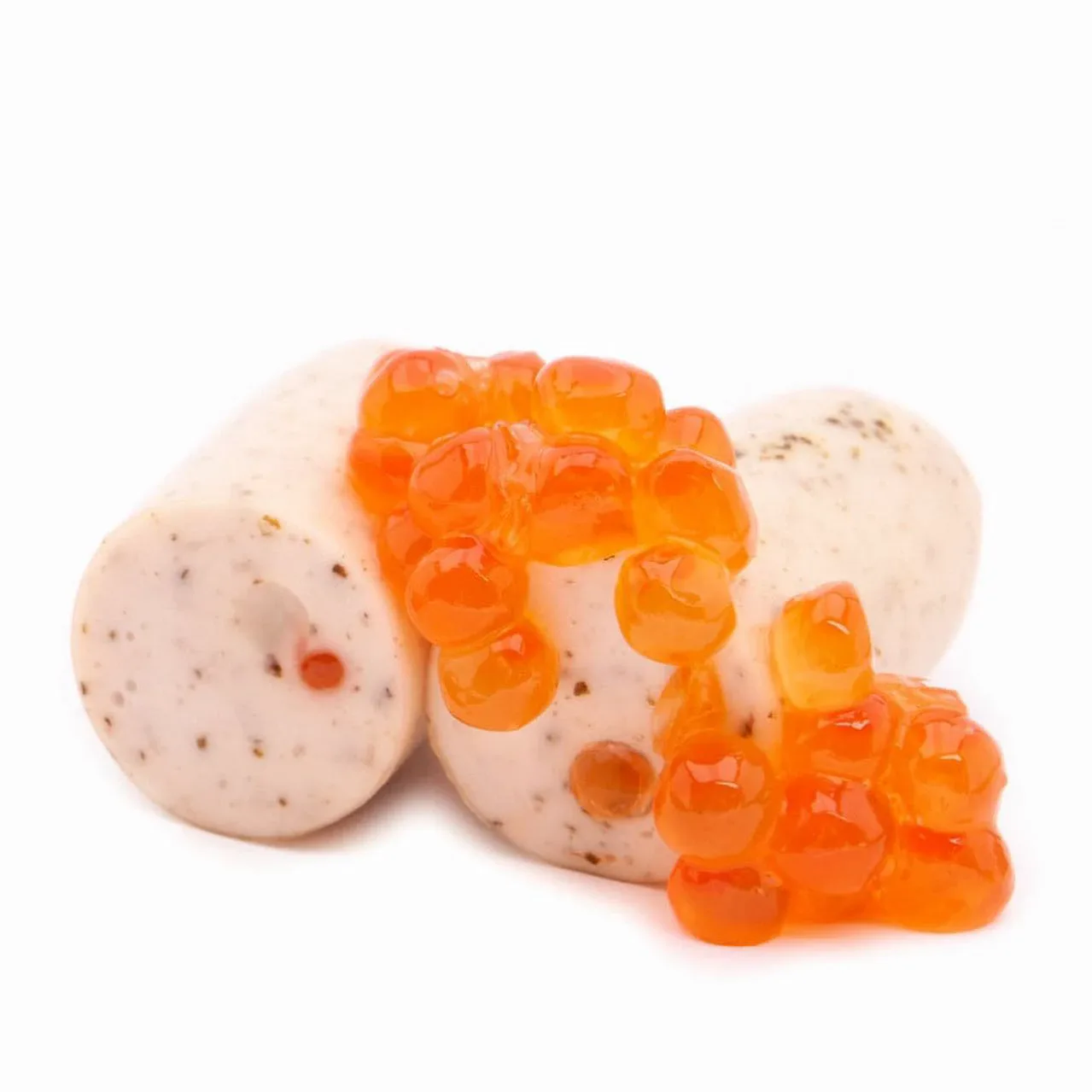
What if the sausage contained salmon roe?
I proposed something rather more extreme.
Salmon roe.
The bright orange fish eggs commonly called red caviar in Ukraine.
And not simply roe mixed into the filling until it became an indistinguishable ingredient.
I wanted the eggs to remain recognisable.
Because one of the pleasures of eating salmon roe is that little burst when the membrane breaks between your teeth.
That characteristic pop.
The liquid released inside your mouth.
What if we could preserve something of that experience inside a sausage?
We discussed formulation, the quantity of roe and the thermal process.
The objective was to have roe in individual bites, not merely list it somewhere in the ingredients.
This was a manufacturing challenge, not just a packaging exercise.
And then I thought:
Why stop there?
Let's make the sausage black.
We could use squid ink.
And add chopped nori seaweed.
Now we had something that looked as unusual as it sounded.
A dark seafood-inspired sausage with visible bright orange salmon roe.
Try putting that beside a conventional chicken sausage and telling me there isn't anything to discuss.
Whether everybody would want to eat it was another question.
But it certainly gave a retailer a reason to stop and look.
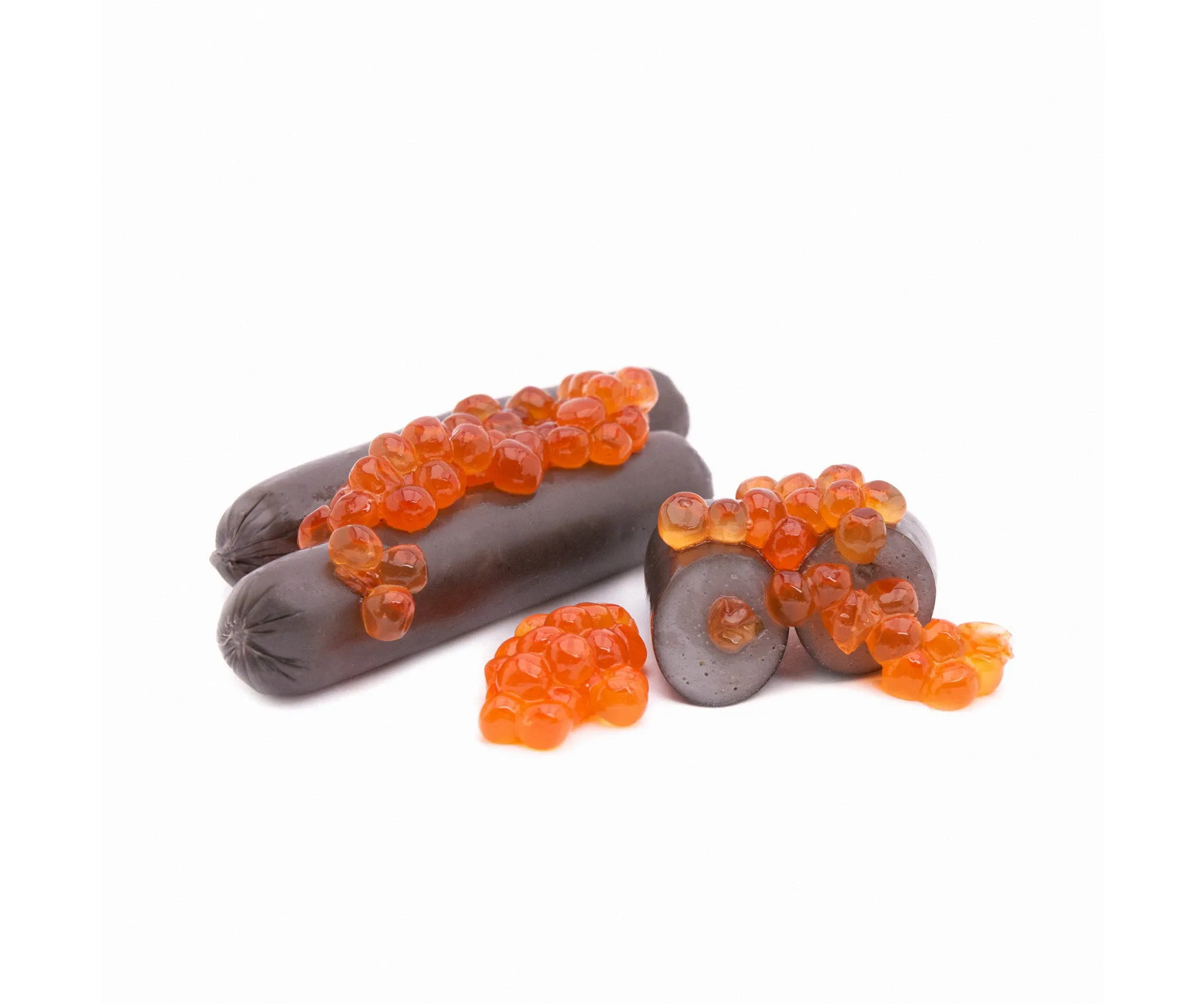
Dark sausages with salmon roe. Original product photograph from the Savin Product visual case.
Rabbits, geese, ostriches and a little bit of madness
Once we started experimenting, the possibilities multiplied.
Turkey.
Goose.
Rabbit.
Goat.
Ostrich.
We explored combinations involving buffalo meat and buffalo milk.
We made sausages with shrimp, including larger prawns whose pieces could remain visible in the cut product.
There were also experiments with small Black Sea shrimp.
These are familiar in Ukraine but notoriously fiddly to peel.
We explored using them finely processed, shells included, and presenting the ingredient's chitin content as part of the product story.
Not every interesting ingredient automatically makes a product healthier, of course. Such claims need to be assessed separately.
But from the perspective of product development, the point was to stop treating sausage as a fixed category with only three possible flavour variations.
We even developed a dry-cured goat-meat concept inspired by the history of the Scythian steppe.
The idea wasn't to make everything exotic for the sake of being exotic.
It was to create a range with distinct stories, distinct flavours and genuinely different ingredients.
A range where the question wasn't simply:
"How much does your sausage cost?"
But:
"Wait. What's in that one?"
And then:
"Can I try it?"
That's a very different sales conversation.
The ingredients had to become visible
There was another important part of the strategy.
Making unusual products wasn't enough.
We needed to show why they were unusual.
The existing brand identity provided a foundation, but there was plenty of room to develop its visual language.
I proposed extending it with engraving-style illustrations.
Something reminiscent of traditional agricultural and natural-history prints.
Animals.
Farms.
Ingredients.
A slightly old-fashioned visual vocabulary that worked well with the idea of small-scale food production.
The illustrations appeared across packaging and presentation materials.
We also worked with product assortments and grouped packs, giving the brand more ways to present its range.
And we developed the website.
But product photographs and attractive boxes still weren't enough to explain the sourcing.
So we went to the farms.
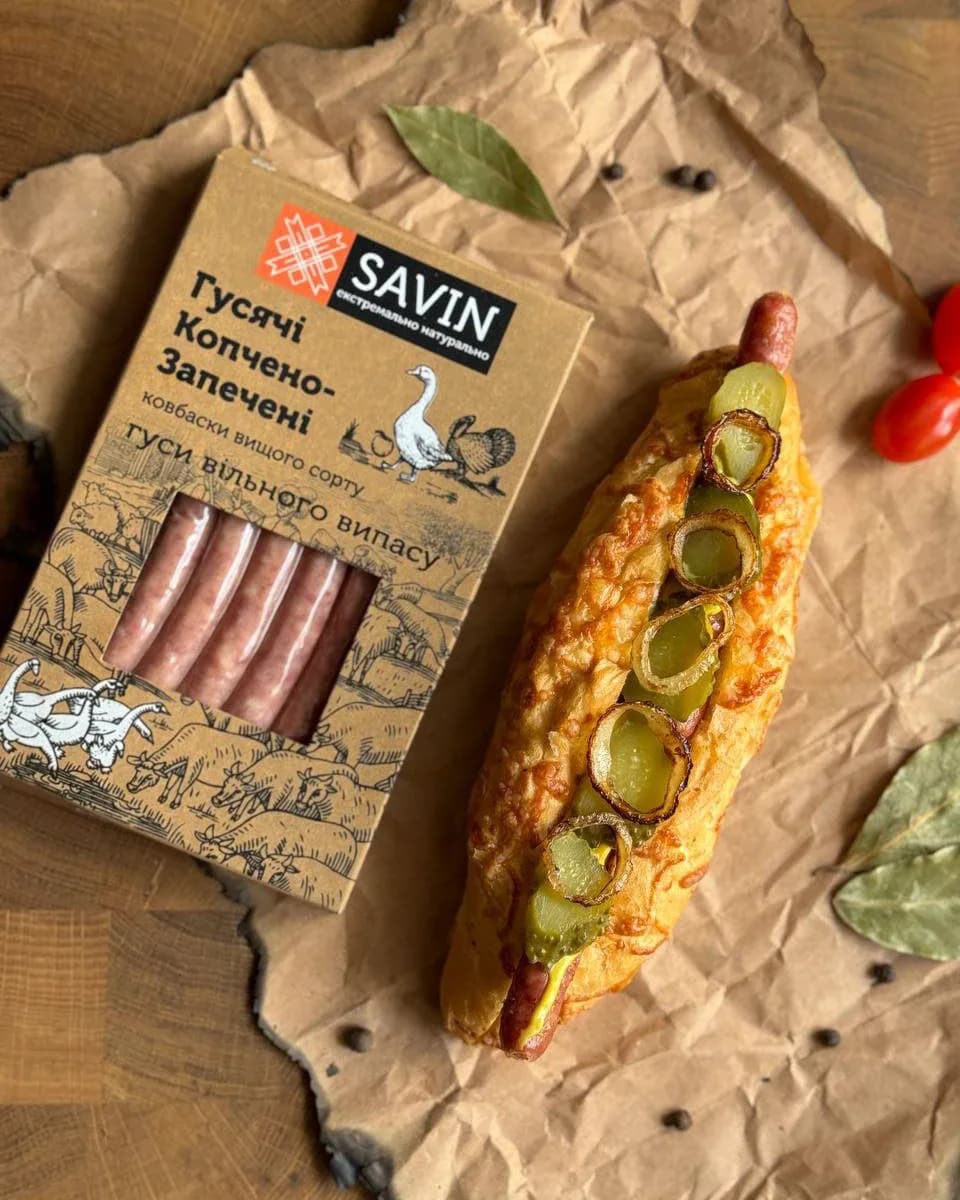
Goose sausages in illustrated packaging, presented beside a prepared hot dog. Original photograph from the Savin Product visual case.
Show me the turkey
It's easy to write farm-raised on a package.
It's much more interesting to show an actual farm.
We organised visits to producers supplying the ingredients.
We filmed the people, the animals and the places where the meat came from.
Turkeys.
Geese.
Rabbits.
Real farms, rather than anonymous pictures of happy livestock downloaded from a stock library.
We produced a series of videos around the supply chain.
That material supported the broader positioning: Savin Product wasn't merely promising customers something natural.
It could show where important ingredients came from and tell the stories of the people producing them.
It also gave us plenty of material for the website, retailer presentations and marketing communications.
And because the unusual products contained visually recognisable ingredients, the photography could do much more than display another beige sausage on a white plate.
The products themselves became part of the advertising.
The three films below, published by Savin Product in 2020, cover turkeys, rabbits and pigs respectively.
The sausages started opening doors
This was where the strategy began to pay off.
Previously, Savin Product had struggled to enter larger premium retail networks.
Smaller independent shops were more accessible, but breaking into major chains was difficult.
Once we had the unusual range, the conversation changed.
We could arrive with products that buyers hadn't seen everywhere else.
Salmon roe.
Mimolette.
Nori.
Rabbit.
Goose.
Goat.
Shrimp.
Octopus.
Suddenly the range was worth exploring.
And that helped the company secure listings in premium retailers.
After establishing a presence in premium channels, expansion into more conventional retail networks became easier as well.
Now, I don't have a neat spreadsheet showing that precisely 37.4% of additional distribution was caused by salmon roe.
I wouldn't pretend that I do.
Product quality, production capabilities, commercial negotiations, packaging and plenty of other work contributed.
But I remember the change in the conversations.
Before, we had to work hard to justify why Savin Product deserved attention.
Afterwards, there was something immediately worth talking about.
And that changed what happened next.
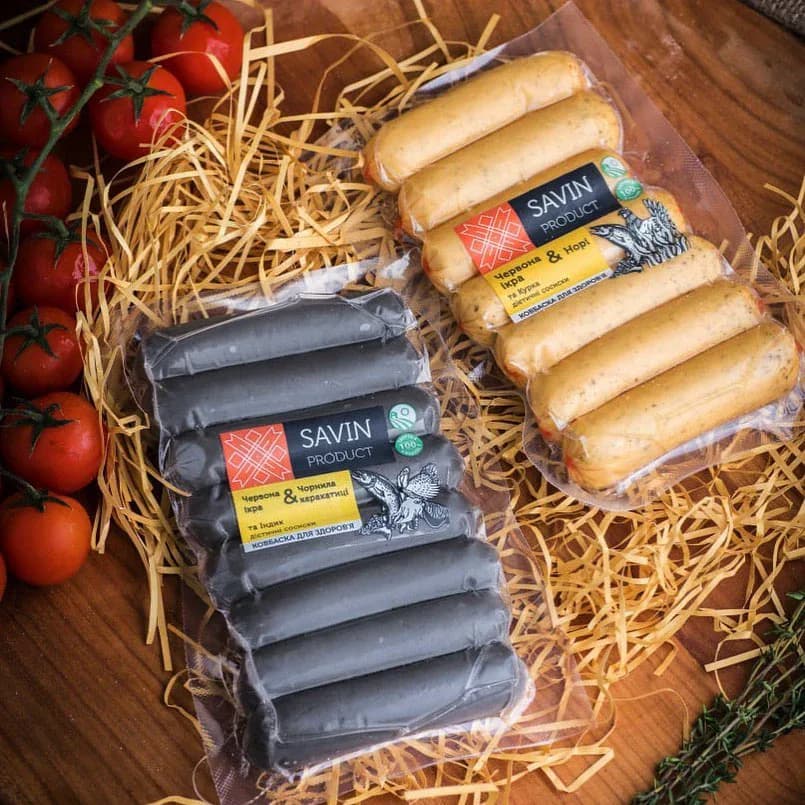
Packaged specialty varieties, showing how ingredient differences carried through to the shelf presentation. Historical packaging language is reproduced as part of the design, not as a verified health claim.
The strange sausages weren't supposed to pay all the bills
Here's my favourite part of the entire story.
The most unusual sausages didn't become the products responsible for most of the sales volume.
And that was perfectly fine.
In fact, it was largely the point.
Once the company entered a retail network with an interesting specialty range, buyers could also consider the rest of the assortment.
Ordinary sausages.
Familiar varieties.
Products that people would buy regularly.
Products that could generate meaningful volume.
The unusual sausages gave the brand a reason to be noticed.
The more conventional products gave customers a reason to return.
That's the distinction.
A product can be commercially valuable without being your biggest seller.
Sometimes its job is to open a distribution channel.
Sometimes its job is to demonstrate expertise.
Sometimes it gives the entire brand a personality.
And sometimes it's simply the thing that gets a purchasing manager interested enough to hear the rest of your presentation.
The unusual range remained part of Savin Product's identity and assortment.
But we hadn't set out to turn every Ukrainian family into regular consumers of octopus sausages.
We wanted to build a market for the company.
And unusual products helped us do that.
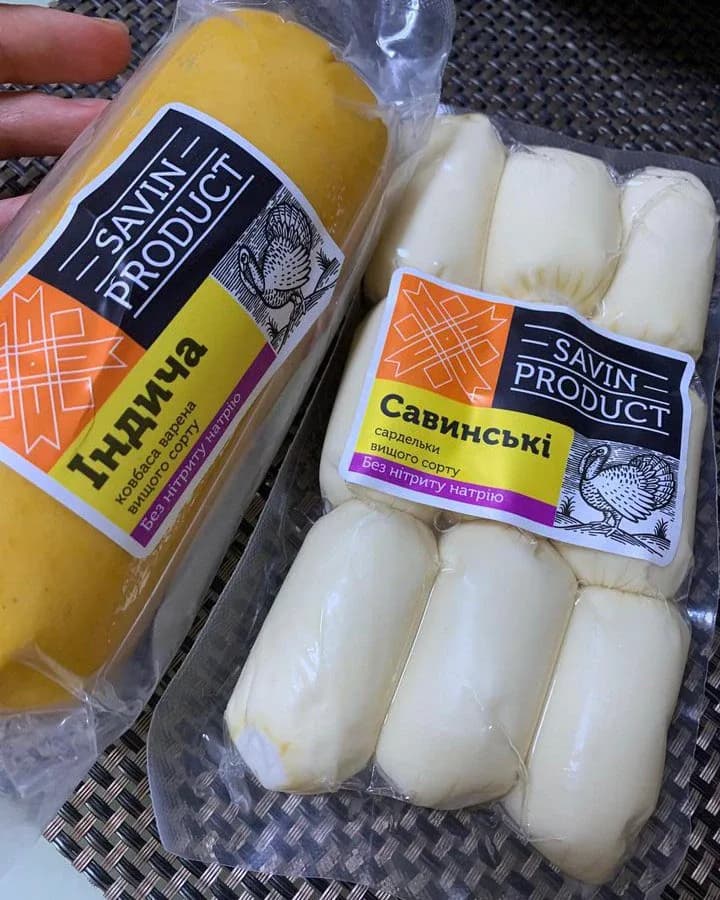
More familiar products in the same illustrated brand system. Original photograph from the Savin Product visual case.
Differentiation has to survive the first question
There's a business lesson here that I've returned to many times.
Companies love describing themselves with adjectives.
High-quality.
Innovative.
Natural.
Customer-oriented.
Premium.
Sustainable.
Pick your favourite five.
The problem is that your competitors probably picked the same ones.
And buyers have no particular reason to believe your adjectives rather than theirs.
An unusual product is different.
It can make the positioning tangible.
You say you're innovative?
Fine.
Show me.
You say you use interesting ingredients?
Excellent.
What's inside?
You say you have a special relationship with your suppliers?
Can I see the farms?
Good differentiation gives the conversation something concrete to work with.
It doesn't depend entirely on the customer believing your self-description.
And in this case, it also created a useful contrast.
The core products became easier to understand because the specialty products established the brand's character.
The ordinary sausages no longer had to do all the marketing work themselves.
An extremely natural way to be unusual
I still enjoy thinking about this project.
Partly because I love food.
Partly because developing products is one of the more entertaining parts of marketing.
And partly because it illustrates something I learned long before AI made generating a hundred brand concepts possible before lunch.
A marketing idea becomes much more powerful when it changes the actual product.
You can spend an enormous amount of money telling people that your sausages are exceptional.
Or you can make a sausage with visible salmon roe and give them something exceptional to talk about.
Of course, it still has to taste good.
It has to be technically feasible.
Safe.
Economically sensible.
And commercially supported.
But at least you're starting from something real.
Igor and I became friends through a shared interest in meat and cooking.
Years later, he visited me in France and, through a rather improbable exchange of gifts involving one of his sausages and a bottle of Georgian chacha, we ended up cooking a roe deer leg with peanut butter and cranberries.
But it's a fitting continuation.
Because Savin Product was never just another branding assignment to me.
It was an opportunity to work with someone who cared about the food he made, and to see what happened when product development and marketing stopped behaving like separate departments.
We made some very strange sausages.
They helped open some very ordinary commercial doors.
And through those doors came the products that could actually build a business.
Sometimes the product you need to sell first isn't the product you need to sell most.
Visual portfolio and a later musical portrait
See the full Savin Product visual portfolio on Behance.
The product and packaging photographs reproduced here come from that project. The original identity was developed by an external agency; my subsequent work covered product strategy, communication, packaging development, visual storytelling and the website.
This musical piece, written and performed by ABV and published in 2025, is a later portfolio tribute, separate from the 2020 farm films and the retail outcomes described above.