
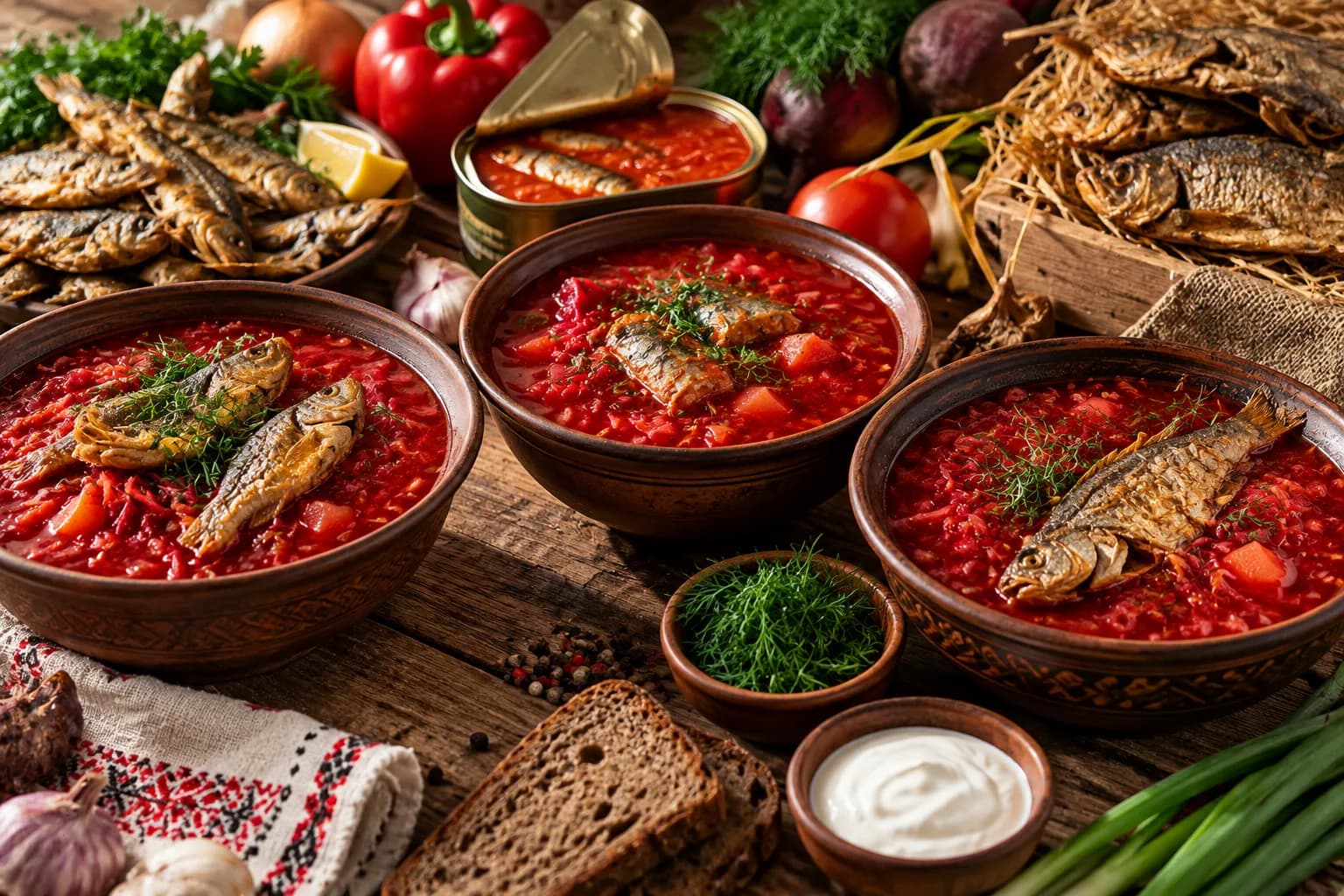
From fried Black Sea gobies in my childhood kitchen to canned sprats in Donetsk and straw-dried crucian carp in a Ukrainian village. Three fish borschts, three periods of my life, and a reminder that there's no such thing as just one Ukrainian borscht.
Tell a Ukrainian you're making borscht, and they'll probably ask what kind.
Pork?
Beef?
Chicken?
With beans?
Without meat?
Then tell them you're putting fish in it.
Depending on which part of Ukraine they come from, you may receive one of two reactions.
"Wonderful. What fish?"
Or:
"What the hell is wrong with you?"
And that's one of the things I love about Ukrainian cuisine.
Everybody knows borscht.
Everybody has a family recipe.
And practically everybody is convinced that their version is the proper one.
In 2022, UNESCO inscribed the culture of Ukrainian borscht cooking on its List of Intangible Cultural Heritage in Need of Urgent Safeguarding.
Quite rightly.
Because borscht isn't simply a recipe.
It's an entire culinary universe.
And some corners of that universe are considerably stranger than others.
Over the years, I've encountered three particularly memorable ways of putting fish into borscht.
The interesting thing is that I discovered them at three different stages of my life.
Each one came with its own people, places and circumstances.
And each tasted much better than the name might suggest.
First, a few words about southern borscht
I grew up in Mykolaiv, in southern Ukraine.
The borscht I knew as a child was distinctly southern.
Lots of tomatoes.
Red bell peppers.
Plenty of cabbage and potatoes.
Onions and carrots, usually sautéed before going into the pot.
And beetroot, although in some southern family variations it could play a surprisingly small role.
Sometimes practically none at all.
In many northern Ukrainian versions I've encountered, the balance is rather different.
Beetroot becomes the main character.
Tomatoes may still be present, but they don't necessarily dominate.
These aren't strict geographical laws, of course. Every family has its own traditions, and recipes move around.
But it's a distinction I've noticed repeatedly.
As for the familiar everyday versions, my childhood kitchen broadly had two.
Borscht with meat, often pork.
Or a meatless borscht, frequently made with beans.
Both excellent.
Both perfectly normal.
Then my great-aunt from Odesa arrived.
And put fish in it.
1. Odesa: the borscht with fried Black Sea gobies
My grandmother's sister lived in Odesa.
She would sometimes come to visit us in Mykolaiv for a month or so.
And, naturally, she cooked.
Odesa has a rather remarkable culinary character.
A Black Sea port shaped over generations by different communities, traditions and ingredients.
Ukrainian, Jewish, Bulgarian and many other influences have contributed to its food culture.
So perhaps I shouldn't have been particularly surprised when my great-aunt prepared borscht with bychky.
Black Sea gobies.
But I was.
Bychky are small, bottom-dwelling fish extremely familiar to people who grew up near the Black Sea.
They're relatively easy to catch and wonderfully tasty when fried.
And I loved fried gobies as a child.
Which probably saved me from rejecting the idea immediately.
Fish in borscht?
Surely not.
But here's how she made it.
First, fry the fish
The base was essentially a normal southern-style meatless borscht.
Tomatoes.
Cabbage.
Potatoes.
Carrots.
Onions.
Bell peppers.
But without the usual beans.
Instead, she prepared the gobies separately.
Cleaned them.
Removed the heads and innards.
Coated them lightly in flour.
Then fried them until beautifully golden and crispy.
Not fillets.
Small whole fish, minus the heads.
And here's the important part.
They didn't go into the pot at the beginning.
The fried gobies were added when the borscht was almost ready.
Then the soup was allowed to finish cooking and rest.
And something interesting happened.
The fish contributed a subtle extra flavour.
Not the overwhelming smell of a fish market.
Not the taste of ordinary fish soup.
Something gentler and more complicated.
A savoury note that worked surprisingly well with the tomato-rich vegetable base.
And the fish themselves were delicious.
I remember being genuinely impressed.
Here was a dish that sounded completely wrong and tasted absolutely right.
I suspect the recipe's popularity in coastal communities had something to do with the availability of the fish.
After all, if you live near the Black Sea, a few gobies might be easier to obtain than a respectable piece of meat.
But that's my interpretation rather than a verified history of how the dish originated.
In any case, it was my first encounter with fish borscht.
It wouldn't be the last.
2. Donetsk: the borscht that came from a tin
Years later, when I was younger and travelling extensively for work, I frequently visited Donetsk.
And there I encountered another kind of fish borscht.
This one was even stranger in its simplicity.
Borscht with kilka in tomato sauce.
Canned sprats.
Yes, the extraordinarily cheap fish preserves that were everywhere in Soviet grocery shops.
An ordinary tin of little fish swimming in tomato sauce.
Not exactly a luxury ingredient.
And that's what makes the recipe interesting.
A very practical piece of Soviet cooking
Canned sprats in tomato sauce were among the cheapest and most accessible preserved foods in the Soviet Union.
Almost everybody knew them.
You could buy them cheaply.
They kept well.
And they were already cooked.
In Donetsk, I encountered a particularly straightforward use for them.
Prepare an ordinary meatless borscht.
Again, no beans.
Potatoes, cabbage, onions, carrots, beetroot if that's how your family makes it, and a good tomato base.
Let the vegetables cook.
Then, towards the end, open a tin of sprats in tomato sauce.
And empty it into the pot.
Fish.
Sauce.
Everything.
Give the flavours a little time to come together.
Done.
No separate fish stock.
No cleaning fish.
No flour coating.
No frying.
No complicated preparation whatsoever.
And, remarkably, it works.
Why the tomato sauce matters
There's a particularly clever thing about this combination.
The canned fish doesn't merely add protein.
It also brings its own tomato sauce.
So you're reinforcing something that already belongs in the borscht.
In my experience, Donetsk cooking shares some of the southern Ukrainian affection for a substantial tomato component.
And kilka in tomato sauce fits naturally into that flavour profile.
The fish adds savouriness.
The sauce adds tomato richness, sweetness and acidity.
And the borscht acquires a character quite different from an ordinary vegetable version.
It's also extraordinarily practical.
If you've already prepared the vegetable base, adding a tin of fish takes almost no time.
I suspect affordability and convenience explain a great deal of the recipe's appeal.
In coastal Odesa, inexpensive fresh gobies made sense.
In an industrial city like Donetsk, cheap and widely available canned fish made just as much sense.
Different ingredients.
Similar economic logic.
At least, that's how I understand these two culinary traditions.
Not exactly restaurant food
What I remember particularly well is where I encountered this borscht.
Not in fashionable restaurants.
Not in establishments selling elaborate interpretations of Ukrainian cuisine.
It was the sort of food you found in ordinary canteens and people's homes.
Everyday cooking.
Inexpensive.
Practical.
And tasty.
I tried it during my business trips and genuinely enjoyed it.
There's something rather charming about a dish that doesn't even pretend to be sophisticated.
A pot of vegetable borscht.
A tin of cheap fish.
Dinner.
And yet the combination has its own recognisable taste and identity.
It also represents another kind of culinary tradition.
Not necessarily something ancient, passed down unchanged for centuries.
But a recipe adapted to the products, prices and everyday circumstances of a particular time.
Food culture doesn't stop developing when somebody invents canned goods.
Sometimes it becomes more interesting.
And from Donetsk, my next encounter with fish borscht would take me somewhere very different.
A nearly abandoned Ukrainian village.
A biologist.
And a traditional stove.
3. Poltava: crucian carp dried on straw
When I was living in Kyiv, I had a friend who was an extraordinary character.
He was wealthy.
Very wealthy, in fact.
But at some point, city life stopped appealing to him.
So he moved to the countryside.
Not to some luxurious suburban estate with a swimming pool.
To a tiny village.
Nine houses.
No other permanent residents.
He built himself a relatively simple rural home and began experimenting with agriculture, animals, plants and all sorts of other things.
He also happened to hold a doctorate in biological sciences.
Which made his experiments particularly interesting.
He approached growing and preparing things with the curiosity of a scientist.
And he loved cooking.
Naturally, we got along extremely well.
I would regularly visit him at weekends.
We'd cook, eat, discuss things and occasionally attempt experiments that probably deserved their own laboratory notebooks.
His house had a traditional Ukrainian masonry stove.
The kind that heats the building but can also be used for slow cooking.
And one weekend, he announced that he'd prepared something special.
A traditional Poltava-style borscht.
With crucian carp.
Dried on straw.
In the stove.
I was immediately interested.
First, you make fish chips
Poltava is one of the regions particularly associated with Ukrainian borscht traditions.
There are numerous local and family variations.
Borscht with dried pears.
With prunes.
With mushrooms.
Different stocks, different cooking methods, different combinations of sweetness and acidity.
And then there's borscht with karasi, crucian carp.
In the version my friend prepared, the fish were dried on straw in a traditional stove.
He explained the process.
The fish were cleaned.
Scales and innards removed.
The heads could remain attached.
Then the stove was heated.
Once the active fire and embers were no longer directly exposing the food, the hot masonry retained a considerable amount of heat.
Straw was laid inside as a protective layer.
The fish were arranged over it.
And the stove was closed.
The residual heat gradually dried the carp.
The result was extraordinary.
Dry.
Golden.
Crunchy.
Almost like crisps.
Actual fish crisps.
Not potatoes with a vaguely fishy flavour.
Whole little fish that had become astonishingly brittle and concentrated in taste.
I tried them before they went into the borscht.
Wonderful.
The kind of snack I could happily imagine eating with beer.
Crucian carp are notoriously bony, and I wouldn't assume that drying automatically makes every bone safe to eat.
But the fish he had prepared had an extraordinarily crisp texture.
And that was only the beginning.
Then the borscht goes into the stove
The next stage was a meatless vegetable borscht.
But unlike the Odesa and Donetsk versions, this one was prepared in the masonry stove.
Instead of boiling rapidly over a burner, the pot sat in the retained heat.
The ingredients cooked gradually.
The vegetables softened.
The flavours developed.
And towards the end, the dried crucian carp went into the borscht.
The fish began to soften in the hot liquid.
Their concentrated flavour entered the broth.
And the soup acquired a character quite unlike an ordinary meat-based version.
What especially impressed me was its richness.
The liquid became noticeably fuller-bodied.
As it cooled, it could become almost jelly-like.
That made sense given the fish skin, bones and other collagen-rich material contributing to the concentrated broth, although the degree of thickening naturally depends on the preparation.
It was absolutely delicious.
And once again, it didn't taste like somebody had simply thrown fish into borscht for the sake of being eccentric.
The whole thing worked.
Three fish, three technologies, three chapters of my life
What interests me now is how different these three versions are.
In Odesa, you fry fresh Black Sea gobies in flour and add them to the borscht near the end.
In Donetsk, you open a tin of sprats in tomato sauce and pour it into the pot.
In the Poltava-style version, you dry crucian carp on straw in a traditional stove before letting them soften in the borscht.
One involves frying.
Another involves preserving fish industrially in tomato sauce.
The third involves drying and slow cooking.
And all three produce a recognisable borscht with an extra dimension of flavour.
But there's another connection.
Each belongs to a different period of my life.
My childhood in Mykolaiv, with my great-aunt visiting from Odesa.
My younger years, travelling to Donetsk for work and discovering everyday regional food.
And my adult life in Kyiv, visiting a scientist friend who had decided that living almost alone in a Ukrainian village was preferable to ordinary city life.
The recipes aren't just recipes.
They're little geographical markers of my own history.
And each of them reminds me of somebody.
The trouble with the one correct borscht
People love arguing about authentic recipes.
Real borscht must contain this.
Real borscht must never contain that.
You need beetroot.
You shouldn't use so much tomato.
The potatoes should be cut a particular way.
The cabbage must be added at precisely the correct moment.
And heaven help you if somebody discovers you've used the wrong kind of fat.
I understand the importance of preserving culinary traditions.
But one of the most beautiful things about Ukrainian borscht is precisely its diversity.
It's not one standardised industrial product manufactured according to a single technical specification.
It's a living tradition.
And differences between regions, families and individual cooks are part of its value.
A heavily beetroot-based northern borscht.
A tomato-rich southern version with bell peppers.
A meatless borscht with beans.
An Odesa borscht with fried gobies.
A Donetsk borscht with canned sprats in tomato sauce.
A Poltava-style borscht with straw-dried crucian carp.
They don't need to compete for the title of the one true borscht.
They're different expressions of the same culinary culture.
And some of the most interesting versions are precisely those that sound rather peculiar until you taste them.
The recipes that disappear between regions
What strikes me is how easily these dishes can disappear from ordinary experience.
I grew up in southern Ukraine.
I loved fish.
I loved borscht.
And I might never have discovered borscht with gobies if my grandmother's sister hadn't brought the recipe from Odesa.
I spent years travelling around Ukraine for business.
And might never have tried borscht with canned sprats if those trips hadn't taken me to Donetsk.
And later, despite years of cooking and experimenting, I might never have tasted that extraordinary crucian carp borscht without my friend, his traditional stove and his almost deserted village.
Sometimes the difference between knowing that a dish exists and actually tasting it is one person.
A relative.
A friend.
A colleague.
Somebody who happens to invite you to lunch.
Or somebody who knows a recipe that never appears on fashionable restaurant menus.
That's why I like collecting these stories.
Not because I want to establish a definitive encyclopaedia of Ukrainian borscht.
Quite the opposite.
The more variations I encounter, the less interested I become in declaring that there is only one correct way to make it.
I have plenty of other borscht stories.
Different regions.
Different ingredients.
Some unusual cooking methods.
And a few combinations that would probably horrify anyone who insists borscht must always look exactly like their grandmother's.
I'll get to those eventually.
But for now, here's the thought I wanted to preserve.
If someone tells you that fish has no business being in borscht, there's a reasonable chance they've simply never had good fish borscht.
And they're missing out.
Can you make borscht almost entirely from canned food?
After discovering Donetsk's wonderfully practical borscht with canned sprats, I eventually took the idea considerably further. French sauerkraut with pork, canned beetroot and chili con carne went into the same pot. Read how my completely unreasonable borscht experiment turned out.