
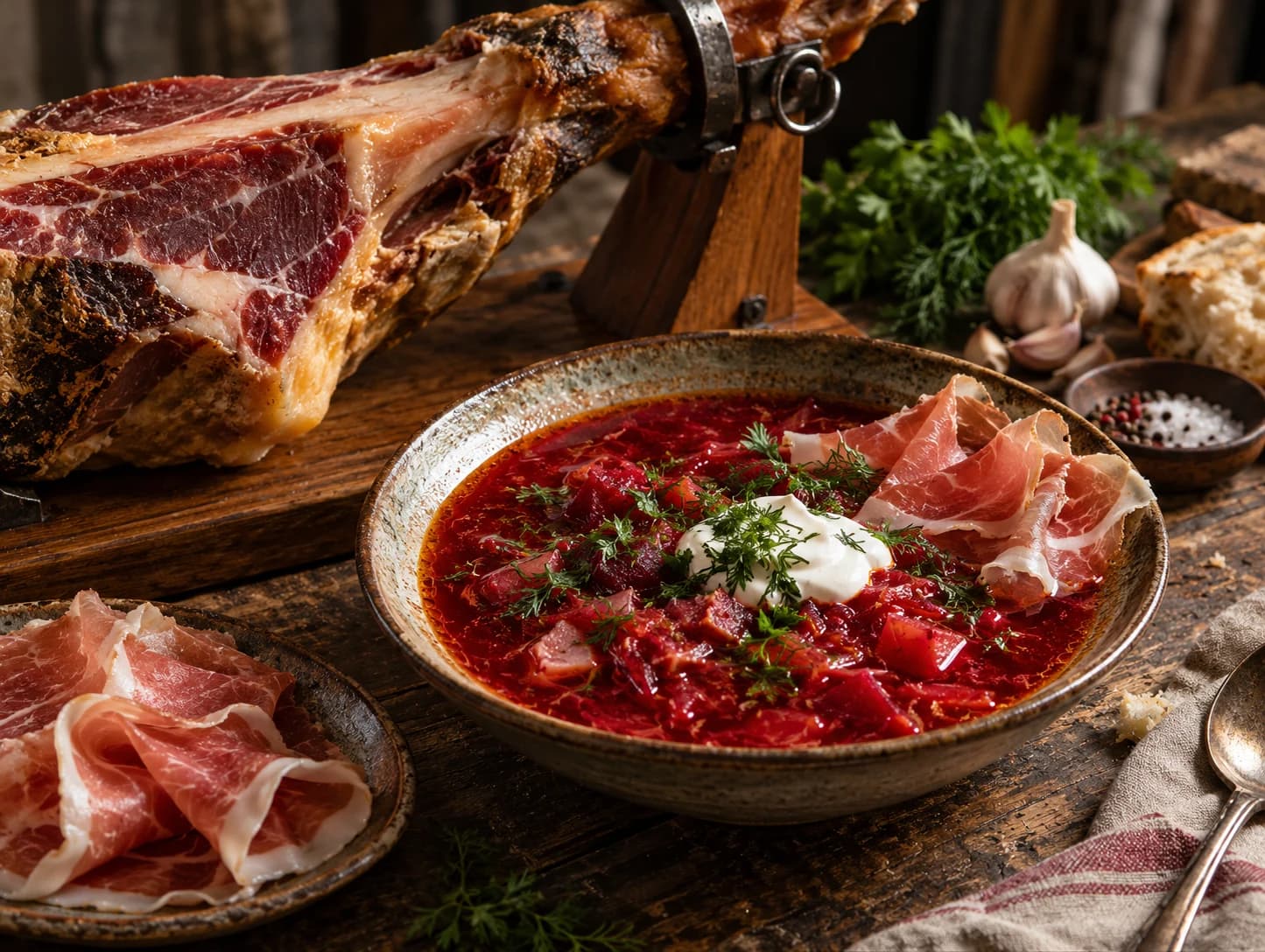
An old-fashioned borscht from my grandmother's kitchen in Belarus eventually led me to Spanish jamón bones, restaurant experiments and a rather successful Italian interpretation of a Ukrainian classic.
There's something wonderful about food that was originally invented because people couldn't afford to waste anything.
Not the modern, fashionable kind of zero-waste cooking, where a chef spends forty minutes explaining why a carrot peel is a revolutionary culinary ingredient.
I'm talking about the real thing.
A pig gets slaughtered.
The family preserves everything it can.
The meat becomes sausages and cured products.
The fat is salted and stored.
And months later, when most of the interesting bits have been eaten, somebody looks at the remaining piece of old pork fat and thinks:
Well, that's dinner.
This is how one of the more interesting borscht traditions works.
Borscht made with old salo.
And it eventually gave me an idea that travelled from my grandmother's village kitchen to Spain and then to an Italian restaurant in Ukraine.
What exactly is old salo?
Salo is one of the fundamental products of traditional Ukrainian food culture.
Salt-cured pork fat, usually with the skin attached.
Freshly prepared salo can be wonderful.
But in older rural households, a pig wasn't necessarily slaughtered whenever somebody wanted a fresh piece.
The slaughter and preservation of meat were seasonal activities.
In many families, winter was an important time for preparing pork products that would have to last for months.
And by the end of the annual cycle, not everything remained young, soft and appetising.
The salo had aged.
Some pieces became firmer.
Drier.
Sometimes yellowish.
The skin could become particularly tough.
Provided the product had been properly cured and stored, rather than spoiled, there was still a use for it.
And in certain regional traditions, that use was borscht.
The idea is simple.
Take an ordinary vegetable borscht.
Instead of starting with fresh meat, use an old piece of cured pork fat.
Let it cook for a long time.
The fat contributes richness and its characteristic mature flavour.
The skin and connective tissue can give the liquid additional body.
And suddenly, a rather humble pot of vegetables becomes something much more substantial.
It's almost a meatless borscht.
Except, of course, for the enormous piece of pig.
A minor technicality.
My grandmother's borscht was different anyway
I knew about this kind of cooking because of my grandmother in Belarus.
Her kitchen was a different world from the one I grew up with in Mykolaiv, southern Ukraine.
She lived in the countryside and kept a substantial household.
Chickens.
Pigs.
Rabbits.
The sort of place where food didn't begin with a supermarket shopping list.
It began somewhere considerably closer to the source.
And she cooked in a traditional masonry stove.
A proper village stove, where the heat surrounds the pot and the food can slowly cook for hours.
This made her borscht rather different from the Ukrainian versions I was accustomed to.
For one thing, she didn't make the conventional zazharka, the sautéed mixture of onions and carrots that forms such an important part of many Ukrainian borscht recipes.
The vegetables simply went into the cast-iron pot.
Raw.
And the whole thing cooked slowly in the stove.
Usually, she made borscht with chicken.
She had plenty of chickens, after all.
But it was the flavour that fascinated me.
The ingredients were broadly familiar.
Cabbage.
Vegetables.
Chicken.
The usual components of a recognisable borscht.
And yet the result was quite different.
It didn't have the pronounced acidity I associated with many Ukrainian versions.
It wasn't particularly sweet either.
It had its own character.
Softer in some ways.
More integrated.
The long cooking and absence of separately fried vegetables produced a flavour I found difficult to compare with ordinary stove-top borscht.
It was different.
And very good.
Then, occasionally, she made borscht with old salo.
And that was another experience entirely.
The enormous piece of old pork fat
The preparation I remember wasn't based on finely chopped fat added at the end.
My grandmother used a substantial piece of aged salo, complete with its firm skin.
It went into the pot early.
Long before the potatoes and other vegetables.
The salo could cook for an hour or two, allowing the liquid to extract flavour and body from it.
Only then did the ordinary borscht ingredients follow.
And because everything was happening in the masonry stove, the process was slow and gentle.
When the borscht was finally ready, the large piece of salo was removed.
It wasn't simply discarded.
The cooked fat was sliced.
And the slices were served directly in individual bowls for whoever wanted them.
I remember that flavour remarkably well.
The broth had a particular richness and aroma that didn't resemble either a normal chicken stock or a conventional pork-meat broth.
The cured fat contributed something quite distinctive.
And the slow stove cooking brought the whole dish together.
I ate it several times.
I loved it.
But for years, it remained one of those childhood food memories that seem difficult to reproduce outside the place where you first encountered them.
Then I went to Spain.
And bought an entire leg of jamón.
An entire jamón seemed like a wonderful idea
I love cured meats.
I've experimented with making them myself.
And whenever I travel through regions with strong traditions of drying and curing pork, I inevitably become interested in what people are producing.
Spain, Italy, France, parts of Central and Eastern Europe — there are fascinating connections between their various traditions of preserving pork.
I sometimes think of this as a kind of European cured-meat belt.
Not a formal geographical classification, just my personal way of connecting regions where curing meat has been an important part of food culture.
It's a subject I could happily spend an entire book discussing.
And probably will, eventually.
But back to Spain.
During one trip, I bought a whole leg of jamón.
A proper one.
The sort you mount on a stand and carve into delicate slices.
We brought it home.
And gradually ate it.
Friends came over.
We cut slices.
Celebrated things.
Cut more slices.
And eventually reached that inevitable stage in the life of a whole jamón.
The beautiful, easily sliced meat was mostly gone.
What remained was the bone and the stubborn pieces of meat around it.
The awkward sections.
The parts you can't easily turn into those lovely thin slices everyone expects.
And I looked at the remains of this rather expensive piece of Spanish gastronomy.
Throw it away?
Absolutely not.
Then I remembered my grandmother.
What if I make borscht from this?
The connection suddenly seemed obvious.
The old salo from my grandmother's kitchen and the remains of a Spanish jamón were different products.
But they shared something interesting.
Both were aged, salt-cured pork.
Both had developed a strong, concentrated flavour.
And both contained parts that could be useful in a long-cooked broth.
So I took the jamón bone, with the remaining meat attached, and put it into a large pot of water.
Then I let it simmer.
For a long time.
The idea was to extract as much flavour as possible from the remaining meat, fat and connective tissue.
Eventually, I removed the bone.
Recovered the softened pieces of meat that were still worth eating.
And used the broth as the base for an ordinary red borscht.
The result astonished me.
It was remarkably close to the borscht with old salo I remembered from my grandmother's kitchen.
Not chemically identical, obviously.
The products were different.
The curing traditions were different.
And the rest of the recipe wasn't exactly the same.
But the characteristic savoury depth, that flavour of well-aged cured pork, immediately reminded me of her borscht.
And it was delicious.
I had discovered a way to reproduce something from my childhood using the remains of a completely different European food tradition.
The Spanish jamón had done two jobs.
First, it provided excellent cured meat for slicing.
Then its leftovers became the foundation of an excellent Ukrainian borscht.
A remarkably efficient career for one pig's leg.
I started collecting ham bones
Once I'd tried it, the idea became difficult to abandon.
Whenever I had suitable leftovers from cured ham, I began thinking about stock.
During an extended stay in Spain, I became acquainted with the owner of a bar that served tapas.
They went through plenty of jamón.
Which meant they also went through plenty of jamón legs.
And eventually, they had bones left over.
I asked what happened to them.
They were discarded.
I asked whether I could have one.
He gave it to me.
And I made borscht.
Again.
It worked beautifully.
Later, when I was experimenting with curing meat myself, I used the remaining bones and attached meat from my own preparations in much the same way.
It became a little personal tradition.
A good cured ham was no longer finished when I'd carved the last attractive slice.
There was still one more dish to make.
And that dish was borscht.
One practical detail is worth remembering: dry-cured ham can be extremely salty. The stock may need dilution, and I wouldn't add salt to the borscht until tasting the finished broth. The bones and remaining meat also need to be properly stored and handled.
But from a culinary perspective, the principle is very straightforward.
The expensive part of a cured ham isn't necessarily the only useful part.
Sometimes the leftovers are where the next interesting meal begins.
Then I had to put borscht on an Italian restaurant menu
Years later, I was involved in developing a restaurant concept called Papa Italiano in Kryvyi Rih, Ukraine.
The idea was to approach Italian cuisine in a more contemporary way.
But Kryvyi Rih was an interesting market.
The target audience included relatively affluent local customers.
And while they were interested in Italian food, they also had certain expectations.
Familiar dishes.
Recognisable favourites.
Things they already enjoyed eating.
Including borscht.
Now, you might reasonably ask why an Italian restaurant needs Ukrainian borscht on its menu.
A fair question.
But if you're building a restaurant for actual customers rather than imaginary critics, you sometimes need to accommodate what the customers genuinely want.
So we needed borscht.
But I didn't particularly want to put an entirely conventional Ukrainian borscht on a contemporary Italian menu and pretend it had suddenly acquired an Italian passport.
I wanted the dish to make sense within the concept.
And then I remembered the jamón bones.
Of course.
Borscht with prosciutto.
The Ukrainian borscht with an Italian accent
The cooking principle was essentially the same one I'd developed after remembering my grandmother's old-salo borscht.
We used bones and suitable remaining pieces from cured hams to prepare the stock.
The broth acquired that rich, distinctive flavour of cured pork.
Then we prepared the borscht using this stock.
But the presentation added another element.
Prosciutto.
Good-quality, thinly sliced Italian cured ham.
Rather than simply hiding every trace of the cured meat inside the pot, we made it visible in the finished dish.
Slices of prosciutto were arranged at the edge of the plate when serving.
So the customer got the familiar experience of Ukrainian borscht, but with an explicitly Italian cured-meat component.
Not merely a decorative gimmick.
The same ingredient tradition that had flavoured the stock became part of the presentation.
And the dish worked.
It tasted excellent.
It fitted the restaurant's concept.
And, as I remember, it became a fairly popular menu item.
Not because we had reinvented borscht from scratch.
But because we'd given it a coherent new interpretation.
One that connected two real culinary traditions rather than simply putting an Italian word in the description.
The method, if you have a cured ham bone
I wouldn't call this a universal recipe, because the starting ingredient can vary enormously.
A large Spanish jamón bone, the remains of prosciutto and a smaller cured-ham offcut will produce quite different quantities and concentrations of stock.
But the method I used is easy to understand.
Start with a suitable cured ham bone.
Ideally, it should still have some meat and connective tissue attached.
Make the stock.
Cover the bone with water and simmer gently for an extended period, until it has released its flavour and the remaining meat can be removed easily.
Recover the meat.
Remove the bone and separate any useful cooked pieces of meat.
Taste the broth.
Cured ham can contribute a considerable amount of salt, so check the balance before adding other seasonings. Dilute if necessary.
Make your normal red borscht.
Use the ham stock instead of your usual meat or vegetable broth. Add the recovered meat if you want it in the dish.
For the restaurant-style version, finish with prosciutto.
Serve the borscht with a few thin slices of good prosciutto arranged alongside or at the edge of the bowl.
That's the essential concept.
No need to disguise the cured-meat flavour.
It's precisely why we're using the ham bone in the first place.
The dish that followed me around Europe
Looking back, I find the geography of this story rather wonderful.
A traditional rural borscht made by my grandmother in Belarus.
A childhood memory of an unusually rich soup cooked with old salo in a masonry stove.
A whole Spanish jamón bought for celebrations.
The discovery that its remaining bone could produce a similar flavour.
A Spanish tapas bar supplying another bone.
My own meat-curing experiments.
And finally, an Italian restaurant in Kryvyi Rih serving Ukrainian borscht with prosciutto.
These aren't identical culinary traditions.
I'm not claiming that Spanish jamón is simply Ukrainian salo with a passport.
Or that the Belarusians, Italians and Spaniards have secretly been making the same dish for centuries.
But there are connections.
Techniques.
Preservation.
Using the entire animal.
Extracting flavour from ingredients that somebody else might throw away.
And finding new ways to make old dishes interesting.
That, to me, is one of the great pleasures of cooking.
A technique you remember from childhood can suddenly become useful decades later, in a completely different country, with an ingredient your grandmother might never have encountered.
And the result can still remind you of her kitchen.
A grandmother, a jamón bone and a restaurant menu
I've written several stories about unusual borscht recipes.
Some traditional.
Some invented almost entirely because I was curious.
But this one is particularly personal.
Because it connects a dish I loved as a child with my later professional work in restaurants.
And it shows something I've always enjoyed about cooking.
You don't necessarily need to invent a completely new dish to make something interesting.
Sometimes you only need to understand why an old one worked.
My grandmother used old salo because it was available, flavourful and worth using.
Years later, I looked at the remains of a Spanish jamón and recognised the same opportunity.
Then I took that principle into a restaurant kitchen and turned it into a menu item with an Italian character.
Three different situations.
One underlying idea.
And a very good bowl of borscht.
The Spanish ate the jamón. The Italians supplied the prosciutto. And my Belarusian grandmother had already taught me what to do with the leftovers.