
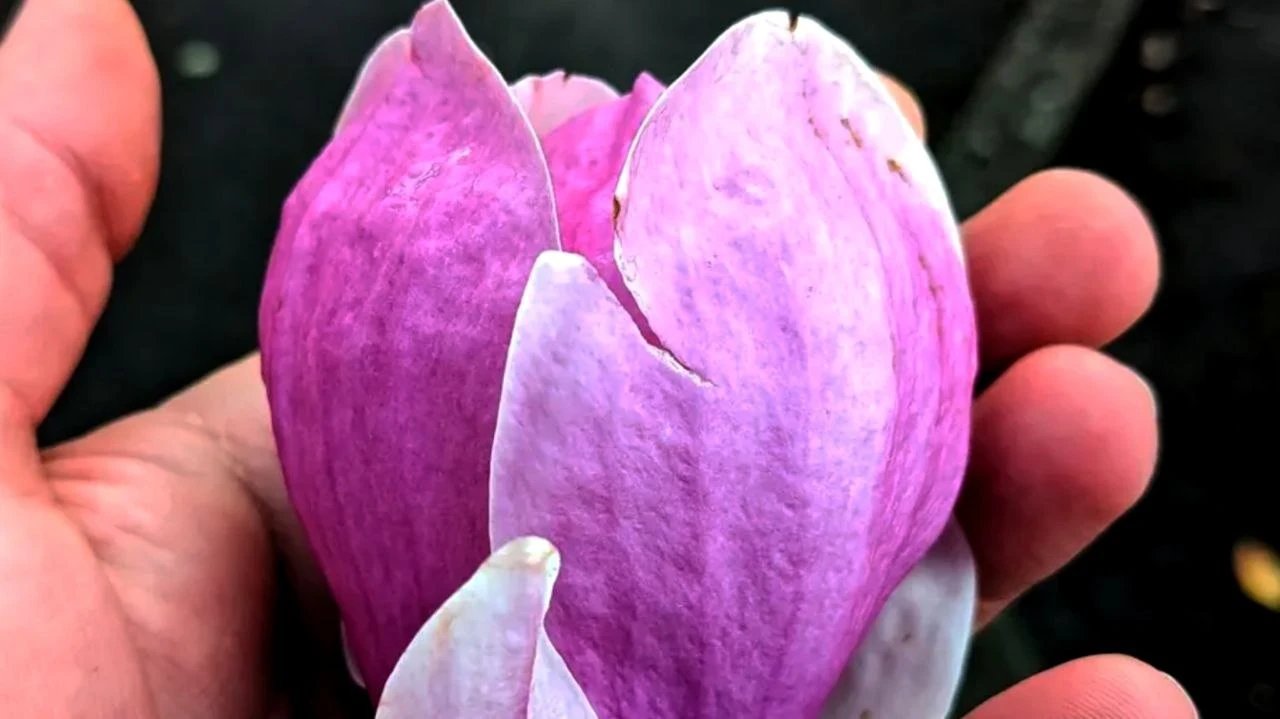
A magnolia blossom in Nantes, from my personal photographic archive. Photo: Anton Biletskyi-Volokh.
A tiny watermelon in Nantes, magnolia petals, my grandmother's rose jam, childhood adventures in Ukrainian acacia trees, and the time we sold stuffed zucchini flowers at a street-food festival.
Yesterday, my son gave me a flower to eat.
Not as a joke.
Not as some strange challenge.
He simply handed it to me as though offering a perfectly ordinary snack.
And I ate it.
Which, considering some of the things I've written about recently in Kitchen Notes, is hardly the most disturbing development in my culinary life.
But it reminded me of something.
I've been eating flowers for almost as long as I can remember.
And apparently, until recently, I hadn't thought of them as a particularly interesting category of food.
Which is rather unfair.
Because some flowers are genuinely delicious.
My son gave me a guided tour of a garden in Nantes
Yesterday, we were in central Nantes with the family.
We'd stopped at a café near the city's Natural History Museum.
Beside the museum there's a public garden with an edible growing area.
My son, who shares my enthusiasm for plants and cooking, had already explored it.
He'd also met a woman responsible for looking after the garden.
She'd shown him around, explaining which plants could be eaten, how they were used, and when different things should be harvested.
So yesterday, he decided to become my guide.
I rather enjoyed this reversal of roles.
Usually, I'm the one explaining unusual ingredients.
This time, he knew the plants and I was the visitor.
First, he offered me a tiny cucumber.
Except it didn't look like a cucumber.
It looked like somebody had taken an ordinary watermelon and reduced it to the size of a large grape.
Green.
Striped.
Absolutely ridiculous.
But when I tasted it, it was unmistakably cucumber-like.
I suspect it was a cucamelon, also called the Mexican sour gherkin or mouse melon.
A wonderful little fruit.
If you wanted to create a vegetable specifically designed to make children interested in gardening, you could hardly do better.
Then he showed me some edible flowers.
He offered one to me and another small blue flower to my daughter.
He explained that the garden's caretaker had told him they could be eaten.
The flower I tried wasn't particularly remarkable in flavour.
But the experience was rather nice.
And it reminded me that flowers aren't necessarily just decorative things that happen to grow around the ingredients we're interested in.
Sometimes they are the ingredients.
We're also planning to return on Sunday, November 8, 2026, for a workshop where we'll make impressions of leaves and flowers in clay.
Which seems like a very appropriate activity for a family that apparently can't decide whether plants belong on a plate or in an art project.
Then I remembered eating magnolias
A couple of years ago, I discovered that some magnolia flowers are edible.
This was news to me.
And slightly embarrassing news, actually.
Because I'd known magnolias all my life.
In Kyiv, the spring flowering of magnolias at the botanical garden is practically an event.
People come specifically to admire them.
Photograph them.
Walk beneath the flowering trees.
It's a beautiful spectacle.
But nobody had ever told me that certain magnolia petals could also be used in cooking.
When I discovered this, I was living in Nantes.
And, conveniently, the magnolias were flowering.
So I decided to investigate.
I found a blooming magnolia and tried a flower.
Then another.
And another.
I even photographed myself holding one in my mouth.
Because apparently simply eating the flower wasn't enough.
I needed documentary evidence.
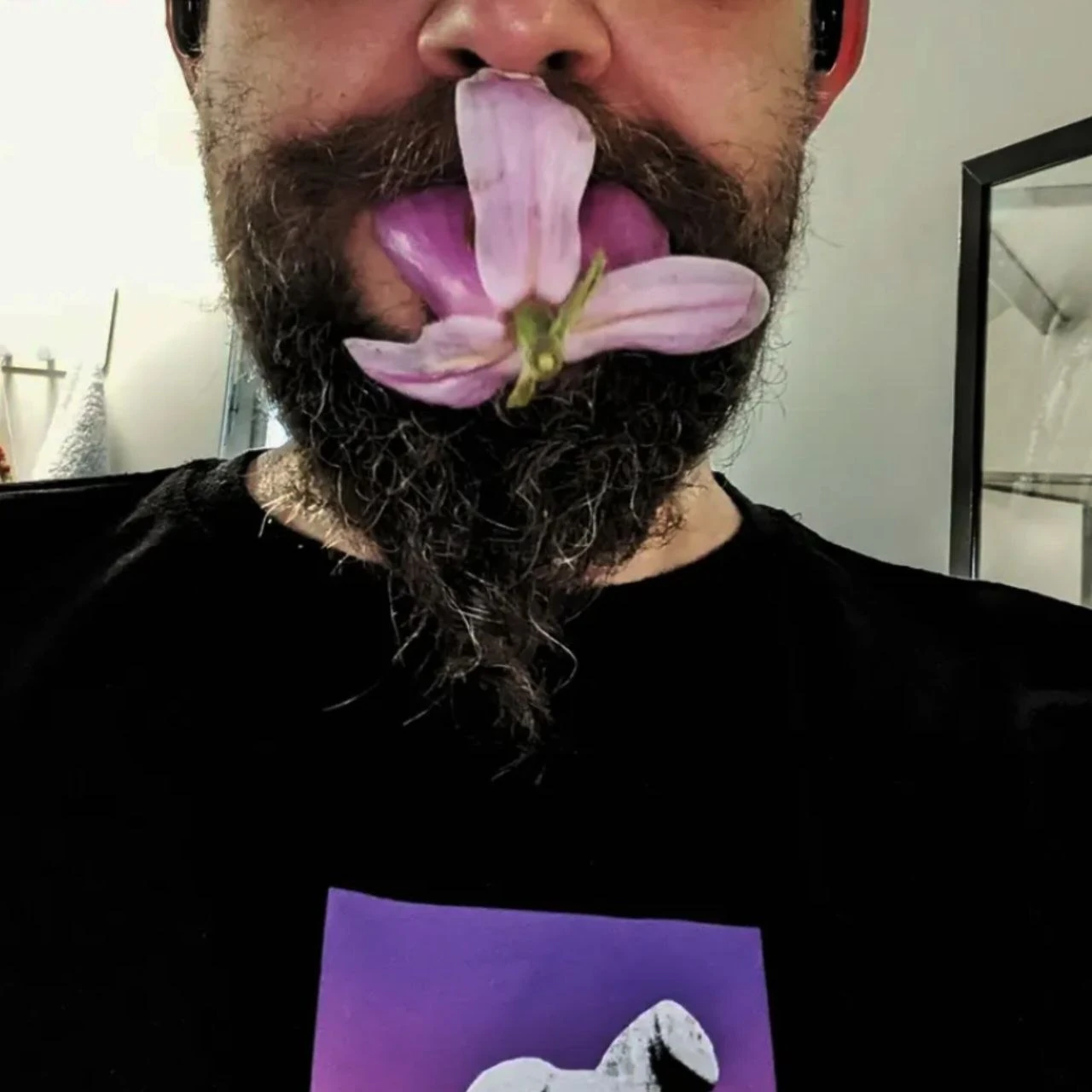
Investigating magnolia as food. Apparently, tasting one blossom wasn't enough. Photo: Anton Biletskyi-Volokh, personal archive.
What surprised me was that I genuinely enjoyed the experience.
A large, beautiful, fragrant flower was suddenly something other than an object to admire.
It had become food.
Magnolia flowers have a history of culinary use in different parts of the world. Depending on the species, buds and petals have been pickled, used as condiments or added to other preparations.
Of course, that doesn't mean every magnolia or every ornamental tree is automatically suitable for eating.
Species identification and the conditions in which the plant was grown matter.
But the discovery changed the way I looked at magnolias.
And I couldn't help thinking about Kyiv.
All those years of going to admire the flowers.
If only I'd known.
I might have arrived with considerably different intentions.
My grandmother was making rose jam long before it became fashionable
Then I remembered something from childhood.
Rose-petal jam.
More specifically, jam made from fragrant roses traditionally used for culinary preparations, often called tea roses in our part of the world.
This was familiar food in southern Ukraine.
And not only there.
Rose preserves have long been popular in parts of the Middle East, the Balkans and neighbouring regions.
My grandmother made her own.
A wonderfully aromatic preparation.
Sweet.
Floral.
Very distinctive.
In our family, the jam also had a reputation as something useful for mouth sores and certain kinds of inflammation.
That was the traditional belief.
I wouldn't turn it into a medical recommendation now.
But I was a child.
I wasn't particularly interested in its therapeutic properties.
I was interested in eating it.
And it was delicious.
I loved that intense floral aroma.
The concentrated sweetness.
The fact that something normally associated with perfume and flower gardens could become a wonderful preserve.
For me, rose jam never seemed strange.
It was simply one of the things my grandmother made.
Which tells you something about food traditions.
A flower becomes completely ordinary once your grandmother starts putting it into jars.
In Mykolaiv, we ate flowers straight from the trees
But perhaps my earliest and most enthusiastic floral experiences involved acacia.
I grew up in Mykolaiv, in southern Ukraine.
And there were plenty of trees that we called acacia.
In late spring, they produced beautiful hanging clusters of fragrant white flowers.
The clusters looked rather like little bunches of grapes.
And we ate them.
As children, we'd climb the trees, pick the flowering clusters and eat the blossoms.
No elaborate preparation.
No recipe.
No discussion about culinary innovation.
Just children sitting in a tree and eating flowers.
It was perfectly normal to us.
Botanically, the tree is more accurately called black locust, Robinia pseudoacacia.
Despite the common name, it isn't a true acacia.
Its flowers are used in certain traditional preparations, including fritters and syrups.
But here's an important distinction: other parts of the tree, including its bark and seeds, are toxic.
It's an excellent example of why recognising an edible flower doesn't mean declaring the whole plant edible.
Still, those fragrant white blossoms remain one of my favourite childhood food memories.
And years later, I discovered they were also a rather good ingredient for cooking.
The farmer who didn't know his trees were producing snacks
About seven years ago, I was visiting a friend in Ukraine.
A substantial agricultural producer involved in growing grain, processing it and producing various flour-based products.
We'd worked together on business and product-development projects.
One day, we were driving around his farm.
And I noticed some flowering black locust trees.
Lots of them.
The familiar white clusters.
The smell.
Instant childhood memories.
So I asked him:
Do you eat these?
He looked at me.
Eat what?
The flowers.
Apparently, this had never occurred to him.
Which I found hilarious.
Here was a professional agricultural producer.
A man who worked with crops, grain and food products.
Surrounded by edible flowers.
And he had no idea that anybody might want to eat them.
So naturally, I explained.
First, the familiar childhood version.
The blossoms themselves, from properly identified, suitable trees.
Then the version I'd learned to prepare as an adult.
Fried blossoms.
And that was considerably more interesting.
Acacia blossom fritters. Almost no effort.
The basic idea is wonderfully simple.
You make a light egg mixture.
Eggs.
A little salt.
Perhaps some milk.
A little sugar, if you want a sweeter result.
Then you coat the flowering clusters with the mixture.
And fry them.
I particularly like using butter.
The flavour works beautifully with the blossoms' natural sweetness and floral aroma.
I've also made them with coconut oil, which gives a different but very pleasant result.
The flowers become part of a delicate little fritter.
Slightly crisp around the edges.
Fragrant.
Sweet, if you've added a little sugar.
And much more interesting than you'd expect from something growing on the roadside.
Of course, for an actual kitchen preparation, you need correctly identified black locust blossoms from an appropriate, untreated source, with the inedible parts excluded.
But as a culinary idea, it demonstrates something I love.
You can take an ingredient that most people regard purely as decoration.
Add a very ordinary cooking technique.
And produce something genuinely delicious.
No expensive equipment.
No exotic imported ingredients.
Just a flower, some eggs and a frying pan.
I taught my friend the idea.
And I remember being rather pleased that I'd managed to introduce a professional farmer to a food growing right on his property.
Zucchini flowers are a much more respectable proposition
Then there's another chapter of my culinary life.
Zucchini flowers.
Or fiori di zucca, as the Italians call them.
These are probably among the most recognisable edible flowers in European cooking.
Large.
Delicate.
Usually yellow or orange.
And wonderfully suited to stuffing.
My second wife was also enthusiastic about cooking, and I remember zucchini flowers stuffed with ricotta becoming part of our culinary experiments.
The broader family interest in gastronomy has continued, too. My current wife studied at Le Cordon Bleu.
So it's fair to say that I've never been the only person in the family interested in doing unusual things with food.
But stuffed zucchini flowers are hardly an outrageous experiment.
They're a well-established part of Italian cooking.
And they're delicious.
The blossom itself is delicate.
The filling can be creamy and savoury.
Ricotta works particularly well.
And depending on the preparation, the flowers can be baked or fried.
The result is attractive enough for a restaurant plate.
But also perfectly suitable for street food.
Which is exactly where we eventually took them.
The time we sold flowers at a street-food festival
Back in Ukraine, I was involved in various restaurant and food projects.
And we regularly participated in street-food festivals.
Sometimes with our established businesses.
Sometimes with concepts developed specifically for the event.
On one occasion, we created a stand selling zucchini flowers stuffed with ricotta.
Actual flowers.
Filled with cheese.
Prepared as a proper dish and sold to festival visitors.
I find this particularly satisfying in retrospect.
Because it takes us all the way from eating black locust flowers straight from a tree as a child to selling stuffed flowers as a commercial food product.
Different ingredients.
Different techniques.
Different circumstances.
But fundamentally the same idea.
A flower doesn't stop being a flower when it becomes food.
It simply acquires another purpose.
And if you approach it thoughtfully, that purpose can be rather delicious.
So why don't we eat more flowers?
I think the answer is partly habit.
Flowers belong in vases.
Vegetables belong in kitchens.
Fruit belongs in bowls.
And apparently these categories have been established by some committee whose decisions we aren't allowed to question.
But the distinctions are much less clear than they appear.
Zucchini flowers are food.
Rose petals become jam.
Certain magnolia petals are used as culinary ingredients.
Black locust blossoms become fritters.
Nasturtiums can add a peppery note to salads.
Chive flowers have a gentle onion flavour.
And borage flowers, with their striking blue colour, can be used in drinks and salads.
Not every flower is edible, of course.
Some are poisonous.
Others may have been treated with pesticides or grown for ornamental rather than culinary use.
And a flower being attractive is absolutely no evidence that it belongs in your mouth.
The rule is to know the plant, the edible part and its source.
But once those questions have been answered, flowers offer a surprisingly broad range of possibilities.
Flavour.
Aroma.
Texture.
Colour.
And sometimes an entirely new way to think about an ingredient you thought you already knew.
My son's little botanical lesson
And that's what made yesterday's walk in Nantes so enjoyable.
My son had discovered something.
He'd talked to somebody who understood the plants.
He'd remembered what she told him.
And then he'd brought me into that little world.
He offered me a tiny striped cucumber that looked like a watermelon.
Then a flower.
And he was pleased to explain what he'd learned.
For a moment, I was simply his student.
Which is rather nice.
Especially since I spend so much time telling stories about my own gastronomic discoveries.
And his little lesson brought back memories from different places and times.
The magnolias in Nantes.
The flowering trees of Mykolaiv.
My grandmother's rose jam.
The farm where I introduced a friend to black locust blossoms.
The zucchini flowers stuffed with ricotta.
Our street-food festival stand.
It's a rather beautiful collection of memories for something as simple as eating a flower.
And perhaps that's the most interesting thing about food.
Sometimes a flavour doesn't merely remind you of a place.
It reconnects several completely different chapters of your life.
I went for a walk with my son.
He gave me a flower to eat.
And I remembered that I'd been eating flowers for most of my life.
Apparently, some things really do run in the family.
This Kitchen Note is based on personal food memories and culinary experiments. Edible uses differ by botanical species and plant part; ornamental or wild flowers should not be treated as food without reliable identification and appropriate sourcing.