
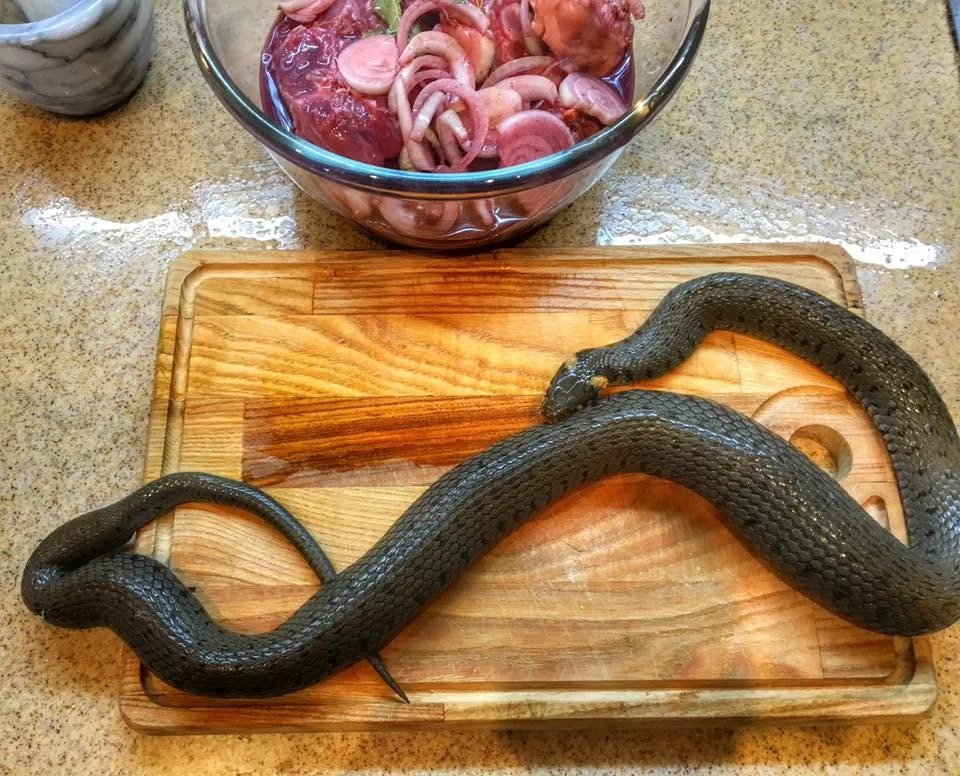
Kyiv, 2 July 2016. A grass snake on my cutting board, with beaver meat marinating in red wine and onions behind it. From my personal archive.
How my biologist friend introduced me to the digestive system of a large rodent, and how I eventually turned another beaver into a red-wine stew, with a rather ambitious experiment involving its tail.
In the previous Kitchen Note, I described a rather unusual Saturday in Kyiv in July 2016.
My friend Alexander, a Doctor of Biological Sciences who lived in a small Ukrainian village called Stepanovka, had sent me a collection of ingredients supplied by local hunters.
A grass snake.
Beaver hindquarters.
And a beaver tail.
The snake went onto my cutting board.
I decided to treat it like fish, cooking it with shallots, leek, white wine and cream.
The beaver was another matter entirely.
It was already sitting in a glass bowl, marinating in red wine and sliced onions.
Because when confronted with an unfamiliar piece of substantial wild meat, my first instinct was perfectly conventional.
Find some Burgundy.
But the beaver story actually began earlier.
And not in a kitchen.
It began on Alexander's terrace, where we were examining something that most people would prefer not to encounter immediately before dinner.
A beaver's intestines.
My first beaver was an anatomy lesson
Alexander was a remarkable person.
A professional biologist, an enthusiastic gastronome and a man who seemed to find very little separation between scientific curiosity and culinary experimentation.
He had moved away from Kyiv to Stepanovka, where he lived close to nature, local hunters and an assortment of animals that occasionally became subjects of either biological investigation or gastronomic interest.
Sometimes both.
I'd visited him before the 2016 cooking experiment.
On one occasion, hunters had brought him a beaver.
Now, most people presented with a beaver would probably think about its famous teeth.
Or its tail.
Or the extraordinary dams it builds.
Alexander had a different idea.
He wanted to show me the animal's digestive system.
Specifically, how an animal that eats bark, twigs and other fibrous plant material manages to extract nutrition from such an unpromising diet.
And so we began examining the digestive tract.
On his terrace.
Naturally.
I remember us laying it out and being astonished by its length.
For years, I recalled the total as something approaching thirty metres.
Now, revisiting the story, I have to admit that this number almost certainly reflects an error in my memory or our original estimate.
Published anatomical research on Eurasian beavers reports a total digestive-tract length of roughly six metres, although measurements vary with the animal and study.
Thirty metres would be a rather extraordinary beaver indeed.
But the exact number wasn't what impressed me at the time.
It was the anatomy.
A seemingly ordinary large rodent had this elaborate internal system for processing vegetation.
And my friend was explaining its biological logic while we examined the real thing.
It was a memorable lesson.
Not necessarily one you'd want delivered just before lunch.
But I found it fascinating.
A beaver doesn't actually eat wooden furniture
There's a popular image of beavers as animals that eat wood.
Which isn't entirely accurate.
They gnaw through trees, certainly.
Their powerful incisors are among the most recognisable features of the animal.
But they don't obtain their nutrition by digesting the solid timber they use to build dams.
Their diet consists largely of bark, the softer inner tissues of woody plants, leaves, twigs, shoots and aquatic vegetation.
Much of this material is rich in fibre.
And beavers are adapted to processing it.
They're hindgut fermenters.
They have a large caecum and specialised microbial communities that help break down plant material.
In a sense, their digestive tract contains its own remarkable biological processing system.
That was the interesting part of Alexander's demonstration.
The animal had developed an internal solution to a dietary problem.
A problem that would make life considerably more difficult for a human being attempting to survive on willow bark.
And this is why I enjoyed visiting Alexander.
You could arrive expecting dinner and leave with a lecture on the digestive anatomy of semi-aquatic rodents.
Sometimes followed by dinner.
The second beaver arrived in pieces
My next encounter with a beaver was much more directly culinary.
In 2016, Alexander contacted me after some local hunters had supplied meat from another animal.
He sent me the hindquarters and the tail, frozen.
Along with the grass snake I described in Part One.
By then I had already encountered beaver anatomy.
But I had never cooked its meat myself.
This was going to be my first attempt.
And I wanted to treat the two parts of the animal differently.
The hindquarters looked like game meat.
That suggested a long marinade and slow cooking in wine.
The tail was something else.
A peculiar, flattened appendage with its own structure, very different from an ordinary muscular cut.
So I planned two preparations.
A rich meat stew.
And an experimental roast tail with a deeply browned exterior and a suggestion of smoke.
One animal.
Two very different culinary problems.
Wonderful.
The meat went into red wine
The photograph from 2 July 2016 shows the beginning of the preparation.
A glass bowl filled with pieces of beaver meat.
Sliced red onions.
And red wine.
I approached the meat as I would other substantial game.
Marinate it while cold.
Allow the wine and aromatics to contribute their flavours.
Then use a combination of browning and slow cooking to develop the dish.
I also remember using a little hoisin sauce.
Yes, hoisin.
The dark, sweet-savoury Chinese sauce commonly associated with dishes such as Peking duck.
Now, hoisin isn't exactly a traditional ingredient in a Burgundy game stew.
But I wasn't attempting to recreate a nineteenth-century French hunting recipe.
I was cooking beaver.
In Kyiv.
With what I had.
And I thought a little hoisin might add an interesting layer of sweetness and savouriness.
I also used other seasonings, but I don't remember every detail well enough to reconstruct them accurately.
That's one of the problems with recovering old culinary experiments.
Sometimes the photograph survives.
The ingredient list doesn't.
But the central idea remains quite clear.
Treat the beaver as game, not as an exotic ingredient requiring an exotic recipe.
A sort of beaver bourguignon
When it came time to cook the meat, I began developing the dish much as I would a traditional slow-cooked game stew.
I browned the pieces of meat.
Prepared onions.
Carrots.
Celery.
And then added mushrooms.
At the time, I had some dark morels.
Which made the whole thing considerably more interesting.
Morels have a distinctive earthy aroma that works beautifully in rich savoury preparations.
Then came the Burgundy wine.
Red Burgundy.
A perfectly respectable thing to pour into a pot containing meat, aromatic vegetables and mushrooms.
Even if the meat happened to be beaver.
The dish simmered slowly.
The wine and vegetables formed the basis of the sauce.
The meat cooked in the aromatic liquid.
And gradually the whole preparation became something closer to a rich game ragout than an ordinary roast.
I served it with mashed potatoes.
A rather conventional accompaniment.
Which was exactly what I wanted.
There was no need to make every part of the dinner strange.
The beaver was unusual enough.
The mashed potatoes could remain reassuringly normal.
I can't give you a precise cooking time now, nor do I remember every final seasoning adjustment.
But I remember the approach very clearly.
Marinate.
Brown.
Build the vegetables and mushrooms.
Braise in red wine.
Serve with mashed potatoes.
If you replaced the beaver with another kind of game, the structure of the dish would hardly raise an eyebrow.
And that was the whole point.
An unfamiliar animal can sometimes be approached using entirely familiar culinary logic.
Then there was the tail
The tail was a completely different experiment.
If you've never examined a beaver tail closely, it doesn't resemble the tail of a conventional meat animal.
It's broad.
Flattened.
Covered externally in a dark, scale-like skin.
And its internal structure contains a considerable amount of fatty tissue.
This isn't simply another piece of leg meat.
It needs to be understood as a separate ingredient.
My idea was to roast it.
But not merely until it was cooked.
I wanted the exterior to develop a very dark crust.
Almost black.
Something with the character of a heavily roasted or lightly smoked product.
I experimented with creating a smoky effect using small fruitwood chips placed beneath the preparation on foil.
The intention was to introduce a little smoke-like character while the tail roasted.
I remember being particularly interested in the exterior finish.
The near-black surface.
The contrast between that outer layer and the interior.
And the possibility of bringing out something closer to a smoked delicacy than an ordinary piece of roast meat.
I wouldn't present the old improvised smoke setup as a method to reproduce in a home oven today.
Burning wood chips inside unsuitable equipment can create fire and ventilation hazards, and smoke doesn't replace proper cooking.
But as an experimental direction, it was interesting.
And, as I later discovered, the idea of treating beaver tail as a separate delicacy was hardly new.
The beaver tail has a surprisingly distinguished culinary history
In northern Canada, beaver has long been part of the food traditions of certain Indigenous communities.
The meat provides protein and other nutrients.
And the tail has a particularly interesting place in the cuisine.
The Government of the Northwest Territories describes beaver tails being singed or smoked under dry willow branches and eaten as snacks, including while travelling.
So my interest in the tail's relationship with roasting and smoke had a very real historical parallel.
Although my own improvised experiment was not a recreation of that tradition.
But there's an even more entertaining historical detail.
In 1795, George Washington received a gift.
Not another portrait.
Not a ceremonial sword.
A dozen beaver tails.
They were sent by George Turner, a territorial judge, together with a Canadian recipe explaining how the tails could be prepared.
The recipe involved cooking the tail until tender, then browning it and applying breadcrumbs and finely chopped parsley.
It was to be served with vinegar, salt and pepper.
The Library of Congress has documented the correspondence.
Which means that, more than two centuries before my little experiment in Kyiv, somebody considered beaver tails a sufficiently interesting delicacy to send a dozen of them to the first president of the United States.
I rather admire that.
It's certainly a more memorable gift than another bottle of whisky.
Although we don't know whether Washington actually ate them.
And I suspect the thank-you letter would have been rather interesting if he had.
Why would anyone eat a beaver?
For most people in contemporary Ukraine, beaver is not an ordinary meat.
In fact, many people regard the animal primarily as a curious creature that builds dams and changes rivers.
Not as dinner.
But different societies have had very different relationships with it.
In northern North America, beaver has been an important animal for food, clothing, tools and other purposes.
In parts of Europe, beaver meat has appeared in hunting and regional culinary traditions.
And in Lithuania, there are even examples of beaver being incorporated into local dishes such as meat-filled potato dumplings.
This doesn't mean that everybody in Canada or Lithuania regularly eats beaver.
They don't.
But it does mean that an animal unfamiliar as food in one country may have a long culinary history elsewhere.
Which is exactly the sort of thing that interested me when I began writing my unfinished Strange Food book.
The important distinction isn't simply whether an animal is edible.
It's whether people have developed a culinary relationship with it.
And what that relationship means in their particular environment.
For some people, the beaver is an ecosystem engineer.
For others, a traditional food.
For others, a protected species.
And for me, in 2016, it was the main ingredient in a red-wine ragout.
All of those descriptions can tell us something real about the same animal.
My friend approached animals differently
There's another reason these memories have stayed with me.
Alexander wasn't simply somebody who enjoyed unusual food.
His curiosity was grounded in biology.
He had worked professionally with animals and understood their anatomy in a way that most cooks don't.
Earlier in his career, while working in the post-mortem facilities of Kyiv Zoo, he had encountered a remarkable variety of species through veterinary and anatomical examinations.
Some of the animals he and his colleagues encountered were species that most Ukrainians would never consider eating.
And that experience influenced his unusually open attitude towards unfamiliar animal ingredients.
Later, living in Stepanovka, he maintained connections with scientists and biologists who raised different organisms for research or as feed for reptiles.
Those connections helped make some of our early culinary experiments with insects possible.
I've already written about his extraordinary blood sausage with leeches.
And about a borscht involving dried crucian carp.
These stories may sound unrelated.
But they share a common origin.
A person who combined scientific curiosity, knowledge of animals and a willingness to question conventional culinary boundaries.
With him, an animal wasn't simply classified as food or not food.
It was also a biological organism.
With an anatomy.
A diet.
A structure.
And characteristics worth understanding.
That didn't automatically make every experiment safe, sensible or successful.
But it certainly made our conversations interesting.
The part I would approach differently today
Looking back, there's one practical distinction I would make much more explicitly.
Wild game requires careful handling.
A hunter providing frozen meat doesn't automatically establish that every necessary inspection or food-safety step has been completed.
Beaver meat can present biological risks, and proper field dressing, chilling, sourcing and cooking matter.
The meat also comes from an animal with scent-producing structures near the base of the tail.
Damaging these during processing can affect the quality of the meat.
So the culinary work begins before anything reaches the frying pan.
And freezing or marinating meat in wine shouldn't be confused with making it safe.
Current Canadian food-safety guidance recommends cooking beaver, classified as small game, to an internal temperature of 74°C.
I didn't document the temperatures of my 2016 preparations, so I won't pretend that an old photograph or my memory proves what happened inside the meat.
This is a record of my historical experiment.
Not a fully validated recipe.
But the broader cooking approach remains perfectly understandable.
A substantial piece of legally sourced, properly handled game can be prepared through slow braising with wine and vegetables.
The exact ingredient, source and safety requirements matter.
And that's where culinary curiosity needs to work alongside biological knowledge rather than replacing it.
A photograph of two dinners
I like the original photograph from that weekend.
A grass snake on a wooden cutting board.
A glass bowl of beaver meat marinating in red wine and onions.
No finished dishes.
No professional styling.
No attempt to make the scene look attractive for a restaurant menu.
Just the ingredients.
And the beginning of an experiment.
The snake went one direction.
White wine.
Shallots.
Leek.
Cream.
The beaver went another.
Red wine.
Root vegetables.
Mushrooms.
A slow stew served with mashed potatoes.
And the tail became a separate investigation into roasting, crust and smoke.
All from one unexpected delivery from a friend.
It's rather satisfying to rediscover these details almost a decade later.
Especially because so much of the original culinary work was improvised.
There was no recipe book telling me exactly what to do.
Just previous experience, knowledge of familiar ingredients and a willingness to experiment.
Sometimes that approach produces something worth repeating.
Sometimes you learn that a particular idea needs reconsideration.
And sometimes you simply end up with an excellent story.
The art of treating strange food normally
When I first became interested in unusual food, I was fascinated by the shocking ingredients.
Insects.
Snakes.
Earthworms.
Leeches.
Beaver.
The creatures people react to with surprise, disgust or disbelief.
But over time, the most interesting part became something else.
The cooking.
What happens when you stop treating an unusual animal as a novelty and begin asking ordinary culinary questions?
What is the texture?
Which parts are fatty?
Which parts contain more muscle or connective tissue?
Would a slow braise make sense?
Would a lighter sauce be better?
Does the ingredient have a recognised culinary history elsewhere?
And how can you make a dish that is genuinely enjoyable rather than merely shocking?
That's what I was doing with the beaver.
I didn't need to invent an exotic-sounding recipe.
I already knew how to prepare game with Burgundy wine.
And I wanted to see how that logic would work with an animal I'd never cooked before.
The tail was another question entirely.
But that was part of the pleasure.
One animal.
Two different ingredients.
Two different preparations.
And a rather memorable dinner.
The snake had gone into white wine.
The beaver went into Burgundy.
And somewhere in Stepanovka, Alexander was probably examining another animal and wondering what else it could teach us.
Part Two of a two-part Strange Food memoir, reconstructed from my personal experiences and an original Facebook photograph dated 2 July 2016. The preparations are historical recollections rather than fully tested recipes. The recalled thirty-metre intestinal measurement has not been verified and differs substantially from published beaver anatomy research.