
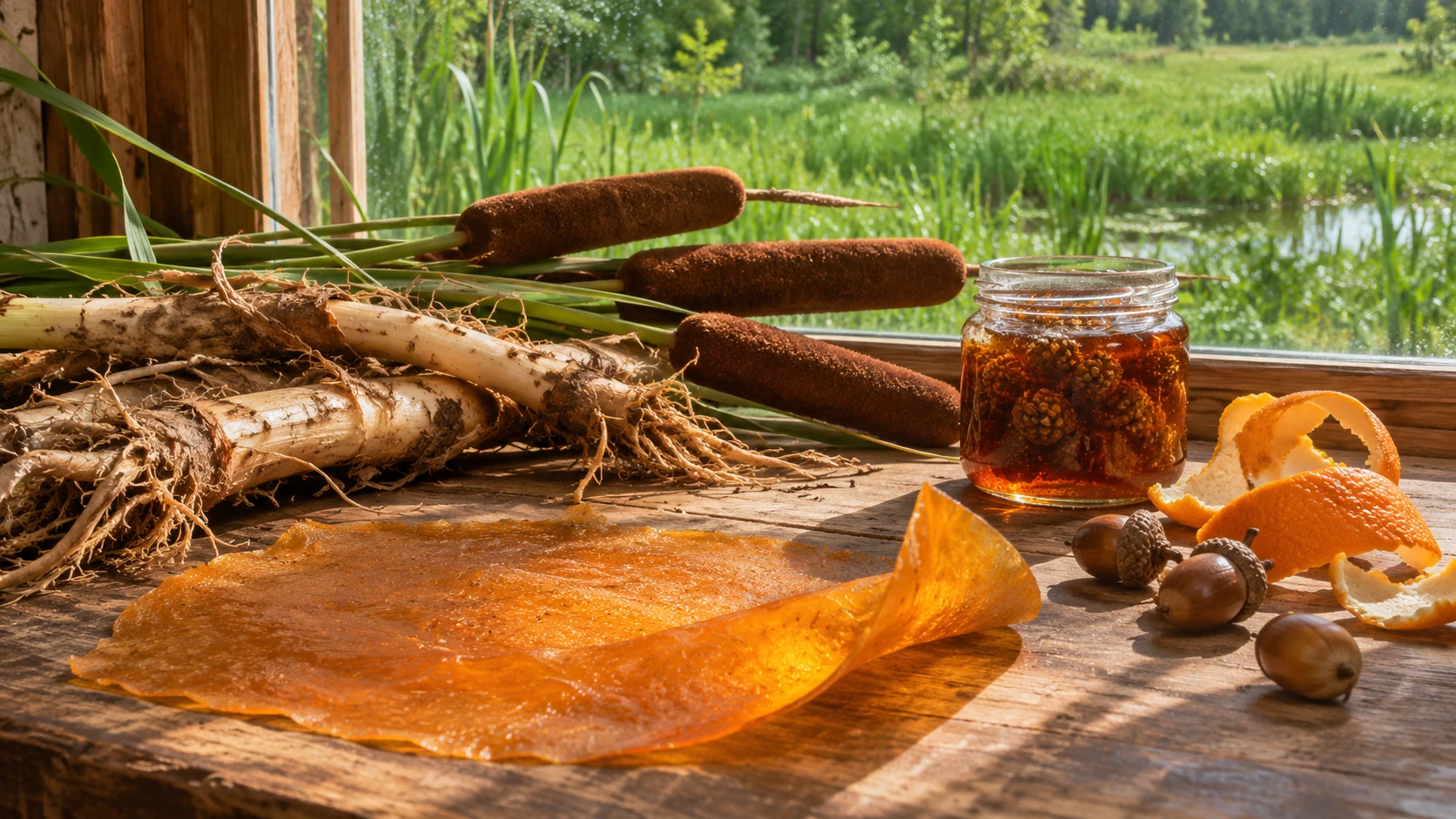
Illustrative still life of cattails, pine-cone preserves and citrus-peel material. Not a documentary photograph of Kyiv in 2022.
The first weeks of Russia's invasion, ten almost-abandoned refrigerators, childhood snacks from Belarusian marshes, pine-cone jam, and why I once made something resembling leather from mandarin peels.
On 24 February 2022, I was in Kyiv.
Russia had launched its full-scale invasion of Ukraine.
We knew a larger war was possible. We had been expecting something for quite some time.
But we thought the fighting would probably escalate along the existing front line in eastern Ukraine.
We certainly hadn't expected Russian troops to advance directly towards Kyiv through the Chernihiv region.
And suddenly they were approaching the capital.
There were explosions.
Air-raid warnings.
Confusion.
People leaving.
Roads becoming dangerous or inaccessible.
And one extremely practical problem that developed almost immediately.
The supermarkets were running out of food.
Now, under normal circumstances, I consider shopping for food one of life's pleasures.
I like discovering unusual ingredients.
Comparing products.
Trying things I've never cooked before.
But when a country is being invaded, grocery shopping acquires a rather different character.
And the first weeks of the invasion taught me something interesting about what people consider food.
Everybody wanted the same things
I lived in Berezniaky, near the Paton Bridge.
There was a good supermarket practically inside our residential complex.
Normally, that was extremely convenient.
Now it had become a place where you needed to calculate when you might actually be able to buy something.
The opening hours were unpredictable.
Air-raid alerts could interrupt shopping.
Queues were enormous.
People were understandably frightened.
Some were leaving Kyiv and buying provisions for the journey.
Others were stocking up because nobody knew what would happen next.
And almost everybody wanted the same products.
Pasta.
Cereals.
Rice.
Flour.
Sugar.
Salt.
Canned meat.
Canned fish.
The ordinary staples that people instinctively associate with having enough food at home.
Nothing surprising there.
Except that when everybody wants the same products, those products disappear first.
I remember seeing people competing for the last familiar items while other shelves still contained perfectly good food.
Things that simply weren't part of the conventional Ukrainian shopping basket.
Gnocchi, for example.
I bought quite a lot of gnocchi.
They're inexpensive, filling, easy to cook and entirely respectable food.
But at that moment, many shoppers apparently weren't thinking about Italian potato dumplings.
They were thinking about macaroni.
And as long as that difference existed, I had an advantage.
The supermarket wasn't necessarily empty of food. It was becoming empty of the foods people instinctively recognised as necessities.
Of course, that advantage didn't last forever.
As the disruption continued, even the less familiar products began disappearing.
But the experience stayed with me.
Nearly ten apartments full of unexpected groceries
Then another rather peculiar situation developed.
Friends and relatives were leaving Kyiv.
Some had been caught by the invasion while away from home.
Others evacuated because their neighbourhoods were becoming dangerous.
And I found myself holding keys to what felt like half the apartments in the city.
Perhaps not quite half.
But close to ten.
The people who had left needed someone to check their homes.
Especially their kitchens.
Refrigerators contained perishable food.
Freezers held meat and other products.
Power interruptions made the situation more complicated.
And nobody knew when the owners would return.
So I had another task.
Go into these apartments.
Check the food.
Recover what could still be used safely.
Cook what needed cooking.
And avoid wasting whatever could be preserved.
This became its own form of emergency food management.
Not a particularly glamorous one.
But useful.
A friend also came to stay with me after Russian forces entered the area around his home on the outskirts.
There were now two of us.
We could cook together, manage the supplies and help one another.
And between the ingredients I'd bought myself and the provisions from evacuated apartments, we had more food than the supermarket shelves suggested.
For a while, at least.
It was a strange contradiction.
Shops were running short.
Yet behind the doors of empty apartments, there were refrigerators full of things that might spoil before anyone returned.
What if the food deliveries never resumed?
As the days passed, I began wondering what would happen if Kyiv became completely surrounded.
What if food deliveries stopped for much longer?
What if shops remained empty?
What if ordinary supply chains couldn't be restored?
And then I caught myself thinking something rather peculiar.
Of all the people around me, perhaps I was unusually well prepared for this particular problem.
Not because I had a huge stockpile.
I didn't.
But because I knew how to recognise and use ingredients that many people would never consider eating.
I'd experimented with insects.
Unusual meats.
Wild plants.
Roots.
Flowers.
Ingredients normally associated with animal feed, gardening or simply the natural environment.
I knew that acorns had historically been processed into food and coffee substitutes.
That some inner tree-bark materials had been used as emergency flour substitutes.
That certain wetland plants contained edible, starchy underground parts.
That young nettles could become soup.
And that there were considerably more potential ingredients in the landscape than you would ever find in an ordinary supermarket.
For a moment, I even found myself imagining whether those skills might have helped me survive one of the great historical famines.
Looking back, that was an overconfident thought born partly from the anxiety of the moment.
The Holodomor and the siege of Leningrad were catastrophes of deprivation, violence and starvation. Knowing how to identify wild foods doesn't somehow cancel the consequences of such conditions.
And knowing that a plant contains edible material is very different from being able to obtain enough safe, nutritious food to survive.
Still, there was something genuinely reassuring about having additional knowledge.
I wasn't limited to thinking exclusively about what remained on the supermarket shelves.
And that reminded me of my childhood in Belarus.
We used to eat the marsh
As a child, I spent time at my grandmother's home in Belarus.
During the summer, other children would arrive to stay with their grandparents too.
Some from Ukraine.
Some from Russia.
Some from other parts of Belarus.
We spent enormous amounts of time outdoors.
There were meadows.
Wetlands.
Fields.
Places to explore.
And, of course, the occasional vegetable garden from which an enterprising child might acquire something edible.
Not always with the owner's knowledge.
But there was another food source.
The wild plants.
We knew some of them well enough that we could find something to eat without going home.
Which was useful.
Because going home meant risking being told to stay home.
And that would have been a terrible waste of a perfectly good summer afternoon.
One of the plants I particularly remember was cattail.
Although we didn't call it that.
We called it a reed.
Which wasn't botanically correct.
The marsh plant with the enormous brown cigar
Cattail, Typha, is the wetland plant with those distinctive brown cylindrical seed heads.
They look like oversized cigars.
And naturally, as children, we pretended to smoke them.
They produced an impressive amount of smoke when ignited.
We weren't particularly interested in actual smoking.
We just wanted to look like adults doing something terribly sophisticated.
Apparently, holding a burning marsh plant was sufficient.
But the more interesting part was underground.
The cattail has thick rhizomes.
These can contain substantial amounts of starch.
We knew that.
Or at least we knew they were something we could eat.
We dug them up.
Removed the outer material.
Washed them.
And ate the parts we liked.
I still remember the taste fondly.
Looking back, I certainly wouldn't recommend our childhood method of cleaning wetland roots in river water and eating them raw.
Cattails can accumulate pollutants from the wetlands in which they grow.
And freshwater environments can contain microorganisms that you don't particularly want to include in lunch.
But the plant's food value is real.
Different species of cattail have long been used as food.
Their shoots, pollen and starchy rhizomes have all had culinary applications.
The underground parts can be processed for starch.
The young shoots can be used as vegetables.
The pollen has even been mixed with flour.
Which makes the cattail rather more interesting than a plant whose principal purpose appears to be providing children with pretend cigars.
Then there was sweet flag
We also encountered another wetland plant.
Sweet flag.
Acorus calamus.
Its aromatic underground rhizome was something I remember tasting as a child.
It had a very distinctive character.
And, again, it was part of our informal knowledge of the landscape.
But this is one memory I wouldn't turn into a modern food recommendation.
Sweet flag can contain beta-asarone and related compounds that raise significant toxicological concerns.
Its use in food is restricted or prohibited in some jurisdictions.
So the fact that we ate it as children isn't evidence that doing so was safe.
It's evidence that children sometimes acquire fascinating local traditions without receiving a comprehensive lecture on toxicology.
A rather common situation.
And one that becomes considerably more interesting when you start revisiting old memories with the benefit of modern scientific information.
Pine cones, mint and the jam business
My interest in unusual plant ingredients didn't disappear when I grew up.
Quite the opposite.
At one point, I worked with a preserves brand, helping develop and improve products.
One of its successful offerings was jam made from young green pine cones.
If you've never tried pine-cone preserves, the idea may sound rather odd.
Pine cones don't exactly resemble strawberries.
But when appropriately prepared from suitable young cones, they can produce a fascinating aromatic preserve.
Resinous.
Sweet.
With a distinctive forest-like character.
I enjoyed it.
And I suggested adding a little mint.
Which, to my taste, made the combination even more interesting.
Pine and mint.
A rather wonderful aromatic partnership.
More recently, my son and I also experimented with a fermented lemonade-style drink involving pine needles.
Again, it was an interesting flavour experiment.
But here, as with all wild plant ingredients, exact identification is essential.
Different conifers aren't interchangeable.
Yew, for example, is highly toxic.
And uncontrolled fermentation introduces its own safety questions.
So I regard the experiment as part of our culinary history, not a general invitation to gather evergreen needles and ferment them.
Still, I like the underlying idea.
A forest contains more potential flavour ingredients than most people realise.
Provided you know exactly what you're dealing with.
The other things a cattail can become
Now comes the part where this Kitchen Note temporarily stops being about eating.
Because I've always been interested in what else natural materials can do.
Remember those brown cattail seed heads?
The oversized cigars?
Inside them is a remarkable amount of fluffy material associated with seed dispersal.
When a mature head breaks apart, the fibres expand into a cloud of soft fluff.
Historically, cattail down has been used in various insulating and stuffing applications.
And that gave me an idea.
Could you turn the surface of a cattail head into something resembling artificial fur?
Imagine a soft furry layer attached to a flexible backing.
A kind of plant-based fleece.
I explored the idea of fixing the outer fibres to a fabric-like support, using a flexible adhesive, and then separating the resulting sheet from the central seed-head structure.
I was fascinated by the possibility.
A material that looked like fur.
But came from a wetland plant.
The concept suggests all sorts of possibilities.
Insulation.
Decorative textiles.
Perhaps experimental clothing.
Although making a small sample that resembles fur is not the same thing as producing a durable, washable fabric suitable for a coat.
The fibres, backing, adhesive, flammability and mechanical durability would all need proper testing.
And once synthetic PVA glue enters the process, the finished material can no longer honestly be described as entirely plant-based.
Still, the idea appealed to me.
I wasn't merely looking at the landscape as a source of food.
I was beginning to see it as a source of materials.
And that led to another experiment.
Mandarin peels.
My experiments with artificial leather made from fruit peels
This is one of the stranger things I used to make.
A flexible sheet resembling artificial leather.
From citrus peels.
I started with mandarin peels.
Although orange and other citrus peels can be useful in related material experiments.
The idea was to transform food waste into a thin, flexible composite.
I'd collect the peels.
Reduce them to a fine pulp with water.
Then combine the plant material with ingredients that could help it form a cohesive film.
In my experiments, those included gelatin and glycerin.
Glycerin helped the material remain flexible rather than becoming an entirely brittle sheet.
The mixture was heated and concentrated into a thick mass.
Then I spread it thinly over a plastic sheet and allowed it to dry.
Sometimes for several days.
Eventually, I could peel away a flexible film.
Depending on the thickness and texture of the backing surface, it could resemble a thin sheet of artificial leather.
The colour of the mandarin version was naturally rather pleasant.
A light orange.
And I could experiment with pigments.
This wasn't industrial material science.
It was home experimentation.
But it was fascinating.
I later discovered that researchers were investigating similar approaches using citrus waste, polysaccharides and plasticisers to create bio-based films.
Which was rather satisfying.
Although my specific formulation included gelatin, an animal-derived ingredient, so it wasn't vegan or fully plant-derived.
And a handmade flexible film isn't necessarily equivalent to commercial synthetic leather in durability, water resistance or mechanical performance.
That would require proper testing.
But it was a real material I could handle.
Bend.
Shape.
And experiment with.
I even made gloves
Naturally, once I'd produced a flexible sheet, I started wondering whether I could make three-dimensional objects.
Gloves, for example.
A rather ambitious choice.
But I liked the idea of making something wearable from a material I'd produced myself.
I experimented with forming the mixture between two glove-shaped surfaces.
The material occupied the space between them.
As it began to set, it took on the shape.
After further drying, I could remove the supports and obtain a thin glove-like object.
Not something I'd confidently recommend wearing in the rain.
Or using for industrial work.
Or relying upon for protection.
But a fascinating prototype.
A glove made from a homemade bio-based composite, with citrus peel among its ingredients.
I found the entire process rather satisfying.
Yesterday, I'd been thinking about mandarin skins as kitchen waste.
Today, I was trying to make clothing accessories from them.
Which probably tells you something about my approach to materials.
And perhaps my inability to leave perfectly ordinary things alone.
The world is full of ingredients that don't come with labels
All these memories came back to me during those strange first weeks in Kyiv.
Because a supermarket is a very peculiar way of organising our relationship with food.
Everything is selected for us.
Identified.
Packaged.
Transported.
Labelled.
Placed on shelves.
We learn to recognise food by its packaging and its position inside the store.
When the shelves become empty, it's easy to feel that the food itself has disappeared.
But the natural world doesn't organise itself around supermarket categories.
There are edible plants that most people consider weeds.
There are roots and shoots with long histories of culinary use.
There are ingredients associated with entirely different cultures.
And there are natural materials that can serve purposes far beyond cooking.
That doesn't mean almost everything can safely be eaten.
It certainly doesn't mean a few weeks of botanical curiosity make someone an expert in surviving a famine.
But it does mean that knowledge changes what we notice.
And sometimes what we notice changes how helpless we feel.
The danger of confusing possibility with preparation
There's an important distinction I'd make today.
Knowing that acorns have been used as food doesn't mean you can eat them straight from the ground.
Many acorns contain tannins that require appropriate processing.
Knowing that parts of tree bark have historically been used in emergency foods doesn't mean ordinary bark is a substitute for flour.
Historically, specific inner-bark materials were processed, not random pieces of woody outer bark.
Knowing that cattail rhizomes contain starch doesn't make polluted wetland roots a safe meal.
And recognising a pine-like tree doesn't mean its needles are suitable for tea.
The difference between knowing that something can be edible and knowing how to obtain safe food from it is enormous.
Then there's the question of quantity.
An edible plant might provide an interesting snack.
That doesn't mean it can provide the calories, protein, fats and micronutrients required to survive a long period of food insecurity.
So I wouldn't recommend replacing ordinary emergency supplies with an optimistic belief that the nearest park contains everything you'll ever need.
I still believe in having stored food.
Safe drinking water.
Basic equipment.
Reliable information.
And a plan.
Wild-food knowledge is an additional capability.
Not a replacement for the fundamentals.
Sometimes knowing more simply makes you less frightened
But perhaps this is what I was really thinking about in Kyiv.
Not that I could survive any catastrophe.
Not that I had discovered some magical solution to shortages.
And certainly not that war was an exciting opportunity to try unusual recipes.
It was frightening.
People were in danger.
Friends were leaving their homes.
Families were separated.
The supply chains we had taken for granted were suddenly unreliable.
But there was something useful about being able to look at an unfamiliar situation and still see possibilities.
The supermarket had run out of conventional pasta.
I found gnocchi.
Friends had evacuated.
I helped recover food from their refrigerators before it spoiled.
I remembered childhood experiences with wild plants.
And I knew that, if circumstances became worse, I had at least some additional knowledge to draw upon.
The emotional effect was real.
It helped me feel less helpless.
And that is valuable even when the knowledge never needs to be used.
Because panic rarely improves a difficult situation.
Curiosity, observation and practical skills sometimes do.
The strange comfort of knowing what else is possible
When I look back over these stories, I see a curious connection.
The little boy eating cattail rhizomes in Belarus.
The adult experimenting with pine-cone preserves.
The man making flexible films from mandarin peels.
And the person standing in a Kyiv supermarket during the first weeks of a war, looking for something that everyone else had overlooked.
They all approached the world in roughly the same way.
Don't assume that the familiar use of something is its only possible use.
A root may contain starch.
A pine cone may become a preserve.
A mandarin peel may become part of a flexible material.
And an unfamiliar package on a supermarket shelf may contain a perfectly good dinner.
Of course, there's a very important second question.
Is it safe?
And a third.
Does it actually work?
But those questions should follow curiosity, not replace it entirely.
I don't know what unexpected circumstances any of us may encounter.
A journey interrupted.
A prolonged power failure.
An isolated place.
A broken supply chain.
Or, as happened to me, a war arriving at the city where you live.
I do know that having more ways to understand and use the world can be reassuring.
Even if all you accomplish is finding dinner while everyone else is looking for macaroni.
The supermarkets were running out of familiar food.
I was beginning to remember how much else I knew.
And, for a little while, that helped me remain calm.
This Kitchen Note is based on personal memories of Kyiv in February and March 2022, childhood experiences in Belarus, and later experiments with food and natural materials. It is not a wilderness survival manual. Some historical practices described here would not meet modern food-safety or material-safety standards.
Further reading
- Ohio Department of Natural Resources — Pine Needle Tea and Plant Identification — link unavailable at publication.
Related Kitchen Notes: Ukrainian borscht entirely from canned food and keeping ingredients ready for quick assembly.