
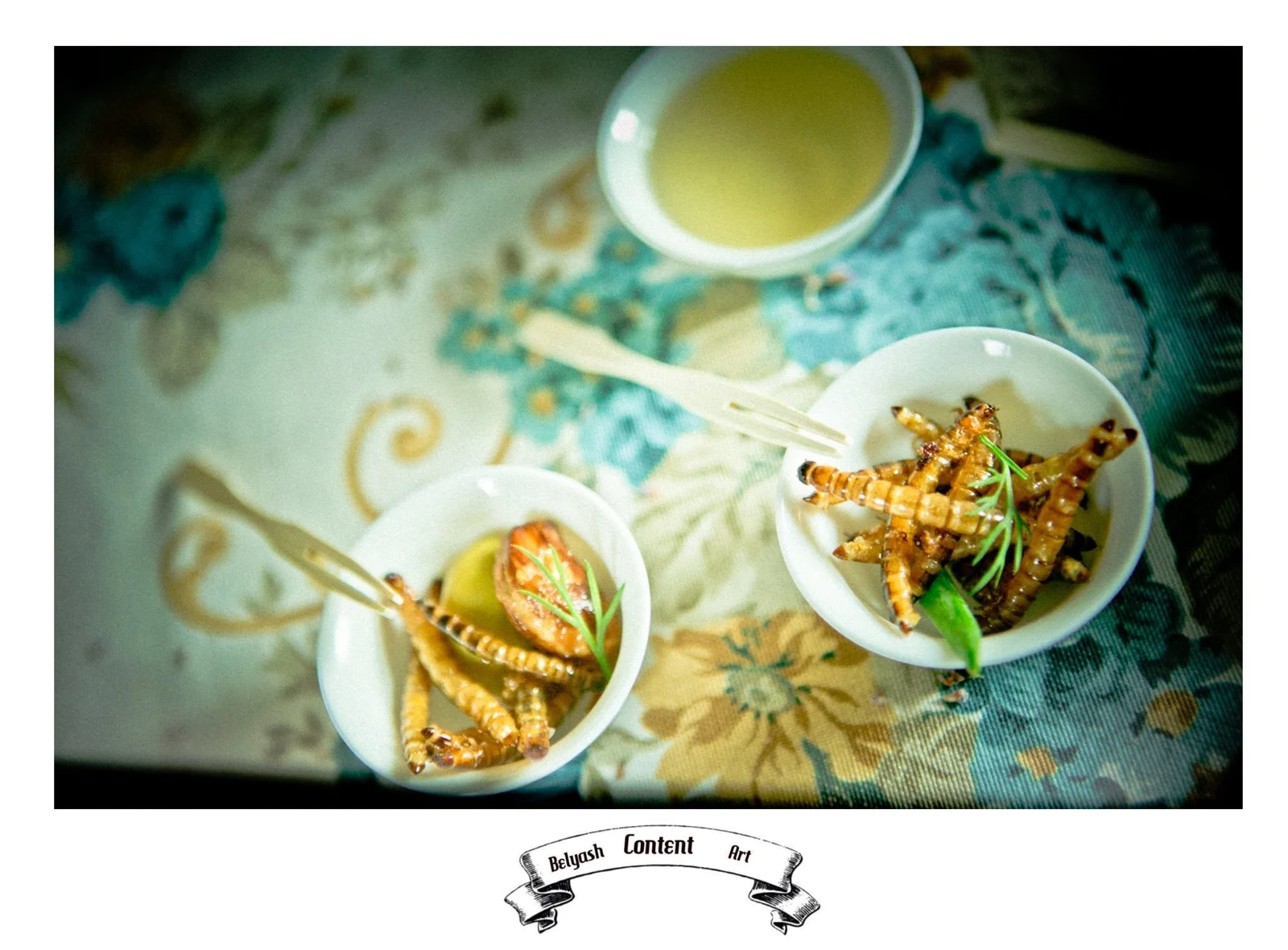
How a plate of crispy insects, a cold Chinese beer, and an interest in culinary taboos eventually led me to put fried larvae on the menu of my own bars.
I've always been interested in strange things.
Not necessarily because they're strange.
But because I want to understand why we consider them strange in the first place.
And food is an absolutely wonderful subject for this kind of investigation.
Consider a perfectly ordinary European dinner.
Roast chicken.
Perhaps some rabbit.
A nice piece of lamb.
A little foie gras.
Everything perfectly respectable.
Now imagine putting a plate of fried crickets on the same table.
Suddenly, people start behaving as though you've brought a small biological weapon into the dining room.
Why?
A cricket is an animal.
A chicken is an animal.
Both can be raised for food.
Both have been eaten by humans.
Yet one belongs on a dinner plate, while the other apparently belongs in a horror film.
And it gets better.
We happily eat rabbits, even though they're adorable little creatures with soft fur and enormous eyes.
But suggest eating a cat, and suddenly you're a monster.
Apparently, cuteness is not the decisive factor.
So what is?
Who decided that one animal is dinner and another is a beloved member of the family?
And why do the answers change so dramatically when you cross a border?
These questions fascinated me long before I became professionally involved in restaurants.
And they eventually inspired an entire unfinished book.
The first rule of unusual food: somebody else probably considers it normal
One thing becomes obvious when you start exploring food cultures.
There's no universal human menu.
In one country, an ingredient is a delicacy.
In another, it's animal feed.
In a third, people react to the idea of eating it with genuine horror.
Guinea pigs are familiar household pets in much of Europe.
They're also traditional food in parts of the Andes.
Insects are ordinary ingredients in various cuisines around the world.
Elsewhere, even touching one can cause a minor domestic emergency.
And while contemporary European attitudes towards eating cats and dogs are generally strongly negative, the historical record is considerably more complicated.
During the siege of Paris in 1870–1871, for example, Parisians ate animals that wouldn't ordinarily have appeared on their tables, including cats, dogs, horses and rats.
There are historical accounts of cat consumption in other European contexts as well.
That doesn't mean eating cats was a normal everyday practice throughout France until the twentieth century.
It wasn't.
But it does mean our current food boundaries aren't eternal laws of nature.
They have histories.
And those histories can be rather uncomfortable.
A rabbit is food. A cat is a friend. Explain.
I find the moral aspect particularly interesting.
Let's take a rabbit.
An intelligent, sensitive animal.
Capable of forming bonds.
Perfectly capable of becoming a beloved pet.
And perfectly capable, according to conventional European cuisine, of becoming dinner.
Now consider a dog.
Also intelligent.
Also sensitive.
Also capable of forming bonds.
But for most Europeans, eating one is almost unthinkable.
I'm not arguing that we should start eating dogs.
I'm asking what makes the distinction morally obvious to us.
Some of it is cultural tradition.
Some is the role an animal plays in our lives.
Some concerns emotion, familiarity, law, welfare and the relationships humans have developed with different species.
These distinctions can be meaningful.
But they aren't always as logically consistent as we like to imagine.
And nowhere is this more entertaining than when somebody expresses disgust at an unfamiliar food while enthusiastically eating something that involves its own ethical complications.
Foie gras, for example.
One can enjoy its taste while still acknowledging serious animal-welfare concerns surrounding conventional production methods.
But it's rather difficult to claim that familiar food is automatically ethical while unfamiliar food is automatically barbaric.
Our moral reactions often depend on what we grew up seeing on a plate.
Not exclusively on the suffering involved in producing it.
And that's worth thinking about before declaring somebody else's dinner disgusting.
The future of protein has six legs. Sometimes more.
Then there are insects.
I've always found the Western reaction to edible insects particularly strange.
Many insects are nutritionally interesting.
Some species contain substantial amounts of protein, fat, minerals and other nutrients.
Certain insects can also convert feed into edible biomass relatively efficiently.
There are serious reasons to investigate insect farming as part of future food systems.
The United Nations Food and Agriculture Organization has been discussing its potential for years.
But let's not replace one set of prejudices with another set of fashionable exaggerations.
Not every insect contains several times more protein than meat.
Nutritional composition varies enormously by species, development stage and processing method. Comparing dried insects with fresh meat can also produce misleading numbers.
And farming insects is not automatically cheap, environmentally perfect or free from welfare concerns.
It's still farming.
It requires knowledge, appropriate feed, hygienic conditions, processing, regulation and a market willing to buy the product.
Nevertheless, the basic idea is fascinating.
An animal we normally consider a pest can, under appropriate conditions, become a deliberately farmed food product.
And sometimes an excellent one.
I know this from experience.
Because my own fascination with edible insects began in a restaurant in China.
The larvae were delicious. That was the problem.
Many years ago, during a trip to China, I ordered something that would probably have horrified quite a few people I knew back home.
Large, fat larvae.
And an assortment of different insects.
I wasn't being forced to eat them.
I wasn't participating in some unpleasant survival experiment.
I ordered them because I was curious.
And they arrived looking exactly like what they were.
Cooked insects.
No elaborate attempt to disguise them.
No reassuring transformation into something resembling chicken nuggets.
Just the insects.
So I tried them.
And they were wonderful.
Crispy.
Savoury.
Surprisingly pleasant to eat.
Especially with a cold Chinese beer.
I remember being genuinely impressed.
Not merely relieved that I hadn't died.
I actually liked them.
And that created a problem.
Because once you've discovered that a food you previously considered strange can be delicious, you start wondering what else you've been missing.
How many ingredients have I rejected without ever tasting them?
How many things does my culture consider inedible simply because nobody around me eats them?
And how many perfectly enjoyable experiences are hiding behind the words we don't eat that?
This was the beginning of a rather long culinary adventure.
At the time, I was still far from the restaurant business.
I wasn't planning menus or developing food concepts professionally.
I was simply somebody with a strong curiosity about unusual things.
And a newly discovered enthusiasm for crunchy insects.
The problem with disgust
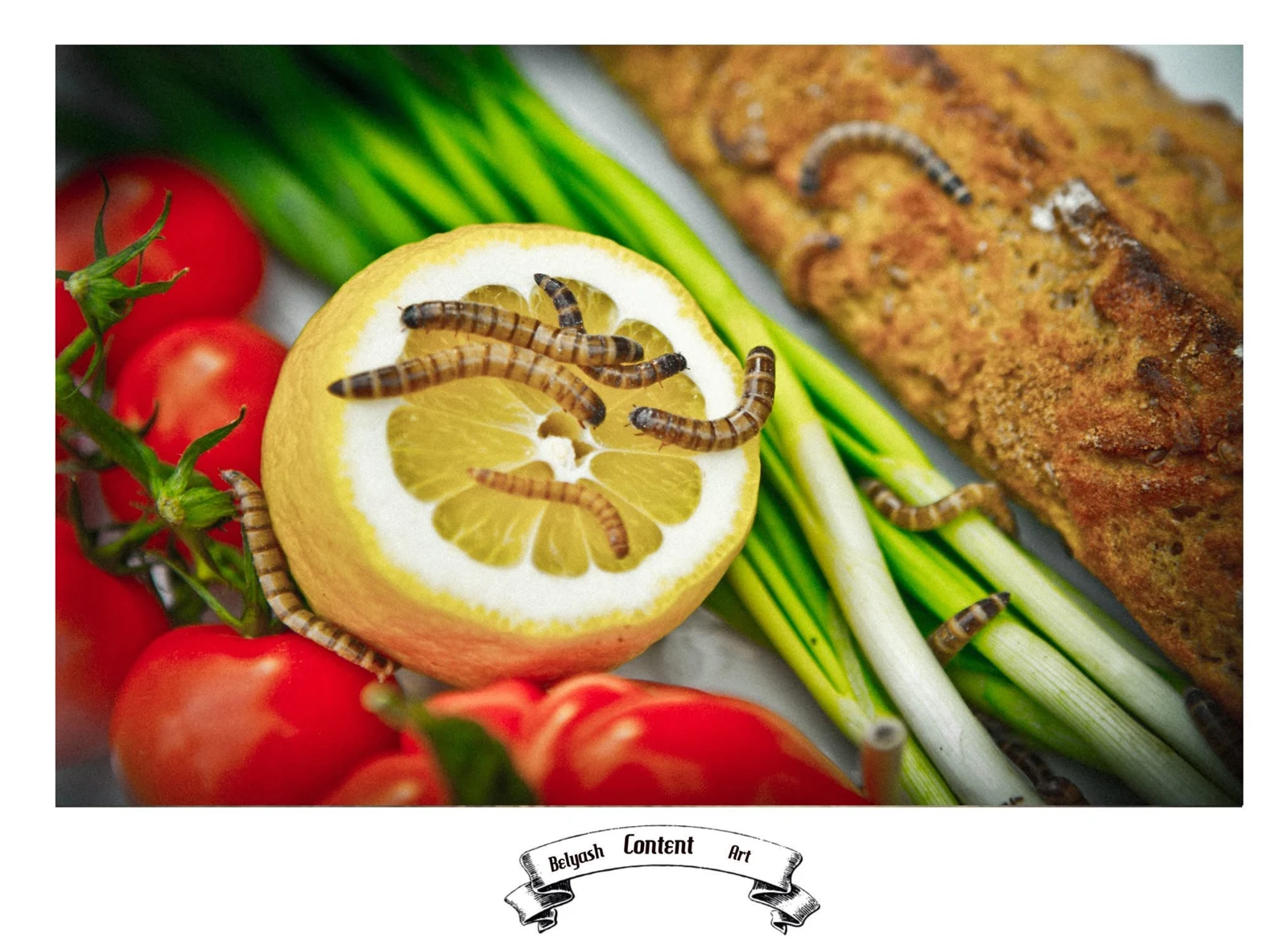
An unusual ingredient becomes part of an ordinary-looking culinary composition. Belyash Content Art session; author’s archive.
Disgust is an extraordinary emotion.
It can protect us from genuine dangers.
Spoiled food.
Contamination.
Certain sources of infection.
Things that might actually make us ill.
But disgust also learns cultural rules.
A person who has never encountered edible insects may find them revolting.
Someone who grew up eating them may associate them with family meals, street food or familiar snacks.
Neither reaction proves that the food itself is delicious or dangerous.
It tells us something about the person experiencing it.
And this is where I began questioning the entire idea of edible and inedible.
Not because I believed every disgusting thing should be eaten.
Quite the opposite.
Some things really are dangerous.
Some involve unacceptable harm.
Some are prohibited for sound reasons.
But I wanted to distinguish three questions that people frequently confuse.
Is it safe?
Is it ethical?
And does my culture consider it food?
Those are three different questions.
And a negative answer to one doesn't automatically answer the others.
A food can be safe but culturally unacceptable.
Familiar but ethically controversial.
Or completely ordinary in one place and dangerous if prepared incorrectly in another.
The interesting part begins when we stop treating all three questions as interchangeable.
And then we arrive at the truly uncomfortable subjects
While working on the manuscript that eventually became the source of this article, I went considerably further.
Cannibalism.
Human bodily products.
Placenta consumption.
Coprophagy.
Urine.
The boundary between nourishment, contamination and taboo.
You know.
The usual subjects for a pleasant Sunday lunch.
But I wasn't planning to convince readers to eat any of these things.
I wanted to investigate the logic of the boundaries themselves.
Consider human blood.
Most people would find the idea of deliberately consuming another person's blood disturbing.
Yet nobody panics because they accidentally taste a little of their own blood after biting their lip.
The physical substance isn't the only thing determining the reaction.
Context matters.
Intent matters.
The source matters.
Consent matters.
And the perceived relationship between the substance and the person consuming it matters.
Human placenta consumption raises another set of questions.
It exists as a documented practice in some communities, despite the absence of established health benefits and the presence of potential risks.
The tissue originates from the human body.
But its separation during childbirth changes how some people interpret the act of consuming it.
Does that make it ethically equivalent to eating human flesh obtained through violence?
Obviously not.
But does the fact that no killing is involved settle every safety and ethical question?
Also no.
These distinctions are precisely why the subject is interesting.
And why it can't be reduced to a simple list of things that are disgusting or acceptable.
The same applies to ingredients associated with animal digestion or waste.
Some famous coffees, for example, are produced from beans that have passed through an animal's digestive system and are subsequently recovered, cleaned and processed.
People may pay extraordinary prices for them.
The resulting drink is considered a luxury product.
Yet mention the biological process involved, and suddenly somebody at the table stops smiling.
I find that contradiction fascinating.
Although I also think the animal-welfare concerns surrounding some of these production systems deserve much more attention than the novelty of the resulting coffee.
Some of my original facts were almost as strange as the food
There's another amusing consequence of reopening an old manuscript.
You discover what you used to believe.
My original introduction contained a wonderful collection of supposedly shocking facts.
The amount of insects every person allegedly consumes accidentally each year.
The quantity of human skin supposedly floating around public places.
The idea that a mattress eventually doubles its weight because of dust mites and their waste.
And a particularly disturbing story about wealthy Chinese diners consuming soup made from human fetuses.
That last story is a good example of why unusual claims deserve investigation before being repeated.
The widely circulated reports about Chinese “baby soup” were not credible evidence of a culinary practice. Images used to support the story came from a controversial work of performance art.
In other words, the shocking fact wasn't what I thought it was.
It was misinformation.
The mattress story and many of the dramatic contamination statistics also circulated far more confidently than the available evidence justified.
I find that an interesting lesson in itself.
Even when your objective is to question other people's prejudices, you can accidentally collect new prejudices and myths of your own.
And the more sensational the claim, the more tempting it becomes to include it.
The strange-food project was supposed to challenge assumptions.
It would be a little embarrassing if it became a catalogue of unverified ones.
So the old manuscript needs some editing.
Fortunately, the actual experiences are considerably more interesting than the invented statistics.
From eating insects to selling them
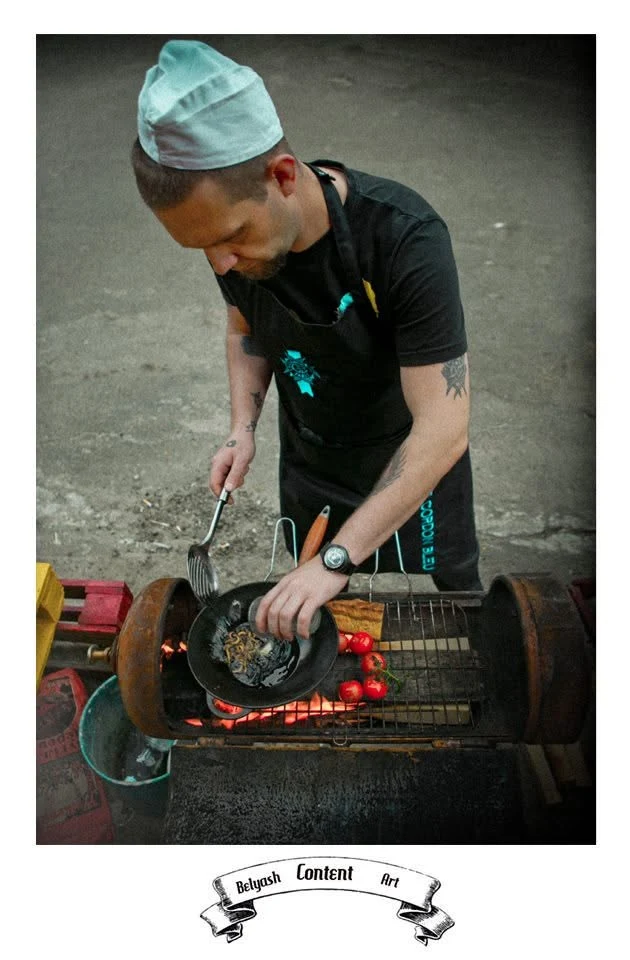
Preparing insect-based dishes during an original Belyash Content Art food photography session. Author’s archive.
Eventually, my professional life moved into hospitality.
I developed and opened Banka, a Ukrainian chain of bars that we also called The Jar Bar in English.
Later came cafés and other food-related projects.
And throughout this period, I continued experimenting with unusual ingredients.
Larvae.
Worms.
Cockroaches.
Scorpions.
Snakes.
Beaver.
Various products that most Ukrainian restaurant menus didn't include.
Some experiments were better than others.
Some were mostly interesting because of the experience.
And some produced things I genuinely wanted to eat again.
I even participated in an unusual food photography session with Belyash Content Art, preparing and presenting dishes using Zophobas larvae.
The photographs survived.
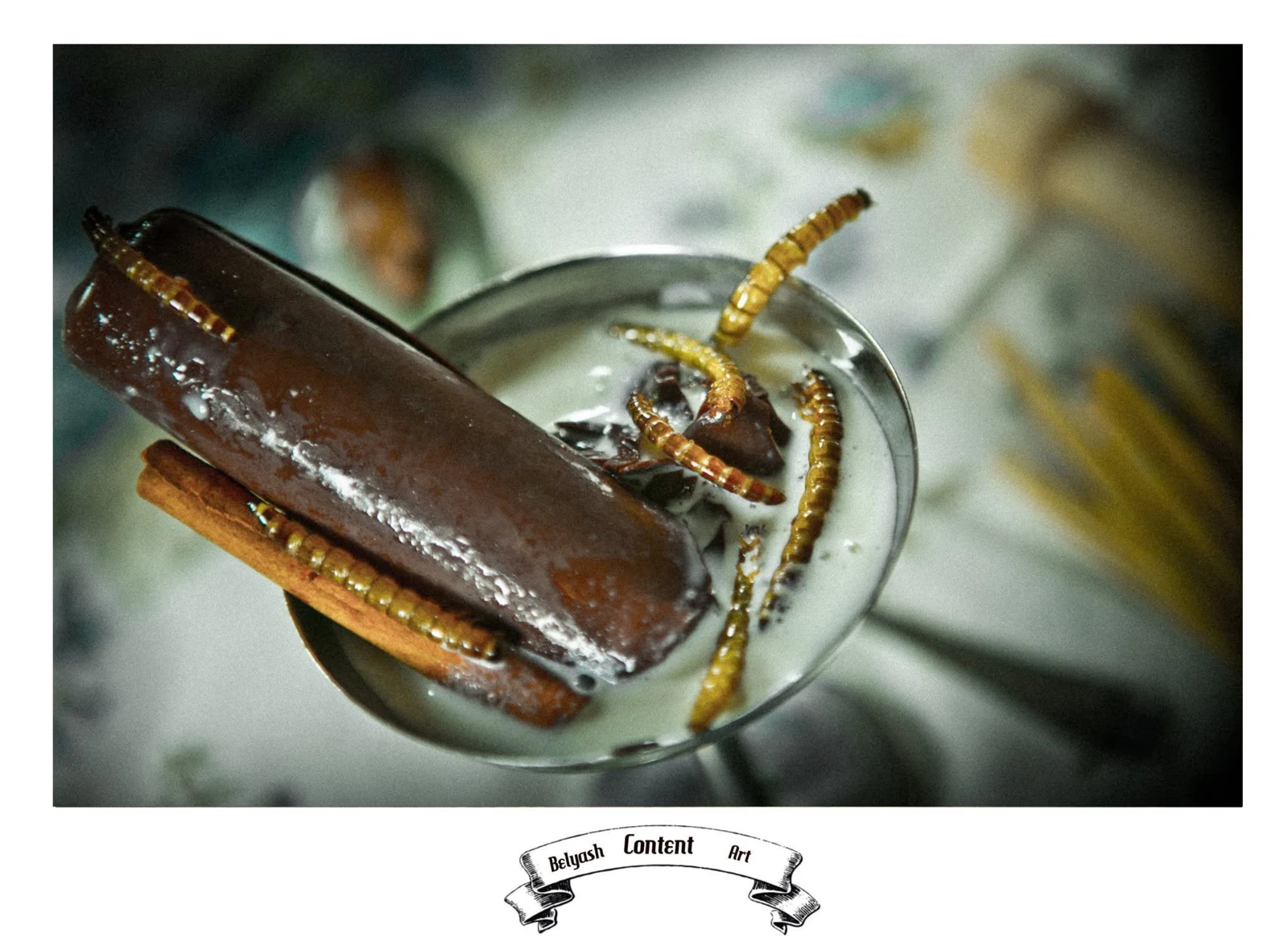
Experimenting with unexpected combinations and presentations during the Belyash Content Art session. Author’s archive.
They show actual ingredients, cooking and serving experiments rather than imaginary dishes created for a marketing campaign.
Looking at them now is a rather enjoyable reminder of the things I used to put in a frying pan.
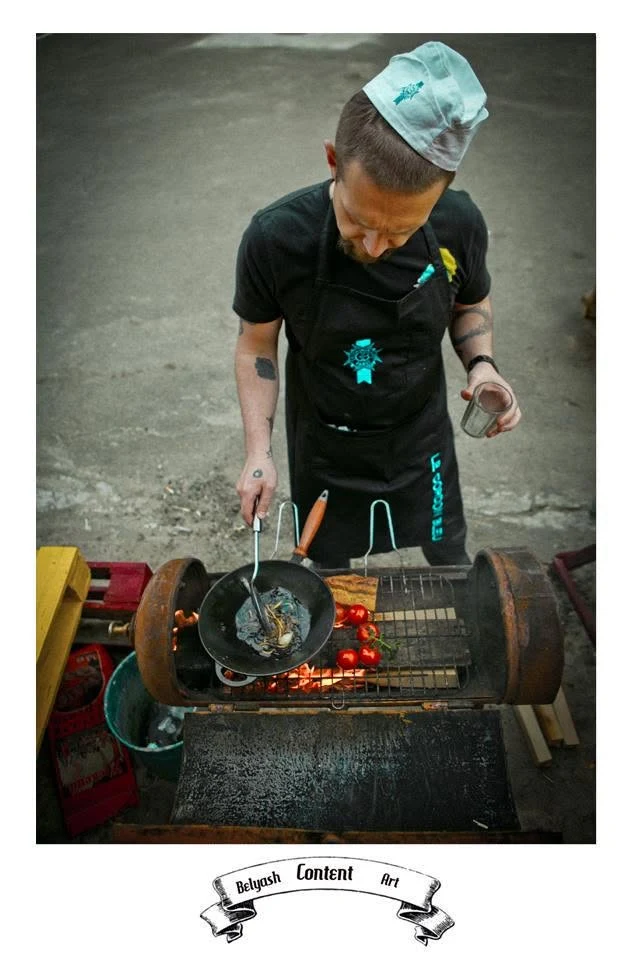
Another moment from the original Belyash Content Art cooking session. Author’s archive.
Eventually, I decided that fried insects could make an excellent bar snack.
Not as a joke.
Not as a punishment for somebody who lost a bet.
As something people might actually order with beer.
So I started looking for a supplier.
No, the larvae weren't collected from somebody's basement
One popular misconception about edible insects is that somebody must have collected them from a dirty cellar or under a rotten log.
In reality, insects intended for food can be raised on dedicated farms.
I found a farmer producing the insects I was interested in.
The larvae were deliberately bred.
Their feed included plant-based materials and grains.
They were maintained as a cultivated product rather than collected randomly from the environment.
We worked with the supplier to obtain veterinary documentation for the products we intended to sell.
That was important.
Because selling something unusual in a restaurant is not the same as trying it yourself while travelling.
You need a legitimate source.
Appropriate handling.
A product suitable for human consumption.
And compliance with the requirements that apply in your market.
We worked through those questions and began offering fried insects in the bars.
Among them were larvae of Zophobas, commonly known as superworms, and crickets.
The Zophobas larvae are the immature stage of a darkling beetle, not the same species as the familiar yellow mealworm.
And they turned out to be surprisingly good snacks.
Crispy.
Savoury.
Excellent with beer.
Which was exactly what I remembered from China.
The Jar Bar really did serve insects in jars
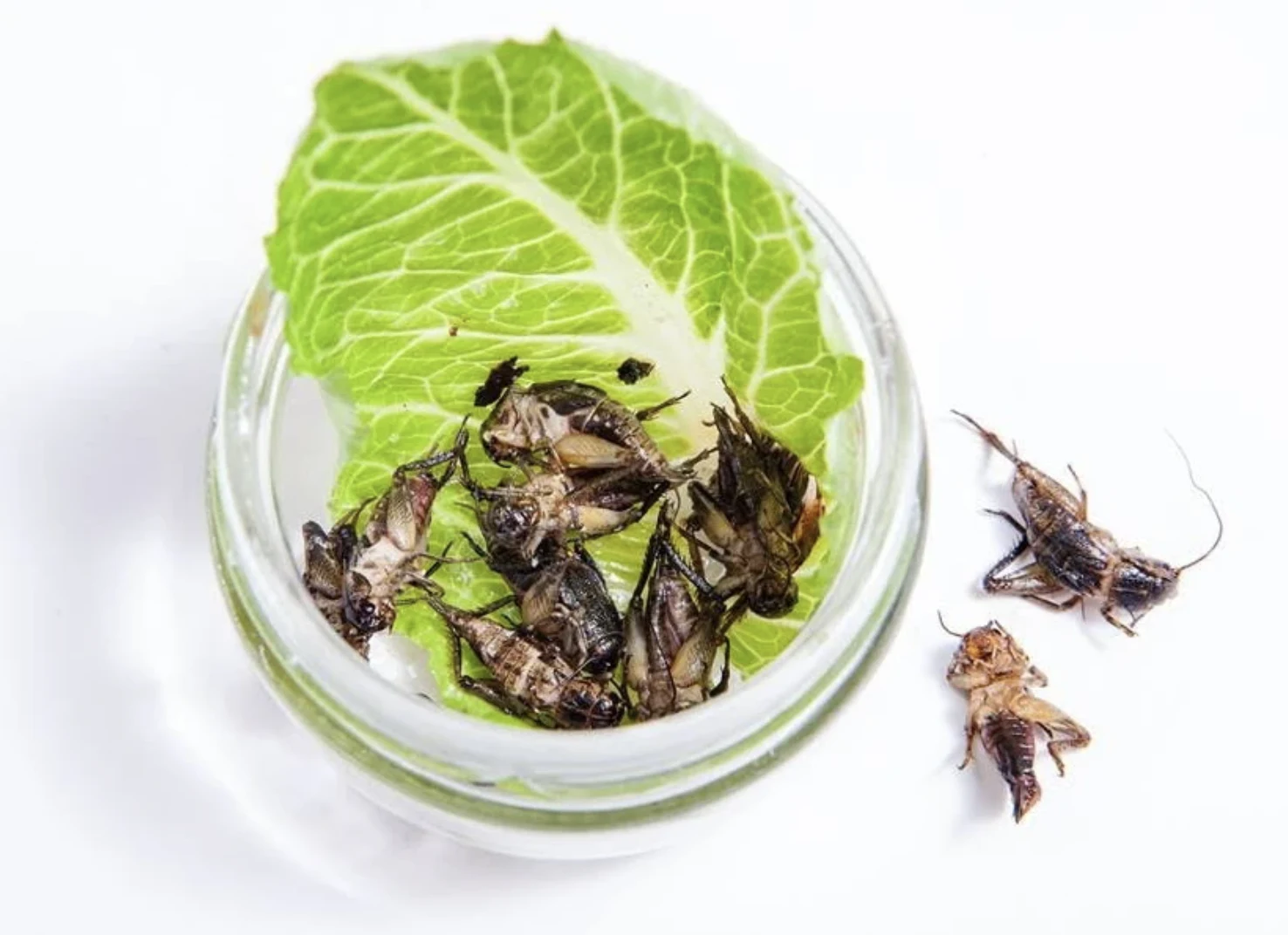
Fried crickets served at Banka (The Jar Bar), our Ukrainian bar chain. Banka project; author’s archive.
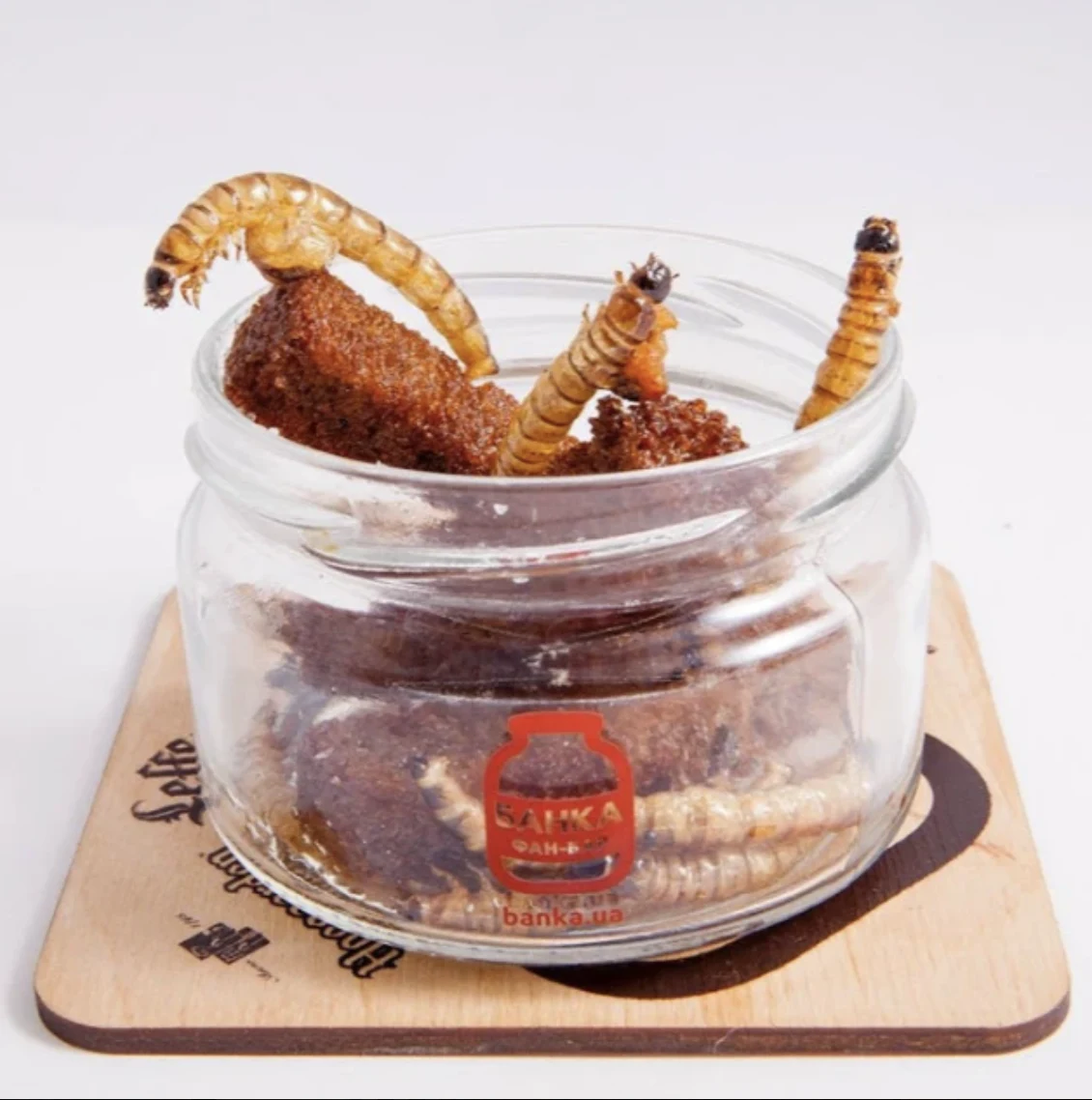
Fried Zophobas larvae served in a signature Banka glass jar. Banka project; author’s archive.
This is probably my favourite detail.
The bars were called Banka.
In Ukrainian, the word refers to a jar.
And serving food in jars was an important part of the brand's identity.
So naturally, when we introduced fried insects, we served them in our signature glass jars.
Fried Zophobas larvae.
Fried crickets.
Actual bar snacks.
Not protein powder.
Not some anonymous flour containing an ingredient that customers would rather not recognise.
The insects themselves.
In a jar.
On the table.
Ready to eat.
And the customers were interested.
Not everybody, obviously.
Some guests were curious.
Some were cautious.
Some were enthusiastic from the beginning.
And some probably decided that the bar had finally lost its mind.
But there was genuine interest.
People tried them.
And the response was positive enough that we continued selling them.
Other establishments became interested too, including Chinese restaurants looking for unusual products.
What began as my personal curiosity had become something more substantial.
A commercial food product.
A supplier relationship.
A new offering for our bars.
And an additional reason for customers to talk about the place.
That last part matters.
I've always liked products that make people stop and ask a question.
Not because novelty automatically guarantees sales.
It doesn't.
But because an unusual product can create an opportunity for conversation, discovery and a different kind of customer experience.
Especially when the product is actually good.
There's a difference between selling a disgusting novelty and introducing people to something they didn't realise they might enjoy.
I was much more interested in the second.
You can see the broader concept and branding of the bar chain in my original portfolio case: Banka Bar — Concept & Branding in Glass Jars.
An unusual ingredient isn't automatically a safe ingredient
I should also admit that some of my curiosity led me towards experiments I wouldn't encourage others to repeat.
At one point, for example, I investigated fly agaric mushrooms, Amanita muscaria.
This is a toxic mushroom containing psychoactive compounds, with documented poisoning risks.
My old manuscript treated it rather casually as something that could be eaten if you knew what you were doing.
I wouldn't present it that way now.
The fact that people have historically used or experimented with a substance doesn't establish that it is safe.
And the distinction between cultural taboo and biological danger is precisely what this project ought to respect.
The same principle applies to insects.
Not every species is appropriate for human consumption.
Wild-caught insects may carry hazards.
Farming conditions matter.
Processing matters.
Allergies matter, particularly because edible insects can cause reactions in people allergic to shellfish or dust mites.
And regulations differ across countries.
In the European Union, authorised edible insect products are subject to novel-food rules and specific labelling requirements.
Curiosity is valuable.
So is not poisoning your customers.
I regard both as important parts of gastronomy.
The book I started and never finished
By this point, my experiments had become sufficiently extensive that I decided to write a book.
A book about unusual food.
The frightening.
The smelly.
The supposedly inedible.
The cute animals we refuse to eat.
The horrifying ingredients other cultures consider delicious.
And the more uncomfortable questions surrounding food, ethics, biology and disgust.
I wanted it to be provocative.
Funny.
Occasionally revolting.
But also informative.
A combination of culinary anthropology, personal experiments, restaurant stories and recipes.
I began writing.
Collected material.
Developed ideas.
And then, as happens with quite a few ambitious projects, life intervened.
The book remained unfinished.
For years.
Recently, I found the old fragments again.
And rather than leave them buried in an archive, I've decided to bring them into Kitchen Notes.
Some may eventually become chapters of the original book.
Others may join different culinary collections.
A story about edible insects could belong in a book about unusual foods.
Or in a collection of restaurant-business experiences.
A discussion of animal fats, offal or food preservation might develop into something entirely different.
I don't particularly want to force those decisions now.
I'd rather recover the material, revise it where necessary, add what I've learned since, and see what begins to emerge.
That's one of the things I like about this growing collection.
It's becoming a place where unfinished ideas can finally find a home.
And occasionally, perhaps, an entire book.
So who decides what belongs on the menu?
I don't believe the answer is that everything should be edible.
That would be an absurd conclusion.
Food safety matters.
Animal welfare matters.
Ecological consequences matter.
Culture matters.
And laws, while imperfect, are not irrelevant.
But I do think we should be more curious about how our food boundaries developed.
Why does a rabbit belong on the menu while a guinea pig causes outrage?
Why can an insect make someone recoil when a shrimp causes no concern?
Why do we accept certain forms of animal suffering in familiar food production while condemning unfamiliar dishes as barbaric?
Why does a product become less frightening when it is ground into flour, placed inside a protein bar or given an attractive label?
And how much of what we consider delicious today was once treated with suspicion?
Potatoes and tomatoes, for example, had complicated introductions into European diets, including periods of resistance and suspicion.
Their acceptance changed.
Our expectations changed.
And eventually they became indispensable ingredients in cuisines that had existed for centuries without them.
Food traditions aren't fixed.
They're continuously negotiated.
Through history.
Trade.
Necessity.
Habit.
Technology.
And occasionally through somebody ordering a plate of insects in a Chinese restaurant.
Which brings me back to where this began.
I ordered those larvae because they looked strange.
I ate them because I was curious.
And I enjoyed them because they were delicious.
Years later, people were ordering fried larvae in my own bars.
Not because I had convinced them that everything disgusting was secretly wonderful.
But because I'd discovered one very simple thing.
Sometimes the difference between food and something disgusting is that nobody has persuaded you to take the first bite.
And sometimes, of course, the first bite confirms that you were right to be suspicious.
That's why we experiment.
Carefully.
Curiously.
And preferably with something cold to drink.
This article is adapted from the unfinished introduction to my earlier book project about unusual foods. I've preserved its questions and personal experiences while revisiting some of its historical and scientific claims.
Further reading
- FAO — Insects for Food and Feed
- EFSA — Novel Foods and Safety Assessment
- AFP Fact Check — The Origin of the False Chinese “Baby Soup” Story
- FDA — Safety Concerns Concerning Amanita muscaria
Photography
Fried Zophobas larvae presented during my Belyash Content Art culinary photography session appear on the cover. The cooking and experimental-dish photographs come from the same session; the serving photographs document Banka / The Jar Bar. All photographs are from my archive.