
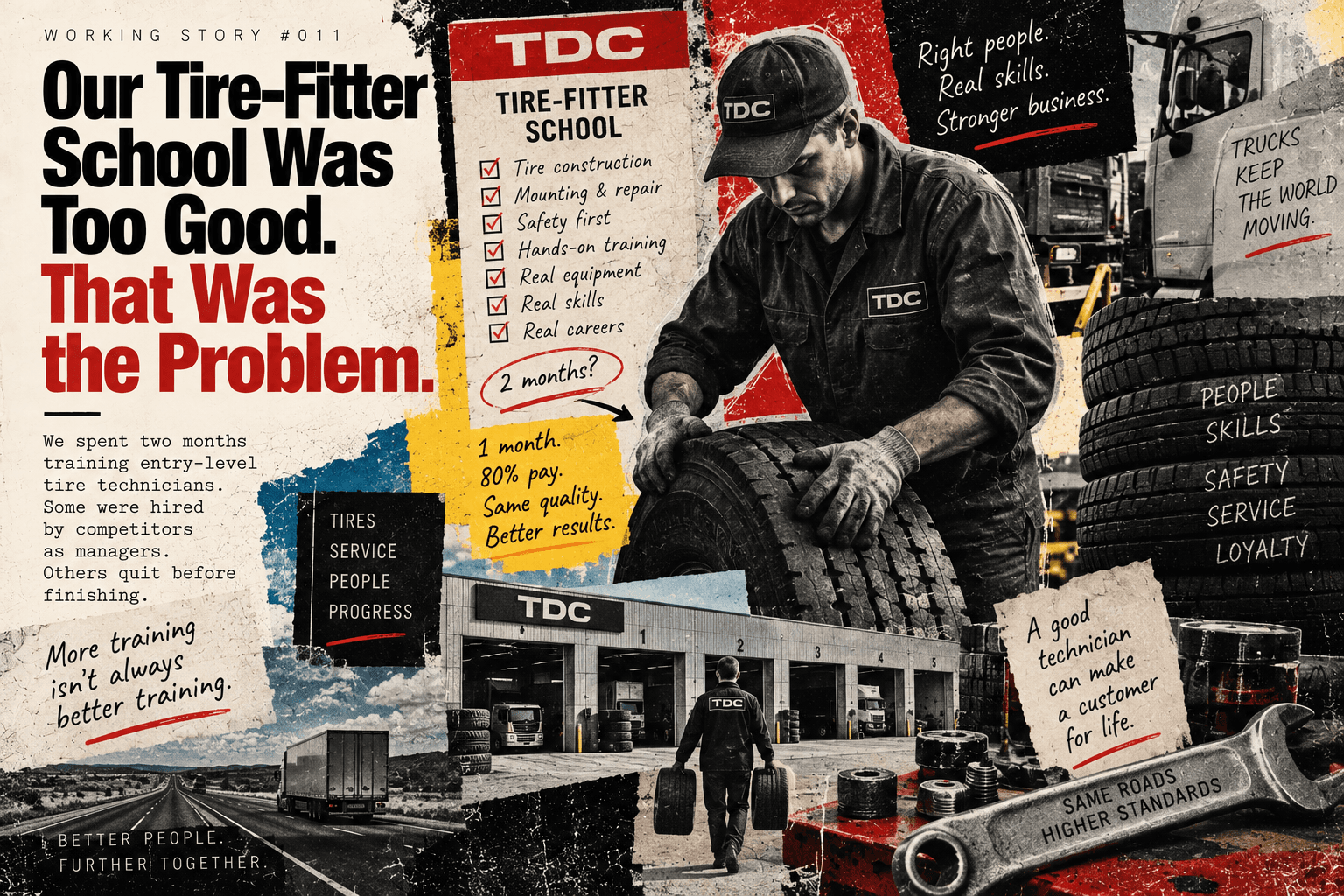
We spent two months training entry-level tire technicians. Some were hired by competitors to manage entire service stations. Others quit before finishing. Eventually, we realised that even good education can become a business problem.
One of the stranger things I remember from my years in the commercial tire business happened in Belarus.
We hired a man to become a tire fitter.
An ordinary entry-level position at one of our service stations.
He went through our corporate training program, learned about tires, materials, construction, installation, repair procedures and everything else we considered important.
And then a competitor hired him.
Not as a tire fitter.
As the manager of an entire tire-service station.
Which was quite a promotion.
Especially considering that we'd trained him for a job at the very bottom of the service-station hierarchy.
At first, you might consider this a compliment to our training system.
And it was.
Unfortunately, it was also a rather expensive compliment.
The same thing happened again, including in Ukraine.
Eventually, we had to admit something uncomfortable.
Our training program was excellent. It was also excessive.
The most important person in the company might be the lowest-paid
Around 2007–2010, I worked as vice president of marketing for a commercial tire distribution group operating across Ukraine, Belarus and Russia.
We sold premium tires and operated a large network of service stations for trucks, buses and other commercial vehicles.
One thing I found particularly interesting was the role of the tire fitter.
Consider McDonald's.
You can spend billions developing the brand, designing restaurants, optimising supply chains and advertising hamburgers.
But the person who hands the customer their order has an enormous influence on the final impression.
A tired, rude or incompetent employee can destroy a customer experience that the rest of the company spent considerable money creating.
We had a similar situation.
A fleet operator could purchase thousands of dollars' worth of premium tires.
Our sales department could negotiate an excellent contract.
Our marketing could explain why the product was worth the price.
The customer could arrive at a beautiful service station with excellent facilities.
But eventually, someone had to physically install those tires.
And that person was the tire fitter.
A relatively modestly paid employee performing a physically demanding job.
Yet the consequences of a mistake could be enormous.
An improperly mounted commercial tire can damage expensive equipment. Incorrect inflation or handling of a high-pressure tire assembly can cause severe injuries or even fatalities.
The technician needed technical knowledge, physical strength, practical skills and an understanding of safety.
He also needed to be reasonably polite to customers.
And, preferably, not destroy a tire worth several hundred dollars.
Quite a list of requirements for one of the less well-paid positions in the company.
We treated tire fitters rather well
We understood the importance of these employees.
Our wages were generally somewhat above the local market.
We provided good tools, quality uniforms, showers and changing facilities.
Uniforms were regularly replaced and professionally laundered.
Employees had access to the same coffee, tea, snacks and meals that we offered drivers visiting our premium stations.
There were also tips.
Drivers of expensive commercial vehicles sometimes tipped technicians quite generously, especially when they were satisfied with the service.
We even organised professional tire-fitting competitions.
Not just for our own employees. We invited technicians from the wider market.
Our people generally performed strongly.
One of the winners was even rewarded with a trip to Brussels.
I remember this because I was travelling there around the same time with our vice president of logistics. We had been sent for training at a corporate university, while several other colleagues were travelling for business meetings or as a reward for their achievements.
Among senior executives and company representatives was a tire fitter who had won one of our professional championships.
I rather liked that.
A person performing one of the most physically demanding jobs in the company was receiving recognition alongside senior management.
But the competitions and rewards weren't the most unusual part of our approach.
That was the school.
Everybody goes to tire school
We operated our own tire-fitting school.
It was initially designed for people arriving with little or no experience.
You could join the company knowing almost nothing about commercial tires.
Two months later, the intention was that you'd understand the product and be ready to work safely and competently.
The curriculum was extensive.
Tire construction.
Materials.
Carcasses.
Tread design.
Types of commercial tires.
Installation.
Repair.
Wear patterns.
Safety requirements.
Practical work.
And considerably more.
It wasn't simply an apprenticeship in how to operate tire-changing equipment.
We wanted people to understand the product itself.
Which makes sense when practically the entire company is built around tires.
In fact, the training requirement extended beyond technicians.
New employees across many departments were expected to learn the fundamentals of tire technology.
Including managers.
The reasoning was straightforward: if you work in a tire business, you should understand tires.
We even had our own publishing operation supporting this approach.
One publication was a magazine for long-haul truck drivers, covering life on the road, transport and other subjects relevant to our customers.
Another was a professional newspaper for tire technicians.
It covered technical developments, changes in tire technology and practical professional knowledge.
This allowed us to keep employees informed after their initial training.
After all, we couldn't send everybody back to school every year.
On paper, it was a very good system.
Perhaps suspiciously good.
Two months of school for a job you wanted to start yesterday
There was one problem we hadn't considered sufficiently.
Not everyone joins a company because they want to spend two months studying.
Many of our tire-fitting recruits wanted practical work.
They were physically capable.
They were motivated to earn money.
They were willing to learn a trade.
But an extended classroom-heavy training program was not necessarily what they had expected when accepting the job.
And there was another detail.
During training, employees received approximately 60% of the salary agreed for their future position.
This policy applied broadly across different roles.
If you were entering a highly paid management position, 60% could still be a substantial amount of money.
Spending two months learning about tires while receiving a respectable salary might seem quite pleasant.
But for an entry-level technician, the calculation looked different.
Even though our regular wages were above the market average, 60% of that amount could be less than what the person could earn elsewhere by starting work immediately.
So imagine the recruit's position.
He wants a practical job.
He is willing to work hard.
He needs money.
And instead, he gets two months of relatively demanding education at reduced pay.
From management's perspective, this is a generous investment in employee development.
From the recruit's perspective, it can feel like a rather complicated way to postpone earning a proper salary.
And some people simply left before completing the program.
Not necessarily because they were incapable of learning.
Because the training demanded more time, effort and financial sacrifice than the job seemed to justify.
We had created a barrier to entry while believing we were creating an opportunity.
And then our competitors started hiring our graduates
Meanwhile, the people who did complete the program sometimes became unusually attractive to other employers.
Remember that employee in Belarus?
He had entered our school to become a tire fitter.
A competitor subsequently recruited him as a service-station manager.
There were similar cases elsewhere.
I don't want to exaggerate this into an industry-wide epidemic.
But it happened often enough to reveal a problem.
We were investing substantial resources in training employees.
And in some cases, competitors were able to benefit from that investment without bearing the training costs.
Our school was effectively providing a pool of well-prepared specialists for the wider market.
There is nothing inherently wrong with that.
A company should expect that some of its employees will eventually leave and use their skills elsewhere.
But when training becomes so extensive that it increases recruitment difficulties, contributes to early departures and produces graduates attractive for positions far above the ones you're trying to fill, it's reasonable to examine whether the program still fits its purpose.
Which we eventually did.
We cut the course in half
The solution wasn't to eliminate training.
That would have been absurd.
Commercial tire fitting involves real technical and safety requirements. You cannot simply put an inexperienced person next to a heavy truck wheel and hope for the best.
We needed competent technicians.
We just didn't necessarily need every entry-level technician to receive two months of broad industry education before beginning normal work.
So we changed the program.
Training was shortened from two months to approximately one.
At the same time, we increased trainee compensation from 60% to 80% of the agreed salary.
This made the entry period less financially painful.
It also made the program more closely aligned with the work people had actually been hired to perform.
The essential practical and safety training still mattered.
But not every interesting fact about tire construction needed to be mastered before a person could become productive under appropriate supervision.
We also reconsidered the requirement that everyone complete the same extensive course.
For some specialisations, particularly roles where deep technical immersion wasn't essential, the training requirements could be reduced or adapted.
And I had a personal reason for supporting that idea.
Sometimes knowing less helps you think differently
I happened not to complete the original tire-fitting school myself.
My entry into the company had been rather unusual, involving project evaluation, management assignments and a somewhat undefined position during my first months.
So I learned the business through actual projects, conversations, observation and working with different departments.
I acquired enough technical understanding to work effectively in the industry.
But I wasn't trained to think like a tire specialist.
And I gradually came to consider that an advantage for some of my responsibilities.
When you spend months being taught how an industry works, you also absorb its assumptions.
Its vocabulary.
Its conventional solutions.
Its established ways of approaching problems.
That knowledge is valuable.
But it can also make alternative approaches less obvious.
As a marketing and innovation executive, I often borrowed ideas from completely different industries.
Retail.
Hospitality.
Consumer products.
Software.
Publishing.
Sometimes a problem in commercial tires looked remarkably similar to a problem I'd encountered elsewhere.
If I'd been trained to see every situation exclusively through the industry's conventional logic, perhaps some of those connections would have been harder to notice.
This isn't an argument against expertise.
Quite the opposite.
You need experts.
But a company also benefits from people who haven't spent their entire professional lives learning why things must be done in one particular way.
Deep industry knowledge is essential for some decisions. A fresh perspective is valuable for others.
Not every employee needs exactly the same combination.
The training paradox
Looking back, the interesting thing is that almost every individual part of our program made sense.
Teach employees properly.
Good.
Make sure they understand the product.
Good.
Maintain high safety standards.
Essential.
Publish technical information.
Excellent.
Organise professional competitions.
Why not?
Reward outstanding workers.
Absolutely.
But when we combined all those reasonable ideas into one standardised onboarding system, we created something less reasonable.
We treated two months of education as an unquestionable benefit.
For some people, it probably was.
For others, it was an obstacle.
We underestimated the difference between how senior management experienced training and how an entry-level worker experienced it.
And we overlooked the possibility that providing more education than a position required could have unintended commercial consequences.
We had been measuring the quality of our training partly by how much knowledge we could provide.
We should also have been asking:
How quickly can a new employee become competent?
How many people complete the program?
What does it cost them financially?
How well does it prepare them for their actual responsibilities?
And how much additional training is genuinely necessary?
More training isn't always better training
I'm still strongly in favour of investing in employee development.
Particularly in jobs where mistakes are expensive or dangerous.
But this experience taught me to distinguish between training quality and training quantity.
They aren't the same thing.
A longer course can be better.
It can also be unnecessarily long.
A broader curriculum can produce more knowledgeable employees.
It can also teach people things they don't need while delaying the moment they become productive.
And a highly structured educational program can look wonderful to the executives who designed it while being frustrating to the people expected to complete it.
Our two-month tire-fitting school was a genuine investment in professional competence.
It helped establish technical standards.
It created skilled workers.
It even produced people who could move into management positions elsewhere.
Those were real achievements.
But it also made some entry-level jobs harder to fill and retain.
So we adjusted it.
One month instead of two.
Better compensation during training.
More flexibility for different specialisations.
Not a rejection of education.
A better match between education and its purpose.
And perhaps that's the most useful lesson.
Sometimes a company becomes so enthusiastic about doing something well that it forgets to ask whether it's doing too much of it.