
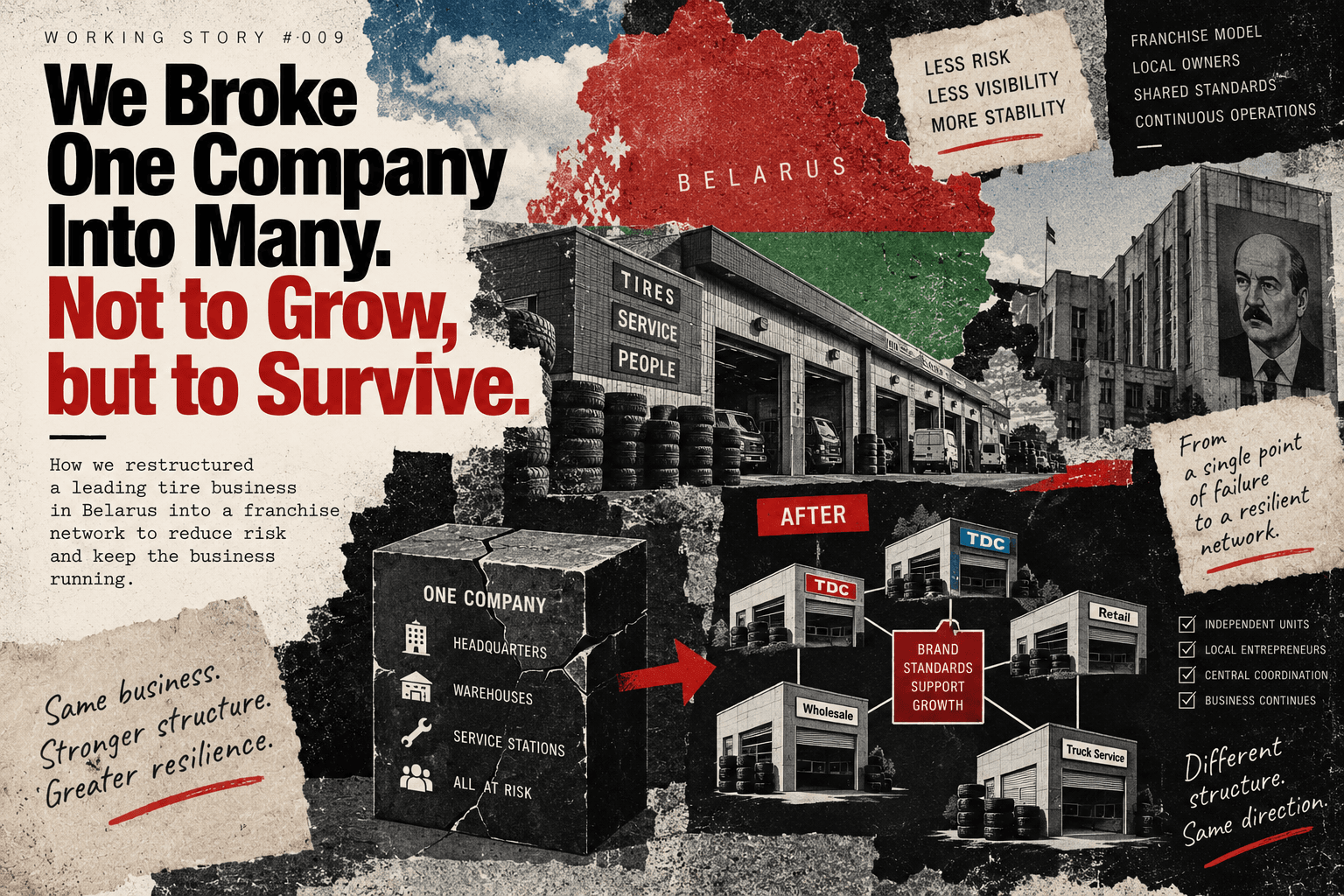
How I restructured a leading tire distribution business in Belarus into a franchise network to reduce the risk of a single intervention bringing down the entire operation.
There is a particular problem with building a successful business in an environment where the rules aren't always predictable.
The bigger you become, the more visible you are.
And visibility isn't necessarily a good thing.
Around 2007–2010, I was sent to Belarus to deal with two problems in one of our group's oldest businesses.
The first was financial.
Despite being a leading player in the commercial tire market, the company was somehow losing money.
Not much, relatively speaking. But consistently.
That's a separate story, and an interesting one.
The second problem was more unusual.
How do you protect an established business from a situation where regulatory or administrative intervention could potentially paralyse the entire company?
My solution was to stop treating it as one company.
At least operationally.
The problem with being successful in Belarus
The holding I worked for had originally been founded in Belarus.
That was where the founders had built their first commercial tire business, developed their first service stations and established their position in the market.
Eventually, the business became one of the country's leading commercial tire distributors.
The money earned in Belarus helped finance expansion into Ukraine, a considerably larger market.
Ukraine gradually became the main business centre.
The group also developed operations in Russia.
But Belarus remained important.
It was the historical starting point of the business, with an established distribution network, warehouses, wholesale operations and commercial tire-service stations.
Unfortunately, its success also created a concern.
The owners were worried about the political and regulatory risks of operating a highly visible private business in Belarus.
Under Alexander Lukashenko's authoritarian government, those concerns were not purely theoretical. The broader environment created significant uncertainty around property rights, regulatory enforcement and the state's relationship with private enterprise.
But the immediate problem was not simply political.
It was architectural.
We had built a business that was unnecessarily vulnerable to a single point of failure.
One company. Everything inside it.
The Belarusian operation was organised in a fairly conventional way.
One major legal entity.
A headquarters in Minsk.
A network of tire-service stations.
Warehouses.
Wholesale distribution.
Corporate sales.
Employees.
Imports.
Logistics.
Most activities belonged to the same organisation.
Operationally, this arrangement was understandable.
It simplified central management.
It made financial reporting relatively straightforward.
It allowed the company to operate as one integrated business.
But there was a problem.
Suppose a serious legal or regulatory issue arose at one warehouse.
Or one service station.
Or within the central office.
Because so much of the operation belonged to one legal entity, measures affecting that entity could potentially disrupt every business unit.
A problem involving one location might threaten the activities of the entire network.
Warehouses.
Service stations.
Corporate customers.
Employees.
The whole thing.
And when I looked at that structure, I saw a question worth asking.
Why should a problem in one small part of the company be capable of stopping everything else?
We had centralised not only management and ownership, but also a substantial amount of operational risk.
That seemed unnecessary.
What if the company stopped being one company?
My proposal was to rethink the legal and operating structure.
Instead of having every service station and wholesale unit belong to one large operating entity, we could reorganise the business into a network of smaller companies.
The individual units would operate under franchise arrangements.
A tire-service station would become its own business.
A wholesale or corporate-sales unit could become another.
The people already managing these operations could take responsibility for them within the new structure.
Each unit would continue using the established commercial identity, service standards and supplier relationships under appropriate agreements.
From the customer's perspective, the network would remain familiar.
The same brands.
The same products.
The same service proposition.
But behind the scenes, the architecture would be very different.
We would have a collection of smaller operating businesses rather than one company containing everything.
A franchise model without losing the network
The key was to preserve the advantages of a large network without concentrating all its vulnerabilities inside one legal entity.
A franchise structure offered a way to separate operational responsibilities while retaining common standards and coordination.
Individual service locations could manage their own business operations.
Wholesale units could operate through separate entities.
Brand ownership, licensing, central coordination and shared services would be handled through the broader group's contractual structure.
The legal and financial details were developed with the company's lawyers and finance specialists.
My role was to design the business architecture: which functions genuinely needed to remain centralised, which could operate independently, and how the overall network could continue functioning if one part encountered serious problems.
The cross-border franchise and royalty arrangements were an important part of the implementation, but they also required legal, tax and regulatory consideration.
I wouldn't present those historical arrangements as a universal template. A structure that is commercially convenient is not automatically legally appropriate in every jurisdiction.
For me, the more transferable part of the solution was the operational separation.
If one service station had a problem, why should that automatically become a problem for every other station?
The headquarters had to change too
Separating the service stations and warehouses was only half the job.
We also needed to reconsider the headquarters.
The Minsk office had roughly fifty employees.
But when we examined what those people actually did, we discovered that many of their functions could be attributed directly to individual operating units.
They were performing work for particular warehouses, sales operations or service businesses.
There was no fundamental reason all of them had to remain employed by one central operating company.
So the reorganisation also involved distributing responsibilities across the new businesses.
The central management structure became considerably smaller.
Instead of a headquarters with approximately fifty people, the core coordinating operation was reduced to something closer to twenty.
The remaining functions could be supported through the individual companies and the group's international management structure.
The central office increasingly acted as a coordinating and representative function rather than as the legal container for the entire business.
That distinction was important.
Because now even a disruption to central management would not necessarily mean that every service station had to stop operating.
And what if the headquarters itself stopped working?
I wanted to consider that possibility explicitly.
Suppose the central office was temporarily unable to function.
What would happen?
Could the service stations continue serving customers?
Could warehouses continue operating?
Could goods still be imported?
Could the distribution network still receive inventory?
Which functions were genuinely dependent on the physical office in Minsk?
And which could be coordinated elsewhere?
We examined the existing relationships with logistics providers, customs brokers and other contractors.
Some operations could continue through those external partners.
Other functions could be coordinated remotely from the group's Ukrainian office.
It would certainly be less convenient.
Some activities would become slower and more complicated.
But the aim was to avoid a situation where losing access to one office meant losing the ability to operate an entire commercial network.
I wanted the business to have alternatives.
Not perfect alternatives.
Just sufficiently workable ones.
Because in crisis management, a less efficient option is considerably better than having no option at all.
What we actually implemented
The restructuring was developed and put into operation.
The original centralised business model was replaced with a more distributed structure built around individual operating entities, franchise relationships and a smaller coordinating organisation.
This wasn't simply a branding exercise.
It required reorganising responsibilities, employment relationships, contracts, operating units and management processes.
It also required the legal and financial teams to determine how the different entities would interact.
The result was a business network with less operational dependence on any single company or office.
I should be precise about what that means.
It does not mean that operating through several legal entities makes a business immune to government intervention.
Authorities may examine related-party relationships, beneficial ownership, common control, franchise contracts and other connections between companies. Separate entities are not automatically independent in every legal or regulatory sense.
Nor can I claim that we proved the entire network would survive every possible intervention.
We implemented a structure designed to reduce concentrated risk.
That is a more accurate description of what we accomplished.
And that was the assignment I had been given.
The interesting part wasn't the franchise
Franchising is hardly a revolutionary invention.
Businesses have been using it for generations.
The unusual part of this project was why we used it.
Most companies franchise because they want to grow faster.
They want to open more locations without financing every new location themselves.
They want local entrepreneurs to invest in expansion.
They want to scale.
We weren't primarily trying to expand.
We already had the network.
We already had the customers.
We already had the market position.
We were using a structure normally associated with growth to solve a problem of business resilience.
That was the interesting inversion.
We took a successful, centralised business and distributed its operating responsibilities.
Not because the original company was too small.
Because it had become too important to depend on one vulnerable organisational structure.
Centralisation isn't always efficiency
There is a common assumption in business management that centralisation creates efficiency.
And often it does.
One accounting department.
One procurement department.
One management team.
One legal entity.
One ERP.
One set of procedures.
That can reduce duplication and make control easier.
But efficiency is not the only variable that matters.
Centralisation also creates dependencies.
If all decisions pass through one office, that office becomes critical.
If all assets and operations sit within one legal entity, problems affecting that entity can have disproportionate consequences.
If one system controls everything, a failure of that system can stop everything.
This doesn't mean decentralisation is always better.
A fragmented business can become expensive, difficult to coordinate and hard to control.
But there are circumstances where redundancy and separation are worth the additional complexity.
Especially when the cost of a complete operational shutdown could be much greater than the cost of maintaining several separate units.
That was how I approached our Belarusian operation.
We weren't trying to make the business smaller
This distinction is important.
The company was already successful in its market.
We didn't want to abandon customers.
We didn't want to reduce the service network.
We didn't want to throw away the supplier relationships or years of investment in distribution.
The objective was to preserve the commercial capabilities while changing the way they were organised.
From the outside, customers could continue dealing with familiar brands and service locations.
Internally, individual operating businesses had more clearly separated responsibilities.
And the group retained the ability to coordinate the network through its broader international structure.
In other words, we weren't trying to make the business commercially smaller.
We were trying to make its risks less concentrated.
The lesson I took from Belarus
This project changed how I think about business architecture.
When people discuss crisis management, they often imagine dramatic situations.
A collapsing company.
A shortage of money.
A sudden market crash.
An emergency restructuring.
But some of the most useful crisis-management work happens before the crisis.
You examine the business and ask:
What can stop it?
Where are the dependencies?
Which parts are unnecessarily connected?
What happens if one supplier disappears?
What happens if headquarters becomes unavailable?
What happens if one legal or operating unit encounters serious problems?
And can the rest of the business continue?
Those questions are not fundamentally different from the questions engineers ask when designing resilient technical infrastructure.
A system with one critical point of failure may be wonderfully efficient.
Until that point fails.
Our Belarusian tire business had been built as one large integrated organisation.
We redesigned it as a network of smaller operating units with shared commercial infrastructure.
The purpose was not to make the company invulnerable.
No organisational chart can do that.
It was to make the business less dependent on everything going right in one place.
Sometimes protecting a business means making it bigger.
Sometimes it means making sure its individual parts can survive without one another.
For us, the second approach made more sense.