
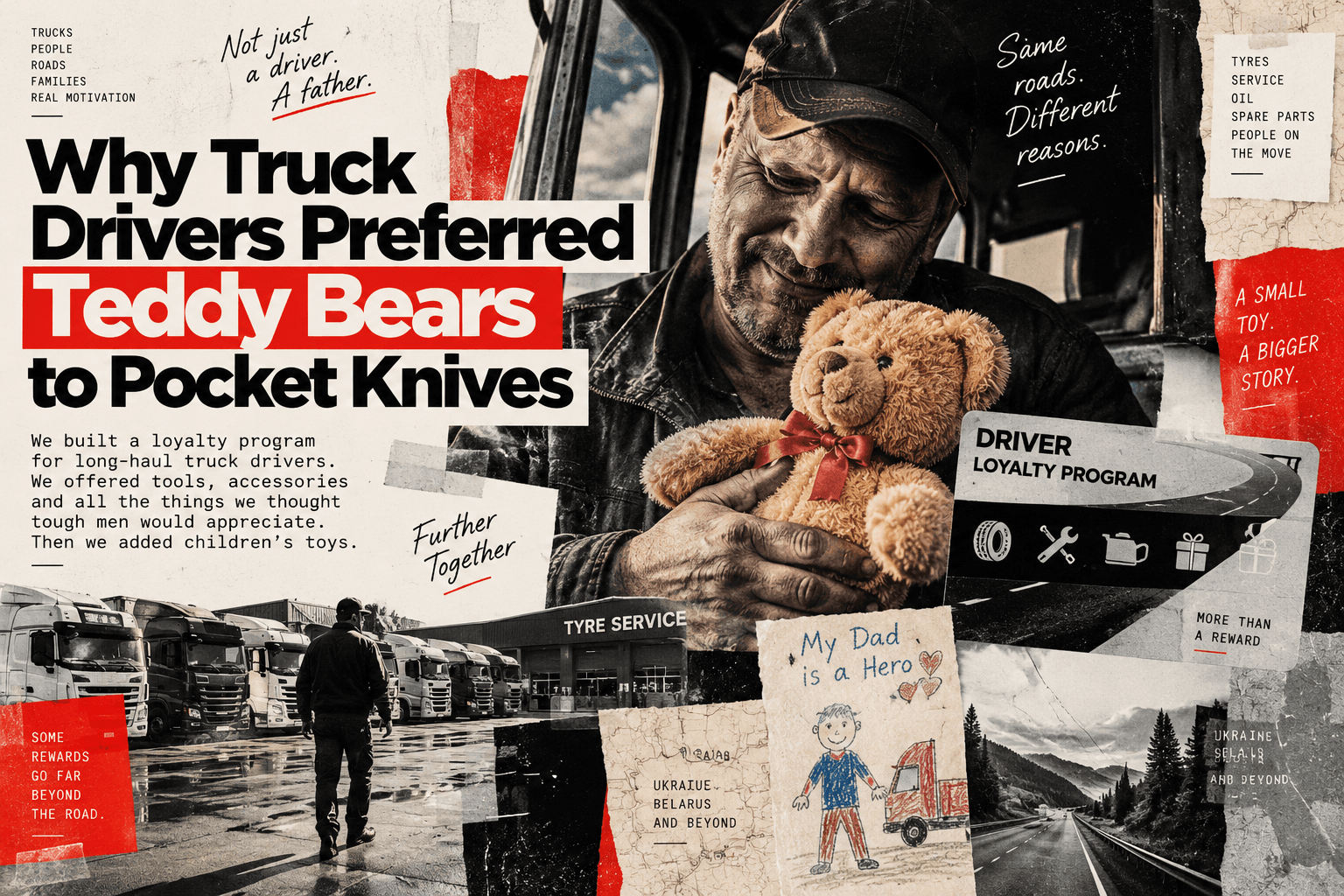
We built a loyalty program for long-haul truck drivers. We offered them tools, accessories and all the things we thought tough men would appreciate. Then we added children's toys.
I once ran a loyalty program for long-haul truck drivers.
These were people who spent much of their lives on the road, driving enormous vehicles across countries, dealing with breakdowns, unpredictable weather, delivery schedules and the general pleasures of commercial transportation.
We thought we understood what they might appreciate.
Useful tools.
Good pocket knives.
Thermos flasks.
Blankets.
Car accessories.
Perhaps some branded merchandise.
And we weren't entirely wrong. People liked those things.
But eventually, we added something that seemed almost ridiculous in the context of a truck-service loyalty program.
Plush toys.
Teddy bears and other children's toys.
And they turned out to be the most successful rewards we had ever offered.
It took us a while to understand why.
A business built around keeping trucks moving
At the time, I was vice president of marketing for a company distributing premium commercial tyres and developing a broader service ecosystem for transport businesses.
Our customers operated trucks, buses and other commercial vehicles.
The business was much larger than simply selling tyres.
We had a growing network of tyre-service stations across Ukraine and neighbouring markets, along with oil-change services, spare parts and other products needed to keep commercial fleets operating.
The larger idea was to help transport companies manage a substantial part of their vehicle maintenance needs through one service ecosystem.
Our customers fell into two broad categories.
The first consisted of large logistics companies and industrial businesses operating substantial vehicle fleets.
The second was made up of smaller transport operators, sometimes with only one, two or five trucks.
These customers had different purchasing processes, but ultimately faced many of the same practical problems.
A commercial vehicle that isn't moving isn't making money.
Tyres wear out. Something breaks. Maintenance needs to happen.
And when it does, somebody needs to decide where the truck goes.
That last detail turned out to be particularly important.
The person signing the contract isn't always the person choosing the service
With large fleet operators, the commercial relationship was relatively straightforward.
You negotiated with management.
You explained the financial advantages.
You agreed on prices, service conditions and other terms.
The company signed a contract.
Then its drivers were instructed to use your service network.
For scheduled maintenance, that worked reasonably well.
A truck needed new tyres, the company had a contract with us, and the driver went to one of our stations.
But scheduled maintenance was only part of the picture.
What happens when a tyre is damaged unexpectedly?
Or when a driver needs an urgent repair somewhere along the route?
There may be several service stations nearby.
One belongs to our network.
Another belongs to a competitor.
A third is a small independent workshop.
The driver may have some discretion about where to go, particularly when the situation is urgent.
And suddenly the person who signed the contract is no longer the only person influencing the purchasing decision.
The driver matters.
We had convinced fleet managers that working with us made financial sense. Now we needed drivers to actually want to visit our stations.
Coffee, lunch and a little respect
Our service network was positioned as premium.
And I wanted the experience to feel premium not just for fleet owners but also for the people driving their vehicles.
At our stations, drivers could have coffee or tea while waiting.
There were biscuits and pastries.
If somebody arrived around lunchtime, we offered a proper hot lunch.
In the evening, there was dinner.
These meals were prepared for our employees and the visiting drivers.
The idea was simple enough.
A driver might spend a considerable amount of time waiting for maintenance or repairs.
Instead of treating him as an inconvenience attached to a truck, why not treat him as a guest?
It wasn't particularly expensive compared with the value of a commercial customer relationship.
And it made the experience more pleasant.
But hospitality alone wasn't enough.
We also wanted to create a reason for drivers to return.
So we introduced a loyalty program.
The catalogue of things men supposedly want
Drivers earned points for eligible tyre changes, repairs and other service transactions.
The points could be exchanged for rewards from a catalogue.
We experimented with the assortment.
There were practical automotive products.
Premium repair kits.
Flasks.
Blankets.
Pocket knives.
Perfumes.
T-shirts.
Key rings.
Branded accessories.
And yes, at one point we even had branded condoms.
We were selling tyres, after all. Someone was inevitably going to make a joke about rubber.
The catalogue was fairly conventional in its understanding of the audience.
Our customers were mostly men.
They spent their working lives with heavy machinery.
They travelled long distances.
So we offered things associated with cars, travel, outdoor activities and the general idea of masculine practicality.
Nothing particularly sophisticated.
But the program worked.
Drivers collected points.
They selected gifts.
They came back.
We experimented with different rewards, trying to understand what people preferred.
Then somebody added children's toys to the catalogue.
And things became interesting.
The toys disappeared
The first batch of plush toys was claimed surprisingly quickly.
We had not expected that.
A soft toy didn't seem like an obvious reward for somebody driving a forty-tonne truck.
We had imagined that our customers would prefer something useful for themselves.
A knife.
A blanket.
A tool.
Something they could keep in the cabin.
But the toys were disappearing faster than expected.
Eventually, we needed more.
The supplier no longer had exactly the same models available, so we introduced different toys.
Those went quickly too.
Then we brought in another assortment.
And the same thing happened.
At some point, it became clear that this wasn't an accident.
We had stumbled onto something much more important than the usual loyalty-program logic.
The drivers weren't necessarily choosing rewards for themselves.
They were choosing rewards for the people waiting for them at home.
The customer had a family
Once we started thinking about it, the explanation seemed embarrassingly obvious.
Long-haul truck drivers can spend days or weeks away from their families.
Some practically live on the road.
They miss birthdays.
They miss ordinary evenings.
They miss the small everyday moments that people working closer to home take for granted.
And when they finally return, they want to bring something back.
Especially for their children.
A plush toy isn't particularly useful to a truck driver.
But it can be extremely valuable to a father who hasn't seen his child for two weeks.
It's something to give.
Something that makes the child happy.
Something that says:
I was away, but I was thinking about you.
A pocket knife might be more expensive.
A thermos might be more practical.
But neither produces quite the same reaction when a small child sees their father coming home with a new toy.
That was the part we had missed.
We were designing a rewards catalogue for the driver's professional identity.
The drivers were making decisions based on their personal lives.
And the personal side turned out to matter more.
Accidentally creating a collection
There was another interesting effect.
Because we kept introducing new toys, the assortment became something resembling a collection.
A driver might already have brought home one toy.
The next time, there was a different one.
And the next time, another.
That created a reason to pay attention to the catalogue.
A blanket is a blanket.
Once you have a good one, you probably don't need another every month.
A child, on the other hand, can be delighted by a new toy even if there are already several at home.
So the rewards became repeatable in a way we hadn't planned.
Drivers could keep collecting points and bringing home different gifts.
The incentive wasn't simply to acquire an object.
It was to repeat a positive experience with their families.
At one point, the enthusiasm became almost comical.
There were situations where drivers seemed extraordinarily eager to find a reason to visit our stations and earn more points.
We joked that soon they would start puncturing their own tyres just to get another toy.
Obviously, that wasn't behaviour we wanted to encourage. A loyalty program should reward legitimate service activity, not create incentives for unnecessary repairs.
But the joke reflected just how unexpectedly attractive the toys had become.
We had introduced one of the least expensive and least technically sophisticated items in the catalogue.
And it had become our strongest reward.
We had been thinking about the wrong person
This is the part of the case I still find most interesting.
We knew who our customers were.
We knew their occupation.
We knew what vehicles they drove.
We knew where they worked.
We knew what services they needed.
We had a fairly detailed understanding of their professional environment.
And yet we had overlooked one of their most important motivations.
Not because it was hidden.
But because we were looking at the customer through the narrow lens of our own business.
We sold tyres and vehicle services.
Therefore, we assumed the rewards should be related to tyres, vehicles and the driver's working life.
It was logical.
It was also incomplete.
The driver wasn't just a driver.
He was somebody's husband.
Somebody's father.
Somebody who had spent a long time away from home and wanted to make his return a little more pleasant.
The toy wasn't really a reward for driving.
It was a reward for coming home.
And that made all the difference.
Two customers, two different reasons to choose us
Looking back, the program illustrates something important about B2B marketing.
There isn't always one customer.
In our case, fleet management had one set of priorities.
Cost.
Reliability.
Tyre performance.
Service coverage.
Vehicle downtime.
Contract conditions.
The driver had another.
Was the station conveniently located?
Would the repair be done properly?
Would he be treated well?
Could he get something to eat while waiting?
And eventually:
Could he bring something nice home to his children?
These weren't necessarily competing priorities.
They were different layers of the same business relationship.
We needed to satisfy both.
A signed contract created the commercial relationship.
A good service experience made the driver comfortable using it.
And a meaningful reward gave him one more reason to prefer our network when he had a legitimate choice.
The important discovery was that meaningful didn't necessarily mean expensive.
It meant emotionally relevant.
Related reading: Dark Gestalt.
Why the obvious rewards lost
There is nothing wrong with giving truck drivers tools, blankets or useful accessories.
Many appreciated them.
But those rewards were based on a demographic stereotype.
Male.
Truck driver.
Heavy machinery.
Therefore: pocket knife.
It's not an unreasonable assumption.
It's just not a particularly insightful one.
The plush toys worked because they connected to a different part of the customer's life.
And that connection was stronger than we expected.
I didn't have a sophisticated psychological framework for the discovery at the time.
We were experimenting, looking at what happened and adjusting the catalogue.
The evidence was practical.
The toys kept disappearing.
New toys kept attracting interest.
The pattern repeated.
We didn't need another presentation about consumer personas.
The customers had already told us what mattered through their choices.
We just needed to notice.
The best reward isn't always for the customer
I still think about this experiment when designing customer experiences and loyalty programs.
Companies tend to reward people based on the role in which they encounter the company.
Business travellers get travel accessories.
Drivers get automotive products.
Office workers get office gadgets.
Technology enthusiasts get electronics.
Sometimes that works perfectly well.
But people don't stop being human when they enter a professional relationship.
Their motivations extend far beyond the transaction.
They have families.
Interests.
Obligations.
Things they miss.
People they want to make happy.
And sometimes the most valuable reward isn't something they want to own.
It's something they want to give away.
That is what happened in our tyre-service network.
We had premium tyres, a wide service network, good coffee, hot meals and a perfectly respectable loyalty catalogue.
All useful.
But the thing that made the biggest impression was a collection of inexpensive children's toys.
Not because our drivers suddenly became interested in plush animals.
Because they were interested in their children.
We thought we were rewarding truck drivers.
We were actually giving fathers something to bring home.
And it took a teddy bear to teach us the difference.