
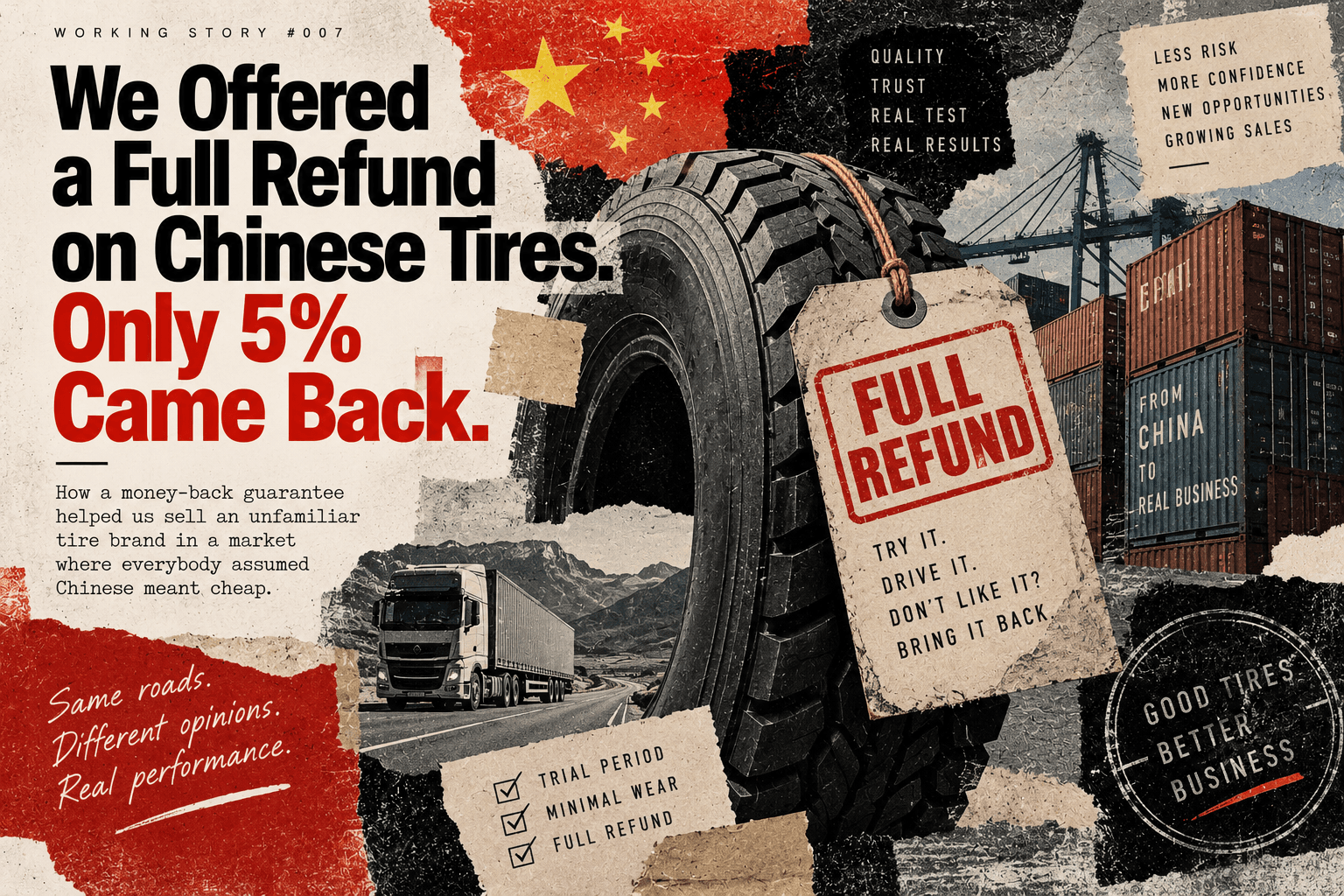
How a money-back guarantee helped us sell an unfamiliar tire brand in a market where everybody assumed Chinese meant cheap.
There's a particularly unpleasant problem in sales.
You have a good product.
You know it's good.
Your supplier knows it's good.
Your testing suggests it's good.
Unfortunately, the customer has absolutely no reason to believe any of you.
This was precisely our situation when we introduced a new Chinese commercial tire brand into our distribution business.
At the time, Chinese tires were largely associated with the budget segment.
There were different manufacturers and very different quality levels, of course.
But the market tended to put them all into one category.
Chinese tires.
Cheap.
Probably not particularly durable.
And definitely not something you should pay a premium for.
Our product didn't fit that stereotype.
It was a relatively high-quality commercial tire, originally intended for China's domestic market.
And it cost more than many of the Chinese alternatives already available.
Which created a delightful marketing challenge.
How do you convince somebody to pay more for an unfamiliar Chinese tire when your competitors sell familiar Chinese tires for considerably less?
We eventually found an answer.
We offered to take it back.
For almost any reason.
A Chinese tire that wasn't supposed to be cheap
By that stage, our business had expanded well beyond premium Japanese tires.
We needed products for different types of transport operators.
Large fleets.
Mid-sized logistics businesses.
Independent carriers with a handful of trucks.
And we had developed service networks for several price segments.
The budget and middle-market categories were particularly interesting because they gave us access to customers who would never have considered purchasing our most expensive products.
But I didn't want to sell the cheapest possible tire simply because somebody was looking for a low price.
We still had a reputation to protect.
And we were developing service guarantees and other customer-protection programs that would become very expensive if the products were unreliable.
So product quality mattered.
We eventually found a Chinese commercial tire that appeared to offer an attractive balance between performance and cost.
The product had an unusual distribution history.
According to the supply arrangements we were working with, it was primarily intended for China's domestic commercial and public-transport markets.
An intermediary in the United Arab Emirates had access to surplus volumes, and we arranged to purchase available stock through that channel.
The brand was largely unfamiliar to our customers.
But the product looked promising, and we believed it could compete with more expensive alternatives.
There was just one small problem.
Nobody wanted to buy it.
The customer was buying a reputation
The sales objection was predictable.
A customer would examine our tire.
Look at the price.
Then compare it with another Chinese tire offered by a competitor.
"Why should I pay fifty percent more for yours?"
Our salespeople could explain the construction.
Discuss the quality.
Describe the intended market.
Present the product's characteristics.
But none of that solved the fundamental problem.
For the customer, an unfamiliar Chinese tire was an unfamiliar Chinese tire.
The cheaper alternative already fitted their expectations.
Our more expensive product required them to take a risk.
What if our claims were wrong?
What if the tire wore out quickly?
What if it performed badly?
What if the customer paid more and got exactly the same result?
The potential upside was uncertain.
The additional cost was immediate.
And because our brand wasn't yet established in that category, we had very little market reputation to support the argument.
So I suggested doing something rather aggressive.
Let's take the risk away from the customer.
Three months. Five percent wear. Full refund.
The proposal was simple.
Buy our tire.
Use it.
Test it on your vehicle.
See how it performs under your actual operating conditions.
And if you don't like it, return it.
We offered a full money-back guarantee within a trial period of up to three months, provided the tire had not exceeded approximately five percent tread wear.
No complicated explanation required.
The customer didn't need to prove a manufacturing defect.
They didn't need to produce a technical report.
They didn't need to convince us that the tire was objectively bad.
If they were dissatisfied and met the return conditions, we would accept it.
We would even handle the removal without charging for that work.
If necessary, we could reinstall the customer's previous tires or fit another product they preferred.
And we would refund the purchase price of the returned tire.
This wasn't an ordinary warranty against manufacturing defects.
It was a promise:
Try it. If you don't like it, you can have your money back.
For a commercial truck tire, that was a substantial offer.
Management thought I was mad
The initial reaction from management was understandable.
Why would we allow customers to use expensive tires for two months and then return them?
Somebody could buy a set.
Drive thousands of kilometers.
Come back before the deadline.
Demand a refund.
And effectively enjoy free tire use.
We would be left with used products, servicing costs and no revenue.
Excellent business model, if your objective is to go bankrupt as creatively as possible.
The concern wasn't unreasonable.
There was a real possibility of abuse.
But I was looking at the problem from another direction.
At the time, the tires weren't selling.
We had a product we believed in, but customers weren't willing to take the risk of trying it.
The cost of doing nothing wasn't zero.
Inventory tied up money.
Slow sales created problems.
And without actual customers using the tires, building a market reputation would take much longer.
So I wanted to test a different assumption.
What if most customers who bought a genuinely good product would prefer to keep it?
What if the guarantee generated enough confidence to overcome the initial objection?
The only way to know was to try.
The guarantee did the selling
We introduced the offer.
And customers started buying.
This time, the salesperson didn't need to win an argument about whether an unfamiliar Chinese tire was worth the additional money.
They could explain the product.
Then explain the guarantee.
The customer's decision became much easier.
They didn't have to believe our entire presentation.
They could test the tire themselves.
And they knew there was a clear way out if it failed to meet their expectations.
That was the breakthrough.
The guarantee didn't make the tire physically better.
It made the purchasing decision less risky.
And in a category where customers were suspicious of unfamiliar products, that was enough to change the conversation.
What about the people returning tires after two months?
That was the question everybody wanted answered.
Would customers abuse the system?
Would we become a free tire-rental business?
Would the returns destroy the economics?
There were returns, naturally.
Not everybody liked the product.
Some customers took advantage of the opportunity to try it and decided against keeping it.
But the return volume turned out to be far smaller than management had feared.
Approximately five percent of purchases were returned.
That is the figure I remember from the period.
The other roughly 95 percent stayed with customers.
It doesn't prove that every tire performed perfectly, and without the original financial records I wouldn't claim a precise return on investment for the program.
But commercially, the result was clear enough.
The offer overcame the initial resistance.
Sales increased.
And the guarantee became an established part of how we sold that product.
Eventually, demand grew enough that the supply available through our original arrangements was no longer sufficient for our ambitions.
We began adding other Chinese tire products to the assortment.
The experiment had helped establish a category that had previously been difficult for us to sell.
Why the five percent mattered
There's a psychological asymmetry in this story.
Before the guarantee, the customer imagined everything that might go wrong.
The tire might fail.
It might wear out too quickly.
It might be disappointing.
And the customer would have paid extra for the privilege.
After the guarantee, the customer could imagine a different outcome.
Perhaps the tire would be excellent.
And if it wasn't, they could return it under the agreed conditions.
The physical product hadn't changed.
The risk had.
We were effectively telling customers:
"We believe in this product strongly enough to accept the consequences if you don't."
That message carried more weight than another quality certificate or another enthusiastic salesperson.
Because now the company had something at stake.
A claim about quality is cheap.
A guarantee that costs you money when you're wrong is considerably more convincing.
The difference between a warranty and confidence
Companies often treat warranties as legal obligations.
Something to describe in small print.
Something the customer is unlikely to read until there's a problem.
We treated this guarantee as part of the product's commercial value.
It wasn't hidden.
It wasn't an inconvenient afterthought.
It was central to the offer.
And I think that distinction explains much of the result.
A technical warranty says:
"If something goes wrong under the specified conditions, we will follow the warranty procedure."
Our offer said something much more direct:
"Use the product. Decide for yourself."
That gave the customer a feeling of control.
They didn't need to rely entirely on our claims.
The final judgement belonged to them.
We didn't sell a better argument
This is what I remember most clearly about the project.
We initially tried to sell the tire through conventional product arguments.
Quality.
Construction.
Performance.
Intended use.
Price-to-performance ratio.
All perfectly reasonable.
But those arguments required customers to believe information they couldn't easily verify before purchase.
The money-back guarantee changed the structure of the decision.
We no longer needed to persuade customers that the product was definitely better.
We needed to persuade them that trying it was reasonable.
That's a much smaller psychological step.
And once customers actually used the product, its performance could do much of the remaining work.
Sometimes the best marketing expense is the one you expect to pay
Looking back, I think management's concern was focused on a visible risk.
Returns would cost money.
Returned tires would require handling.
Some customers might exploit the arrangement.
Those were concrete, measurable potential losses.
But there was another risk that was much easier to ignore.
Customers might never try the product at all.
And that was already happening.
We were so concerned about losing money on returns that we risked continuing to lose sales without learning anything.
The guarantee changed that balance.
We accepted a limited, measurable risk in exchange for an opportunity to build demand and product credibility.
It wasn't a universally applicable strategy. You need a good product, a sensible return window, enough margin and a way to manage returned inventory.
An unconditional guarantee on a product that frequently fails would be financial suicide.
But when the underlying product is sound and the main barrier is customer uncertainty, shifting some risk from the buyer to the seller can be remarkably effective.
For us, the experiment worked.
Customers began buying.
Only a relatively small proportion returned their tires.
And the offer remained in place.
We had started with a product that was difficult to sell because customers didn't trust an unfamiliar name.
We finished with a product customers were willing to try because they no longer had to trust our words alone.
We didn't convince customers that the risk was imaginary.
We made that risk our problem instead of theirs.