
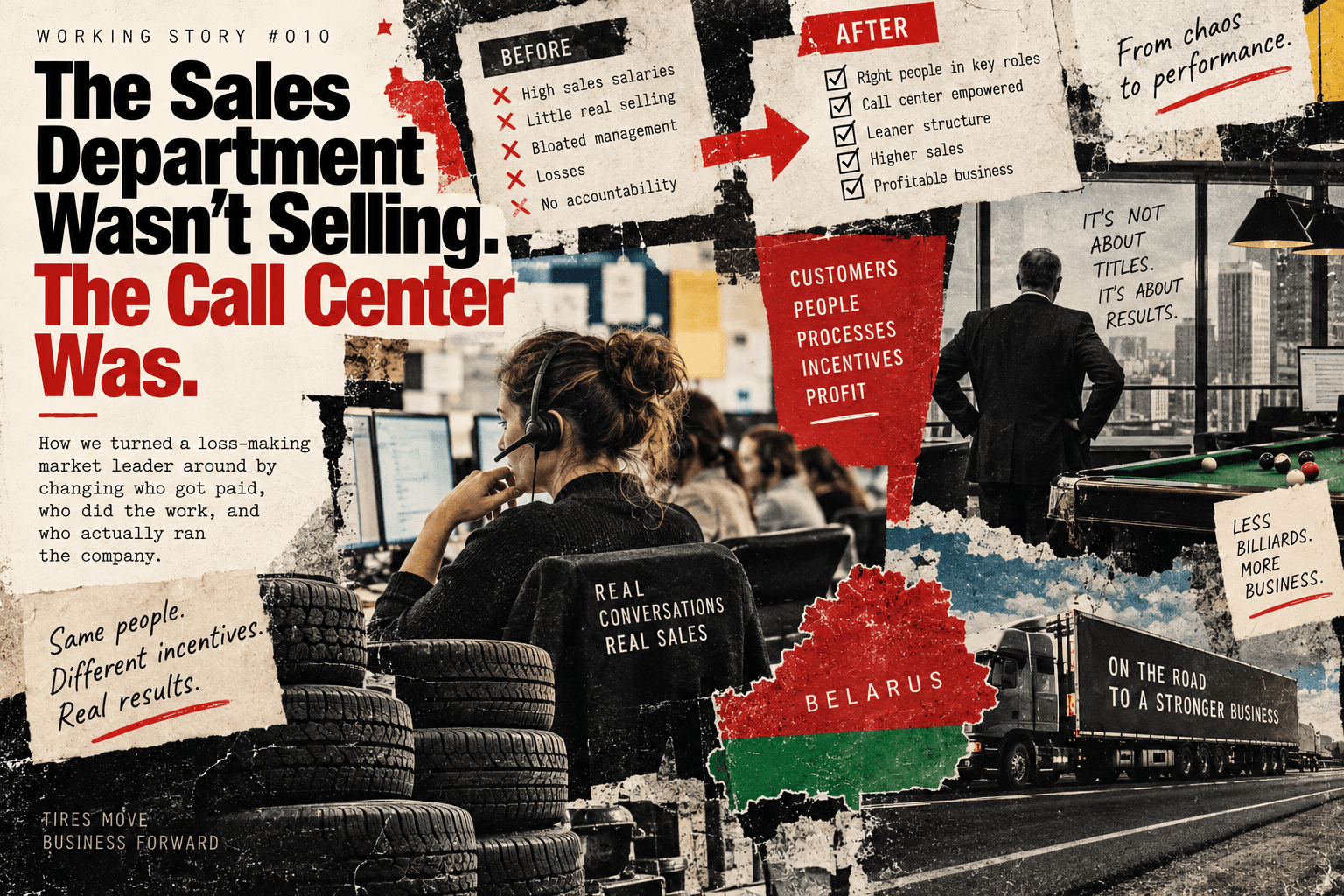
How I turned around a loss-making market leader by changing who got paid, who did the work, and who actually ran the company.
Imagine a company that dominates its market.
Almost every major customer already buys from it.
The competition is relatively weak.
Sales volumes are substantial.
The business has established brands, distribution infrastructure, service stations and long-standing customer relationships.
And yet, somehow, it's losing money.
Not catastrophically.
Just steadily.
Month after month.
Which is almost more irritating, because there's no obvious disaster to explain it.
This was the situation I encountered when I was sent to Belarus on a crisis-management assignment around 2007–2010.
The company distributed commercial truck tires and operated a network of service stations.
It was also where our entire international holding had originally started.
The business had grown in Belarus before expanding into Ukraine and Russia. The founders eventually moved the group's main management functions to Kyiv, where the much larger Ukrainian market offered more room for growth.
Belarus continued operating.
For years, it generated profits.
Then it stopped.
The market position remained strong. Customers were still there. The business was still running.
But the profit had disappeared.
My job was to find out where it had gone.
Everyone was working. Apparently.
When I arrived, I wasn't initially introduced as the person responsible for restructuring the business.
I was presented as someone from the central office who wanted to observe operations.
I asked to sit with the sales department.
The Belarusian headquarters wasn't particularly large. It occupied an office connected to one of our commercial tire-service facilities near Minsk.
You entered through a reception and service counter.
Behind it sat approximately five people handling customer inquiries.
They answered phones.
Processed orders.
Responded to emails.
Coordinated repairs.
Arranged tire deliveries.
Prepared documents.
Reminded customers about payments.
And dealt with people arriving directly at the service station.
They were constantly busy.
Phones ringing.
People talking.
Documents moving.
Someone needed a particular tire. Someone else wanted a repair. Another customer had a question about an order.
The place looked like a small airport control tower.
Then there was the sales department.
A separate open-plan office with several desks.
I sat there for a while.
And discovered something interesting.
There were almost no salespeople in the sales department.
The salespeople had excellent cars
The sales team usually appeared in the morning.
They drank coffee, chatted, smoked, discussed something and left.
According to the official explanation, they were visiting customers.
Perhaps they were.
But it was difficult to understand what required so many visits.
The company already supplied practically every major commercial fleet in its market.
The relationships had existed for years.
Contracts were established.
The customers knew the products.
The service network was familiar.
Most operational communication happened directly through customer service.
Nevertheless, the salespeople had comfortable jobs.
Good cars.
High salaries by local standards.
And, more importantly, substantial commissions from the purchases made by customers assigned to them.
In the evenings, they frequently returned to the office around the same time.
More coffee.
More conversation.
And at least once a week, the department seemed to have an important appointment with a billiards table.
I'm not against billiards.
I'm not even against drinking coffee during working hours.
I am, however, interested in the relationship between what somebody is paid to do and what they actually contribute.
And that relationship was becoming increasingly difficult to see.
The company had finished growing. The compensation system hadn't noticed.
Eventually, I understood the underlying problem.
Years earlier, the sales department had been genuinely valuable.
The company was expanding.
Salespeople were acquiring customers.
They were introducing a premium product to a new market.
They were building relationships.
And commissions made perfect sense.
But the company had grown to the point where almost every major potential customer was already buying from us.
There were still opportunities.
Smaller transport operators.
Additional products.
Competitors' residual customers.
Increasing the share of purchases from existing accounts.
But those opportunities required a different kind of work.
The sales department wasn't particularly interested in that work.
Instead, its members continued collecting commissions from accounts they had acquired years earlier.
The customers kept buying.
The customer-service department processed the orders.
And the original salesperson received a percentage.
We were paying commissions for the historical achievement of having found a customer, not for generating additional business today.
It was a perfectly reasonable compensation model that had outlived the conditions that made it reasonable.
And nobody had changed it.
The billiards tournament
For approximately the first week, I mostly watched and listened.
Then my actual role became more widely understood.
I was not just a visiting marketing specialist.
I represented the group's central management and had considerably broader authority than the local organisation initially assumed.
The atmosphere changed.
People suddenly became unusually friendly.
The sales department invited me to play billiards.
I agreed.
I'm not particularly good at billiards.
I can play, but nobody is going to confuse me with a professional.
Which made the following experience rather amusing.
I started winning.
Repeatedly.
People who were clearly more experienced than me suddenly seemed to have difficulty making relatively simple shots.
There was much smiling and encouragement.
Everybody was having a wonderful time.
Except that I could see what was happening.
They were letting me win.
I suppose the intention was to make a favourable impression on the representative from headquarters.
Unfortunately, it had the opposite effect.
I don't mind losing at billiards.
But I do become suspicious when people assume that allowing me to win is a useful substitute for demonstrating professional competence.
The problem extended far beyond sales
As I examined the company's operations, I noticed the same pattern elsewhere.
There was a senior financial executive who had been with the business for years.
A substantial salary.
An established position.
Considerable authority.
But much of the actual financial work was being performed by younger accounting specialists.
The technical department had a similar structure.
An elderly director who had been part of the company almost since its foundation.
Very reliable attendance.
Always present.
But when something genuinely needed solving, everyone went to his deputy.
The deputy was energetic, competent and constantly occupied.
He understood the equipment, the facilities and the practical problems.
He was the person people trusted to get things done.
Yet he was paid considerably less than the person above him.
The local managing director presented another challenge.
He had a large, rather grand office.
I've always found excessively impressive executive offices interesting.
Sometimes they communicate success.
Sometimes they communicate the amount of effort someone invests in appearing successful.
Shortly after my arrival, the director went on sick leave.
The timing was unfortunate, particularly given the questions I was beginning to ask.
But the larger problem was already becoming clear.
The organisation had developed a layer of senior positions that no longer corresponded to the work being performed.
The company had grown under its original leadership.
Then the owners moved away.
The local management structure remained.
And over time, the distinction between authority, compensation and actual contribution became increasingly distorted.
The people doing the work were the cheapest people in the building
The contrast was almost absurd.
The customer-service employees handled a huge proportion of the daily commercial workload.
They spoke to customers.
Accepted orders.
Coordinated service.
Prepared documentation.
Maintained ongoing contact.
And helped keep the company's revenue flowing.
Yet they earned relatively modest fixed salaries.
No meaningful participation in the commercial results.
No substantial commissions.
Meanwhile, salespeople who were rarely involved in actual order processing continued receiving generous commissions.
The difference wasn't subtle.
It was built into the company's compensation system.
I began to suspect that the problem wasn't simply excessive spending.
The company was paying the wrong people for the wrong activities.
And the most productive employees had relatively little financial incentive to improve the business further.
Why I didn't simply fire the sales department
The obvious solution was to eliminate unnecessary positions.
And, frankly, I believed much of the sales department had become unnecessary.
But there was a complication.
The salespeople had long-standing relationships with major customers.
They claimed those relationships were essential.
If we removed them, they warned, customers would leave.
I wasn't convinced.
Our customers had commercial reasons to work with us.
We offered competitive products, established service infrastructure and a nationwide network.
A fleet operator wasn't necessarily going to abandon those advantages because a particular salesperson stopped visiting.
But I couldn't simply assume the relationships were worthless.
And I didn't want to risk the revenue of a profitable customer portfolio just to demonstrate that I was right.
Some large customers even contacted the company to express concern about possible changes.
So I needed to separate two things.
The genuine commercial value of these relationships.
And the personal claims salespeople made about owning them.
Rather than immediately dismissing the department, I changed the incentive system.
The last survivor
I designed something resembling a professional version of a survival competition.
The old model rewarded salespeople for purchases made by their existing accounts.
The new model focused on incremental commercial contribution.
Bring in new customers.
Increase recurring purchases from existing customers.
Sell additional services.
Expand the company's share of a customer's tire and maintenance spending.
In other words, do something that produces new business.
Simply receiving another routine order from a customer who had been purchasing from us for five years would no longer justify the same level of reward.
The existing salespeople were given a transition period and performance targets.
The team would gradually become smaller, with account portfolios redistributed as positions were eliminated.
Smaller accounts could be handled directly by customer service.
The remaining salespeople would focus on the largest and most demanding commercial relationships.
I also wanted to avoid a particular form of gaming.
A salesperson could persuade a friendly customer to bring forward several months of purchases.
That might make one month look wonderful.
But the next month would be empty.
So we needed to evaluate sustained improvement rather than a single impressive transaction.
The objective was not a one-time increase in reported sales.
It was a measurable improvement in the business.
Looking back, the competitive structure was deliberately severe. I wouldn't treat an elimination contest as a universal management technique, particularly given the stress and incentives it can create.
But the underlying principle remains valid.
If you pay people for growth, measure actual growth. Not the existence of customers acquired years ago.
Meanwhile, I was building another sales operation
I didn't rely on changing commissions alone.
Because I had another problem.
What if the sales department really did leave?
Could customer service absorb the workload?
The existing customer-service team was already overloaded.
And removing salespeople might increase the number of customers contacting it directly.
So I started preparing additional capacity.
I rented an apartment.
Not for myself.
For a small temporary office.
I took one experienced employee from customer service and assigned that person to help train several new recruits there.
Meanwhile, we hired additional trainees for the main customer-service department.
We equipped the temporary office with laptops and communications tools.
The new people learned the products, customers, service procedures and ordering processes.
They also began making proactive calls.
Not just responding when customers wanted something.
Actually contacting existing accounts.
Checking whether they were satisfied.
Understanding their purchasing patterns.
Finding out whether they were buying competing products.
And discovering whether they needed anything we weren't currently supplying.
This was useful for two reasons.
First, it created additional operating capacity.
Second, it allowed us to test how dependent customers really were on their assigned sales representatives.
The results were reassuring.
Many customers had far more frequent and useful interactions with customer service than with the sales department.
They already knew the people who processed their orders.
They already trusted the technical teams.
They already had established relationships with the company itself.
The salesperson was often much less central to that relationship than everyone had assumed.
I started paying the people who actually sold things
At the same time, I changed customer-service compensation.
The employees received modest increases in their fixed salaries.
More importantly, I introduced a variable component linked to the company's sales.
Not the generous individual account commissions previously paid to sales representatives.
A much smaller shared percentage.
But it meant the employees now had a direct financial interest in the company's commercial performance.
They could benefit when the business grew.
And unlike the old sales structure, their work was directly connected to everyday transactions and customer service.
The effect was encouraging.
The team became more commercially proactive.
There was an obvious reason to process requests efficiently, maintain customer relationships and look for additional opportunities.
We had stopped treating customer service as merely an administrative cost.
It was one of the company's principal commercial functions.
The entire sales department resigned
I had expected the transition to take longer.
Instead, approximately three months into the process, the remaining sales team decided to leave together.
As I understood it, they expected that losing the entire department would create a serious problem for the business.
It might have done.
Three months earlier.
But by then we had already strengthened customer service, trained additional people and established alternative processes for handling customers.
The temporary office had helped us prepare for exactly this type of disruption.
So when the salespeople announced their decision, we accepted it.
And the business continued operating.
The important thing wasn't that I had somehow outsmarted a group of employees.
It was that we had tested an assumption.
We had assumed the customer relationships belonged to the individual salespeople.
In practice, much of their commercial value belonged to the company's products, services, infrastructure and operational relationships.
Once those functions were properly supported, the business was far less dependent on the old sales structure than anyone had believed.
Then we changed the management team
The restructuring didn't stop with sales.
We also replaced several senior management positions.
The technical deputy who had been doing much of the actual work was promoted to lead the department.
His salary increased substantially.
But the total cost was still lower than maintaining both the previous director and deputy positions.
The same principle applied in finance.
A capable younger specialist who had already been carrying much of the responsibility received a promotion and a meaningful salary increase.
The expensive senior position above her was eliminated.
And the manager of customer service, the department that had turned out to be central to the company's daily commercial activity, was promoted to managing director.
That was probably one of the more important decisions.
Instead of appointing somebody whose primary qualification was long service and executive status, we promoted someone who understood the customers, the employees and the processes that generated revenue.
The business no longer needed a ceremonial leadership structure.
It needed people who could run it.
Naturally, not everyone was delighted
I won't pretend this was a pleasant restructuring.
People lost jobs.
Some had worked at the company since its earliest years.
Some had helped build the business when it was growing.
That history mattered.
But past contributions did not automatically make every existing role necessary forever.
There were disputes and complaints.
Former senior employees challenged some of the changes and raised concerns with outside authorities.
The company faced inquiries and administrative pressure.
This was happening while we were also implementing the broader organisational restructuring described in my previous Belarusian case, where we separated parts of the business into smaller operating units.
That created additional complexity.
The company needed to maintain lawful operations, proper records and continuity while changing its internal structure.
There were difficult moments.
But the operational reforms continued.
I wouldn't romanticise that part of the experience.
A turnaround involving longstanding employees, contested dismissals and regulatory attention carries real human and organisational costs.
It is much easier to describe such decisions years later than to implement them while people are angry and the business still has to operate every morning.
And the company became profitable
The result was significant.
The payroll burden fell substantially.
Several expensive management positions disappeared.
The sales department's old commission structure was eliminated.
The employees responsible for much of the real work received better compensation and greater authority.
Customer service gained capacity and a commercial incentive to improve performance.
The company also reduced problems associated with opaque management practices and suspected conflicts of interest.
And sales increased.
That last point matters.
We didn't simply cut expenses until the financial statements looked better.
The remaining organisation became more commercially effective.
Customer relationships were maintained.
Additional opportunities were identified.
The employees doing the work were better motivated.
The business began operating more efficiently.
And the Belarusian company returned to profitability.
I don't have the historical financial statements available to give you a precise percentage improvement, so I won't invent one.
But the turnaround was real.
A business that had been losing money despite its dominant market position was generating profits again.
Without a new product.
Without entering a new market.
Without a major advertising campaign.
And without needing to increase the size of the organisation.
We had primarily changed how the existing business worked.
The company had become a museum of its own success
Looking back, I think that was the underlying problem.
The Belarusian business had been extremely successful during its growth years.
Its original team had built the company.
They had acquired customers.
Established the network.
Created commercial relationships.
And made the expansion into other countries possible.
That success had also created a particular organisational structure.
A sales department designed to acquire customers.
A management hierarchy developed during the company's early growth.
Compensation systems reflecting the importance of those roles at the time.
But the market had changed.
The company was no longer fighting to acquire every major fleet operator.
It had already acquired most of them.
The main task was now to serve customers efficiently, expand the value of existing relationships and control costs.
The organisation hadn't adapted.
It was still paying for the business it used to be.
The company had become a museum of its own earlier success.
And museums, however interesting, are rarely efficient commercial organisations.
Sometimes the most valuable employees have the least impressive titles
The most important lesson I took from this project wasn't that companies should fire their sales departments.
That would be a rather dangerous generalisation.
Many businesses depend on excellent salespeople, including people who maintain valuable customer relationships over many years.
Nor was it that senior executives become useless simply because they've been in a company for a long time.
The lesson was about the relationship between formal structure and actual contribution.
Who really solves the problems?
Who speaks to customers?
Who knows what is happening?
Who makes the decisions that keep the business functioning?
And who is being rewarded because of something they achieved many years ago?
Those questions can produce uncomfortable answers.
In our company, some of the most valuable people occupied relatively modest positions.
The customer-service team.
The technical deputy.
The younger finance specialists.
They weren't the people with the grandest offices or the most impressive job titles.
But they were the people who knew how the business actually worked.
Once we gave them more responsibility and a fairer share of the financial rewards, we needed much less of the old hierarchy.
The best turnaround doesn't always need a growth strategy
Business consultants love growth strategies.
New markets.
New products.
New channels.
New technologies.
New organisational charts.
Preferably all of them at once, supported by an expensive presentation.
Sometimes that is necessary.
But sometimes the company already has enough customers.
Enough products.
Enough market share.
Enough infrastructure.
And more than enough people.
The problem is that its resources are distributed according to an organisational model that no longer makes sense.
In Belarus, we didn't need to conquer another market.
We had already conquered most of the one we operated in.
We needed to stop paying for activities that were no longer happening and start rewarding the work that actually created value.
That sounds simple.
It wasn't.
The difficult part wasn't finding the unnecessary expenses in a spreadsheet.
It was recognising that the people who once made the company successful were not necessarily the same people required to operate it successfully today.
And then having to act on that conclusion.
We didn't save the business by teaching everyone to work harder.
We saved it by recognising who was already doing the work and reorganising the company around them.