
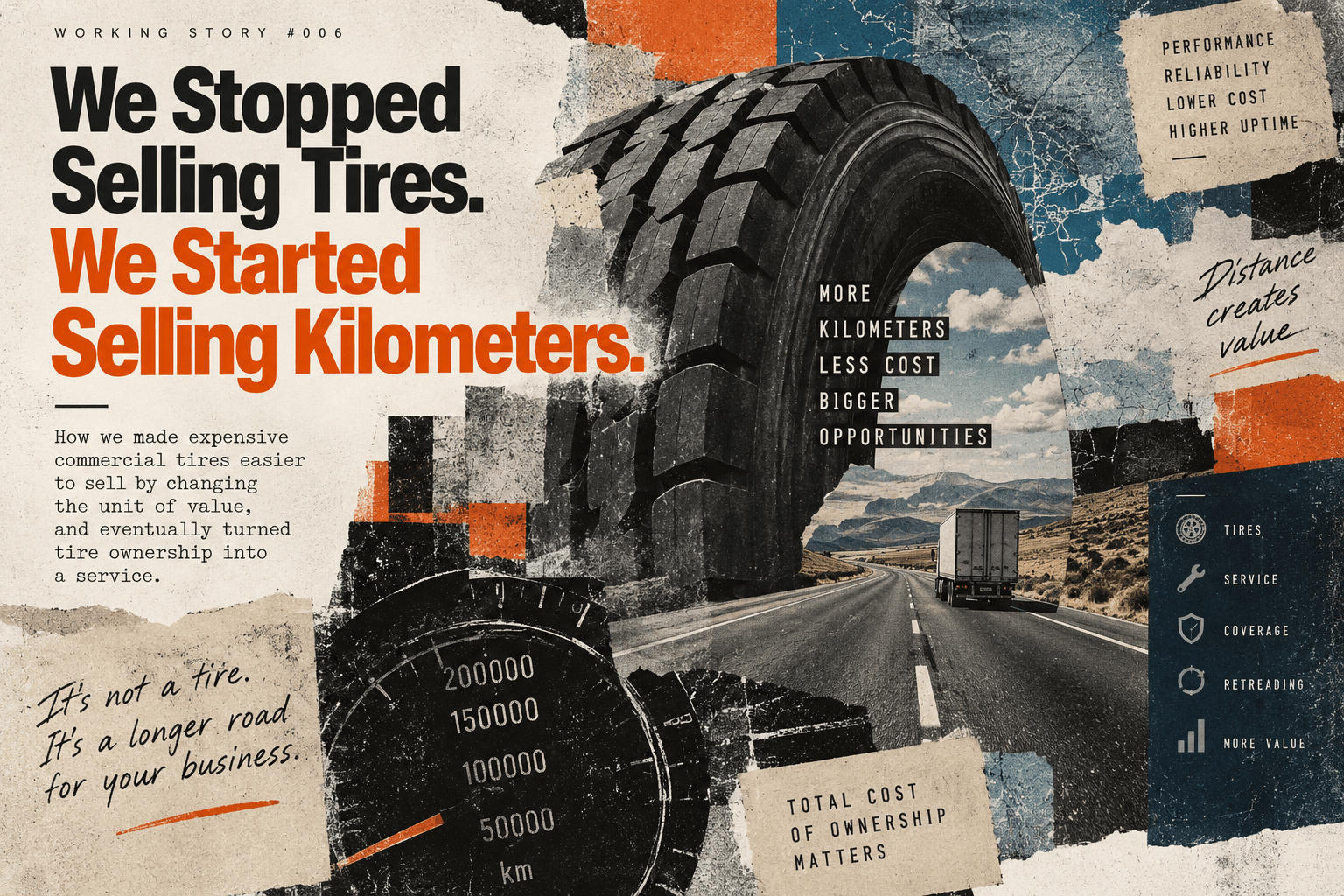
How we made expensive commercial tires easier to sell by changing the unit of value, and eventually turned tire ownership into a service.
A truck tire costing $500 is a difficult thing to sell when somebody can buy another tire for $250.
Now multiply that by six.
That's $3,000 for a basic set of commercial tires, and some vehicles need considerably more.
Then explain to the customer that these things wear out, get punctured, suffer damage and eventually have to be replaced.
Naturally, the customer starts looking for alternatives.
This was a problem I encountered while working as vice president of marketing for a commercial tire distribution business around 2007–2010.
We sold premium Japanese tires to logistics companies, industrial businesses and large vehicle fleets.
The products were excellent.
The prices were excellent too, at least from the manufacturer's perspective.
And customers regularly told us the same thing.
"Great tires. But your competitors are half the price."
Fair enough.
We needed a better answer than another presentation about Japanese quality.
Eventually, we found one.
We stopped selling tires. We started selling kilometers.
The problem with selling expensive things
Commercial tire purchasing looks simple until you start examining the economics.
A fleet manager can compare two quotations.
One tire costs $500.
Another costs $250.
The second appears to be the obvious choice.
Especially when the company needs dozens or hundreds of them.
But a tire is not an office chair. Its economic value doesn't end when somebody pays for it.
It is a component that continuously wears out while generating revenue for the business.
Its useful life is measurable.
And that changes the calculation.
Imagine two tires.
The inexpensive tire costs $250 and lasts 20,000 kilometers.
Its purchase cost is 1.25 cents per kilometer.
Now imagine a $500 tire that lasts 80,000 kilometers.
Its purchase cost is 0.625 cents per kilometer.
The expensive tire costs twice as much to buy but half as much per kilometer.
These are illustrative numbers, not the actual results of our historical tests, but they show the principle.
The cheapest tire to purchase is not necessarily the cheapest tire to use.
That sounds obvious now.
It was considerably less obvious to some customers when we were standing in front of them with a $500 quotation.
We had something better than advertising claims
Fortunately, we had a useful advantage.
Our company operated its own network of commercial tire-service stations.
We sold tires, installed them, repaired them and saw the same vehicles returning for maintenance.
That gave us access to practical information.
When a truck arrived, we could record its odometer reading.
When we changed its tires, we knew approximately when those tires entered service.
When it returned, we could see how far it had travelled.
We also had our own testing experience and observations from different products and operating conditions.
Over time, we accumulated a picture of how different tires performed.
Not just in terms of normal tread wear.
We also considered premature replacement.
A tire might have plenty of tread remaining but become unusable because of damage.
Punctures.
Road debris.
Accidents.
Construction-site hazards.
All the charming things that happen to commercial vehicles while they're earning money.
Some cheaper products performed reasonably well under predictable conditions but became considerably less attractive once real-world failures were included.
Other products lasted substantially longer.
So instead of presenting only tire prices, we began showing customers a different comparison.
Cost per kilometer of actual usable service.
The expensive tire suddenly became cheaper
The effect on sales conversations was substantial.
Instead of saying:
"Our tire is more expensive because it's a premium product."
We could say:
"Let's compare how much it costs you to drive 100,000 kilometers."
That is a much more useful conversation for a transport business.
We showed the customer our operating data, the expected service life of different products and the resulting cost per kilometer.
In some comparisons, our premium tires cost approximately twice as much upfront but worked out to be around three times less expensive per kilometer.
That was a completely different proposition.
The customer no longer had to decide whether the premium brand was worth its impressive price.
They could examine a familiar business metric.
How much does this vehicle cost to operate?
How much does each kilometer cost?
What happens if we have fewer unexpected tire replacements?
And what happens to the budget over the lifetime of the vehicle?
Large fleet operators were particularly receptive.
They had the financial capacity to make a larger initial purchase and benefit from lower operating costs later.
For them, the change in perspective often made the decision considerably easier.
We weren't asking them to pay extra for prestige.
We were showing them why a more expensive component could reduce their operating expenses.
Then we asked a different question
Once we had started selling tires through their cost per kilometer, another idea became possible.
Why sell the tire at all?
A transport company doesn't fundamentally need to own a particular tire.
It needs trucks that can operate reliably.
The tire is simply one of the components required to deliver that outcome.
So we developed a service model for larger fleet customers.
Instead of purchasing individual tires and paying separately for repairs and replacements, the customer could pay an agreed amount per kilometer travelled.
We monitored vehicle mileage.
The customer used our service network under the contract.
We provided the required tires, servicing, repairs and replacements as part of the arrangement.
Naturally, these services weren't economically free. Their expected costs were incorporated into the mileage rate.
But from the customer's perspective, the accounting became much simpler.
Drive a certain number of kilometers.
Pay the corresponding amount.
The responsibility for managing the tire lifecycle increasingly shifted to us.
From unpredictable repairs to predictable costs
This changed the customer's financial problem.
Under traditional purchasing, tire expenses are irregular.
One month, little happens.
The next month, several vehicles need replacements.
A construction vehicle damages a tire.
Another truck returns with a puncture.
A set reaches the end of its service life earlier than expected.
Suddenly, the maintenance budget looks very different from the forecast.
With a mileage-based arrangement, much of that uncertainty could be converted into a predictable operating expense.
The customer knew the agreed rate.
We knew the mileage.
The calculations became straightforward.
For large fleets, this was particularly valuable because it simplified budgeting and reduced the need to manage individual tire-purchasing decisions.
And for us, it created a stronger, longer-term service relationship.
We were no longer competing for every replacement transaction.
We were responsible for delivering a service outcome over time.
Of course, the model also transferred more risk to us.
If we underestimated tire wear, damage or servicing costs, the economics could become unpleasant.
So accurate operating data became even more important.
Which was another reason to keep improving our understanding of real tire performance.
We also started selling protection against surprises
The mileage model wasn't the only way we approached this problem.
We also experimented with service and warranty packages.
One option allowed customers to pay extra when purchasing a tire and receive covered repairs without additional charges.
Another provided broader protection, including replacement under agreed conditions when a tire failed to deliver its expected service life.
The commercial logic was similar.
A customer wasn't simply buying rubber.
They were buying reduced uncertainty.
The question shifted from:
"What happens if this tire fails?"
to:
"What have we already agreed will happen if this tire fails?"
That distinction mattered.
A transport business can tolerate many types of expense if they're predictable.
Unexpected interruptions are much more difficult.
And the ability to offer credible protection became another way to differentiate our products from cheaper alternatives.
The second life of a tire
There was another part of the business that made all of this more interesting.
Retreading.
Commercial tires don't necessarily need to be discarded once their original tread reaches the end of its useful life.
Under suitable conditions, a structurally sound tire casing can be retreaded and used again.
But not every tire is suitable.
Its condition matters.
Its maintenance history matters.
The timing of removal matters.
If a tire is operated until the casing is damaged beyond recovery, the opportunity is lost.
So we became interested in monitoring wear and collecting suitable tires before they reached that point.
The customer could receive a replacement under the applicable arrangement.
The removed casing could be assessed for retreading.
And a successfully retreaded tire could enter a different part of our commercial assortment, including our mid-range and budget service networks.
This created another economic layer.
We weren't necessarily managing a single product with one life.
We were managing a component that might have several commercially useful stages.
And the better we understood its condition, the more value we could potentially recover from it.
That is quite a different business from simply buying tires wholesale and selling them with a margin.
We changed what the customer was buying
Looking back, the most important part of this project wasn't the particular pricing formula.
It was the decision to change the unit in which customers evaluated our offer.
Initially, we sold tires.
A physical product.
A brand.
A specification.
A price.
Then we sold a calculation.
Cost per kilometer.
Then we went further and offered a service directly linked to that calculation.
Kilometers of operation, with tire maintenance included under agreed terms.
And around that, we developed warranties, repair coverage and ways to manage the remaining value of used tires.
Each step moved us further away from a simple product transaction.
The physical tire was still there.
But it was becoming less central to the commercial conversation.
The real question was how economically and reliably the customer's vehicles could operate.
The lesson I kept
I have encountered versions of this problem in many other industries.
Companies become very attached to the products they manufacture or distribute.
They measure success in units.
Boxes.
Bottles.
Licenses.
Machines.
Tires.
But customers are rarely interested in the unit itself.
They're interested in what it allows them to achieve.
In our case, fleet operators didn't wake up in the morning dreaming of owning expensive Japanese tires.
They wanted their trucks moving.
They wanted fewer surprises.
They wanted predictable operating expenses.
And they wanted to make money from transporting goods.
Once we understood that, the sales conversation changed.
The $500 tire stopped looking like an expensive object.
It became one component of a much larger operating calculation.
Eventually, we no longer needed to sell the object separately at all.
We started with a price objection.
We ended up changing the business model.
And it all began with a very simple question:
What if the customer isn't really buying tires?