
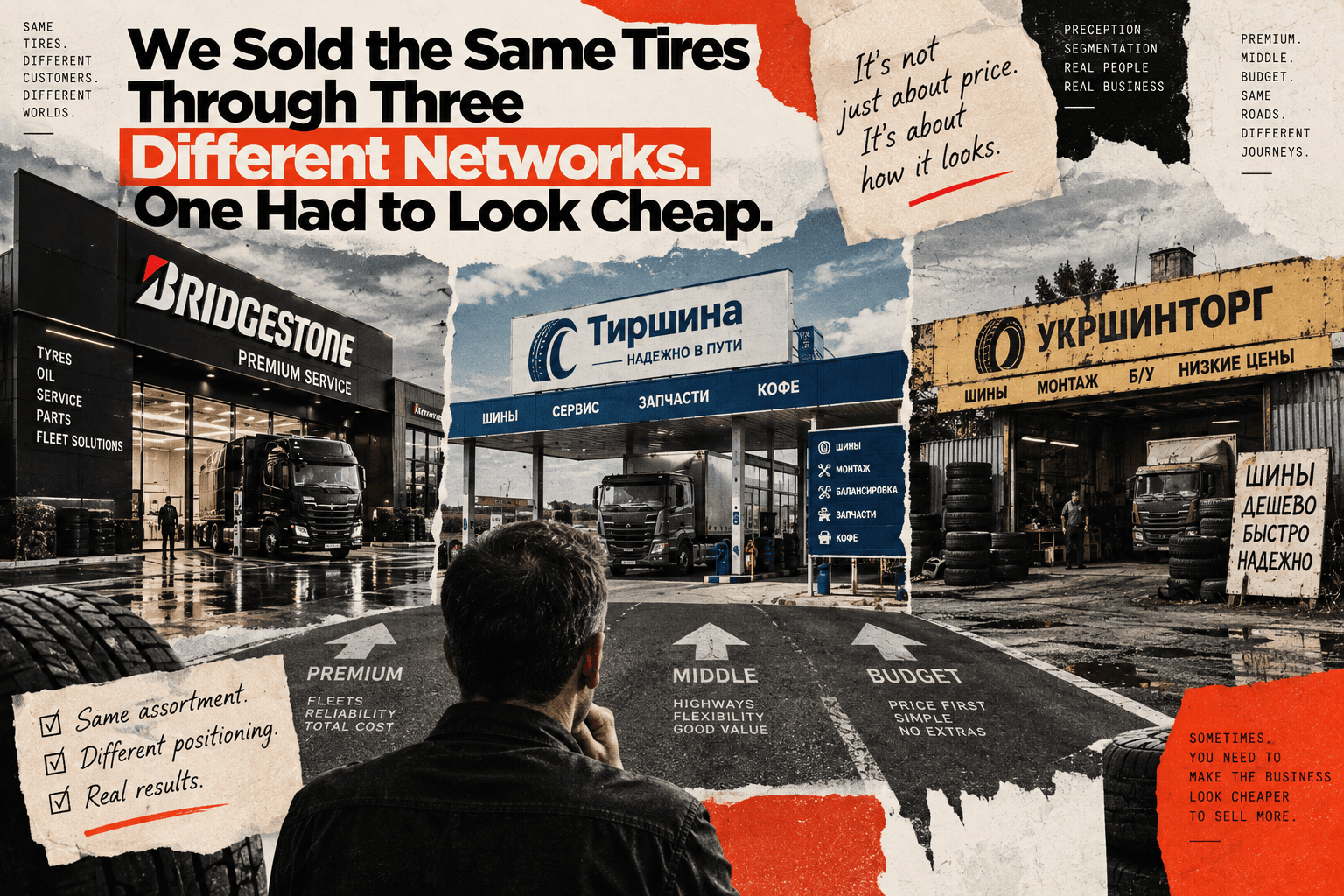
How a premium commercial tire business discovered that looking expensive could be a problem, and why I deliberately created a service network that looked like it belonged in the Soviet Union.
I once walked into a beautiful restaurant in a small Russian town and discovered something rather strange.
It was cheaper than the filthy café next door.
Not slightly cheaper. The difference was noticeable.
The restaurant had marble floors, proper tables, attentive waiters and surprisingly good food.
The café had questionable furniture, a crowd of people eating fairly miserable-looking pastries and the general atmosphere of a place where nobody had invested in interior design since the collapse of the Soviet Union.
Naturally, the café was packed.
The restaurant was almost empty.
I had been waiting for a train and had enough money to eat wherever I wanted, so I chose the restaurant.
Most people didn't.
And I realised why.
The restaurant looked too expensive for the people who could actually afford it.
Related reading: Dark Gestalt, on perceived value and psychological barriers in purchasing decisions.
They never went inside to discover the prices.
That observation eventually became the foundation for one of the more unusual marketing projects I developed while working in the commercial tire industry.
We ended up operating three different service networks for three different customer segments.
All three could sell the same tires.
But they looked, felt and behaved like entirely different businesses.
One was premium.
One was middle-market.
And one was deliberately designed to look cheap.
When premium becomes a limitation
Around 2007–2010, I worked as vice president of marketing for a large commercial tire distributor operating across Ukraine, Belarus and Russia.
The business was originally built around Bridgestone, one of the world's major premium tire manufacturers.
We primarily served commercial transport.
Trucks.
Buses.
Large logistics operators.
Industrial companies with substantial vehicle fleets.
We had developed a service network offering much more than tire sales.
There were tire-fitting and repair stations, oil-change services, spare parts and other maintenance products.
The larger strategy was to cover as many of a fleet operator's vehicle-related expenses as possible through one commercial relationship.
Our original service network was distinctly premium.
The stations looked professional.
The service was good.
Drivers could get free coffee, tea and snacks.
At certain times, they were offered hot meals.
We had loyalty programs, gifts and other incentives.
The entire experience was designed around companies that operated expensive commercial vehicles and understood the economics of premium tires.
Bridgestone tires were among the more expensive products in the market.
But for a large fleet, the purchasing decision wasn't simply about the price of one tire.
It was about durability, mileage, reliability, downtime and the total cost of operating a vehicle.
A more expensive tire could make financial sense if it delivered better performance over its service life.
That was the logic behind our premium positioning.
And it worked.
Perhaps a little too well.
We ran out of room at the top
When the company was younger, selling its allocated Bridgestone volume had been difficult.
By the time the business had developed substantially, the situation had reversed.
Demand was growing faster than the premium tire supply available to our regional operation.
We had production allocations and supply limitations. Premium tire manufacturing was not something we could simply expand locally whenever sales increased.
Meanwhile, the market itself was changing.
More affordable alternatives were becoming increasingly available.
Japanese and Korean manufacturers offered products in different price segments.
Chinese tire producers were becoming more competitive.
There were also inexpensive tires manufactured in Belarus and Russia.
We started expanding the assortment.
Instead of selling only premium Bridgestone products, we could now offer several price and performance categories.
That made commercial sense.
Not every transport operator needed premium tires.
And not every transport operator could afford them.
But we quickly encountered a problem.
We had expanded the product range without expanding the customer's perception of our business.
Our service stations still looked expensive.
Our brand still felt expensive.
And that reputation was keeping an entire category of potential customers away.
A truck owner with two vehicles doesn't think like a fleet director
Large logistics companies and small independent transport operators may use similar trucks.
But their purchasing behaviour can be completely different.
A major fleet operator has procurement procedures, service contracts and people responsible for calculating total operating costs.
A small entrepreneur with two or three trucks is often making decisions much more directly.
Money is tight.
The next repair matters.
The immediate purchase price matters.
A tire that costs significantly less today may be more attractive than a premium alternative with better long-term economics.
Not necessarily because the owner misunderstands the calculation.
Sometimes cash flow simply doesn't allow the theoretically optimal decision.
We wanted to serve those customers too.
We had suitable products.
We had purchasing capabilities.
We had service infrastructure.
But we had a brand problem.
An independent truck owner looking for a budget tire was unlikely to drive into a beautiful premium service station just to find out whether it had anything affordable.
In his mind, the answer was already obvious.
That place is expensive.
He hadn't checked.
He didn't need to.
The building had already told him.
The restaurant that explained everything
This is where my experience at that railway station became useful.
The expensive-looking restaurant had created an invisible barrier.
The people eating at the shabby café were making an assumption about prices based on appearance.
They weren't comparing menus.
They weren't checking the actual cost of lunch.
They were comparing visual signals.
Marble floors meant expensive.
Plastic tables meant cheap.
And that assumption was strong enough to influence where they went.
Even when the actual prices contradicted it.
Our premium tire stations were doing something similar.
They were communicating quality, professionalism and higher service standards.
Exactly what we had intended.
But those same signals were also communicating:
This is not for people looking for cheap tires.
We could put budget tires inside.
We could display competitive prices.
We could train employees to explain the product range.
It wouldn't solve the entire problem.
A customer who never enters your business will never discover that their assumptions were wrong.
So instead of trying to change the established premium image, I suggested creating separate service brands.
Three doors into the same company
My proposal was to divide the service proposition into three distinct formats.
Not three completely separate product assortments.
That would have been unnecessarily restrictive.
All three networks could offer premium, mid-range and budget tires.
The difference would be positioning, location, service level, operating costs and customer experience.
In other words, we weren't dividing the market simply by what people could buy.
We were dividing it by where different customers felt comfortable buying it.
The premium network
The existing premium chain remained largely as it was.
Professional service stations.
Strong visual identity.
Comfortable facilities.
Coffee, snacks and meals for drivers.
Loyalty programs.
A focus on larger commercial customers and fleet relationships.
These stations were typically located around major cities and important transport centres.
They had a clear role.
We weren't going to damage a successful premium business merely because we wanted to sell cheaper tires.
The middle-market network
The second network was created for customers who wanted good service but didn't necessarily want the full premium experience.
Here the location strategy changed.
Instead of concentrating around major cities, we focused more heavily on highways and transit routes.
The stations needed to be visible and convenient for trucks passing through.
The buildings looked respectable.
The service remained professional.
There was coffee.
There might be a pastry.
But there were no elaborate driver hospitality programs, complimentary hot meals or extensive reward catalogues.
The experience was simpler.
And the overall appearance communicated something different from our premium network.
Good tires. Good service. Reasonable prices.
This network began attracting customers who had little reason to consider our premium stations.
People would notice a service point along the road, stop, look at the assortment and discover that we offered products suitable for their budgets.
The important part was that they were willing to enter.
The budget network
The third format was the most interesting.
Because this time, I needed to design something that didn't look particularly attractive.
At least not according to conventional corporate design standards.
The deliberately unglamorous tire shop
Before developing the budget network, I spent time looking at how inexpensive tire shops and small tire traders actually operated.
It was a completely different market.
Many businesses used names inherited from the Soviet commercial tradition.
Abbreviations.
Functional descriptions.
Something equivalent to "Regional Tire Trading Enterprise."
Nothing emotional.
Nothing sophisticated.
Nothing that would ever win a branding award.
Their facilities were equally straightforward.
A rented space on the outskirts of town.
A small workshop.
Tires stacked under a canopy.
One person who was simultaneously the manager, salesperson and possibly half the operations department.
Minimal decoration.
Minimal hospitality.
Minimal overhead.
Customers didn't arrive expecting a premium experience.
They arrived expecting a cheap tire.
So I proposed building our budget network around the same visual and operational conventions.
We gave it a deliberately bureaucratic, old-fashioned name.
The kind of name that sounded as if the company might once have been a Soviet tire wholesaler.
The signage was intentionally simple and somewhat rough.
No marble.
No elaborate branding architecture.
No premium hospitality.
If customers wanted coffee, there was a vending machine.
They could pay for it themselves.
The stations operated in inexpensive locations, often on the outskirts of towns or alongside existing low-cost tire services.
The staffing was minimal.
The operating expenses were low.
And the prices could reflect that.
Even the advertising changed.
Instead of sophisticated campaigns, we used channels familiar to the target audience.
Local newspapers.
Radio.
Simple announcements.
The kind of advertising that a small transport operator looking for inexpensive tires might actually encounter.
From a conventional branding perspective, much of this looked like moving backwards.
From the customer's perspective, it looked exactly right.
The ugly sign was part of the strategy
This was probably the most counterintuitive part of the project.
Normally, a marketing director is expected to make things look better.
Cleaner.
More professional.
More contemporary.
More expensive.
I was deliberately doing the opposite.
We were creating a brand whose appearance said:
You won't pay for unnecessary luxury here.
That message was not entirely superficial.
The budget network really did operate with fewer extras and lower overhead.
It wasn't a premium station disguised with cheap graphics.
It was a genuinely different service proposition.
But the visual identity made that proposition immediately understandable.
A small transport operator didn't need to study a price list to decide whether the station might be relevant.
The building, name and signage answered the question before he got out of the truck.
And that was exactly what we wanted.
There was no point in creating an elegant budget brand if the elegance itself discouraged budget customers from visiting.
The same tires, different expectations
There was another detail I particularly liked.
All three networks could sell tires from across our assortment.
A customer at the premium station could buy a less expensive Chinese tire.
A customer at the budget station could buy Bridgestone.
We weren't creating artificial restrictions around the inventory.
We were creating different entry points into the same commercial ecosystem.
The product didn't have to change.
The customer's expectations did.
A premium fleet operator wanted reassurance, reliability and a professional service environment.
A middle-market operator wanted a reasonable balance between service and price.
A budget-focused entrepreneur wanted to know that the business wasn't going to charge him for things he didn't need.
The same tire could be relevant to all three.
But the place where the tire was sold influenced whether the customer would even consider the offer.
That was the real segmentation.
Not only income.
Not only vehicle type.
Not only company size.
Perceived price, expected experience and psychological comfort.
Why one brand wasn't enough
There is a common assumption in marketing that a strong brand should be stretched as far as possible.
Once customers recognise the name, why create another?
Why spend money building separate identities?
Why not put everything under one umbrella?
Sometimes that's absolutely the right strategy.
But brands don't just tell people what a company offers.
They also tell people what kind of customer belongs there.
Our premium network had spent years establishing its identity.
That identity was valuable.
But it also created boundaries.
Trying to make the same brand simultaneously mean premium hospitality and the cheapest practical option would have been difficult.
One audience wanted to feel that they were choosing a superior service.
Another wanted to feel that they weren't paying for unnecessary sophistication.
Those expectations weren't entirely compatible.
So rather than force the same identity to communicate contradictory promises, we separated the propositions.
The company remained connected behind the scenes.
The customer experience became segmented.
Did it work?
Yes.
The new formats attracted customers who had been poorly served by our original positioning.
The middle-market network gained traction with passing transport operators and customers looking for a practical alternative to premium service.
The budget format appealed to smaller businesses and price-sensitive buyers who would not necessarily have considered our original stations.
I don't have reliable historical figures for the separate networks' sales performance, so I won't pretend to remember exact growth percentages from nearly twenty years ago.
What I remember is the commercial logic becoming visible in actual customer behaviour.
Different people started entering different stations.
They were more comfortable with the environment.
And once inside, they could discover the full assortment.
That last part was crucial.
We weren't simply selling different tires.
We were making the existing assortment accessible to customers who had previously excluded themselves before reaching the counter.
The problem wasn't the price. It was the imagined price.
This is the central lesson I took from the project.
Customers don't experience prices in isolation.
They interpret prices through their expectations of the business.
A luxurious hotel lobby tells you something about the likely room price before you see it.
An expensive-looking restaurant communicates a price category before you open the menu.
A beautiful boutique may discourage someone from entering even when it has affordable products.
And a rough-looking tire shop can attract customers who assume that its overhead, and therefore its prices, must be lower.
Of course, these signals aren't always accurate.
My railway-station restaurant was proof of that.
The shabby café was more expensive.
The beautiful restaurant was cheaper.
But perception determined where people went.
The actual prices only mattered to those who entered.
Sometimes your most important competitor isn't another company. It's the customer's expectation of what your company must cost.
Design isn't always about making things beautiful
I started my professional life in art and design.
And I've spent a large part of my career in marketing, branding and business development.
One of the things this combination taught me is that visual quality and commercial effectiveness aren't identical concepts.
A beautifully designed service station can be a marketing mistake.
A deliberately unsophisticated sign can be exactly what the market needs.
That doesn't mean bad design is better.
It means design is not the same thing as decoration.
Design is about making choices that serve a purpose.
In our case, the purpose wasn't to win design awards.
It was to convince three different categories of transport customers that our business had something relevant to offer them.
For one audience, marble and free coffee helped.
For another, a clean, straightforward service station beside the highway was enough.
And for the third, a cheap-looking building, a basic sign and a vending machine were more convincing than anything we could have done with a premium brand identity.
All three could sell the same tires.
But only after the customer decided to drive in.
Sometimes you need to make the business look cheaper
I still think about that restaurant near the railway station.
The beautiful interior.
The attentive waiter.
The surprisingly reasonable prices.
And the almost empty dining room.
A few metres away, people were paying more money for worse food because the place looked like somewhere they could afford to eat.
At the time, I thought it was an amusing example of irrational consumer behaviour.
Later, I realised it was a fairly accurate description of a common branding problem.
Businesses invest enormous effort in looking more prestigious.
More premium.
More professional.
More expensive.
And sometimes, without realising it, they make themselves look inaccessible to the very customers they want to attract.
With our commercial tire networks, we solved that problem by creating three different doors.
One looked expensive.
One looked reasonable.
One looked cheap.
Behind all three was essentially the same company and the same broad product assortment.
The difference was that customers finally recognised which door was meant for them.
We didn't need three different businesses.
We needed three different ways for customers to feel that they belonged.