
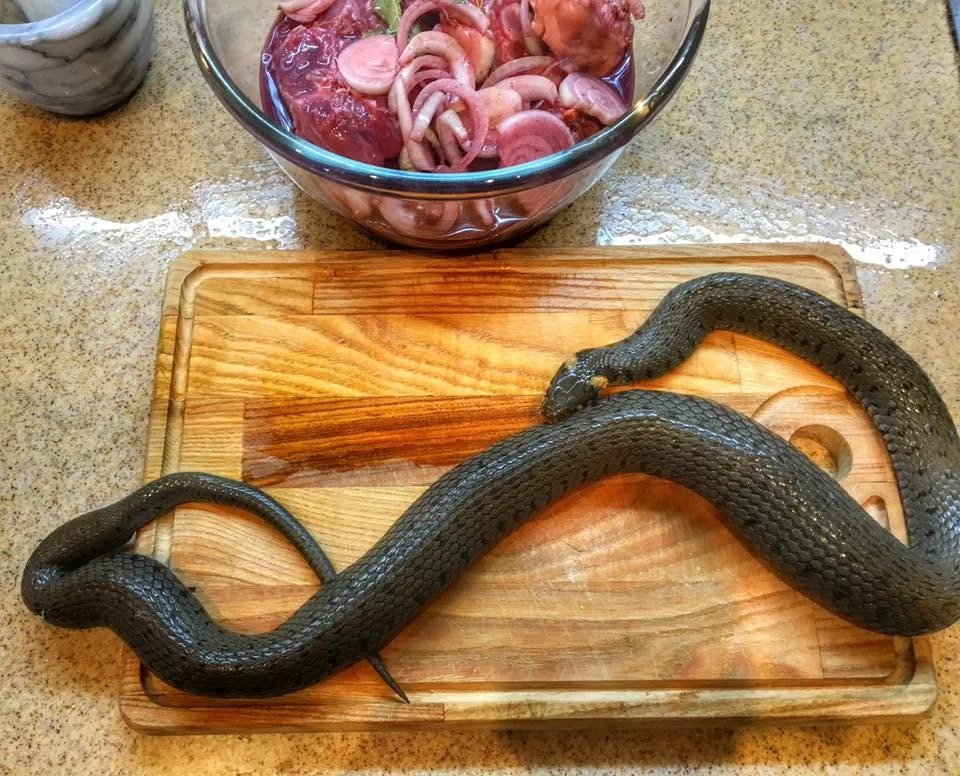
Kyiv, 2 July 2016. A grass snake on my cutting board, with beaver meat marinating in red wine and onions behind it. From my personal archive.
In July 2016, a biologist friend sent me a grass snake and some beaver meat. One became a rather unconventional seafood-inspired dish. The other was already marinating in red wine. And it reminded me of a group of Ukrainian artists who once became famous for eating snakes.
On 2 July 2016, I posted a photograph on Facebook.
It showed a wooden cutting board.
On the board lay a rather substantial snake.
Behind it stood a glass bowl containing pieces of meat, red wine and sliced onions.
A perfectly ordinary Saturday in my kitchen.
Well, almost.
The snake was a grass snake, known in Ukrainian as vuzh.
The meat in the bowl was beaver.
And both had arrived courtesy of my friend Alexander, a Doctor of Biological Sciences who had moved from Kyiv to a small village called Stepanovka.
Alexander was a rather extraordinary man.
A professional biologist.
An enthusiastic gastronomic experimenter.
And someone who regarded animals with a combination of scientific curiosity and culinary imagination.
He knew local hunters who sometimes brought him unusual game.
And on this occasion, some of it came to me.
Beaver hindquarters.
A beaver tail.
And a large grass snake.
Frozen and ready for my experiments.
I had cooked neither animal before.
So naturally, I decided to prepare both.
What could possibly go wrong?
The snake looked surprisingly well fed
Let's begin with the snake.
It was quite a substantial specimen.
Not one of those delicate little creatures you occasionally encounter near a pond.
It had a thick body, dark scales and a decidedly respectable appearance.
I decided to approach it as though it were fish.
Not because a snake is a fish.
Obviously.
But because that seemed a useful culinary starting point.
The animal lived close to water.
It ate aquatic prey.
And I assumed its relatively delicate meat might respond well to techniques I already knew from cooking fish.
That was my working hypothesis.
When I cleaned it, I discovered something that supported at least one part of the idea.
Its digestive tract contained numerous small fish.
My dinner had apparently already enjoyed a rather substantial dinner of its own.
Which is a peculiar discovery when you're preparing food.
But rather interesting from a biological perspective.
I'd been given not merely an ingredient but a small record of what that animal had been doing before it ended up in my kitchen.
And this is where having a biologist friend makes life entertaining.
Some people discuss the freshness of the fish.
Others discuss what the fish had been eating.
Alexander was more likely to become interested in the digestive anatomy of the animal that had eaten the fish.
We'll return to that habit when we get to the beaver.
Treat it like fish. More or less.
Once the snake had been cleaned, I divided it into portions.
I didn't have a carefully developed snake recipe.
Nor was I particularly interested in trying to reproduce something from an exotic restaurant menu.
Instead, I chose a preparation based on familiar ingredients.
A little initial frying.
Shallots.
Leek.
White wine.
And cream.
The kind of combination I might happily use with certain fish.
The idea was to give the meat a gentle cooking environment rather than overwhelm it with spices.
I started by lightly browning the pieces.
Then I worked with the shallots and leek, allowing them to soften before bringing everything together with white wine.
I let the dish cook gently.
And towards the end, I added a little cream.
That was the general method.
No elaborate seasoning.
No spectacular collection of rare ingredients.
Just a fairly classic European approach to a delicate protein.
With one rather unconventional substitution.
Instead of fish, I was cooking a grass snake.
I don't want to invent detailed tasting notes a decade later.
What I remember clearly is the decision to treat it as fish, the ingredients I used and the satisfaction of turning an unfamiliar animal into a recognisable cooked dish.
The interesting part wasn't simply that I'd prepared a snake.
It was that I'd found a way of thinking about it through techniques I already understood.
Apparently, the French had thought of something similar
Years later, while revisiting my old notes for Strange Food, I discovered a rather amusing parallel.
In southern France, particularly Provence, there are historical accounts of people eating snakes referred to as couleuvres.
An ethnographic study by Danielle Musset, Serpents: représentations et usages multiples, describes traditions associated with these animals.
One recollection concerns a family that prepared snake with onions, a little flour, tomato and white wine.
A regional cookbook from the Var also records a preparation called daube de couleuvre.
A snake stew.
In other words, my decision to combine a snake with onions and white wine wasn't nearly as original as I might have imagined.
Somebody in France had already been doing something similar.
Possibly generations earlier.
I find that delightful.
But there's an important zoological detail.
The French word couleuvre covers several kinds of nonvenomous snakes. It doesn't establish that those historical recipes used the same species as the Ukrainian animal I cooked.
So I wouldn't claim to have independently rediscovered an ancient French grass-snake recipe.
I simply find the parallel interesting.
Different places.
Different circumstances.
And cooks independently reaching for familiar ingredients when confronted with an unfamiliar animal.
Apparently, white wine has solved more than one culinary problem.
The artists who ate snakes
But this wasn't my first encounter with the idea of eating a grass snake.
That story goes much further back.
I was about eighteen or nineteen years old.
At the time, I worked as an artist, and one of our projects involved decorating a recreation complex near the Tiligul Estuary, on the border between Ukraine's Mykolaiv and Odesa regions.
The location was quite remote.
A beautiful coastal landscape, with limited facilities and not exactly an abundance of urban conveniences.
The work itself was interesting.
We were creating decorative elements for buildings at the complex.
Stained glass.
Mosaics.
Various metalwork pieces.
Decorative chandeliers.
The sort of project that requires a team of artists and craftspeople rather than somebody arriving with a paint roller and a bucket of white emulsion.
We had hired a group of artists for part of the work.
They were provided with money for expenses, including food.
Then we left them to get on with the project.
About a week later, we returned.
And discovered that our artists had developed a rather unconventional approach to catering.
Instead of spending the allowance on food, they'd sent much of the money home to their families.
Then they supported themselves by fishing.
Which was understandable.
The estuary offered opportunities for catching fish.
And when the fishing went well, apparently everything was fine.
But fishing doesn't always go well.
And on those occasions, according to local villagers, the artists found another food source.
Grass snakes.
Yes.
Our artists were apparently eating snakes.
A reputation you don't normally want on your CV
I didn't personally watch them preparing the snakes.
That distinction matters.
I can't tell you how they cooked them.
Whether they roasted them over a fire.
Made soup.
Fried them.
Or invented some spectacular culinary method that deserves to be preserved for posterity.
I don't know.
The story came from local people, and the artists' unusual food habits had clearly attracted attention.
Because before long, the group acquired a local reputation.
They became known as the artists who eat snakes.
Which is a magnificent professional distinction.
There are artists famous for their paintings.
Others for their sculptures.
Some for extraordinary architectural projects.
And then there was our group near the Tiligul Estuary.
The ones who ate snakes.
I sometimes wonder whether their mosaics and stained-glass work are still remembered locally.
Or whether everybody only remembers what they had for lunch.
Personally, I find both accomplishments interesting.
Although I'm not entirely sure which one impressed the villagers more.
Food, necessity and curiosity
There is, of course, a difference between these stories.
The artists were trying to save their expense money and make use of what was available around them.
I was conducting a culinary experiment with ingredients sent by a friend.
The motivation was different.
And that distinction matters.
People have eaten unusual animals for many reasons.
Hunger.
Necessity.
Tradition.
Curiosity.
Availability.
Or simply because an ingredient tastes good.
Historically, accounts of eating grass snakes also appear in Ukrainian testimonies of extreme hunger, including memories of the Holodomor.
Those are records of survival under catastrophic conditions, not evidence that snake was a widespread or celebrated traditional Ukrainian dish.
They should never be confused with the sort of voluntary gastronomic experimentation I'm describing here.
But together, these accounts remind us that the boundary between food and non-food is much more complicated than a national menu suggests.
An animal that most people would never consider eating can become food under particular circumstances.
And occasionally, someone discovers that it can be approached through an entirely familiar cooking technique.
Which brings me back to the kitchen in 2016.
Alexander's rather unusual deliveries
My friend Alexander deserves a story of his own.
Actually, several stories.
I've already mentioned him in my Kitchen Notes about an extraordinary borscht made with dried crucian carp.
He was the kind of person who could discuss biology, cooking and the peculiarities of a particular animal with equal enthusiasm.
And his move to Stepanovka created the perfect environment for that combination of interests.
There were local hunters.
Farm animals.
Access to unusual ingredients.
And far fewer reasons to worry about what the neighbours might think of an unconventional dinner.
Alexander had also worked with fellow biologists who raised different organisms for scientific purposes and as food for reptiles.
Some of my earliest experiments with insect-based dishes were connected to him.
So when he offered to send me beaver meat and a grass snake, the proposal didn't seem especially outrageous.
At least not to me.
I was delighted.
And the entire package arrived frozen.
The snake was one experiment.
The beaver would be another.
I had no intention of treating the two animals identically.
The snake suggested fish.
The beaver suggested game.
And that distinction determined the approaches I chose.
Why the beaver went into red wine
In the photograph from July 2016, the snake is lying on the wooden board.
Behind it, in a glass bowl, you can see pieces of beaver meat surrounded by sliced onions and red wine.
The preparations were happening in parallel.
But I had different plans for the two dishes.
The snake was going to be prepared relatively gently, with white wine and cream.
The beaver was going to receive a much more traditional game treatment.
Red wine.
Aromatic vegetables.
A slow preparation.
The sort of approach I might use for a substantial piece of wild meat.
And the beaver tail was going to become an entirely separate experiment.
My ambition was to produce something with a deeply roasted exterior and a touch of smoke.
In other words, the menu was becoming quite ambitious.
And there was another reason I was particularly interested in the beaver.
This wasn't my first encounter with one.
I'd previously visited Alexander in Stepanovka when hunters had brought him a beaver.
And instead of immediately thinking about dinner, he decided to show me something about its anatomy.
We ended up examining an astonishing length of intestine across his terrace.
But that story deserves its own chapter.
The photograph that survived
I particularly like having the original Facebook photograph.
It's not professional food photography.
There's no carefully arranged restaurant presentation.
No elegant lighting.
No polished plate.
Just a kitchen counter.
A wooden board.
A snake.
And a bowl of marinating beaver meat.
The original post is dated 2 July 2016, Kyiv.
It's a wonderfully matter-of-fact record of something that would have seemed quite extraordinary in most kitchens.
The caption mentions preparations for Saturday dinner.
Beaver meat marinating in wine.
A snake ready for preparation.
And, rather casually, the fact that I'd also made homemade Pimm's No. 1.
Because apparently there weren't enough unusual things happening that weekend.
Looking back at the photograph now, I find it valuable for a reason that has little to do with the novelty of the ingredients.
It's evidence of a period in my life when I was experimenting constantly.
Not just reading about strange foods.
Not merely collecting recipes.
Actually trying things.
Comparing ingredients.
Working out which familiar cooking techniques might be adapted to unfamiliar animals.
Some experiments became restaurant products.
Others became stories.
And some remained photographs in an old Facebook album.
Until I started recovering them for Kitchen Notes.
Not every unusual animal belongs in a frying pan
One thing I'd approach differently today is the question of sourcing and safety.
A snake being nonvenomous doesn't automatically make it a safe food ingredient.
Reptiles can carry parasites and bacteria, and appropriate identification, legal sourcing, handling and processing matter.
There are also wildlife-conservation rules that vary by species and jurisdiction.
The European Food Safety Authority has specifically examined potential health risks associated with reptile meat, including parasitic infections linked to snake consumption.
So this isn't a recommendation to collect snakes from a park, clean them and start experimenting.
It's a recollection of something I prepared in 2016, not a validated modern food-safety procedure.
That doesn't make the history less interesting.
I simply think the difference between a personal experiment and advice to other people deserves to be clear.
Especially when the ingredient isn't something ordinarily sold in a supermarket.
The difference between strange and unfamiliar
I started recovering my unfinished Strange Food manuscript because I've always been fascinated by the way people classify animals.
Food.
Pets.
Wildlife.
Pests.
Things to fear.
Things to admire.
Things to eat.
And these categories overlap in surprisingly inconsistent ways.
A frog can be an ordinary dinner in one Ukrainian village and a disgusting idea in another.
A cricket can be a bar snack or a household intruder.
A beaver can be a conservation symbol, a source of fur or part of a traditional hunting cuisine.
And a grass snake can be a harmless animal in a wetland, a source of emergency food, or the main ingredient in an unusual Saturday dinner.
The animal hasn't necessarily changed.
The human context has.
I don't think that means we should eat everything.
Biology, safety, conservation and ethics still matter.
But I do think it means we should be more thoughtful about why certain animals seem inherently edible and others don't.
In my case, I looked at a grass snake and thought of fish.
Another cook might have thought of poultry.
A rural French family apparently thought of a stew.
And our artists near the Tiligul Estuary thought of dinner when the fishing wasn't going well.
Different approaches.
Same basic question.
What can we do with an ingredient that our culture doesn't normally recognise as food?
Next: the beaver
The snake was only half of that weekend's experiment.
The meat in the glass bowl was already soaking in red wine.
The beaver tail was waiting for its own preparation.
And my earlier visit to Alexander had left me with a rather extraordinary memory involving the digestive anatomy of a large rodent.
For now, I'll leave you with the original photograph.
A snake on a cutting board.
Beaver meat in a glass bowl.
And a young version of me who thought this was a perfectly reasonable way to prepare Saturday dinner.
I decided to cook the snake like fish.
The beaver, naturally, required Burgundy wine.
To be continued.
Part One of a two-part Strange Food story, reconstructed from my personal memories and an original Facebook photograph dated 2 July 2016. The historical research provides culinary context; it does not independently verify the species shown or establish a safe method for preparing wild reptiles.