
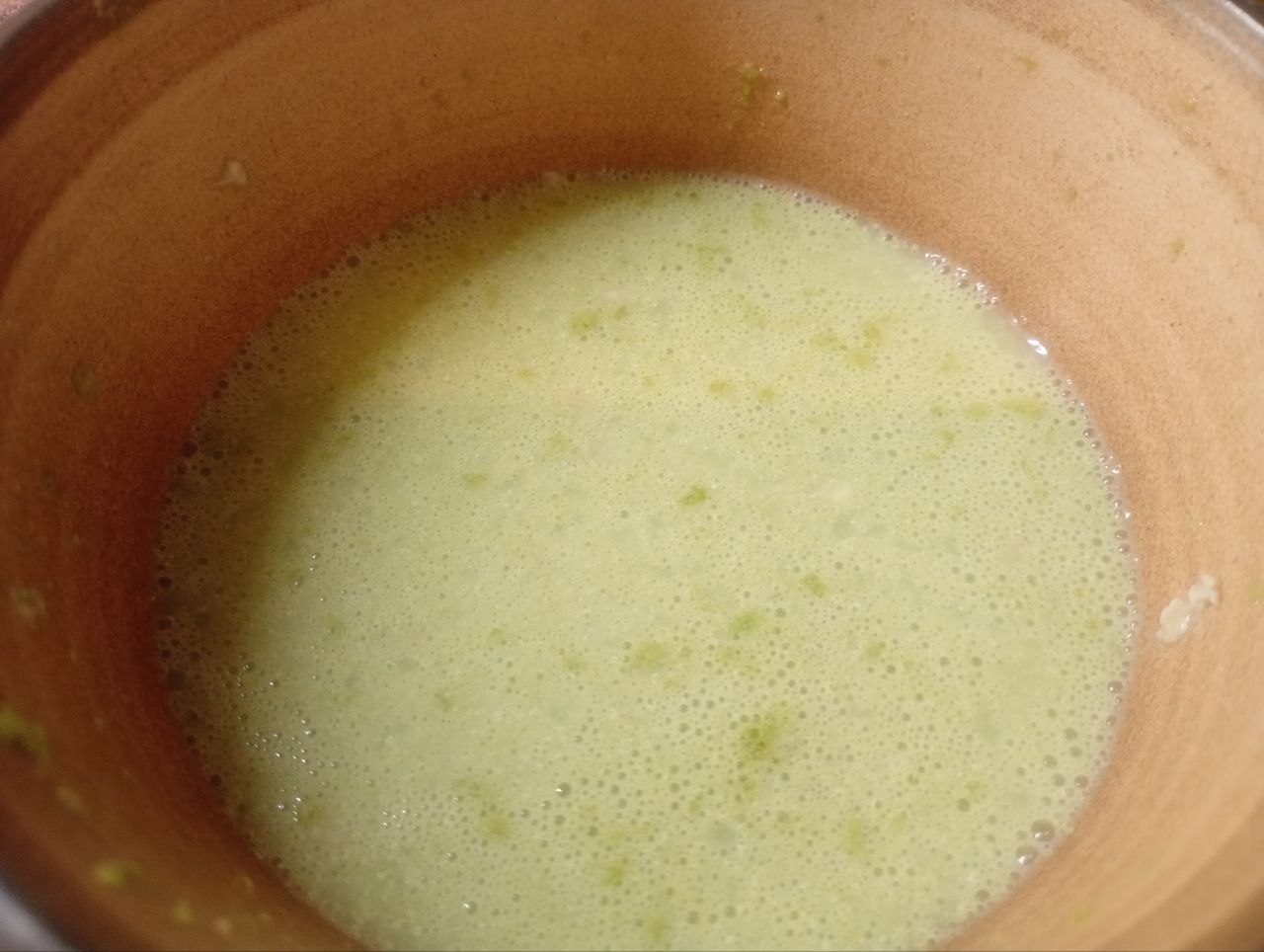
The final matcha-flavoured oat mixture. Much thinner than I wanted.
Twenty-five-year-old memories of Finnish yogurt, two bowls of oats, a surplus of Breton dairy products, and an AI assistant that made a very simple experiment considerably more complicated.
I have two fairly serious food obsessions.
Oats.
And yogurt.
I can eat both in almost unreasonable quantities.
So it was probably inevitable that, at some point, I would become fascinated by the possibility of combining them.
Not ordinary oatmeal with a spoonful of yogurt on top.
That's perfectly nice, but hardly revolutionary.
I'm talking about something more interesting.
Oat yogurt.
A pleasantly sour, creamy oat preparation with a texture somewhere between thick yogurt and soft porridge.
It's something I used to make occasionally.
And then, as happens with recipes you only prepare once every few years, I'd forget the details.
Until the next time I remembered how much I liked it.
Which happened a few days ago.
And naturally, I decided to ask AI for help.
An innocent mistake.
The Finnish connection
My interest in Finnish dairy products goes back roughly twenty-five years.
Back then, when I was living in Ukraine, Finnish Valio yogurts were available in shops.
I remember them being particularly good.
Then, after a year or two, they more or less disappeared from the shops I visited.
But the memory stayed.
I can't reconstruct the exact product range after all these years, and I wouldn't claim that the oat preparation I make today is the same product I bought then.
What I remember is discovering how much I enjoyed those Finnish yogurts.
And, over time, developing a particular affection for fermented oat preparations.
Finland has a substantial tradition of oat-based foods, including modern fermented oat products.
Which makes the association understandable.
But my own version was always very simple.
Some oats.
Some water.
A little patience.
No elaborate equipment.
And, as far as I remembered, absolutely no need for added yeast.
I'd made it several times over the years, occasionally returning to it after long intervals.
Then I'd forget about it again.
For some reason, I'd always remember that it was delicious.
But not exactly how much water I'd used.
Which was the detail that turned out to matter enormously.
I had plenty of yogurt. Obviously.
Readers of my recent Kitchen Notes may remember that somebody gave me a five-litre bucket of excellent natural Breton yogurt.
Five litres.
I've been working my way through it with considerable dedication.
Eating it.
And generally finding new ways to justify my enthusiasm for dairy products.
I still had plenty left.
I also had oats.
I always have oats.
So I decided it was time to revisit my old fermented oat experiment.
And because I hadn't made it in several years, I asked Gemini to remind me of the process.
A perfectly reasonable thing to do.
I assumed it would help reconstruct what I already knew.
Instead, we embarked on a rather entertaining culinary negotiation.
First, Gemini wanted yeast
I explained that I wanted to make something like my old fermented oat yogurt.
Gemini immediately recognised the idea.
Finnish tradition!
Fermented oats!
Very simple!
Excellent!
It suggested oats, water, a little sugar and yeast.
Hold on.
What yeast?
I didn't remember using yeast.
Ever.
I'd always simply left the oats to develop their own sour flavour.
Gemini agreed immediately.
Of course!
Spontaneous fermentation!
Wild microorganisms!
Apparently, that was the traditional method all along.
Wonderful.
I do admire how quickly an AI assistant can discover that it agrees with something you have just told it.
So I asked for the proportions.
The answer was approximately two or three tablespoons of oats per glass.
Fill the rest with water.
Add a little sugar.
Maybe some salt.
Cover it.
Leave it for three days.
This already sounded rather different from what I remembered.
But I decided to continue the conversation.
And then it discovered my yogurt
I mentioned that I had yogurt.
A great deal of yogurt, actually.
Gemini was delighted.
Why not add a teaspoon?
It explained that the yogurt would provide a ready-made starter culture.
Instead of relying entirely on whatever microorganisms happened to be present, I'd introduce some lactic-acid bacteria from the yogurt.
This sounded plausible.
Although, as I later reflected, adding ordinary dairy yogurt to oats and water doesn't automatically establish a controlled, reliable fermentation.
But at the time, I was mostly interested in getting on with the experiment.
Then came another familiar Gemini habit.
After explaining the recipe, it asked whether I'd like some additional suggestions to make it even creamier and more delicious.
Well, obviously.
But I couldn't help wondering why it hadn't simply included its best suggestions in the original answer.
It reminded me that grinding the oats would help with the texture.
Ah.
Yes.
I'd done that before.
I'd almost forgotten.
Back in Ukraine, I used to crush the oats a little with a mortar and pestle.
Nothing fancy.
Just breaking the flakes down enough to make the final mixture smoother.
Unfortunately, I was now in my little apartment in France.
No mortar.
No grinder.
No blender.
Just a small kitchenette, two bowls and an increasingly ambitious AI assistant.
Fine.
Whole oats it would be.
Two bowls and far too much water
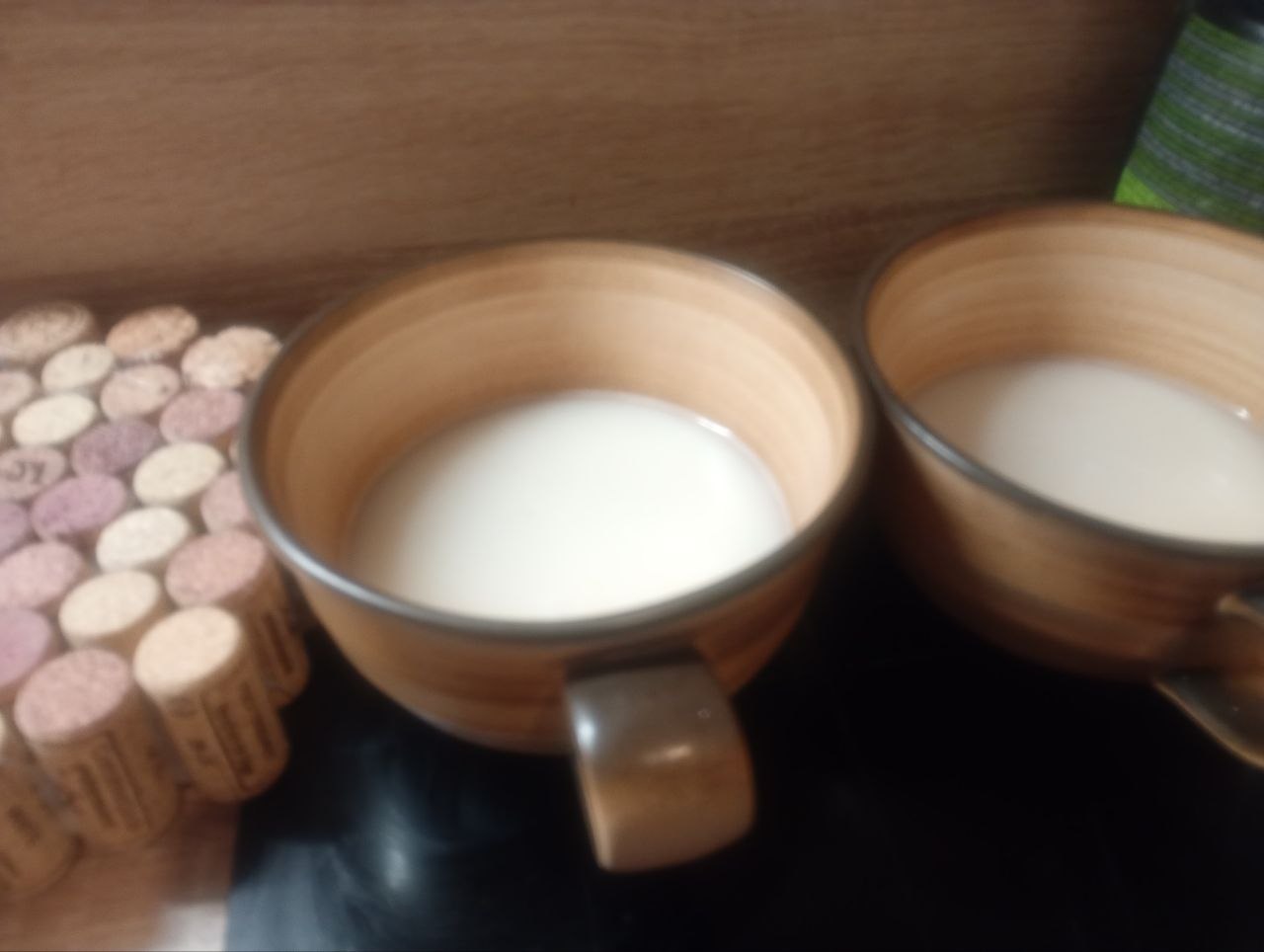
The experiment before the matcha intervention.
I decided to make two portions.
I had fairly large oat flakes.
And I began with the suggested proportions.
A few tablespoons of oats in each bowl.
Water.
A teaspoon of yogurt.
A little sugar.
A pinch of salt.
Now, even as I was pouring the water, something felt wrong.
Two or three tablespoons of oats in an almost full glass of water?
Surely that was too much water.
I remembered my old preparation being much thicker.
But I'd asked for a recipe.
And, for once, I was attempting to follow it.
So I added the water.
Stirred everything.
Covered the bowls.
And left them.
The following day I took another look.
It was a rather depressing sight.
A lot of water.
Some oats sitting at the bottom.
And very little evidence of the lovely creamy mixture I'd been imagining.
It looked more like somebody had started washing a bowl of porridge and then lost interest.
This was not encouraging.
Naturally, I decided to interfere.
Matcha. Because why not?
I had some matcha.
Regular matcha, which I use fairly often.
And also some convenient little three-in-one matcha sachets.
Those contain matcha powder along with sugar and powdered milk.
I thought this might make the mixture more interesting.
Perhaps give it more flavour.
Perhaps improve its appearance.
Perhaps rescue it from its general atmosphere of disappointment.
So I added one sachet to each bowl.
Whisked everything together.
And suddenly the whole thing looked rather more cheerful.
A pale green mixture.
A little frothy.
Much more appetising than the previous day's collection of submerged oat flakes.
Was this going to fix the texture?
Probably not.
But at least it looked as though it had a purpose in life.
And by the third day, I had something that resembled a drinkable oat-yogurt mixture.
Day three: the result
Today was the third day.
I examined the bowls.
The mixture had acquired some acidity.
The appearance had changed.
And the oats, water, yogurt and matcha had combined into something more coherent.
So I tasted the first bowl.
The result was interesting.
But not what I wanted.
For one thing, it was far too liquid.
More like a drinking yogurt than a thick one.
And I don't particularly like drinking yogurts.
I prefer something substantial.
Something you eat with a spoon.
Something that doesn't immediately run away when you try to pick it up.
The flavour had some pleasant sourness.
There was the taste of oats.
And the matcha was certainly there.
But it was also too sweet for me.
I'd added sugar at the beginning.
Then the matcha sachets had contributed more sugar.
And whatever microbial activity had taken place hadn't eliminated that sweetness.
The result wasn't awful.
It was actually quite interesting.
But it wasn't the oat yogurt I'd been trying to remember.
And that was when I finally recalled the missing proportions.
My original method was much simpler
I hadn't used two or three tablespoons of oats.
I'd used something closer to half a cup.
And I hadn't filled the rest of the container with water.
I'd only added enough water to cover the oats by approximately a finger's width.
That was the difference.
The oats absorbed the water.
The mixture remained relatively concentrated.
And after a few days, the texture I remembered was considerably thicker.
Closer to a soft cream than a drinking yogurt.
I'd also broken the oat flakes down slightly with a mortar and pestle.
Which helped create a smoother consistency.
And I hadn't used sugar.
Or salt.
Or commercial yogurt.
Just oats and water.
That was my old experiment.
It was what I remembered enjoying years ago.
I should be careful here: this is a recollection of an improvised spontaneous fermentation, not a laboratory-verified or food-safety-tested recipe. Reproducing it safely would require more control than simply leaving wet oats on a countertop.
But as a reconstruction of what I used to make, the memory suddenly came back.
And I realised that this time I'd changed almost everything.
The proportions.
The concentration.
The culture.
The sweetness.
The texture of the oats.
And finally the flavouring.
Then I'd wondered why the result was different.
An excellent example of how to make an experiment difficult to interpret.
Sometimes AI helps you remember by getting things wrong
I find this aspect particularly funny.
Gemini wasn't entirely useless.
Far from it.
The conversation reminded me of things I'd forgotten.
Grinding the oats, for example.
The importance of texture.
The role of fermentation.
And the possibility of experimenting with different flavour combinations.
But it also encouraged me to make changes I hadn't originally intended.
More water.
Sugar.
Salt.
Yogurt as a starter.
Then I added the matcha mixture myself.
So instead of reconstructing my old preparation, I created something new.
That's not necessarily a problem.
Cooking experiments are supposed to produce surprises.
But there's a difference between an interesting variation and an accurate reconstruction.
And there's another important distinction.
Gemini spoke very confidently about spontaneous fermentation and the role of the yogurt culture.
In reality, fermentation isn't automatically controlled because you add a spoonful of yogurt.
The microorganisms, temperature, acidity and time all matter.
A mixture becoming sour isn't proof that it has fermented safely.
I had treated the conversation as casual cooking advice.
Looking back, the three-day room-temperature process with added dairy yogurt wasn't something I should regard as a verified recipe.
So I wouldn't recommend repeating this particular batch as written.
If I revisit the idea, I'll use a controlled, food-safe fermentation method rather than relying on smell, taste or an AI assistant's confidence.
That seems like a sensible improvement.
What actually went into my experiment
For the record, here's what I used.
This is an experiment log, not a tested recipe for home fermentation.
The two original bowls contained:
- A small amount of large oat flakes, following Gemini's suggestion of roughly two to three tablespoons per portion
- Much more water than I would normally use
- A little natural Breton dairy yogurt
- Sugar
- A pinch of salt
On the second day, I added:
- One three-in-one matcha sachet to each bowl, containing matcha, sugar and powdered milk
On the third day, I observed:
- A pale green, lightly frothy mixture
- Some sourness
- A thin, drinkable consistency
- More residual sweetness than I wanted
My remembered older version used substantially more oats relative to water and slightly crushed flakes, without the added yogurt, salt or sugar.
That's the comparison I want to preserve for next time.
Not because the old method has been validated as safe.
But because it explains the texture I was trying to recreate.
A small experiment with a useful result
I didn't get the thick oat yogurt I wanted.
I got a sweet, slightly sour, matcha-flavoured oat drink.
Which is an entirely different thing.
Was it an interesting experiment?
Certainly.
Did it help me remember an old favourite?
Yes.
Would I follow the same instructions again?
No.
Next time, I'll separate two goals that I mistakenly mixed together.
First, creating the thick oat texture I actually enjoy.
Second, using an appropriately controlled fermentation process if I want a genuinely fermented product.
And perhaps I'll leave the matcha until the end.
Because there is already plenty happening in that little bowl without inviting green tea to join the negotiations.
Still, I find it rather satisfying that a memory from twenty-five years ago can resurface in a small French kitchenette and produce an entirely new experiment.
The Finnish yogurt.
The Breton dairy bucket.
The oats.
The matcha.
The AI assistant.
And me, standing in front of two bowls, wondering why I didn't simply trust my memory in the first place.
Gemini gave me a recipe.
I gave it several corrections.
And the oats, quite reasonably, decided to become something else.