
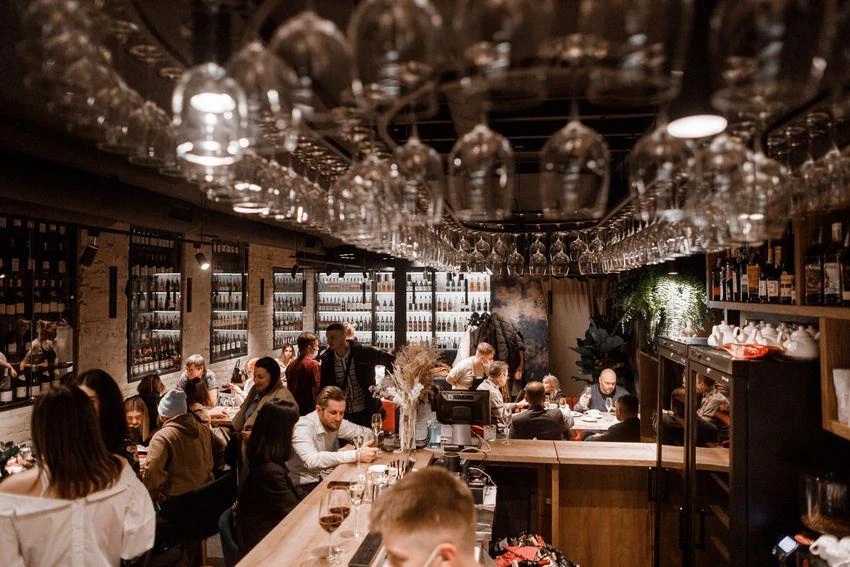
In Kyiv, I developed Gastronom: a restaurant, wine bar and delicatessen built around an unusually simple promise. The concept was accepted, much of it was implemented, and the restaurant opened. But the project gradually moved away from the economics I had designed it around.
There's something particularly frustrating about watching a business concept become a real business — and then watching it gradually lose the very thing that was supposed to make it work.
Not because somebody completely rejected your idea.
That would almost be easier.
But because they accepted it.
Built most of it.
And then started improving it.
Or at least, what they considered improvements.
I've encountered this problem more than once in hospitality.
A business owner commissions a concept. You spend a considerable amount of time working out its positioning, commercial logic, product architecture, customer experience and operating model.
The owner likes it.
Then comes the dangerous moment.
What if we made it just a little more premium?
A slightly more expensive interior.
A more sophisticated kitchen.
A few additional menu categories.
Some complicated service ideas.
More equipment.
More investment.
All perfectly reasonable suggestions when considered individually.
Until you discover that the business has become rather more expensive and difficult to operate than the one you originally designed.
My project Gastronom Food & Wine Bar, in Kyiv, is a particularly memorable example.
And unlike some of my other concepts, this one actually opened.
A restaurant, a wine bar and a grocery store walk into the same building
The basic idea behind Gastronom was straightforward.
Create a place that combined three familiar businesses.
A restaurant.
A wine bar.
And a delicatessen.
But not in the usual way, where a restaurant has a tiny retail corner selling a few overpriced bottles of olive oil.
I wanted the retail component to be a genuine part of the operating model.
My original concept described the business as a restaurant, shop and delicatessen with shop-like prices on selected products.
That qualification matters.
I wasn't proposing that every restaurant dish should be sold at supermarket prices.
A professionally cooked main course still has the costs of ingredients, kitchen labour, preparation, equipment and service.
But certain products already arrive ready to sell.
A bottle of wine.
A piece of cheese.
Some excellent cured meat.
A jar of something delicious.
Why should those products suddenly become dramatically more expensive simply because the customer chooses to consume them at a table rather than carry them home?
That question became the foundation of Gastronom.
The price of a bottle shouldn't depend on which side of the door you're standing
Wine was particularly important.
In a conventional restaurant, you might buy a bottle for one price in a shop and then encounter an entirely different price for the same bottle in a restaurant.
Naturally, the restaurant has costs to cover.
And the customer pays for the environment and service.
I understood that perfectly well.
But I wanted Gastronom to explore a different proposition.
You choose a bottle from the shelf.
You buy it at the retail price.
And if you want to drink it in the restaurant, you can.
We'll provide the glasses.
No additional corkage fee.
The same principle would apply to selected cheeses, cured meats and other delicacies.
The customer would be able to build a wine-and-food experience around products that remained visibly and intelligibly priced.
Meanwhile, the restaurant would still have its own prepared-food menu, drinks by the glass and more conventional hospitality revenue.
The idea wasn't to eliminate profit.
It was to construct a different relationship between pricing, trust and consumption.
A person who doesn't want to pay a large restaurant markup on a bottle of wine might happily order a cheese board.
Or a dessert.
Or another dish.
Or buy something to take home.
And, importantly, they might return.
These were hypotheses, not guaranteed outcomes.
But they formed a coherent commercial proposition.
Accessible prices would bring people in. A broader hospitality experience would give them reasons to spend more.
That's quite different from simply offering cheap food.
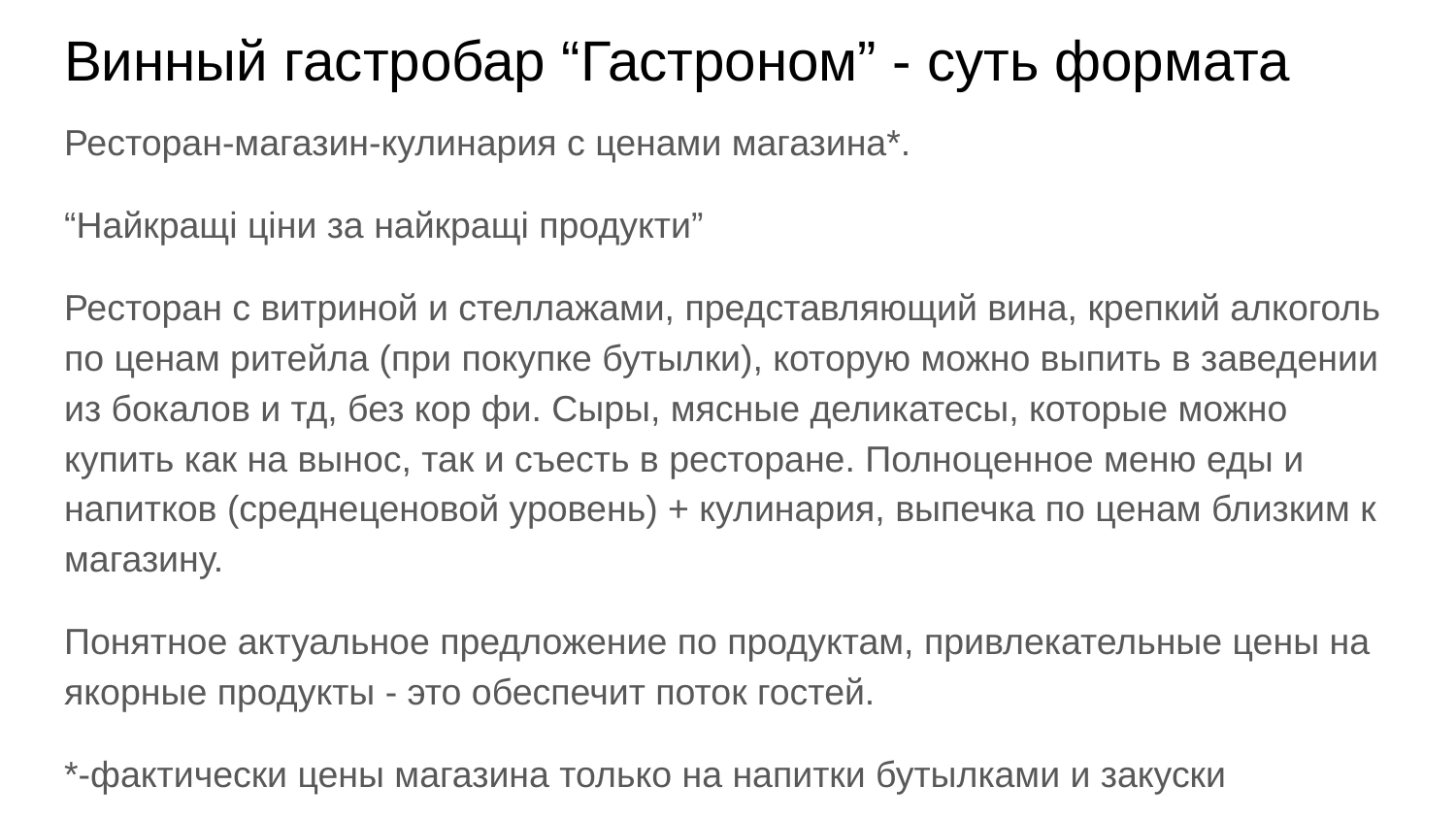
Original concept, slide 2: selected bottles and delicacies at retail prices, with no corkage; prepared restaurant dishes retain their own pricing. Archive text preserved.
The shelves were supposed to do some of the selling
I didn't want the grocery store to disappear into a corner.
The products needed to be visible.
Wine bottles.
Cheeses.
Cured meats.
Bread.
Ready-made meals.
The displays themselves would become part of the interior.
And the customer's journey would move naturally between buying something, eating something and discovering something new.
This required thinking carefully about what went into those displays.
For the specific location in central Kyiv, I didn't expect enormous demand from nearby residents shopping for their weekly groceries.
The surrounding audience was different.
Students.
Office workers.
People walking through the city.
Visitors.
So the retail selection needed to overlap strongly with the restaurant's assortment.
If a cheese was displayed in the shop, it could also appear in a cheese board.
If a meat delicacy was sold by weight, it could become part of a sandwich or a platter.
If the kitchen prepared something suitable for takeaway, it could also be sold from the delicatessen counter.
The objective was to make the two activities reinforce one another.
Not create two completely separate businesses with two entirely separate inventories.
Which sounds obvious.
But anyone who has worked with restaurant operations knows how quickly inventory, staffing and production can become complicated.
Especially when the owner develops an enthusiasm for new menu items.
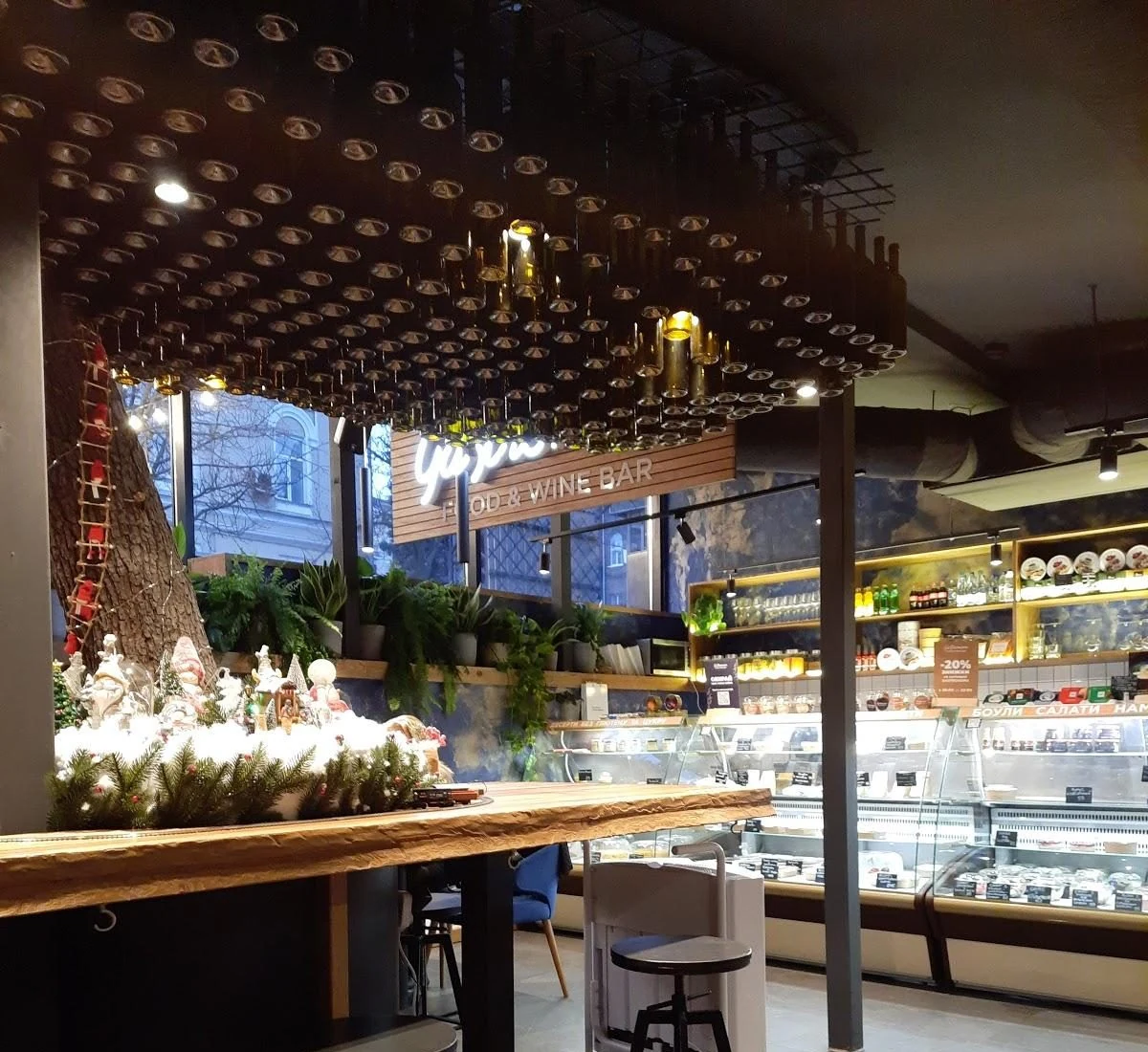
The implemented retail and delicatessen zone. Supplied venue photograph, cropped to exclude the added character.
Two rooms. Two different reasons to visit.
The location also suggested a spatial approach.
I proposed separating the experience into two recognisable zones.
The first would be brighter.
More active.
Closer to the street.
Displays, retail products, ready-made food, takeaway options, coffee.
A place where somebody could come in, choose lunch and leave quickly.
The second would have a more relaxed restaurant and wine-bar atmosphere.
Lower lighting.
Comfortable seating.
A proper bar.
A place to spend an evening rather than five minutes.
The idea was to make the business relevant to different customers at different times.
A student looking for an affordable lunch.
An office worker needing something quick.
A couple meeting for wine after work.
Someone wanting a proper dinner.
They didn't all need exactly the same experience.
But they could all visit the same establishment.
The visual concept supported this division.
I explored a combination of modern minimalism, restrained retro references, dark blue branding and the familiar visual language of traditional grocery stores.
The name Gastronom itself was deliberately evocative.
A word associated with food shops and delicacies, but also with an older retail culture.
The branding wasn't meant to look like another luxury restaurant announcing how exclusive it was.
It needed to feel accessible.
Knowledgeable.
And slightly playful.
Because being an expert in wine doesn't require making everybody else feel ignorant.
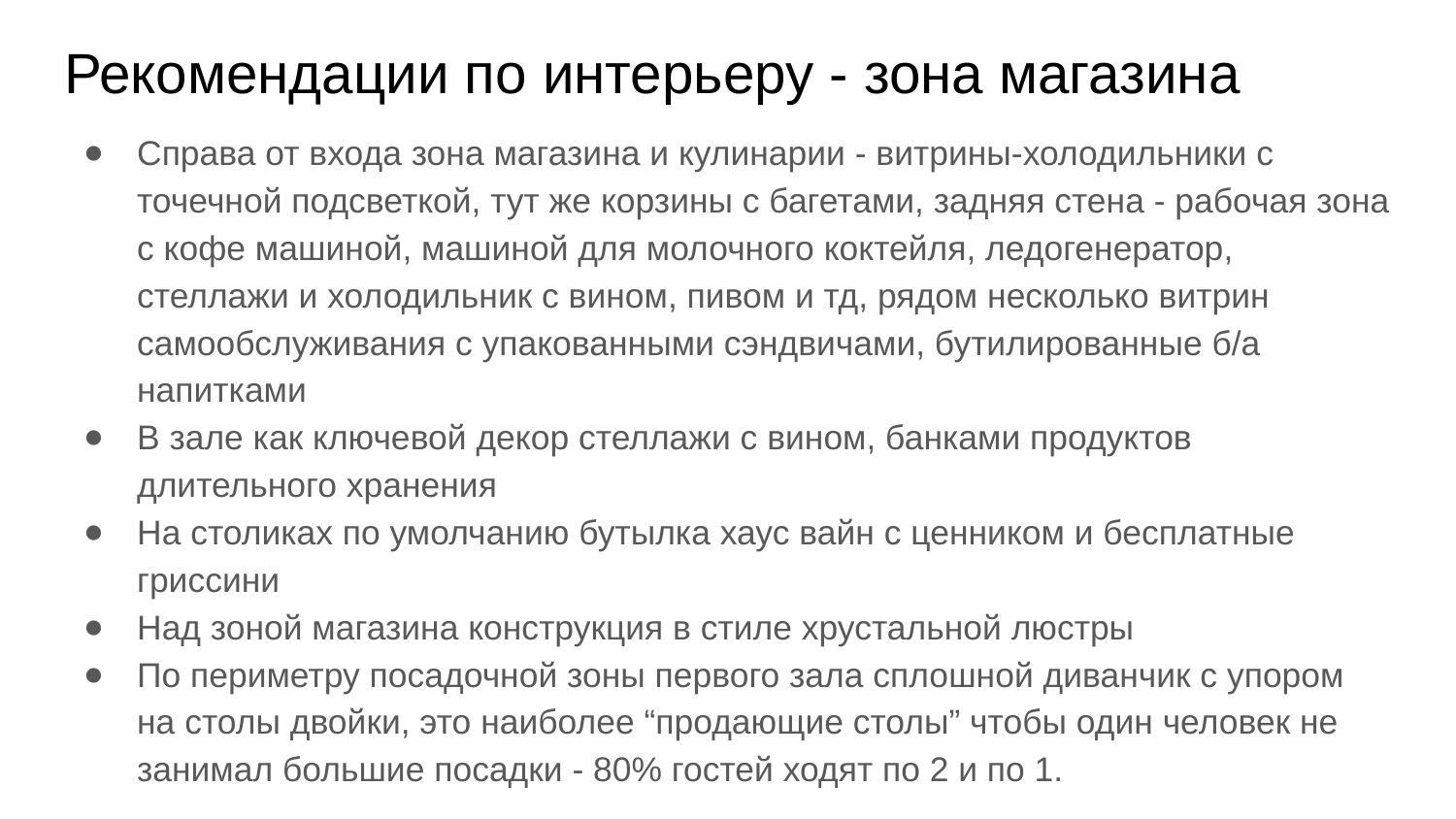
Original concept, slide 74: the proposed retail zone, ready-made food displays and product-led interior. This is the proposal, not a photograph of the finished venue.
Accessible expertise was part of the product
This was another important part of the concept.
I wanted Gastronom to be a place where people could learn about wine, cheese and food without feeling that they had entered an examination.
In the presentation, I proposed regular educational evenings.
Wine tastings.
Cheese introductions.
Meetings with producers.
The customer would pay for the products being tasted, not an additional premium for the privilege of being educated.
The precise event format would have needed testing.
But the positioning was deliberate.
Gastronom wasn't supposed to compete with prestigious wine establishments by becoming even more prestigious.
It was supposed to compete by making interesting products more approachable.
Expertise without intimidation.
Quality without ceremonial nonsense.
And a business model that encouraged customers to explore.
The presentation also contained more experimental ideas.
Product recommendations on shelves.
Takeaway picnic sets.
Meal subscriptions.
Digital loyalty mechanisms.
Even the possibility of including a glass of prosecco with breakfast and allowing the customer to claim it later.
That last idea had a very specific behavioural purpose.
Give somebody a reason to return.
Not necessarily a discount coupon.
Something already waiting for them.
Would it have worked?
I don't know.
We didn't establish that through controlled testing.
But it shows the way I was thinking about the relationship between the restaurant and its customers.
Not just the transaction happening today.
The next visit.
The kitchen was not meant to be an uncontrolled collection of ideas
The original presentation explored a substantial menu.
Breakfasts.
Sandwiches.
Pinsa.
Tapas.
Soups.
Salads.
Main courses.
Desserts.
Ready-made dishes for the delicatessen counter.
But an exploratory menu is not the same thing as a finished menu.
Its job is to define the territory.
The final operating assortment has to account for preparation time, equipment, ingredient overlap, staffing, waste and actual customer demand.
One of my proposed advantages was the ability to adjust the balance between restaurant and retail operations.
If ready-made food sold particularly well, the business could strengthen that direction.
If dinner service proved more attractive, it could develop the restaurant side.
The original business model was intended to preserve some of that flexibility.
Because restaurants have a habit of becoming expensive precisely when they lose the ability to simplify.
Every additional dish needs ingredients.
Storage.
Training.
Preparation.
Quality control.
And sometimes additional equipment.
A more sophisticated dish can also require a more experienced team.
The food cost is only part of the calculation.
That's why a menu should be treated as part of the business model, not simply a collection of things that sound delicious.
And it's one of the reasons I was cautious about making Gastronom too premium.
Then the concept became a real place
The concept was accepted.
And, unlike my earlier Anderson coffeehouse project, Gastronom proceeded to implementation.
By my assessment, roughly 70 percent of the original concept made it into the real establishment.
That's not a measured compliance score.
It's my estimate, looking at the relationship between the development document and the eventual business.
The essential structure survived.
The retail component.
The restaurant.
The wine bar.
The opportunity to buy prepared food.
The different customer scenarios.
The physical relationship between product displays and hospitality.
And on 3 December 2020, Gastronom Food & Wine Bar opened on Volodymyrska Street in central Kyiv.
The finished venue was real.
People came in.
They ate.
They drank wine.
They bought products.
And there are photographs, menus and contemporary reports documenting the place.
That's an important distinction.
This wasn't simply a presentation that looked convincing on a screen.
The central business format crossed the distance between a proposal and an operating establishment.
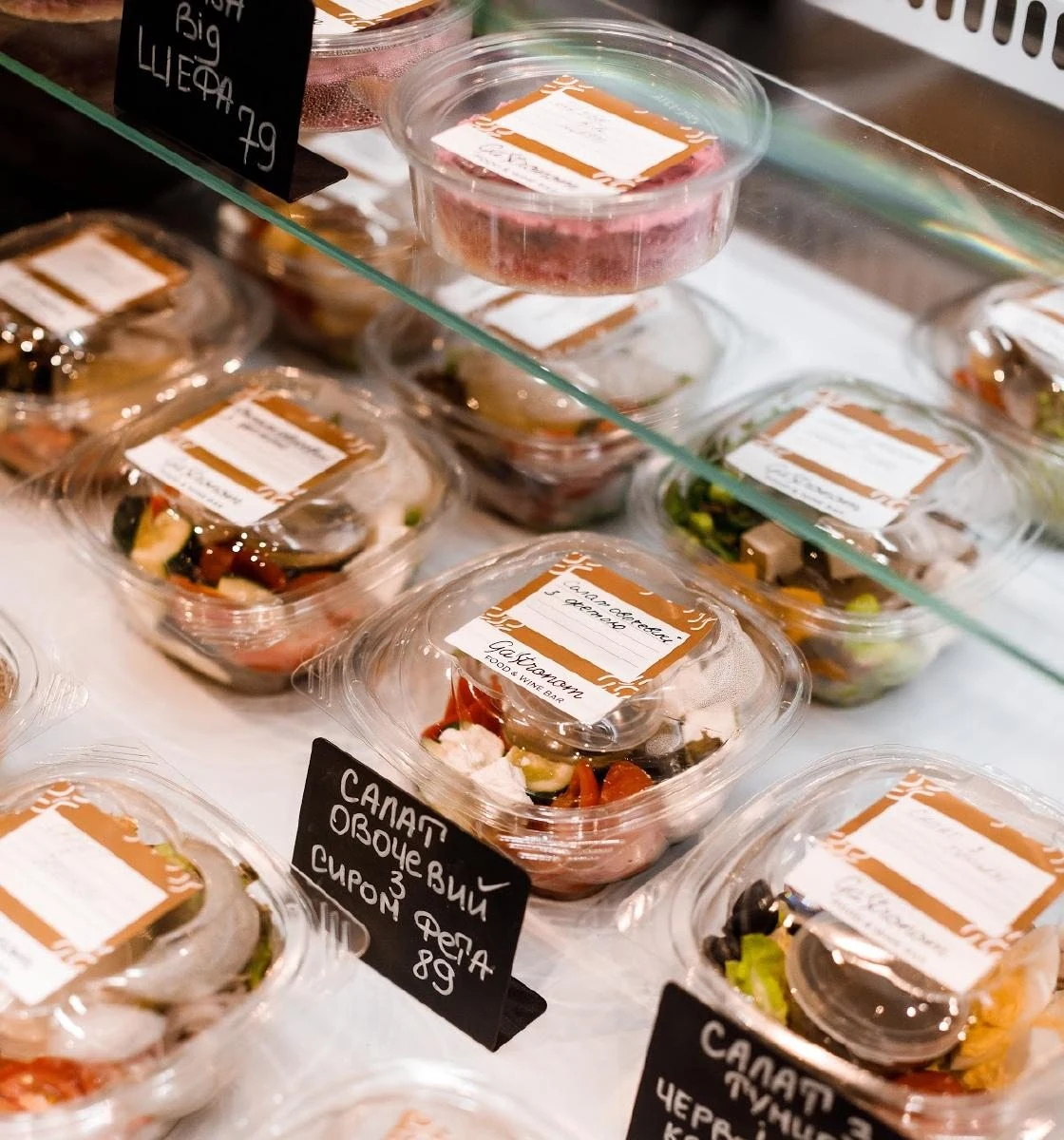
Prepared takeaway food in the implemented venue. Supplied photograph, cropped to exclude the added character.
What the public saw
At launch, Gastronom publicly presented three service scenarios.
Fast Smart Food.
Ready-made meals and products that customers could choose quickly.
Slow Smart Food.
The restaurant experience, built around dishes prepared by the kitchen.
And Wine & Dine.
The wine-bar component, including a selection of more than 140 wines and food pairings.
In other words, the core architecture had survived.
The concept had become something customers could recognise and use.
The food menu had also developed substantially.
The restaurant's culinary team, including chef Anton Yakymchuk, introduced its own dishes and interpretations.
I want to be clear about that.
I was the author of the original business concept.
I wasn't the chef responsible for every finished dish, nor the person managing the kitchen after opening.
The real restaurant was the product of subsequent work by the owner and the implementation team.
And that work deserves its own credit.
But the commercial architecture and many of the fundamental format decisions were recognisably connected to my original proposal.
So where did things go wrong?
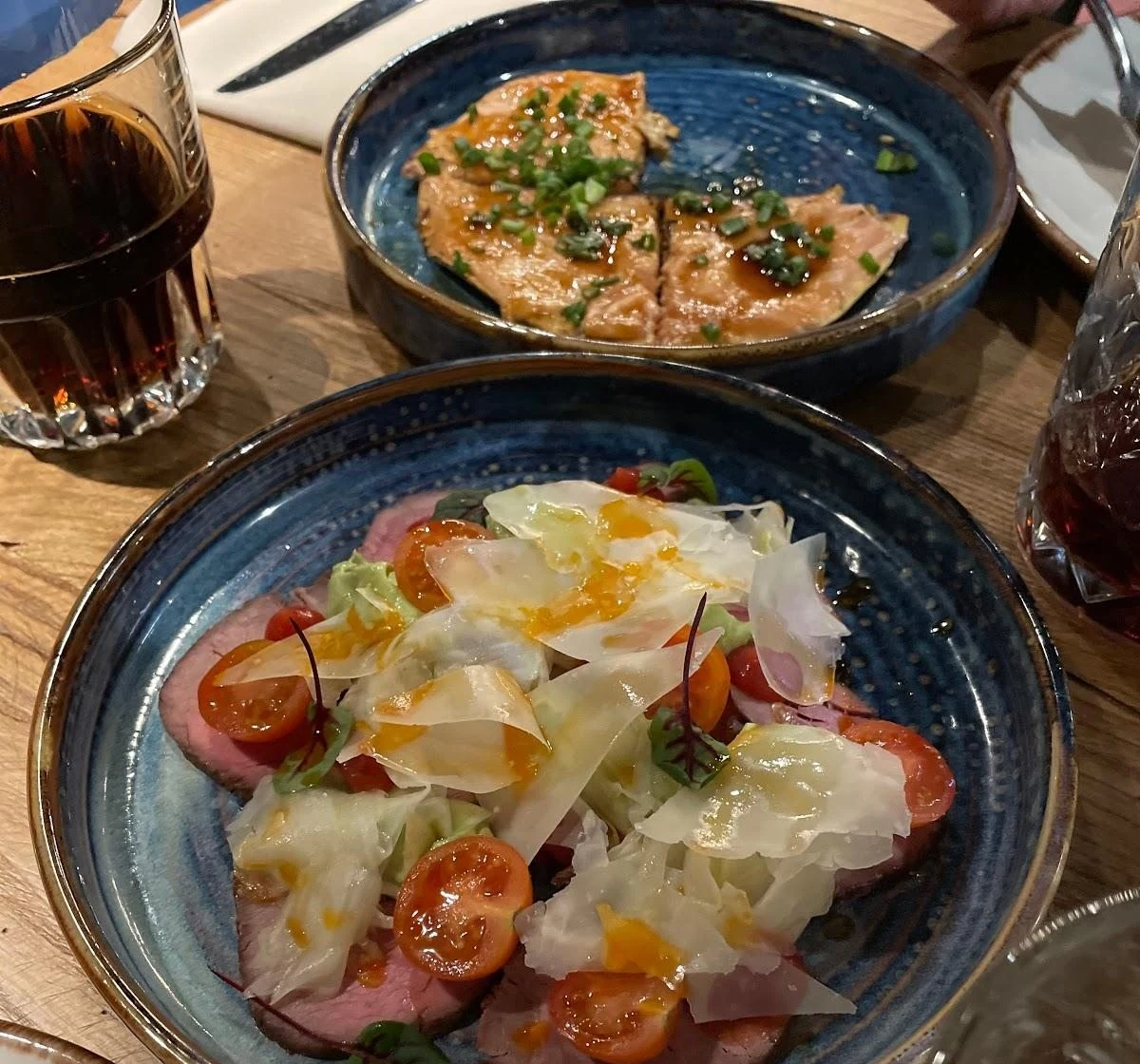
Dishes from the implemented restaurant, developed by its culinary team. Supplied photograph, cropped to exclude the added character.
The dangerous temptation to make everything a little better
From my perspective, the most significant problem was a gradual change in priorities.
I had designed Gastronom around accessible expertise.
A deliberately democratic alternative to the traditional premium gastronomic experience.
The owner wanted something more prestigious.
More sophisticated.
More visibly premium.
And he became personally involved in changing and developing the concept.
That isn't inherently a problem.
It's his business, after all.
The owner has every right to decide what he wants to build.
But when an operating concept is designed around a particular economic logic, changing individual elements can have consequences far beyond their immediate cost.
A more expensive interior isn't just a prettier room.
It's additional capital that has to be recovered.
A more complicated kitchen isn't just a better menu.
It can mean more people, more equipment, more preparation, more stock, more waste and more opportunities for things to go wrong.
Higher operational complexity requires stronger management.
And an investment-heavy restaurant needs an equally convincing explanation of how its revenue will cover that investment.
In my assessment, Gastronom began moving away from the relative simplicity and accessibility that were supposed to distinguish it.
There was overinvestment.
The positioning drifted towards greater premiumisation.
And elements of the operating model became more complicated.
I raised concerns about these risks.
But the owner wanted to remain creatively involved.
And the project continued in the direction he preferred.
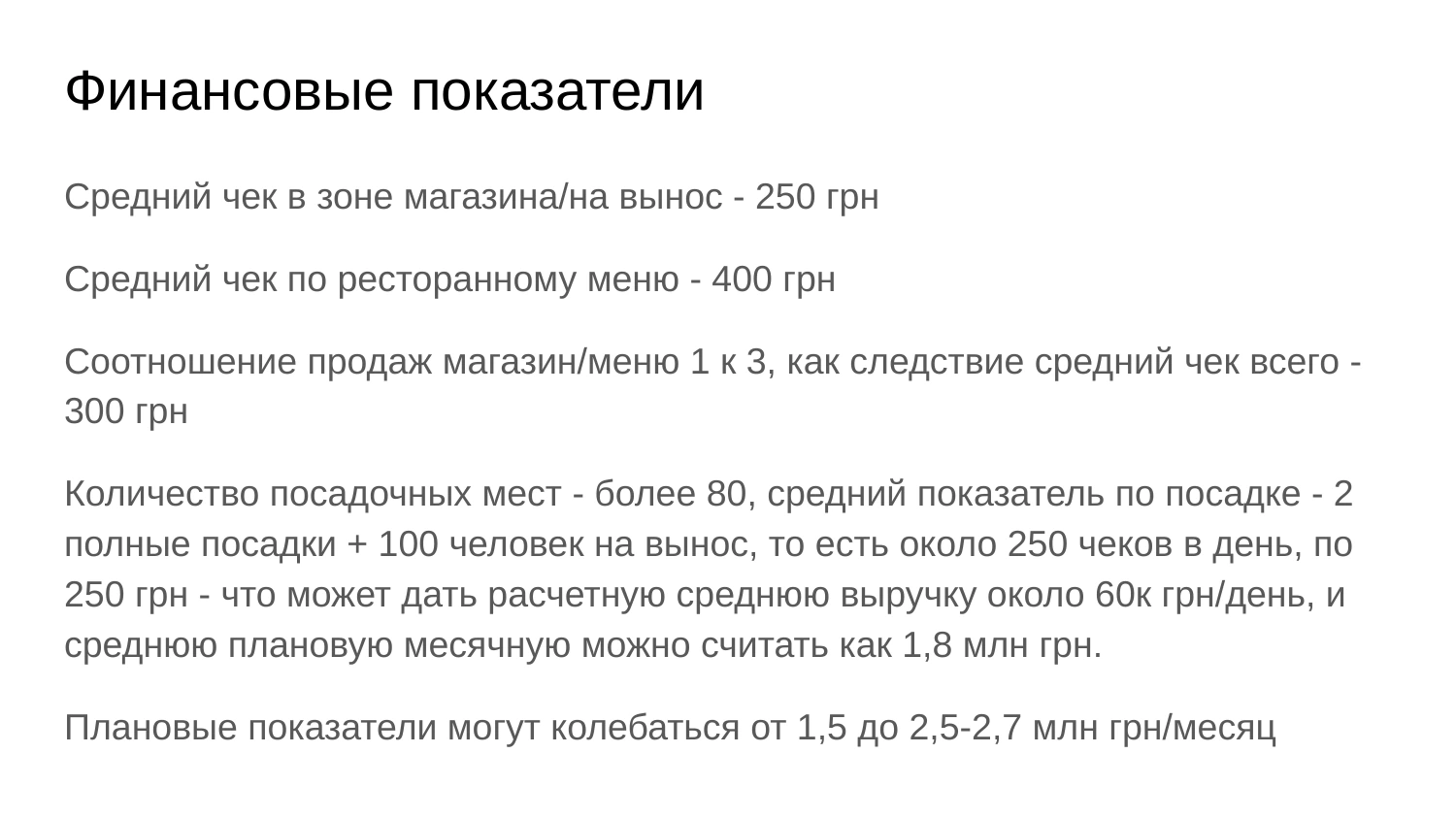
Original projections, not actual financial results. Slide 49 records assumptions for average checks, visits and monthly revenue; these are historical planning figures, not audited performance.
Why restaurant owners so often underestimate their own business
I've always found this phenomenon fascinating.
People who have successfully built businesses in other industries often look at restaurants and think they understand how the model works.
They have visited hundreds of restaurants.
They know what good food tastes like.
They have opinions about interiors, wine lists, service and music.
And they may have enough money to create something very attractive.
So opening a restaurant can look deceptively simple.
Find a place.
Renovate it.
Hire a chef.
Create a menu.
Open the doors.
Unfortunately, the customer's experience of a restaurant tells you almost nothing about the operational machinery required to produce it consistently.
Restaurants are unusually complex businesses.
Inventory expires.
Demand changes by the hour.
A small failure in staffing can disrupt the entire service.
Kitchen production, dining-room service, purchasing, stock control, pricing, sanitation and customer expectations all interact.
You can't simply optimise one part of the system and assume the others will follow.
And the more elaborate the format becomes, the more expensive the consequences of weak management can be.
This is why I think a restaurant owner's creative enthusiasm needs to be balanced by operational discipline.
Creativity is valuable.
But not every attractive idea belongs in the business.
Especially when the business was designed around a different proposition.
The restaurant eventually closed
Gastronom operated in Kyiv and was subsequently listed among the establishments that closed in 2022.
I consider the departure from the original economic concept, excessive investment and weaknesses in management important factors in what happened.
That's my professional assessment, based on my involvement with the concept and what I observed.
It isn't an audited financial postmortem.
I don't have independently verified operating figures that would allow me to calculate exactly how much each decision contributed to the closure.
And 2022 was also the year of Russia's full-scale invasion of Ukraine — an extraordinary disruption for businesses across the country.
It would be irresponsible to pretend that a restaurant's closure in that period can be explained by a single neat management lesson without considering the broader circumstances.
Still, the strategic risks I had identified were real concerns well before any final outcome.
And for me, that's the central lesson of this project.
A concept can be accepted, largely implemented and still lose its economic coherence during execution.
A restaurant can look wonderful.
Serve interesting food.
Attract attention.
And yet be structurally more difficult to operate than it needed to be.
Photographs don't tell you whether the investment was proportional to the expected return.
An impressive wine list doesn't tell you whether the inventory is turning fast enough.
A sophisticated menu doesn't tell you whether the kitchen is profitable.
The business still has to work.
What I would preserve from Gastronom today
Looking back, I still believe in the basic format.
The combination of restaurant, delicatessen and wine bar.
Retail pricing for selected products.
No unnecessary barrier between buying a bottle and enjoying it at a table.
A bright, quick-service retail zone alongside a more relaxed restaurant space.
Visible merchandise as part of the interior.
A menu structured around overlapping ingredients and multiple consumption occasions.
And an approachable, democratic relationship with wine and gastronomy.
I would still consider many of those decisions worth exploring in a new project.
But I would insist on stronger boundaries between concept development and owner-led changes during implementation.
Not because the original concept should be treated as sacred.
It shouldn't.
Every concept needs to adapt when it meets the real world.
But changes should be evaluated as changes to a system.
If we increase capital investment, what happens to the payback assumptions?
If we expand the menu, what happens to staffing, inventory and preparation?
If we move towards premium positioning, what happens to the original target audience and the customer promise?
If we add an expensive design feature, what precisely does it contribute to the economics or the customer experience?
Sometimes the answer will justify the change.
Sometimes it won't.
The important thing is to ask before spending the money.
The difference between designing a restaurant and running one
I didn't operate Gastronom.
I developed the concept that became the foundation of much of it.
That distinction matters.
I'm proud that a substantial part of my work became a real establishment.
And I'm equally interested in what happened when the idea was implemented differently from the way I intended.
Because this is where business design becomes more complicated than graphic design.
You can't simply look at the final photographs and decide whether the project succeeded.
The beautiful parts are visible.
The economics usually aren't.
And a concept is ultimately valuable not because every element looks impressive, but because its parts support a viable business.
Gastronom taught me something I already suspected from other hospitality projects, but illustrated it unusually clearly.
An owner doesn't always damage a project by ignoring the concept.
Sometimes the owner likes the concept very much.
Implements most of it.
And then changes just enough of its assumptions to make the whole thing significantly harder to run.
That's a much more subtle problem.
And a much more expensive one.
A good restaurant concept isn't a collection of things worth adding.
It's also a disciplined understanding of what not to add.
Related Working Stories
The Dutch Coffeehouse That Never Opened — an accepted hospitality concept that remained unbuilt.
When the Flour Bag Became Part of the Product — another case of designing the relationship between product, presentation and customer value.