
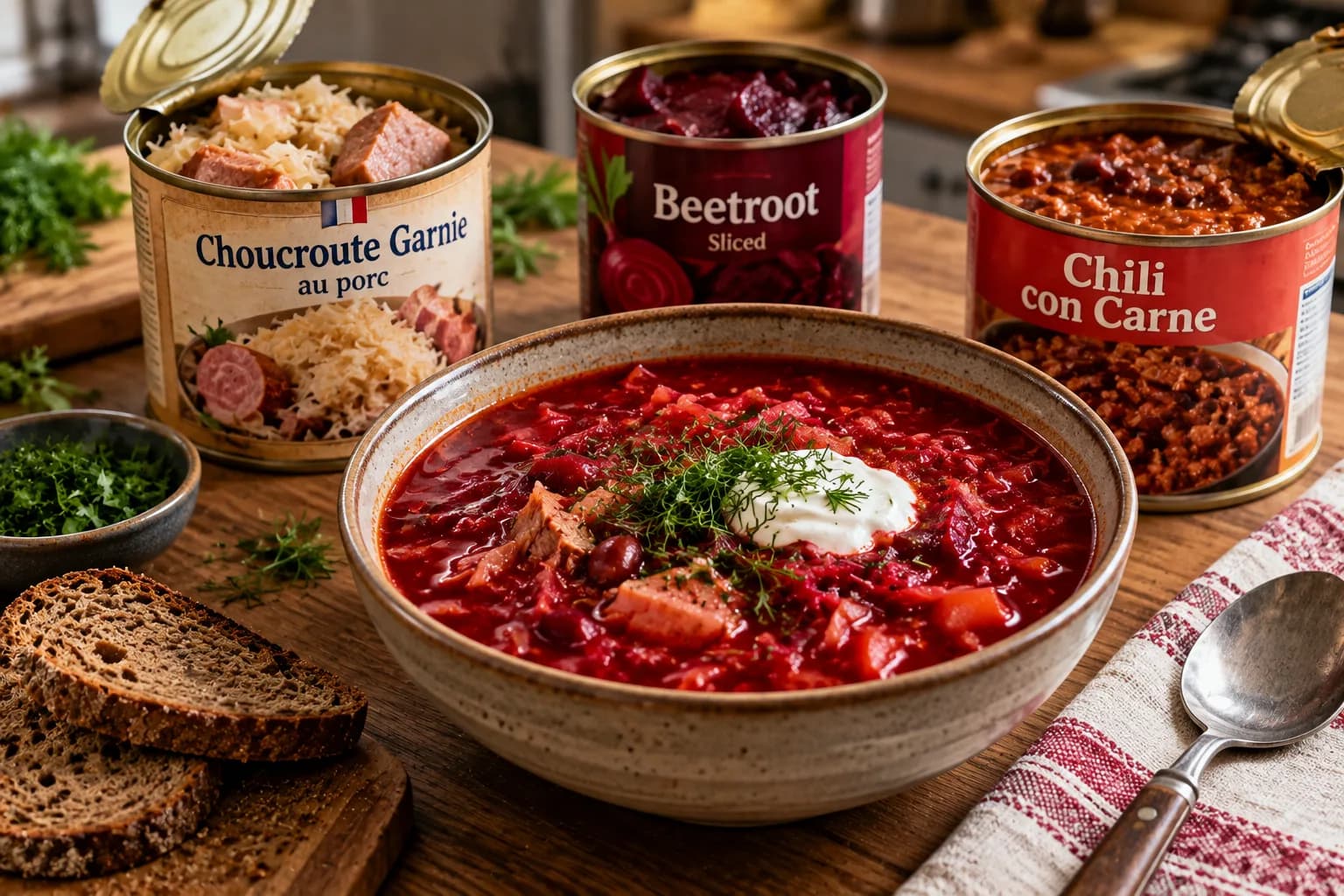
French sauerkraut with pork, canned beetroot, chili con carne, and a cooking experiment that should probably have been a disaster.
I've written before about Ukrainian borscht.
The traditional varieties. The regional differences. The fierce arguments about whether beetroot or tomatoes should dominate.
I've even written about three rather unusual fish borschts.
One from Odesa, with fried Black Sea gobies.
One from Donetsk, with canned sprats in tomato sauce.
And one from the Poltava tradition, with crucian carp dried on straw in a traditional stove.
Wonderful dishes.
All of them perfectly legitimate expressions of Ukrainian food culture.
And then there's something I made myself.
A borscht assembled almost entirely from canned food.
Including Mexican chili con carne.
And French sauerkraut.
I should probably apologise to several nations at once.
But the damned thing actually worked.
First, let's dismantle the borscht
I'm Ukrainian.
I grew up eating borscht, and I know perfectly well what goes into it.
I also spent years working in the restaurant business, which gave me a slightly unfortunate habit of looking at dishes not merely as recipes but as collections of functions.
What makes a dish work?
Which ingredients provide the structure?
Which contribute acidity, sweetness, colour, texture or richness?
And what happens if we replace the traditional ingredients with something that performs approximately the same function?
This is a dangerous way of thinking about food.
It's also how interesting things occasionally happen.
Consider borscht.
Underneath all the family traditions and regional arguments, we have a combination of cabbage, beetroot, vegetables, a savoury base and a particular balance of acidity and sweetness.
Meat is optional.
Beans are optional.
Tomatoes may play a major role or a relatively minor one.
There is plenty of room for variation.
So I began wondering how much of the actual preparation I could eliminate.
Not by buying ready-made borscht.
That would be cheating.
But by assembling the dish from other prepared foods.
Foods that were never intended to become borscht in the first place.
The French have already prepared the cabbage
The first component was French choucroute garnie.
For anyone unfamiliar with it, this is a traditional Alsatian dish based on sauerkraut, usually served with various pork products.
In France, you can buy prepared versions.
Including canned ones.
And I thought:
Well, there's my cabbage.
And some meat.
And acidity.
And quite a lot of flavour already built into the product.
Admittedly, using Alsatian sauerkraut instead of ordinary fresh cabbage changes the flavour considerably.
But fermented cabbage isn't exactly an alien concept in Eastern European cooking.
We know what to do with sauerkraut.
And the pork was already there.
One substantial part of the borscht problem had been solved before I'd even opened the next can.
Then came the beetroot
This part was almost embarrassingly easy.
Canned beetroot.
Already cooked.
Already prepared.
No peeling.
No grating.
No stained cutting board.
No hands looking as though I'd spent the afternoon investigating a particularly gruesome crime scene.
Just beetroot.
From a can.
It would provide the familiar colour and flavour.
Two major ingredients accounted for.
And now we needed something to bring the rest of the soup together.
Which is where things became a little unconventional.
Even by my standards.
Mexico enters the kitchen
Chili con carne.
Yes.
The Mexican-inspired dish made with meat, beans, tomatoes and spices, available in supermarkets in ready-made canned versions.
Now, I know what you're thinking.
Chili con carne?
In Ukrainian borscht?
Are we attempting to start an international incident?
But think about what it provides.
Meat.
A substantial savoury base.
Seasoning.
Often beans and tomato.
And, depending on the particular product, enough salt and spices that you don't need to spend half an hour constructing a separate flavour base.
In other words, it's already doing several jobs that would otherwise require multiple ingredients and cooking stages.
Of course, chili con carne is not a Ukrainian ingredient.
Its seasoning is different.
And the whole thing is a rather spectacular departure from any recipe my grandmother would have recognised.
But I wasn't attempting to recreate my grandmother's borscht.
I was conducting an experiment.
And I had a theory.
If the essential components of a dish are already prepared, perhaps you don't need to prepare them again.
A revolutionary discovery, I know.
The world's least traditional borscht
So the idea was simple.
Take the prepared French cabbage-and-pork dish.
Add the canned beetroot.
Add the canned chili con carne.
Use water to bring the mixture towards a soup consistency.
Adjust the seasoning as necessary.
Heat everything together until the flavours come together.
No long stock-making process.
No elaborate vegetable preparation.
No separate pan of sautéed onions and carrots.
No extended cooking ritual.
The original experiment involved a few additional adjustments, but I didn't preserve a precise ingredient-by-ingredient record or the quantities. So I'm not going to invent measurements and pretend this was a carefully standardised recipe.
The important point was that almost all the substantial cooking had already been done by somebody else.
In three different food factories.
Possibly in three different countries.
And now their products were meeting in one saucepan to discuss Ukrainian national cuisine.
A potentially disastrous diplomatic summit.
And what did it taste like?
Borscht.
Remarkably, recognisably borscht.
Not a perfect imitation of a slow-cooked family recipe, obviously.
The sauerkraut introduced its own fermented acidity.
The chili con carne contributed a different spice profile from a conventional Ukrainian preparation.
And the balance of ingredients depended heavily on what was inside those particular cans.
But the overall combination worked.
It had the vegetable character.
The savoury richness.
The cabbage.
The beetroot.
The tomato notes.
Enough of the familiar structure to make the result recognisable.
And, more importantly, it was enjoyable to eat.
That's what surprised me.
I hadn't merely assembled something technically edible.
I'd discovered that a dish with a fairly complicated traditional preparation could be approximated using three completely unrelated ready-made products.
And the result was actually good.
Is it authentic Ukrainian borscht?
Oh, absolutely not.
Let's not pretend otherwise.
No Ukrainian grandmother ever looked at a tin of chili con carne and said:
"At last. The secret ingredient my ancestors have been waiting for."
At least, I very much doubt it.
But I've never been particularly interested in treating recipes as sacred texts.
Food traditions are important.
Understanding them is important.
Preserving them is important.
But that doesn't mean every meal has to be a historical reconstruction.
Sometimes you want to explore what makes a familiar flavour possible.
Sometimes you want to cook with whatever happens to be available.
And sometimes you simply want to see whether a ridiculous idea actually works.
This was definitely the third category.
The recipe, or rather the principle
I wouldn't present this as a precise recipe with scientifically calibrated proportions.
It's a kitchen experiment worth remembering.
The essential components were:
- Prepared canned French choucroute garnie with pork.
- Canned beetroot.
- Canned chili con carne.
- Water to adjust the consistency.
- A small amount of additional seasoning, according to taste.
The practical approach is to combine the prepared components in a saucepan, adjust the liquid and seasoning, and heat them together thoroughly.
The exact balance matters because different brands of choucroute, beetroot and chili can vary considerably in acidity, sweetness, salt and spices.
So it's better to taste and adjust than to pretend every can is identical.
If the chili is heavily spiced, that flavour will be more noticeable.
If the choucroute is particularly acidic, it will dominate more.
And if the beetroot is packed in a strongly seasoned liquid, that will affect the result too.
This is less a recipe than an invitation to understand what you're putting into the pot.
Which, come to think of it, is true of most cooking.
There's a funny historical parallel here
In my previous Kitchen Note, I described a borscht I encountered during business trips to Donetsk.
It was made with canned sprats in tomato sauce.
A normal vegetable borscht, without beans, finished with a tin of inexpensive fish.
Very practical.
Very affordable.
And surprisingly tasty.
That was an established regional preparation I encountered in ordinary homes and canteens.
My canned-food experiment was something else entirely.
But the two share a little philosophy.
Take a familiar dish.
Find a prepared ingredient that adds several useful things at once.
And reduce the effort without necessarily sacrificing the pleasure of eating.
The difference is that the Donetsk cooks used one convenient canned ingredient.
I apparently decided to see whether the entire pot could become a small international exhibition of canned goods.
And, against reasonable expectations, it worked.
Sometimes cooking is an exercise in not cooking
I love elaborate recipes.
I've spent entire days preparing complicated meals.
I once helped roast an enormous pig in a pit on a beach in Kyiv.
I've cooked fish soup that required a rooster, several varieties of fish, roasted poultry, aspic and a separate garlic sauce.
So I'm not against hard work in the kitchen.
Quite the opposite.
But I also enjoy a clever shortcut.
Especially one that teaches me something about how a dish works.
The canned-food borscht won't replace a proper homemade Ukrainian borscht.
It was never supposed to.
But it proved something interesting to me.
Sometimes the identity of a dish survives much more radical substitutions than you might expect.
And sometimes, when you stop asking whether a combination is respectable and start asking whether it tastes good, you discover something worth keeping.
Even if it involves chili con carne.
Even if it involves French sauerkraut.
And even if several generations of Ukrainian grandmothers would be absolutely furious.
Three cans. One saucepan. And a completely unreasonable borscht that turned out to be delicious.