
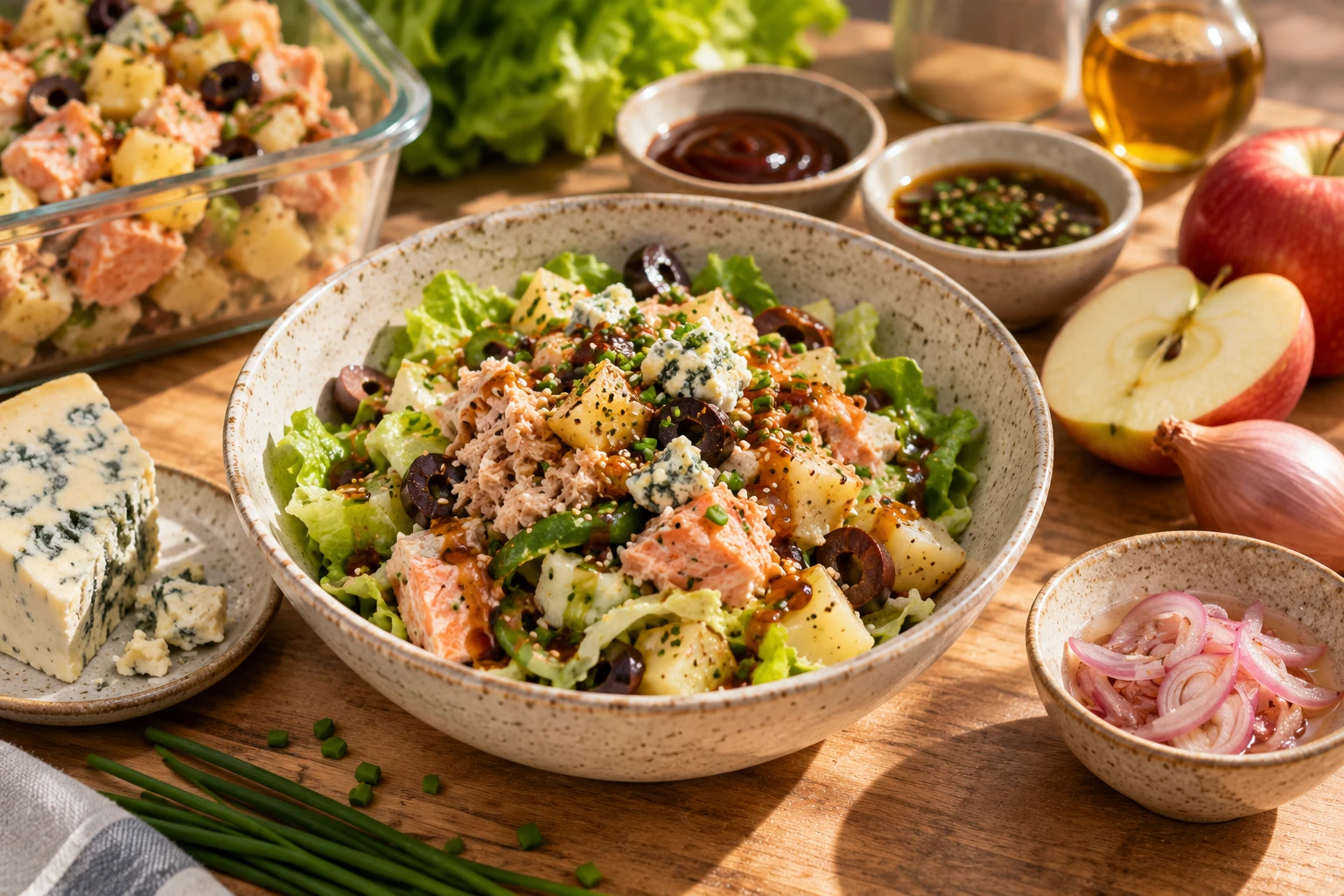
Lettuce, baby mozzarella, radishes, jalapeño, tuna-and-olive paste, Gorgonzola, three sauces, and my alternative to preparing seven identical lunches.
I'm not particularly enthusiastic about traditional meal prep.
You know the ritual.
Sunday afternoon.
Seven identical containers.
Seven identical lunches.
Everything carefully calculated and arranged in the refrigerator.
By Thursday, the lettuce has probably developed a rather philosophical attitude towards existence.
I'm sure it works for some people.
But I prefer another approach.
I prepare a selection of ingredients for the week, not seven finished meals.
Or, more accurately, I buy some of those ingredients already prepared.
Then, when I want something to eat, I assemble a fresh portion.
A little chopping.
A few interesting additions.
Some sauces.
And five minutes later, I have something that tastes like an actual meal rather than an obligation I prepared last Sunday.
This week's experiment turned out particularly well.
Although, looking at the ingredient list, I'm beginning to wonder whether I still have the right to call it a simple salad.
The starting point: tuna, olives and potatoes
I recently bought a large package, approximately 1.5 kilograms, of a prepared salad mixture.
It's an interesting product.
The main components are tuna and olives, combined into a savoury paste, with small cubes of boiled potatoes.
And the potatoes are particularly good.
They're fully cooked but remain firm.
Not overboiled.
Not disintegrating.
Almost al dente, if you'll forgive me for borrowing an Italian pasta term to describe a French supermarket potato.
That's important because I want to use the mixture as a component in different salads.
Not simply eat it straight from the container.
The tuna-and-olive paste provides a concentrated savoury base, while the potato cubes give the mixture substance and texture.
I can add fresh ingredients, vary the dressing, and create something different each time.
Naturally, I keep the prepared mixture refrigerated and follow its instructions for storage after opening, especially because it contains fish.
The idea is to have convenient ingredients available, not to gamble on how long a large opened container might last.
A small bowl and an increasingly ambitious salad
I usually prepare relatively small individual portions.
At least, that's the intention.
I take a bowl.
Start with chopped lettuce.
Then add more than ten little balls of baby mozzarella.
They're soft, mild and pleasantly creamy.
Next come the radishes.
More than ten small radishes, chopped into pieces.
I love that fresh crunch and slightly sharp flavour.
Then half a jalapeño.
Not an ordinary green bell pepper.
A proper jalapeño.
That gives the salad a little heat and a more pronounced green-pepper character.
At this point, we have lettuce, mozzarella, radishes and jalapeño.
Fresh, crunchy, creamy and slightly spicy.
Now I add the prepared tuna mixture.
Approximately four heaped tablespoons, perhaps around 100 grams.
The tuna-and-olive paste brings savouriness, and the little pieces of cooked potato make the salad substantially more filling.
It would already be a perfectly reasonable meal.
But I hadn't started on the dressing yet.
Gorgonzola makes an appearance
First, a very small amount of Gorgonzola.
Not enough to dominate the salad.
Just a little.
The baby mozzarella already provides plenty of mild, creamy cheese.
The Gorgonzola has a different job.
I want its stronger, slightly sharp flavour to become part of the dressing.
So I work it into the other ingredients rather than treating it as a separate topping.
Two cheeses.
Two completely different functions.
Perfectly reasonable.
At least in my kitchen.
Korea, Japan and Italy meet in a French salad bowl
Then I start adding sauces.
A little Korean barbecue sauce.
Not much.
Just enough for its characteristic sweetness, savouriness and depth.
Next, ponzu with chives, or ciboulette, as they're called in France.
This gives the dressing an acidic, fresh and slightly onion-like dimension.
Then a little sesame oil.
I love sesame oil.
You don't need much to introduce that distinctive roasted, nutty aroma.
And remember, the ready-made tuna-and-olive mixture is already a paste.
So when I mix everything together, that paste becomes part of the dressing too.
It combines with the Gorgonzola and sauces, coating the mozzarella, radishes, lettuce, jalapeño and potatoes.
Finally, I add a little of my seed-and-grain salad topping.
I enjoy these kinds of mixtures, with ingredients such as flaxseed, buckwheat and other small crunchy additions.
They bring another texture to the dish.
And that's it.
No added salt. No added pepper.
There's already plenty of seasoning in the prepared tuna mixture and the sauces.
Adding more simply because a recipe normally ends with “season with salt and pepper” would be rather pointless.
I taste the result first.
And this one didn't need anything else.
Why this combination works for me
It might sound like too many ingredients.
Two cheeses.
Tuna.
Olives.
Potatoes.
Fresh vegetables.
Several sauces.
And a crunchy topping.
But I wasn't adding enormous amounts of everything.
The pleasure was in the balance.
The lettuce gives freshness.
The baby mozzarella adds soft, creamy bites.
The radishes bring crunch and a peppery sharpness.
The jalapeño adds heat.
The potatoes give the salad substance.
The tuna and olives create a deep savoury base.
The tiny amount of Gorgonzola adds another layer of richness.
The Korean BBQ sauce brings sweetness and savoury depth.
The ponzu adds acidity.
The chives contribute a little onion aroma.
And sesame oil gives everything that wonderful roasted note.
The salad topping finishes it with a little more texture.
Nothing here is particularly difficult to prepare.
The interesting part is deciding how these things work together.
I don't especially care that Korean barbecue sauce, Japanese ponzu and Italian Gorgonzola aren't supposed to belong to the same culinary tradition.
They don't need passports.
They need to taste good together.
And they did.
The actual salad
Here's what I used this time. I didn't measure every sauce, because I added them gradually according to taste.
Ingredients
- Chopped lettuce
- More than 10 balls of baby mozzarella
- More than 10 small radishes, chopped
- Half a jalapeño, chopped
- 4 heaped tablespoons, approximately 100 g, of prepared tuna-and-olive paste with small cubes of boiled potato
- A very small amount of Gorgonzola
- A little Korean BBQ sauce
- Ponzu sauce with chives (ciboulette)
- A small amount of sesame oil
- A little seed-and-grain salad topping
No additional salt or pepper.
Preparation
- Put the chopped lettuce into a salad bowl.
- Add the baby mozzarella balls.
- Chop the radishes and add them.
- Finely chop half a jalapeño and mix it into the vegetables.
- Add four heaped tablespoons of the prepared tuna, olive and potato salad.
- Crumble in a very small amount of Gorgonzola.
- Add small quantities of Korean BBQ sauce and ponzu with chives.
- Add a little sesame oil.
- Mix thoroughly so that the tuna-and-olive paste, Gorgonzola and sauces coat the other ingredients.
- Finish with the salad topping.
And eat.
No separate dressing preparation.
No cooking.
Very little chopping.
Quite a lot of interesting flavour.
Exactly the kind of everyday cooking I enjoy.
Next time, I'm thinking about apple and shallots
Naturally, while finishing the salad, I was already thinking about what to change next time.
Two ideas.
First, shallots.
Thinly sliced and marinated in apple cider vinegar.
I think that mild onion flavour and extra acidity could work particularly well with the tuna, potatoes and Gorgonzola.
Second, fresh apple.
Small pieces added just before serving.
Something crisp.
Juicy.
A little sweet.
A little acidic.
I suspect apple could work beautifully against the stronger savoury flavours, especially the Gorgonzola and tuna-and-olive paste.
I haven't tried that combination yet.
It's the next experiment.
And if it works, perhaps it will become next week's version of the salad.
I don't need every ingredient to be homemade
I've written before about my habit of using prepared supermarket ingredients.
Ready-grated carrots in Ukrainian borscht.
Vacuum-packed beetroot.
Canned beans.
Prepared vegetables.
And now this tuna, olive and potato mixture.
I don't regard cooking as a competition to see how many individual operations I can perform personally.
If somebody has already prepared the potatoes properly, why should I boil them again?
If a good tuna-and-olive mixture is available, why not use it?
What matters to me is what happens afterwards.
The combinations.
The textures.
The little adjustments.
The decisions that make the final dish taste the way I want.
Tomorrow, I may use the same prepared base with an entirely different dressing.
Or with apple and marinated shallots.
Or with some other vegetables.
That's why I prefer this approach to traditional meal prep.
I haven't prepared seven identical meals.
I've prepared a collection of possibilities.
And each day, I get to decide what to do with them.
I don't need every ingredient to be homemade.
I just want the finished dish to be mine.