
An old story about geese and bloodsucking creatures, a rather extraordinary dinner in a Ukrainian village, and the biologist who helped turn my curiosity about strange food into something much more serious.
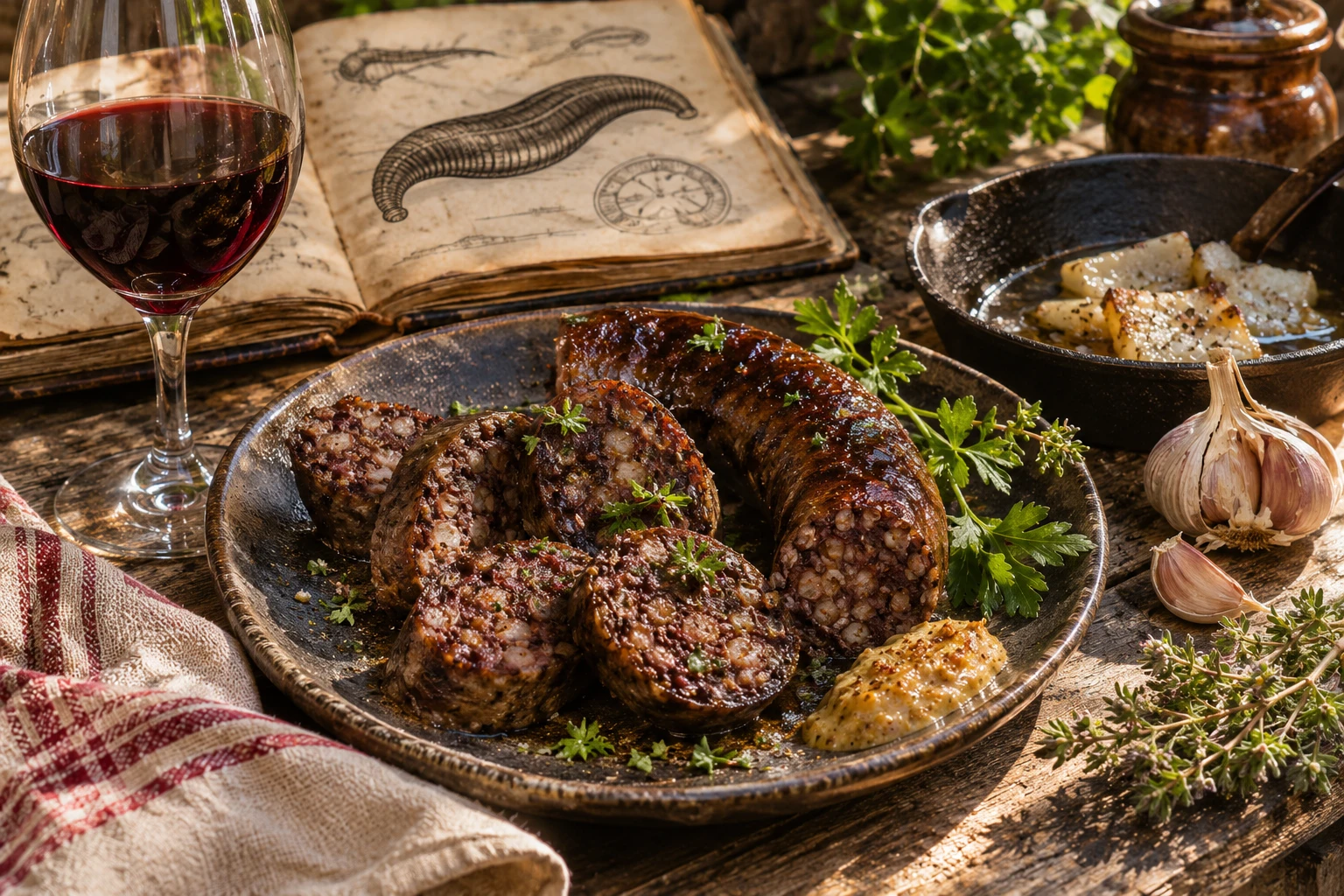
Cover illustration: a rustic blood-sausage meal and a naturalist’s journal; not a photograph of the recalled leech dish.
There are certain ingredients that make people uncomfortable.
Insects, for example.
Earthworms.
Frogs.
Various internal organs that are perfectly ordinary in one country's cuisine and considered utterly horrifying in another.
But I think leeches occupy a special place in this category.
They're rather difficult to make attractive.
A dark, slippery creature that attaches itself to an animal, drinks its blood, and becomes increasingly swollen in the process.
Wonderful.
Exactly what you want to see on the menu of a respectable restaurant.
And yet, somewhere in my old unfinished cookbook, I devoted an entire section to cooking leeches.
Not merely discussing their nutritional properties.
Actually cooking them.
With sauces.
With vegetables.
And even as blood sausage.
Yes, blood sausage.
My friend made it.
And I ate it.
But before we reach that particularly memorable dinner, let me tell you about a goose.
A goose, some leeches, and a deeply questionable culinary tradition
Years ago, while collecting recipes for my book about unusual food, I encountered a remarkable story.
It was presented to me as an old French way of preparing leeches.
The general idea was that a goose and a collection of bloodsucking leeches would somehow become the ingredients for two dishes.
The bird would provide the blood.
The leeches would become little blood-filled sausages.
And the goose would eventually be roasted.
I found the idea wonderfully grotesque.
Imagine explaining the menu to your dinner guests.
For the main course, roast goose.
Excellent.
And for the starter, some of the goose's blood, conveniently packaged inside the animals that drank it.
Perhaps a glass of wine would help.
The original recipe was rather graphic, and my younger self described the entire operation with considerable enthusiasm.
Looking back, however, I can't establish that this was genuinely a traditional French recipe.
I don't have a reliable French historical source for it.
And that's an important distinction.
But while revisiting the material, I found something rather interesting.
Heston Blumenthal had apparently been thinking about the same thing
Heston Blumenthal, the British chef famous for his experimental approach to cooking, explored a remarkably similar idea.
His inspiration came from a Romanian account involving leeches and a goose.
While researching a Gothic-themed feast, he encountered a local story about leeches fed on goose blood and subsequently prepared as food.
Naturally, Blumenthal decided to investigate.
Because apparently the correct response to hearing a story about blood-filled leeches is to wonder whether they might taste good.
He experimented with the idea.
And the result was not an unqualified success.
The blood itself behaved rather like a familiar blood-based food when cooked.
But the leeches' texture was significantly less appealing.
Their outer bodies remained an unpleasant part of the experience.
Blumenthal ultimately chose other dishes for his finished menu.
Which makes me smile.
Even one of the world's most adventurous experimental chefs occasionally discovers an ingredient that simply refuses to cooperate.
I find the connection fascinating.
My manuscript contained a story about goose-fed leeches.
Blumenthal had explored a Romanian story about goose-fed leeches.
Whether those accounts share a common historical origin is another question.
But at least I now know I wasn't the only person who found the idea worth investigating.
And in my case, the curiosity went considerably further.
What makes a leech different from blood sausage?
Let's consider ordinary blood sausage.
In Ukraine, we have krovianka.
In Britain, there's black pudding.
In France, boudin noir.
In Spain, morcilla.
And many other countries have their own versions.
The ingredients and methods differ.
But the underlying principle is familiar.
Blood is combined with other ingredients, often including grains, fat, onions or seasonings.
Then the mixture is enclosed in a casing and cooked.
Perfectly respectable.
Traditional.
Delicious, if you enjoy that sort of thing.
Now consider a leech that has fed on blood.
The blood is still blood.
The animal, however, provides a rather unconventional container.
Suddenly, the entire idea becomes revolting.
Why?
Partly because the casing is now a recognisable creature.
Partly because of the association with parasites and bloodsucking.
And partly because the image of a plump leech triggers the sort of disgust that an ordinary slice of black pudding generally doesn't.
Of course, there are genuine biological differences and genuine safety concerns. A leech is not simply a miniature sausage casing.
But from the perspective of culinary psychology, the comparison is irresistible.
People may happily eat blood sausage while recoiling from the very idea of blood inside a leech.
And that is precisely the sort of contradiction my Strange Food project was created to investigate.
My old manuscript got rather enthusiastic
At this point, my original chapter described various ways people supposedly prepared leeches.
Some accounts referred to rural hunters and fishermen.
Others involved the idea of allowing leeches to feed directly on the person who intended to eat them.
My younger self thought this was especially amusing.
Fairness, you see.
If something is going to eat your blood, perhaps you should be entitled to eat it afterwards.
A perfectly balanced culinary relationship.
I also suggested that feeding leeches on one's own blood might eliminate the risk of transmitting somebody else's diseases.
That was not a sound conclusion.
Leeches have their own complex microbiology, including bacteria naturally associated with their digestive systems.
They can cause infections, and blood exposure introduces additional risks.
Using your own blood doesn't make the animal sterile or safe to eat.
Modern medical practice treats leeches as biological materials requiring careful infection-control procedures, not as ordinary edible livestock.
So the old chapter's practical suggestions are better left in the archive.
But the culinary question remains interesting.
Could the flavour and texture of leeches be made genuinely enjoyable?
And what would happen if we approached them not as a novelty designed to frighten people, but as an ingredient requiring a thoughtful preparation?
I actually had an opportunity to explore that question.
I preferred them with a proper sauce
Of the leech preparations I remember tasting, one of the most interesting involved a fairly conventional savoury vegetable sauce.
Onions.
Carrots.
Tomatoes.
A little wine vinegar.
Bay leaf.
Cloves.
Some hot pepper.
A restrained balance of sweetness and salt.
Nothing especially exotic there.
You could find a similar flavour combination in various Eastern European preparations involving meat, fish or vegetables.
The leeches were incorporated into this rich, aromatic sauce.
And I remember liking the result.
The important observation was that the dish didn't depend entirely on the novelty of its main ingredient.
It used an ordinary culinary idea.
A well-developed sauce.
Acidity.
Aromatics.
Seasoning.
The kind of preparation that gives an unfamiliar ingredient a more recognisable gastronomic context.
My old notes contained precise preparation instructions.
I wouldn't reproduce those as a modern recipe without validated food-grade sourcing, processing and safety controls.
But I want to preserve the idea.
Because it was an experiment in making something unusual genuinely enjoyable.
Not simply making people uncomfortable.
And then there was the blood sausage.
Which brings me to a rather extraordinary friend.
My friend, the biologist who preferred living in a village
I've mentioned this friend before in my Kitchen Notes.
He was a scientist.
A Doctor of Biological Sciences.
A man with extensive knowledge of biology and an equally extensive enthusiasm for gastronomy.
At some point, he decided that ordinary civilisation had become rather less interesting than life in the countryside.
So he moved to a small village called Stepanovka.
He lived away from the usual urban distractions.
And he cooked.
Experimented.
Collected unusual ingredients.
Read.
And generally approached food with the curiosity you might expect from a professional biologist who didn't particularly believe that an ingredient should be rejected simply because it looked alarming.
Visiting him was always interesting.
You never knew exactly what might appear on the table.
And he had a significant advantage over most amateur enthusiasts of unusual food.
He understood the organisms he was dealing with.
More importantly, he also had professional contacts who worked with them.
Some of my earliest experiments with preparing insects took place with him.
He could ask fellow biologists for laboratory-reared larvae, cockroaches and other organisms that were ordinarily bred as feed for reptiles.
That made the supply rather different from wandering around collecting insects under rocks.
Although it's worth noting that laboratory-reared reptile feed isn't automatically approved or safe for human consumption.
The distinction still matters.
But it gave us access to materials that were practically impossible to obtain through conventional food suppliers at the time.
And naturally, we began experimenting.
Those experiences became an important part of the story that eventually led me towards edible-insect farming and introducing fried Zophobas larvae and crickets in our Banka bars.
But my friend was interested in considerably more than insects.
Including leeches.
Blood sausage. With buckwheat. And leeches.
One day, he prepared something I still remember.
Blood sausage made with leeches.
Not merely a plate of fried leeches pretending to be sausages.
An actual sausage.
With a casing.
A conventional sausage shape.
And a filling built around the unusual ingredient.
He used pork intestine as the casing.
There was buckwheat porridge.
And the sausage was baked with rendered pork fat, smalets.
Now, if you know Ukrainian blood sausage, the general idea is wonderfully familiar.
Buckwheat.
A pork casing.
A rich, savoury filling.
Pork fat.
These are hardly unfamiliar ingredients in Eastern European cooking.
The unusual part was the use of leeches.
My friend had effectively taken a traditional culinary structure and replaced one of its fundamental components with something most people wouldn't dream of putting into a sausage.
The result was interesting.
And, to my taste, genuinely delicious.
I don't remember every detail of the preparation, and I won't invent measurements or a complete recipe now.
What stayed with me was the idea.
A dish that sounded absolutely outrageous when described in one sentence could become surprisingly recognisable when approached through an established culinary tradition.
It wasn't presented as a dare.
It was food.
Experimental food, certainly.
But food prepared by somebody who took both the science and the gastronomy seriously.
And I enjoyed it.
The most interesting experiments aren't necessarily the most disgusting
There's a tendency to approach unusual food as entertainment.
Find the most revolting ingredient possible.
Put it in front of somebody.
Record their reaction.
Perhaps make them eat it while everyone else laughs.
I understand the attraction.
But that was never the most interesting part for me.
I wanted to know whether an unfamiliar ingredient could become a good dish.
Not merely a shocking dish.
Could its flavour be improved?
Could its texture be made more pleasant?
Which familiar cooking methods might work?
What did its biology tell us about the challenges involved?
And were the obstacles genuinely culinary, or merely cultural?
My friend's leech sausage belonged to that line of experimentation.
The fact that it contained leeches was the spectacular part of the story.
But the reason I remember it fondly is that it tasted good.
The buckwheat, pork casing and rendered fat made the preparation feel connected to something I already knew.
That made the unusual ingredient easier to understand.
I find this particularly interesting from the perspective of food traditions.
We often treat familiar recipes as fixed collections of ingredients.
But historically, recipes have changed whenever people migrated, encountered new products or adapted to different circumstances.
Sometimes the changes become classics.
Sometimes they disappear.
And sometimes they produce blood sausage with leeches.
Which, admittedly, is less likely to appear in your grandmother's handwritten recipe book.
Unless your grandmother was a particularly adventurous biologist.
The biology refuses to disappear
There's another lesson in this story, and it's one I appreciate more now than when I originally wrote the chapter.
An unusual ingredient isn't automatically safe because someone has eaten it successfully.
Leeches are especially problematic.
Research on their microbiota has documented bacteria such as Aeromonas, which can be involved in serious infections associated with medicinal leech use.
Clinical leech therapy requires specialised sourcing and infection controls.
That's medical treatment, not food production.
And the fact that an organism has been raised for a laboratory or medical purpose doesn't establish its suitability as a food ingredient.
There's also the question of blood.
Its origin.
Handling.
Potential contaminants.
And the risks of exposing people or animals to leeches in the first place.
Those aren't details that can be dismissed with a few minutes in a frying pan.
So I wouldn't encourage anyone to imitate the methods described in my old manuscript.
They're part of my history of culinary experimentation, not an established method for safely preparing dinner.
But I also wouldn't erase the experience.
It happened.
It was memorable.
And it taught me something about how much of our perception of food depends on familiarity, presentation and context.
Why these stories are finally leaving my archive
I've recently started recovering fragments of an unusual-food book I began writing years ago and never finished.
The material is rather extensive.
Fried larvae.
Crickets.
Earthworm burgers.
Frogs.
Unusual animal products.
Strange regional traditions.
And now leeches.
Some chapters are based mainly on research and culinary history.
Others contain recipes I considered developing.
And some preserve things I actually cooked, tasted or introduced into restaurant menus.
The leech story belongs partly to all three categories.
There's the old goose tale, whose origins still need proper investigation.
There's my own memory of a savoury leech preparation.
And there's the very real experience of eating my friend's extraordinary buckwheat-and-leech blood sausage in Stepanovka.
What interests me now isn't simply publishing the old manuscript exactly as it was.
Some of its claims need correction.
Some of its confidence was misplaced.
And some of its culinary suggestions deserve to remain experiments rather than become recommendations.
But the central curiosity is still there.
Why do certain foods frighten us?
Why can a familiar dish become unacceptable when one ingredient changes?
And what happens when somebody who understands both biology and cooking decides to challenge those boundaries?
Those questions are still worth exploring.
Perhaps the recovered stories will eventually become the book I originally intended to write.
Perhaps they'll be divided between Kitchen Notes, restaurant stories and other culinary collections.
I haven't decided.
For now, I rather enjoy bringing them back to life one at a time.
A very unusual dinner invitation
I sometimes think about what it would have been like to invite a completely unsuspecting guest to my friend's village house.
They arrive.
There's a warm kitchen.
A good meal in preparation.
Perhaps some wine.
And the familiar aroma of buckwheat and pork fat.
What's for dinner?
Blood sausage.
Excellent.
What kind?
Oh, a rather special one.
And that's the point when the evening becomes memorable.
Not every culinary experiment needs to become a commercial product.
Not every ingredient deserves a permanent place on a restaurant menu.
And some experiments should probably remain experiences rather than reproducible recipes.
But I don't regret exploring the stranger corners of gastronomy.
They made me question things I'd previously taken for granted.
They introduced me to remarkable people.
And occasionally, they produced surprisingly good food.
Including one meal that I suspect very few people have ever had the opportunity to taste.
My friend made blood sausage from leeches.
And the most disturbing part of the story is that I genuinely liked it.
Adapted from my unfinished Strange Food manuscript and my personal memories of culinary experiments in Stepanovka. The historical goose story remains unverified as a French tradition. The leech preparations are described as past experiences, not recommended cooking procedures.