
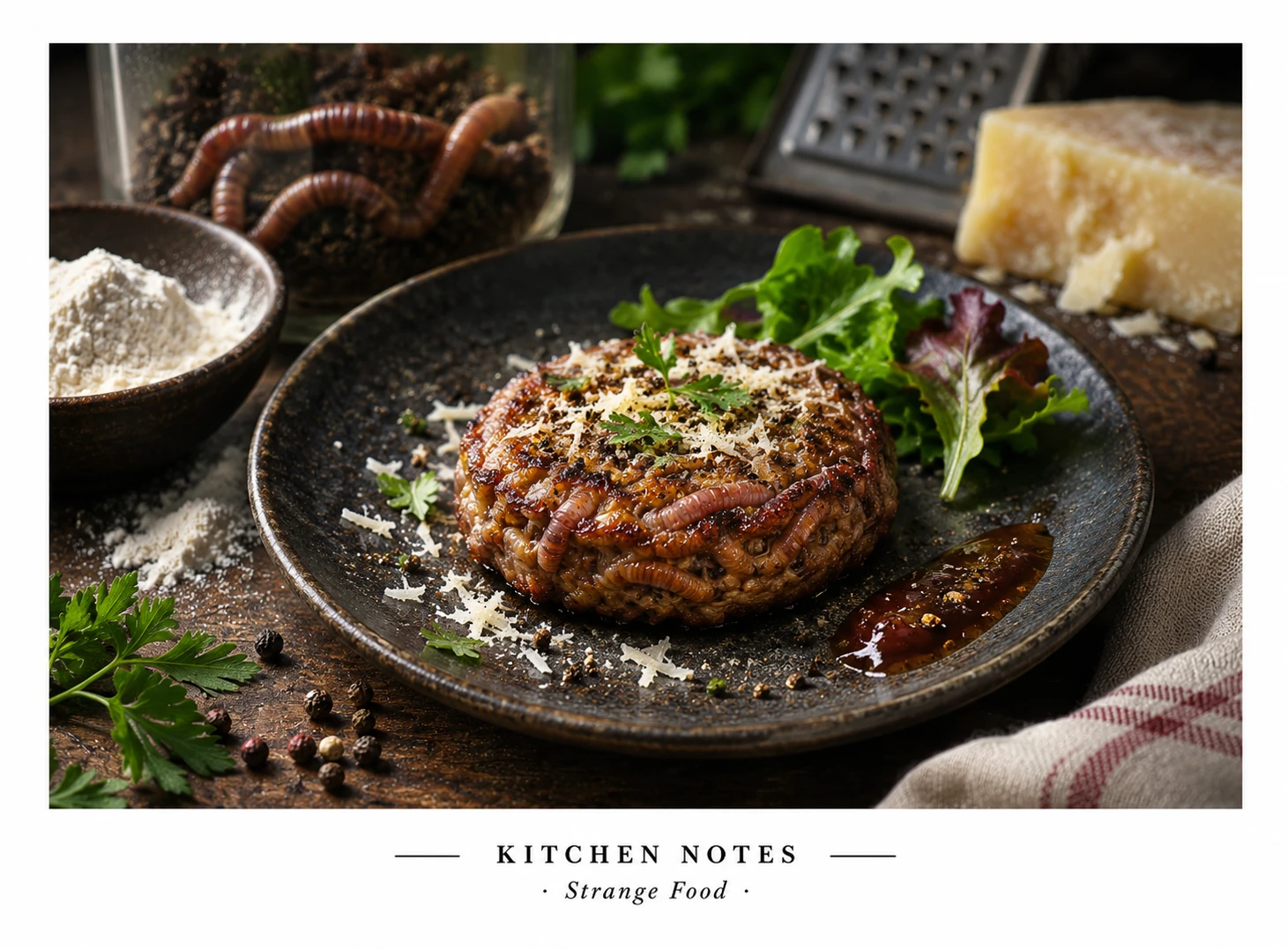
An unfinished chapter about earthworms, upside-down meat pies, suspiciously impressive protein statistics, and my attempt to turn a fisherman's favourite bait into something resembling dinner.
Cover: a conceptual illustration of the archived earthworm-burger idea, not a documentary photograph of a prepared dish.
There are certain animals that people encounter throughout their lives without ever considering them potential food.
Earthworms, for example.
Everybody knows earthworms.
Children find them in gardens.
Fishermen put them on hooks.
Gardeners appreciate their work in the soil.
And after heavy rain, they occasionally appear all over the pavement, looking as though they've organised a particularly unsuccessful mass migration.
But almost nobody in modern European society looks at a large, pinkish earthworm and thinks:
That would make an excellent burger.
Which is unfortunate.
Because at one point in my life, that was precisely what I was thinking.
And I even developed a rather unusual idea for preparing them.
It involved flour.
But not quite in the way you might expect.
First, the worm that supposedly becomes two worms
Before we get to dinner, there's something I've always found fascinating about earthworms.
Their ability to regenerate.
There's an old story that if you cut an earthworm in half, both halves will grow into complete worms.
Two worms for the price of one.
An excellent business model.
Unfortunately, biology doesn't work quite like that.
Different earthworm species have different regenerative abilities.
Some can regenerate missing tail segments.
Certain species can also regenerate parts of their anterior end under particular conditions.
But the idea that any earthworm can be cut in half and reliably produce two healthy new worms is nonsense.
I used to describe the result jokingly as one and a half worms.
Even that is inaccurate.
A missing body part doesn't automatically regenerate, and survival depends on the species and the extent of the injury.
But the regeneration story is only one interesting part of an earthworm's biography.
The other is that an animal most of us associate with fishing bait has attracted serious interest as a potential food ingredient.
And that's where things become deliciously uncomfortable.
The protein statistics were almost too good to be true
When I originally wrote this chapter, I was very enthusiastic about the nutritional properties of earthworms.
Possibly a little too enthusiastic.
My old manuscript claimed that approximately 60 percent of American baby food in the early 1990s contained earthworm protein.
An astonishing statistic.
Also one I can no longer substantiate.
I've looked for credible evidence supporting it, and I haven't found any.
The same applies to my old suggestion that earthworm protein was already a dominant ingredient in sports nutrition.
So those claims won't survive the transition from my old manuscript into Kitchen Notes.
Which is a pity.
They were wonderfully shocking.
But the verified nutritional research remains interesting.
Some species of earthworm contain substantial amounts of protein when dried and processed.
Scientific studies have reported approximately 50 to 70 percent protein in dried earthworm material, depending on species and processing.
That's a significant concentration.
Although it is important to remember that we're talking about dry matter, not a fresh, moisture-filled worm.
Comparing dried earthworm powder directly with fresh beef or fish is about as meaningful as comparing powdered milk with a glass of milk and announcing that cows have been underperforming.
Still, the underlying possibility is real.
Earthworms have been investigated as alternative protein sources for both animal feed and, potentially, human food.
They're not merely useful little creatures that improve garden soil.
They may also contain nutritionally valuable material.
But nutritional potential and safe commercial food production are two different things.
And that distinction becomes very important when the proposed ingredient spends much of its life eating material found in soil.
The problem with the contents of a worm
An earthworm is essentially a small biological processing system.
It consumes organic material and, depending on the species, soil.
Then it processes that material through its digestive tract.
Which is excellent for the soil.
Less excellent if your immediate ambition is to turn the earthworm into a delicately seasoned restaurant dish.
Because the animal's digestive tract may contain material you didn't intend to include in dinner.
And this was the problem I became interested in solving.
My original manuscript proposed two approaches.
One was to let the worms empty their digestive systems.
The other was considerably more entertaining.
Feed them flour.
Instead of merely removing the soil from their digestive tracts, I wanted to replace it with something more appropriate for a culinary preparation.
An ingredient that already belonged in countless conventional recipes.
Wheat flour.
In my imagination, this created something rather wonderful.
A worm with a little flour inside.
Not exactly breaded meat.
Not exactly stuffed pasta.
More like a miniature meat pie constructed completely backwards.
The pastry was on the inside.
The meat was on the outside.
I found that idea absolutely delightful.
The world's smallest inside-out meat pie
Think about conventional cooking.
We take meat.
Perhaps mince it.
Add flour or breadcrumbs.
Shape it.
Coat it.
Fry it.
A very familiar arrangement.
But what if the animal itself became the container for part of the preparation?
What if the ingredient you normally add to the meat could be introduced before cooking?
That was the thinking behind my flour-fed earthworms.
The old manuscript described the idea in great detail, with the cheerful confidence of someone who regarded practically anything as a potential culinary experiment.
And then came the proposed finishing.
The flour-fed worms would become the main ingredient, receive a simple heat treatment, and finally acquire a lightly browned exterior.
I imagined the finished dish with freshly ground pepper.
Perhaps a little grated Parmesan.
Or a touch of teriyaki sauce.
Nothing particularly complicated.
Just a small plate of unusual savoury food.
There's something wonderfully absurd about using Italian cheese or Japanese-inspired seasoning to finish an ingredient that most people associate with the contents of a fishing tackle box.
Yet the basic culinary logic isn't absurd at all.
Take an unusual protein.
Consider its texture.
Think about the flavour.
Then choose a familiar preparation that might suit it.
The weakness was in my assumptions about the safety of the raw material.
Today, I wouldn't assume that feeding worms flour, rinsing them or briefly cooking them makes an uncontrolled source safe for human consumption.
Earthworms can accumulate contaminants from their environment, including heavy metals and pesticide residues. They can also carry microorganisms and parasites.
The flour doesn't magically solve those problems.
So I now regard the original preparation as an archived experimental concept, not a validated recipe that readers should reproduce with garden or fishing-bait worms.
But I still love the idea of the inside-out meat pie.
It's precisely the sort of question that made the unfinished book enjoyable to write.
And then I designed an earthworm burger
The original chapter contained another idea.
A burger.
Not a conventional beef burger with a little earthworm protein added for nutritional novelty.
A patty made from the worms themselves.
The concept was to use a burger mould to bring the prepared worms together into a compact portion, then cook the resulting shape like an ordinary patty.
The attraction was partly textural.
I didn't want to grind the worms into an anonymous protein powder and pretend they were something else.
I wanted the ingredient to remain recognisable.
That was the whole point of the project.
If you're investigating an unusual food, why go to extraordinary lengths to make it indistinguishable from the food you already eat?
A powder can be nutritionally interesting.
But it tells you very little about the culinary character of the original ingredient.
A whole worm has a texture.
An appearance.
A flavour.
And an unfortunate tendency to make dinner guests suddenly remember urgent appointments elsewhere.
The proposed burger was an attempt to approach the ingredient as food in its own right.
I even wrote that earthworms reminded me somewhat of very fresh lamb.
Would I use exactly the same comparison today?
I don't know.
Taste memories change, and my old notes weren't written as a controlled sensory evaluation.
But the important point was that I wasn't interested in insects and worms purely because they were shocking.
I was interested in whether they could actually taste good.
Apparently, other people had the same terrible idea
One of the pleasures of writing about unusual food was discovering that almost any ridiculous culinary idea had already occurred to somebody else.
Take The Worm Book, published in 1998 by Loren Nancarrow and Janet Hogan Taylor.
A book ostensibly about earthworms and gardening.
Which also contains a section dedicated to cooking with them.
The authors explored an unexpectedly imaginative range of dishes.
Vermicelli with meatballs containing earthworm flour.
Oatmeal muffins with earthworms and raisins.
Earthworm meatloaf.
Even caramel brownies incorporating earthworm flour.
Brownies.
With worms.
Somebody looked at chocolate, caramel and a perfectly respectable baking recipe and decided that what it really lacked was earthworms.
I admire that level of culinary curiosity.
Whether I would want to reproduce the recipe is another question.
But the historical fact that such recipes were being published in an ordinary gardening book tells us something interesting.
The idea of edible earthworms wasn't restricted to a handful of obscure ethnographic observations.
People were actively exploring ways to incorporate them into recognisable Western dishes.
Not necessarily successfully.
Not necessarily safely by present-day standards.
But creatively.
And that was precisely the territory I wanted to investigate.
Earthworms with mushrooms and sour cream
Another author whose work I encountered was Christopher Nyerges.
In his 1979 book Urban Wilderness: A Guidebook to Resourceful City Living, Nyerges explored self-reliance and the practical use of resources available even in urban environments.
Among the recipes associated with the book was an earthworm dish involving butter, broth, onions, mushrooms and sour cream.
Now we're talking.
That sounds almost reassuringly familiar.
If you remove the worms from the description, you could be discussing a very conventional Eastern European dish.
Something served over rice.
Or noodles.
Something rich and savoury.
The kind of thing my grandmother might have recognised immediately.
Until somebody explained what was actually being cooked.
And that's what makes it such a useful example.
The culinary technique is not especially exotic.
The seasoning isn't exotic.
The surrounding ingredients are familiar.
The difference is one ingredient.
The worm.
Change that ingredient to chicken, mushrooms or some conventional meat, and the dish suddenly becomes perfectly respectable.
Change it back, and the exact same culinary structure becomes a provocation.
I find that fascinating.
The real challenge isn't the recipe
My old chapter was written in a rather confident spirit.
If earthworms contain useful protein, why shouldn't we eat them?
If people have developed ways to prepare them, why not experiment?
If we can make a burger from beef, why not from worms?
Those remain interesting questions.
But I now think they need to be separated more carefully.
An animal being biologically edible doesn't automatically mean that every example of that animal is safe to eat.
A worm raised in a controlled environment is not necessarily equivalent to one collected from soil whose contamination history is unknown.
And a fishing-bait supplier is not automatically a food producer.
Scientific research on earthworm protein has found promising nutritional characteristics.
It has also identified important safety concerns involving microbial contamination, farming substrates and the potential accumulation of environmental pollutants.
One study of processed Eisenia andrei powder, for example, detected lead, cadmium and arsenic, illustrating why source control and testing matter.
Other research using carefully controlled production conditions has reported more encouraging results.
That's how food science should work.
Not by deciding in advance that an ingredient is disgusting.
And not by deciding in advance that it's wonderful.
By investigating it.
Testing it.
And finding out under what conditions, if any, it can become a safe and useful food.
The idea of a worm burger may be amusing.
The requirements for producing a safe one are considerably less amusing.
Which doesn't make them any less important.
What I was really trying to cook
Looking back, I don't think the earthworm burger was primarily about the burger.
It was about my ongoing fascination with the boundary between food and non-food.
Why do we happily eat a sausage whose original ingredients have been transformed beyond recognition?
Why is a product more acceptable when its animal origin is hidden?
Why does protein powder sound modern and scientific, while a plate containing the animal from which it came sounds revolting?
And how much of our reaction is about actual danger rather than appearance and cultural habit?
These are not simple questions.
And they shouldn't lead to the conclusion that every strange ingredient deserves to be eaten.
Some don't.
Some cannot be obtained safely.
Some raise serious ethical concerns.
Some are prohibited.
And some are probably just not particularly good.
But I still think there's value in questioning our assumptions.
Especially when the answers are more complicated than because that's disgusting.
Another chapter from the book that never happened
This text comes from the same unfinished manuscript that gave me my recent Kitchen Note about eating fried larvae in China and eventually introducing edible insects to the menu of Banka, our Ukrainian bar chain, also known as The Jar Bar.
That story was about how an unfamiliar food became part of my professional restaurant experience.
This one is a little different.
It's about the cooking ideas that emerged once I started treating unfamiliar animals as potential ingredients.
Some of those ideas became actual dishes and commercial experiments.
Others remained proposals in the manuscript.
And some need substantial reconsideration before I'd be comfortable calling them recipes today.
That's fine.
I don't want to rewrite the history of the project to make every experiment sound more successful or scientifically sound than it was.
I want to preserve the curiosity behind it.
And occasionally laugh at the confidence with which my younger self made certain claims.
Especially the one about 60 percent of American baby food.
Good grief.
I really did need to check my sources.
But the central question hasn't changed.
Why should one animal be a normal part of dinner while another is dismissed without consideration?
And what happens when we challenge that distinction through cooking?
Sometimes we discover something delicious.
Sometimes we discover a myth.
Sometimes we discover a genuine safety problem.
And sometimes we discover that the recipe involved feeding flour to the main ingredient before it was even invited into the kitchen.
An earthworm burger may not be the future of gastronomy.
But it's a wonderfully effective way to find out how many assumptions we bring to dinner.
Adapted from an unfinished chapter of my earlier Strange Food manuscript. The original preparations are discussed as culinary history and experimental concepts, not as safety-tested recipes for preparing wild or bait-shop earthworms.