
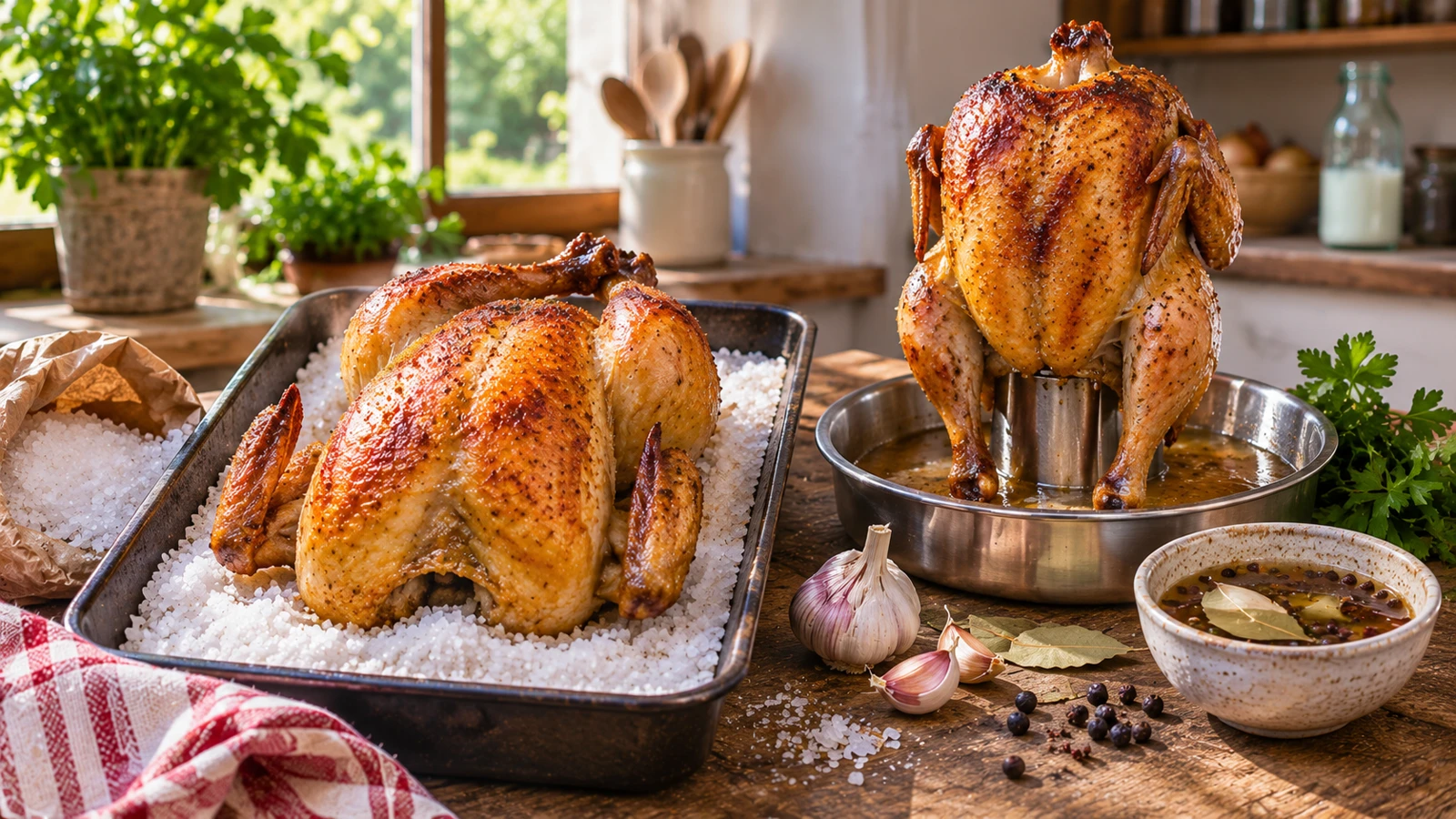
Two wonderfully uncomplicated ways of roasting a whole chicken, one from my own kitchen and another from my father's, with a surprising amount of flavour and almost no actual culinary sophistication.
There are recipes that require seventeen ingredients, three special appliances and a small written examination before you're allowed to turn on the oven.
And then there are recipes that require a chicken.
And some salt.
That's it.
I've always enjoyed cooking complicated things, but I have a particular affection for preparations that seem almost suspiciously simple.
Especially when they produce something genuinely delicious.
Recently, I remembered two ways of roasting an entire chicken that I used to make in Ukraine.
One I cooked quite frequently.
The other I tried perhaps once or twice, although my father was rather fond of it.
Both involve putting a whole chicken into the oven.
Both work with very little intervention.
And both produce results that seem considerably more sophisticated than the effort involved.
The first requires exactly two ingredients.
The second traditionally involved an object that wasn't originally intended to be cooking equipment.
A milk bottle.
Naturally.
Recipe one: a chicken and an entire kilo of salt
When I say this recipe requires two ingredients, I'm not exaggerating.
You need:
- One whole, ordinary chicken.
- One kilogram of salt.
Not a small chicken breast.
Not a delicate little poussin.
A proper whole chicken.
And a whole packet of salt.
In Ukraine, I generally used ordinary Artemivsk salt, sold in those familiar one-kilogram packages.
Now that I live in France, I'd be tempted to try it with coarse sea salt from Guérande.
But that's a variation I haven't actually made yet.
The version I know is the Ukrainian one.
And the method is absurdly straightforward.
Take a baking tray.
Pour the entire kilogram of salt onto it.
Break up any large lumps.
Spread the salt into a fairly even layer.
Preheat the oven to 180°C.
Then take the chicken and place it directly on its back, breast-side up, on the salt.
Don't rub it with spices.
Don't add garlic.
Don't make a marinade.
Don't brush it with oil.
And definitely don't sprinkle extra salt over it.
The salt is already there.
Quite a lot of it.
Put the tray into the oven.
And leave the chicken to roast.
That's the recipe.
I realise this sounds like something a very lazy cook invented after discovering that the spice cupboard was empty.
But it produces a remarkably good roast chicken.
Why does a chicken on salt taste so good?
The result always surprised me.
The skin became beautifully browned and crisp.
The meat remained juicy, provided I didn't overcook it.
And the chicken developed just enough seasoning to taste complete without a complicated spice mixture.
Now, I used to explain this by saying that the chicken absorbed exactly the right amount of salt from the surrounding salty atmosphere.
A lovely idea.
Almost magical.
Unfortunately, it's not quite how the physics works.
Salt doesn't turn into seasoning vapour at ordinary roasting temperatures.
What happens is more practical.
The chicken rests on a layer of salt.
Some moisture and cooking juices come into contact with it.
A little salt can dissolve and season the surface of the bird.
The salt bed also provides a different thermal and moisture environment at the bottom of the roasting tray.
Meanwhile, the oven's hot air cooks and browns the exposed skin.
The salt isn't a magical thermostat, and it doesn't guarantee perfect seasoning under every possible condition.
A wet chicken, a different kind of salt, a different tray or a much smaller bird could change the result.
But the basic method is established, and it can work extremely well.
I particularly enjoy the fact that it doesn't need any additional flavours.
The result tastes of roast chicken.
Which is a rather underrated achievement.
The recipe that makes a cheap oven look clever
There's another reason I like this preparation.
It doesn't demand an expensive oven.
You don't need a machine with fifteen cooking modes.
No dedicated steam function.
No special fan setting.
No elaborate switching between top and bottom heat.
Just an oven capable of holding a reasonably steady temperature.
And plenty of people have exactly that.
A basic electric oven.
An older gas oven.
Something with a dial and very little else.
The salt bed helps provide a consistent roasting surface without requiring the cook to develop a complicated method for the equipment.
Of course, the oven still has to cook the chicken properly.
But you can get a lovely result without turning the process into a technical project.
My memory is that the roasting usually took somewhere around an hour to an hour and a half, depending on the chicken.
I rarely timed it precisely.
I tended to look at the colour and the appearance.
These days I'd add one sensible precaution: use a meat thermometer.
A whole chicken should reach 74°C / 165°F in the relevant thickest parts, away from the bone.
Golden skin is an excellent reason to become hungry.
It isn't a reliable measurement of food safety.
Once the chicken is ready, lift it away from the salt, brush off any crystals stuck to the skin and let it rest briefly before carving.
Don't pour the used salt back into the kitchen salt jar.
It has been in contact with raw poultry and its juices.
And that's all.
One chicken.
One kilo of salt.
An ordinary oven.
A very good dinner.
I really must make it again in France.
Perhaps with Guérande salt.
Although part of me wonders whether such an expensive salt deserves to spend its afternoon underneath a chicken.
Recipe two: my father's chicken on a bottle
Now for the other method.
The one my father particularly liked.
Chicken on a bottle.
If you grew up in the Soviet Union or in parts of Eastern Europe, this might sound familiar.
The classic apparatus was often a half-litre glass milk bottle.
The old kind.
With a relatively wide neck.
Those bottles were useful for all sorts of things after the milk had been consumed.
Including, apparently, holding a chicken upright in an oven.
You could also use a beer bottle with a narrower neck, although I always thought the result was slightly different.
The principle was simple.
Instead of roasting the chicken lying down, you placed it upright.
The bottle acted as a support.
And because it contained some water and aromatic ingredients, people believed it also helped flavour and moisten the bird from the inside.
I made this once or twice.
My father liked it much more regularly.
And I still remember the wonderful sight of an entire chicken standing in the oven like a rather offended little person.
The bottle had its own seasoning
Unlike the salt-bed recipe, chicken on a bottle invited improvisation.
First, there was the outside of the bird.
You could rub it with salt, black pepper and whatever spices you liked.
In my case, I'd probably make a rather enthusiastic mixture.
Perhaps several spices.
A little garlic.
Maybe a sauce to bind everything into a paste that could be spread over the skin.
I tend to improvise these things.
The exact combination is less important than the idea.
The chicken has its own exterior seasoning.
And then there's the liquid.
I remember the bottle being partially filled with water, perhaps a third full, with aromatics added.
Crushed garlic.
Bay leaves.
Juniper berries.
Allspice.
Black peppercorns.
Perhaps a little soy sauce.
Whatever seemed likely to produce a pleasant aroma.
Again, nothing particularly complicated.
The bottle supported the chicken.
A tray beneath it collected the drippings.
And the whole construction went into the oven.
There's something wonderfully resourceful about these old home-cooking inventions.
You didn't buy a specialised appliance.
You looked at what was available.
Then figured out how to make it do something entirely different.
Although there's one part of this particular invention I would definitely change today.
The bottle belongs in the memory, not necessarily in today's oven
Ordinary beverage bottles aren't designed to be used as roasting equipment.
A glass milk bottle may look reassuringly solid, but that doesn't mean it's safe to expose it to oven temperatures, uneven heating and the weight of a chicken.
It can crack or shatter.
And broken glass in a hot oven containing dinner is not a culinary experiment I'd recommend.
So while I remember the original method fondly, I wouldn't suggest recreating it with an ordinary glass bottle.
The modern alternative is quite straightforward.
A purpose-made vertical chicken roasting stand, ideally made from oven-safe metal, placed securely in a roasting pan.
Some stands also have a reservoir for liquid and aromatics.
They reproduce the upright cooking position without depending on repurposed beverage glass.
That seems like a reasonable improvement.
My father might have wondered why anybody needed to buy equipment for something a milk bottle did perfectly well.
I'd probably have agreed with him at the time.
Now, I rather like the idea of not having broken glass with my roast chicken.
Does the aromatic steam really make the chicken juicier?
Here's another part of the old recipe worth reconsidering.
I used to think that the flavoured water inside the bottle steamed the bird from within.
And that this was what made the meat so juicy.
It's a very appealing explanation.
Garlic and spices rising in aromatic steam.
The chicken absorbing all those wonderful flavours.
Unfortunately, the actual effect isn't quite so simple.
A container sitting inside a chicken can be slow to heat up.
The chicken itself insulates it.
And the presence of liquid doesn't necessarily mean significant steam is circulating through the meat or making it more moist.
Food scientists have questioned this familiar explanation in similar preparations such as beer-can chicken.
Much of the result may instead come from roasting the bird vertically, exposing its skin to heat in a different way.
And, of course, from not overcooking it.
But even if the steam isn't working as dramatically as we once imagined, the upright roasting method can still be interesting.
The bird has a different relationship with the oven's heat.
The drippings fall into the tray below.
And with suitable equipment and careful temperature control, it can develop a good, crisp exterior.
The spices remain useful for seasoning the surface and the drippings.
I just wouldn't promise that a little aromatic water hidden inside the bird will somehow transform its interior into a perfectly steamed delicacy.
Still, I remember enjoying the result.
And I understand why my father did too.
The two chickens are almost opposites
What I find most entertaining about these recipes is how different their philosophies are.
The salt-bed chicken is an exercise in restraint.
Two ingredients.
No seasoning mixture.
No preparation.
No fuss.
The oven does almost everything.
The bottle chicken is an invitation to play.
Spices.
Aromatic ingredients.
An unusual position.
A bit of improvisation.
And a decidedly strange piece of kitchen engineering.
Yet both began with the same objective.
Take an ordinary whole chicken and make it delicious without requiring an elaborate recipe.
One solution uses a bed of salt.
The other uses the geometry of a vertically positioned bird.
Neither method requires cutting the chicken into pieces.
Neither requires professional culinary training.
And both represent something I particularly like about home cooking.
People discover practical solutions with the equipment and ingredients they have.
Sometimes those solutions become traditions.
Sometimes they deserve updating.
And sometimes they're so simple that you wonder why you don't cook that way more often.
If I were making them today
I'd approach the two methods slightly differently.
For the salt-bed chicken, I'd stay very close to what I used to do in Ukraine.
One whole chicken.
One kilogram of coarse salt.
A baking tray.
An oven at 180°C.
No extra seasoning.
I'd place the chicken on its back, breast-side up, on the even salt layer, roast until properly cooked and verify the internal temperature before serving.
That's the original idea, and I see very little reason to change it.
For the bottle-style chicken, I'd preserve the flavours and the upright cooking approach but replace the bottle with a purpose-built oven-safe roasting stand.
I'd rub the skin with whatever spice mixture appealed to me that day.
Put the bird securely on the stand over a drip tray.
And roast it, checking the internal temperature rather than relying on a fixed cooking time.
If the stand has a reservoir specifically designed for aromatic liquid, I might experiment with garlic, juniper, bay leaf and peppercorns.
I'd treat that as an aroma experiment, not a guarantee of extra juiciness.
And if the oven had a grill setting, I might use it briefly towards the end, provided the chicken was positioned safely and the skin wasn't already too dark.
A little crisping is good.
Burning dinner to prove you have a grill function is less good.
A whole chicken is a wonderfully forgiving idea
I've already written about another whole-chicken preparation I particularly enjoy.
Or rather, my own oven-based version of it, where I remove the backbone, flatten the chicken and finish it with garlic, herbs and Breton butter.
That's a completely different approach.
There, the objective is to turn a whole bird into a relatively flat surface.
With the salt-bed chicken, I leave the bird exactly as it is.
With the bottle method, I do the opposite of flattening it.
I stand it upright.
Apparently, if you give me a whole chicken, I can spend a surprising amount of time thinking about its geometry.
But I like that.
One ingredient.
Several possibilities.
Different textures.
Different flavours.
Different memories.
The chicken on salt reminds me of the pleasure of discovering an almost absurdly simple preparation that works.
The chicken on a bottle reminds me of my father, old Soviet milk bottles and a time when a specialised kitchen gadget was often just an ordinary object somebody had found another use for.
I don't know why I haven't made the salt-bed version since moving to France.
I really should.
And perhaps I'll revisit the other one too.
With a proper metal stand.
A little garlic.
Some juniper.
And considerably less risk of broken glass.
Because sometimes the most interesting cooking isn't about discovering a new ingredient.
It's about remembering an old idea and understanding why it worked.
One chicken. One kilo of salt.
Or one chicken standing upright like it's waiting for a bus.
Both sound ridiculous.
Both can make a very good dinner.
And that, to me, is exactly what Kitchen Notes is about.