
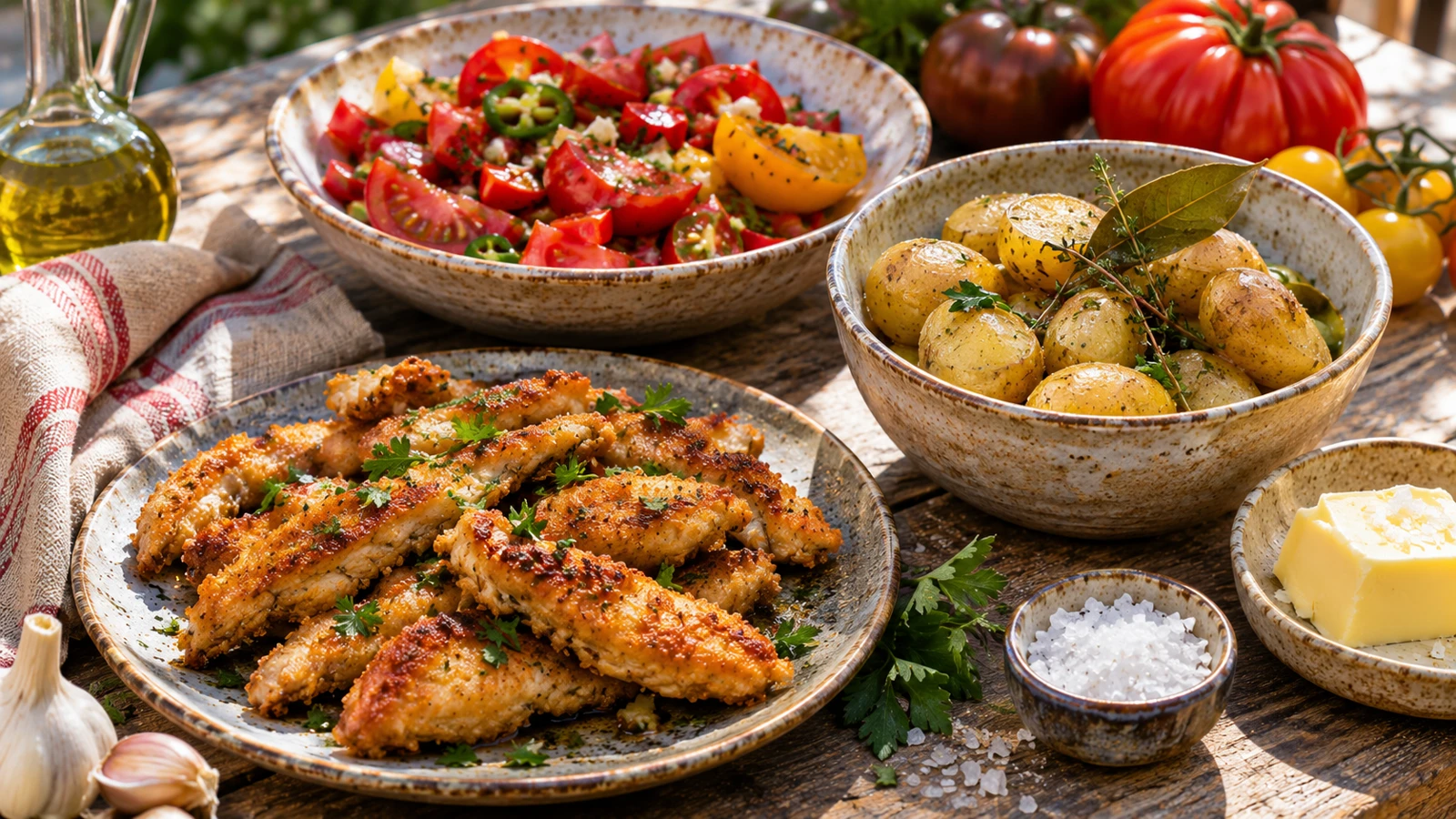
Boiled potatoes, fried chicken breast and tomato salad. Three completely ordinary dishes that somehow involved Japanese stock, Breton butter, kefir, Dijon mustard and two excellent products from the French Atlantic coast.
I'm currently living in a hotel.
Temporarily, fortunately.
We've been moving into a new apartment, but the internet connection isn't quite ready yet, so I'm spending my last few days at the hotel while the family is already settling in.
On Sunday, I went over to cook them lunch.
They aren't particularly enthusiastic about cooking. I am. So this arrangement works rather well.
I looked through what they had in the kitchen and decided to make something extremely simple.
Boiled potatoes.
Fried chicken breast.
Tomato salad.
There.
A perfectly ordinary Sunday lunch.
Nothing exotic. Nothing particularly ambitious. No complicated recipes requiring three days and a specialist piece of equipment.
Of course, being me, I couldn't quite leave it at that.
Not because I wanted to make the food complicated.
But because simple food is often where small decisions become particularly interesting.
First, some potatoes from a rather special island
I had some lovely little potatoes from Noirmoutier, an island off the Atlantic coast of France, in the Vendée.
If you haven't encountered Noirmoutier potatoes, they're worth knowing about.
The island is famous for its early potatoes, which benefit from its mild maritime climate and distinctive sandy soils.
They have delicate skins and a pleasantly subtle, slightly sweet flavour.
Noirmoutier produces several varieties, including the famous Bonnotte, as well as Sirtema and Lady Christ'l.
The Bonnotte, in particular, is something of a local celebrity, with a remarkably short harvesting season and a reputation for being a rather precious little potato.
I don't know exactly which variety I had that Sunday.
But they were small.
Thin-skinned.
And looked far too good to peel.
So naturally, I didn't.
I brought a pot of water to the boil and dropped the potatoes in.
Whole.
Unpeeled.
Uncut.
No unnecessary heroics.
Then, approximately five minutes before they were ready, I decided the cooking water could do with a little more personality.
I added a couple of bay leaves.
Some coarse Guérande sea salt.
A couple of sprigs of classic French bouquet garni.
And one crushed garlic clove.
Now, Guérande is another place worth mentioning.
Its salt comes from the salt marshes near the Atlantic coast, not far from Nantes.
I use it regularly, both the coarse salt for cooking and the finer version for seasoning.
It's one of those regional French products that have become a normal part of my kitchen.
So there I was, boiling potatoes from Noirmoutier in water seasoned with salt from Guérande.
A rather nice little meeting of two Atlantic food traditions.
The herbs and garlic added a gentle aromatic finish.
I wasn't trying to turn the potatoes into something unrecognisable.
They were already good potatoes.
When they were ready, I drained the water and left them under the lid while I finished the rest of lunch.
No elaborate sauce.
No complicated garnish.
Just small, beautifully cooked potatoes with a little aromatic character.
Sometimes the smartest thing you can do with a good ingredient is interfere with it as little as possible.
Which brings us to the chicken.
Where I interfered rather more.
The chicken had already been working for two hours
I'd actually started preparing the chicken earlier.
There were breast portions from two chickens.
I cut the meat into long strips, roughly the thickness of a finger.
Then I put everything into a large bowl and began making the marinade.
My starting point was rather international.
First, a little concentrated Japanese dashi stock.
Dashi is traditionally used as a savoury foundation in Japanese cooking, often made with ingredients such as kombu and bonito flakes.
It isn't exactly the first thing most people reach for when preparing fried chicken breast in a French kitchen.
But I like its savoury character.
And the concentrated product I was using was already salty.
So I didn't add any additional salt.
Then came a fairly generous amount of curry powder.
A seasoning blend intended for roast chicken.
A couple of finely chopped garlic cloves.
Some fresh parsley, chopped.
Approximately half a cup of kefir, perhaps a little more.
And finally, two tablespoons of Dijon mustard.
That was it.
I mixed everything thoroughly, making sure the strips of chicken were well coated.
Then I left them to marinate in the refrigerator for a couple of hours.
Now, if you look at this mixture, you'll notice that it doesn't belong to any particular culinary tradition.
Japanese dashi.
Curry spices.
French Dijon mustard.
Eastern European kefir.
Fresh parsley.
A perfectly ordinary chicken-grill spice mixture.
Some people might be concerned that these ingredients haven't been properly introduced to one another.
I wasn't.
I wanted a savoury, aromatic marinade with a little acidity and enough body to cling to the meat.
And I already had all these things in the kitchen.
The marinade became the batter
Here's my favourite part of the entire preparation.
When it was time to fry the chicken, I didn't take the strips out and prepare a separate breading station.
No plate of flour.
No beaten eggs.
No breadcrumbs.
No series of bowls gradually covering the kitchen in mysterious sticky substances.
I simply took the bowl containing the chicken and its marinade.
Added some flour.
And mixed everything together.
That's it.
The marinade became the batter.
The kefir provided the liquid base.
The mustard, dashi and seasonings were already distributed throughout the mixture.
The flour thickened everything into a coating that clung to the chicken.
I added enough to achieve a consistency that coated the strips rather than running off them.
I didn't measure the flour precisely.
This wasn't supposed to produce a perfectly uniform, delicate tempura shell.
It was a more rustic coating.
But I liked the logic.
Why prepare one mixture to flavour the chicken, discard most of it, and then prepare an entirely different mixture to coat it?
If the marinade already tastes good, why not make it part of the finished dish?
Of course, the coating contained raw chicken juices, so it was strictly for the chicken being cooked, not something to save or serve separately.
And because the strips were coated, they needed proper cooking through the centre, not just an attractive golden exterior.
But as a way of simplifying the preparation, I found the approach rather satisfying.
Breton butter meets Japanese dashi
For frying, I used a mixture of vegetable oil and salted Breton butter.
I love butter.
Living in western France has only made that preference stronger.
And I particularly enjoy the flavour of good salted Breton butter.
But I don't necessarily want to fry everything exclusively in butter, especially when the coating needs enough time to cook properly.
So I combined a little vegetable oil with the butter and kept the heat under control.
The vegetable oil doesn't magically stop butter solids from burning, of course.
But the combination gives me a cooking medium whose flavour I like.
And I can adjust the temperature as necessary.
The chicken went into the pan.
The coating began to brown.
The aroma of curry, mustard, garlic and butter filled the kitchen.
And gradually the strips developed a rather attractive golden crust.
I cooked them in batches as needed, until the chicken was fully cooked.
The result was good.
Tender meat.
A lightly crisp, well-seasoned coating.
A little tang from the kefir and mustard.
The savoury depth of the dashi.
And that unmistakable flavour of Breton butter.
Nothing complicated.
Nothing particularly sophisticated.
Just a perfectly decent way of frying chicken breast without producing another mountain of dirty dishes.
Which, I think, deserves some recognition.
The tomato salad was supposed to be the boring part
Now we arrive at the third component.
Tomato salad.
Surely there's nothing particularly interesting to say about tomato salad.
You cut tomatoes.
Add salt.
Perhaps a little oil.
And you're finished.
Well.
I had four different varieties of tomatoes.
So naturally, I used all four.
I chopped them into relatively small pieces and put them in a bowl.
Then I added half a jalapeño.
I seem to have developed a habit of putting jalapeños into things recently.
They're wonderfully convenient when you want a little fresh green heat.
Next came one whole red bell pepper.
Finely chopped.
I wanted its sweetness and crunch alongside the tomatoes.
Then two garlic cloves.
Crushed and chopped.
A few drops of rice vinegar.
Some extra-virgin olive oil.
A little fine Guérande sea salt.
And a teaspoon of mustard.
I mixed everything together.
Then left it alone for approximately ten minutes.
Not because something magical was supposed to happen.
Simply because tomatoes release some juice when salted, and I wanted the flavours to mingle a little.
The tomato juices combined with the oil, vinegar, mustard and garlic into a very simple dressing.
After ten minutes, I mixed everything again.
And that was the salad.
Four kinds of tomatoes.
Two peppers.
Garlic.
Mustard.
Rice vinegar.
Olive oil.
A little Guérande salt.
Fresh, aromatic and pleasantly sharp.
Exactly what I wanted alongside the richer fried chicken.
Three dishes that don't really belong to one cuisine
Looking at the finished lunch, I found the whole combination rather amusing.
Potatoes from an Atlantic island, cooked with French herbs and Guérande salt.
Chicken marinated in Japanese stock, kefir, curry and Dijon mustard, then fried in Breton butter.
And a tomato salad involving jalapeño, rice vinegar and more French mustard.
A rather international menu.
But there was no attempt at fusion cuisine here.
I wasn't designing a concept for a restaurant.
I wasn't trying to combine Japan, France, India and Eastern Europe into some grand culinary statement.
I was simply cooking lunch for my family.
And using the ingredients I liked.
That's an important distinction.
I don't think cooking needs to be organised around national borders.
If Japanese dashi makes chicken taste good, why shouldn't I use it?
If rice vinegar gives a tomato salad the acidity I want, why must I use wine vinegar instead?
And if the potatoes are already excellent, why should I disguise them under an elaborate sauce?
The ingredients don't care where their neighbours came from.
They just need to work together.
The entire Sunday lunch
For anyone who wants to reproduce the general approach, here's what I did.
I didn't measure every ingredient, so this is a practical description rather than a precisely calibrated recipe.
1. Whole Noirmoutier potatoes
Ingredients
- Small, thin-skinned potatoes from Noirmoutier
- Coarse Guérande sea salt
- Bay leaves
- A couple of sprigs of bouquet garni
- One crushed garlic clove
Method
Boil the washed potatoes whole, with their skins on.
Approximately five minutes before they're ready, add the salt, bay leaves, bouquet garni and crushed garlic.
Continue cooking until tender.
Drain and leave covered while preparing the other dishes.
2. Kefir, dashi and Dijon chicken strips
Ingredients
- Chicken breast portions from two chickens
- A little concentrated dashi stock
- A generous amount of curry powder
- Roast-chicken seasoning blend
- Two chopped garlic cloves
- Approximately half a cup of kefir, or a little more
- Fresh chopped parsley
- Two tablespoons of Dijon mustard
- Flour, enough to thicken the marinade into a coating
- Vegetable oil
- Salted Breton butter
Method
Cut the chicken into finger-thick strips.
Mix with the dashi, spices, garlic, kefir, parsley and mustard.
Marinate in the refrigerator for approximately two hours.
Just before cooking, add flour directly to the chicken and marinade, mixing until the strips are coated in a reasonably thick batter.
Fry in a mixture of vegetable oil and salted butter over controlled heat until golden and fully cooked through. For chicken, the safe internal temperature is 74°C / 165°F.
I didn't add extra salt because the concentrated dashi and chicken seasoning already contained it.
3. Four-tomato salad with jalapeño
Ingredients
- Four varieties of tomatoes
- Half a jalapeño
- One whole red bell pepper
- Two garlic cloves
- A few drops of rice vinegar
- Extra-virgin olive oil
- Fine Guérande sea salt
- One teaspoon of mustard
Method
Chop the tomatoes and peppers into small pieces.
Add crushed, finely chopped garlic.
Season with the vinegar, oil, salt and mustard.
Mix thoroughly.
Leave for approximately ten minutes, then mix again before serving.
And that's it.
Three ordinary dishes.
With a few small decisions that made them rather more interesting.
The simplest meals are often the most satisfying
I think there's a tendency to associate interesting cooking with difficult recipes.
Something involving twelve stages.
An overnight reduction.
Ingredients available only from a specialist supplier.
And a chef explaining why the sauce must be stirred clockwise.
I enjoy complicated cooking too.
But I don't think complexity is what makes food interesting.
Sometimes it's recognising that a little aromatic salt and some herbs can improve a pot of potatoes.
Or that a marinade can become a batter if you add flour.
Or that combining several varieties of tomato creates more interesting flavours and textures than using just one.
These aren't revolutionary discoveries.
They're small practical decisions.
But together they make the difference between simply feeding people and enjoying the process of feeding them.
And that Sunday, I particularly enjoyed it.
I was still living in a hotel.
We were still getting the new apartment sorted out.
There were practical things to deal with.
But I had a kitchen to use for a few hours.
Some good ingredients.
And a family to cook for.
So I made boiled potatoes, fried chicken and tomato salad.
A perfectly ordinary Sunday lunch.
Nothing unusual at all.
Apart from the Japanese stock, the Breton butter and the potatoes from an island.