
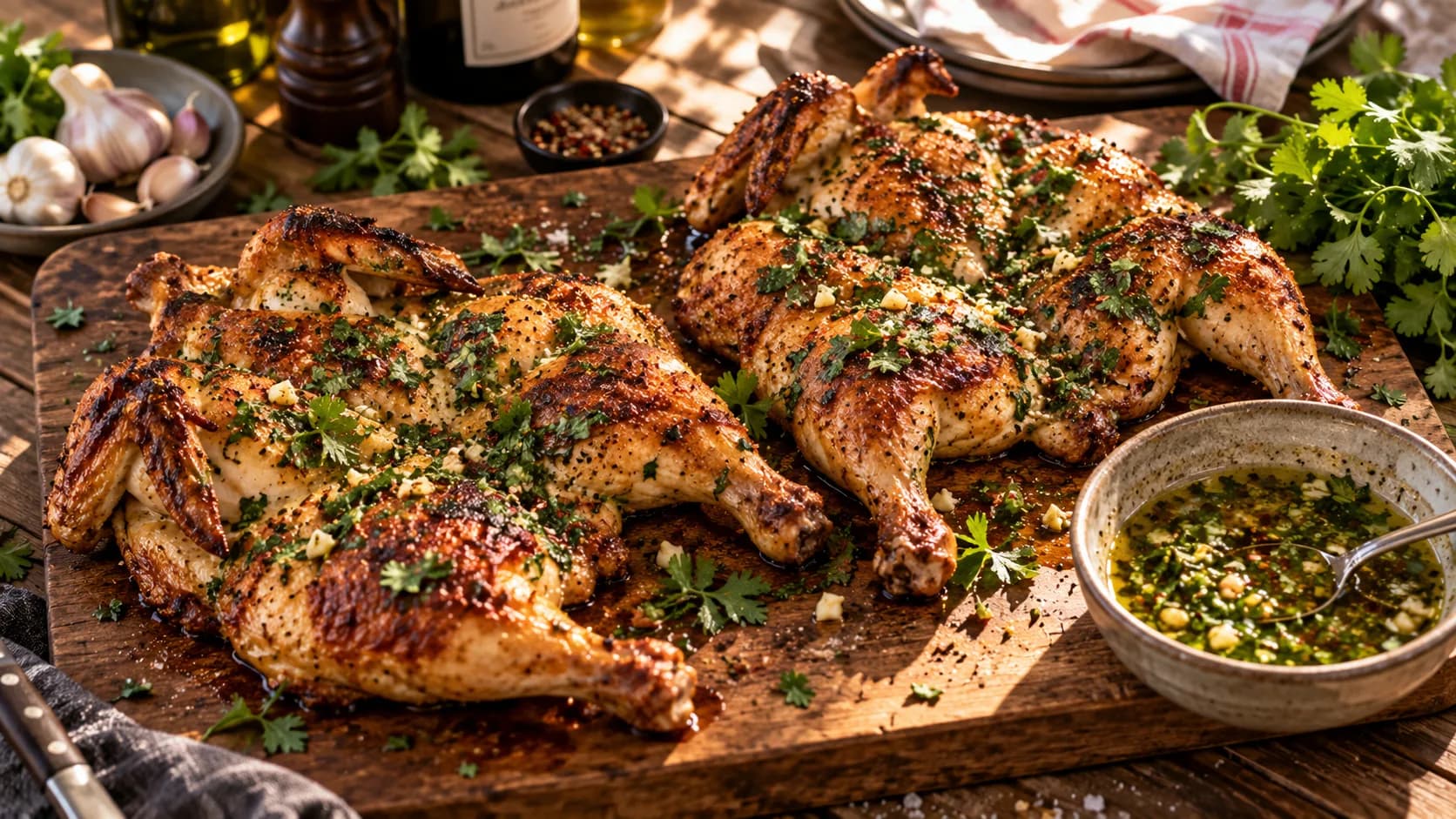
My oven-roasted version of a Georgian classic: no heavy cast-iron skillet, no press, a juicy chicken breast, and plenty of garlic butter.
There's a Georgian dish that practically everyone who grew up in the Soviet Union or its former republics knows.
Chicken Tabaka.
Or Tsyplyonok Tabaka, as we usually called it.
Which sounds rather amusing in Russian because tabak means tobacco.
But no, nobody is stuffing cigarettes into a chicken.
The name comes from the Georgian tapa, a traditional frying pan.
And the dish is wonderfully straightforward.
Take a young chicken.
Cut it open.
Flatten it until it resembles something that has had a fairly serious disagreement with a steamroller.
Place it in a heavy cast-iron pan, preferably under a substantial weight.
Fry it until both sides are beautifully golden and the skin is crispy.
Finish with garlic, herbs, traditionally plenty of coriander, and serve.
Absolutely delicious.
I love chicken tabaka.
My family loves it too.
But, as usual, I eventually decided that the traditional method wasn't quite how I wanted to cook it.
First, I remove the backbone
In versions of chicken tabaka I've encountered, the bird is often cut open through the breast and flattened along the backbone.
I prefer doing exactly the opposite.
I take a good pair of kitchen scissors and cut along both sides of the backbone.
From the tail all the way to the neck.
The entire backbone comes out.
And I put it in the freezer.
Why throw it away?
There's very little meat on it, but it's excellent for making chicken stock.
A backbone that's been thoroughly fried until crisp isn't particularly useful to me.
A backbone that becomes part of a future soup?
Much better.
More importantly, removing the backbone allows me to flatten the chicken while keeping the breast intact.
And I like the result.
The breast stays protected by its skin, without a large cut running straight through the middle.
In my experience, that makes it easier to keep the white meat pleasantly juicy.
Which matters, because dry chicken breast is one of those things I have very little enthusiasm for.
Then I give the chicken a good beating
With the backbone removed, I open the bird flat on a cutting board.
Skin side up.
I press it down, cracking the necessary joints so that it lies as flat as possible.
Then I take a meat mallet.
And give it a proper, though reasonably controlled, beating.
Not because I have unresolved issues with poultry.
The objective is to make the bird flatter and more evenly shaped.
That helps it cook consistently.
I don't want to destroy the meat or pulverise the bones. Just flatten the thicker sections enough to get something resembling the original chicken tabaka profile.
And now comes the main departure from tradition.
I don't use a frying pan at all.
The oven replaces the cast iron
The classic version is usually cooked under pressure in a heavy skillet.
It works beautifully.
But it also means standing over a pan, turning the chicken and managing the heat.
And if you want to cook for the entire family, you may need to repeat the process several times.
I prefer a more scalable solution.
Yes, apparently I approach cooking chicken with the same attitude I bring to business operations.
I brush the flattened chicken with a little vegetable oil suitable for roasting.
Then I wrap it in foil and put it in the oven at approximately 180°C.
Depending on the size, I can cook two or three small chickens at once.
There's no heavy press.
No gigantic cast-iron skillet.
And no need to occupy the entire kitchen with multiple rounds of frying.
The chicken cooks inside the foil, retaining moisture while the meat becomes tender.
But we're not finished.
Because chicken tabaka without a crispy skin is just a rather flat chicken.
And that would be disappointing.
Now we make it crispy
Once the chicken is cooked through, I remove the foil.
Then I switch the oven to convection and grill mode, keeping the temperature around 180°C.
I brown the bird on both sides, turning it carefully.
The skin begins to crisp.
The surface becomes golden.
Then darker golden.
And finally develops that lovely roasted colour we're looking for.
This is the stage that brings the dish back to its Georgian inspiration.
The oven does the work of the heavy frying pan.
The grill provides the crust.
And the flattened shape helps everything cook evenly.
I find the result extremely satisfying.
But there's still one important step.
Possibly my favourite.
The Breton butter treatment
Traditionally, chicken tabaka is often finished with plenty of garlic and fresh herbs.
I'm entirely in favour of that.
But I take it a little further.
I live near Nantes, and I have developed a particular appreciation for good salted Breton butter.
So I melt some.
Quite generously.
Then I add crushed garlic.
Lots of garlic.
Finely chopped fresh coriander.
A little parsley, which isn't necessarily part of the traditional version but works beautifully here.
Freshly ground black pepper.
White pepper.
Green pepper.
Occasionally, a little curry spice blend.
Just enough to introduce a slightly different aromatic note.
And sometimes a little smoked paprika.
Not too much.
I don't want the chicken tasting like an entire spice market exploded in the kitchen.
The idea is to complement the roasted flavour.
Not bury it.
Once the chicken comes out of the oven, I brush it generously with the warm butter, garlic and herb mixture.
The garlic and spices release their aromas.
The buttery coating sinks into the little cracks in the roasted skin.
The herbs cling to the surface.
And the whole thing smells absolutely wonderful.
Then I leave it for a short rest.
The chicken cools slightly, the juices redistribute, and the garlic butter settles into the surface.
And finally, it's ready.
My oven-baked chicken tabaka
This is more of a method than a precisely measured recipe. I adjust the seasoning by eye.
Ingredients
- 1–3 small whole chickens, depending on how many people you're feeding
- A little neutral vegetable oil for roasting
- Salt, if needed
- Salted Breton butter
- Several cloves of garlic
- A generous handful of fresh coriander
- A little fresh parsley
- Freshly ground black, white and green pepper
- Optional: a pinch of curry spice blend
- Optional: a little smoked paprika
Method
1. Remove the backbone using kitchen scissors, cutting along both sides. Save it for stock.
2. Open the chicken flat, skin side up, and press it down.
3. Gently flatten the thicker parts with a meat mallet.
4. Brush with vegetable oil, season as needed and wrap securely in foil.
5. Roast at approximately 180°C until the chicken is properly cooked through.
6. Remove the foil and finish under the convection grill, turning carefully until both sides develop a crisp, golden crust.
7. Melt the butter and mix in the crushed garlic, chopped herbs, peppers and optional spices.
8. Brush the hot chicken generously with the aromatic butter.
9. Let it rest briefly before serving.
The cooking time depends on the size of the birds and the oven. I don't use a fixed number of minutes for every chicken; a meat thermometer is the reliable way to check doneness. The safe internal temperature for poultry is 74°C, measured in the thickest parts without touching bone.
If you're making several chickens, give them enough room to roast and brown properly.
Is it still chicken tabaka?
Technically?
Purists might object.
There's no traditional tapa.
No heavy weight.
No frying in a cast-iron pan.
And I've introduced Breton butter, parsley, smoked paprika and occasionally curry into a Georgian dish.
I'm sure somebody somewhere is deeply offended.
But look at what we have.
A flattened chicken.
Beautifully crispy skin.
Juicy meat.
Plenty of garlic and herbs.
And a preparation that allows me to cook enough for the family without spending the entire afternoon managing a frying pan.
As far as I'm concerned, I've preserved everything I love about the original.
And adapted the rest to my kitchen, my preferences and the ingredients I enjoy.
Which is how quite a lot of good cooking happens.
I don't think traditional recipes should be treated like sacred documents that nobody is allowed to edit.
They're accumulated experience.
Some techniques are essential.
Others are simply the most practical solutions people had available when the dish developed.
And sometimes a different piece of equipment allows you to achieve a similar result with less effort.
So this is my version.
Georgian chicken tabaka.
Without the taba.
With Breton butter.
And an extremely happy family.
The chicken may have lost its frying pan, but it certainly hasn't lost its crunch.
Related Kitchen Note: Ukha from a Rooster.