
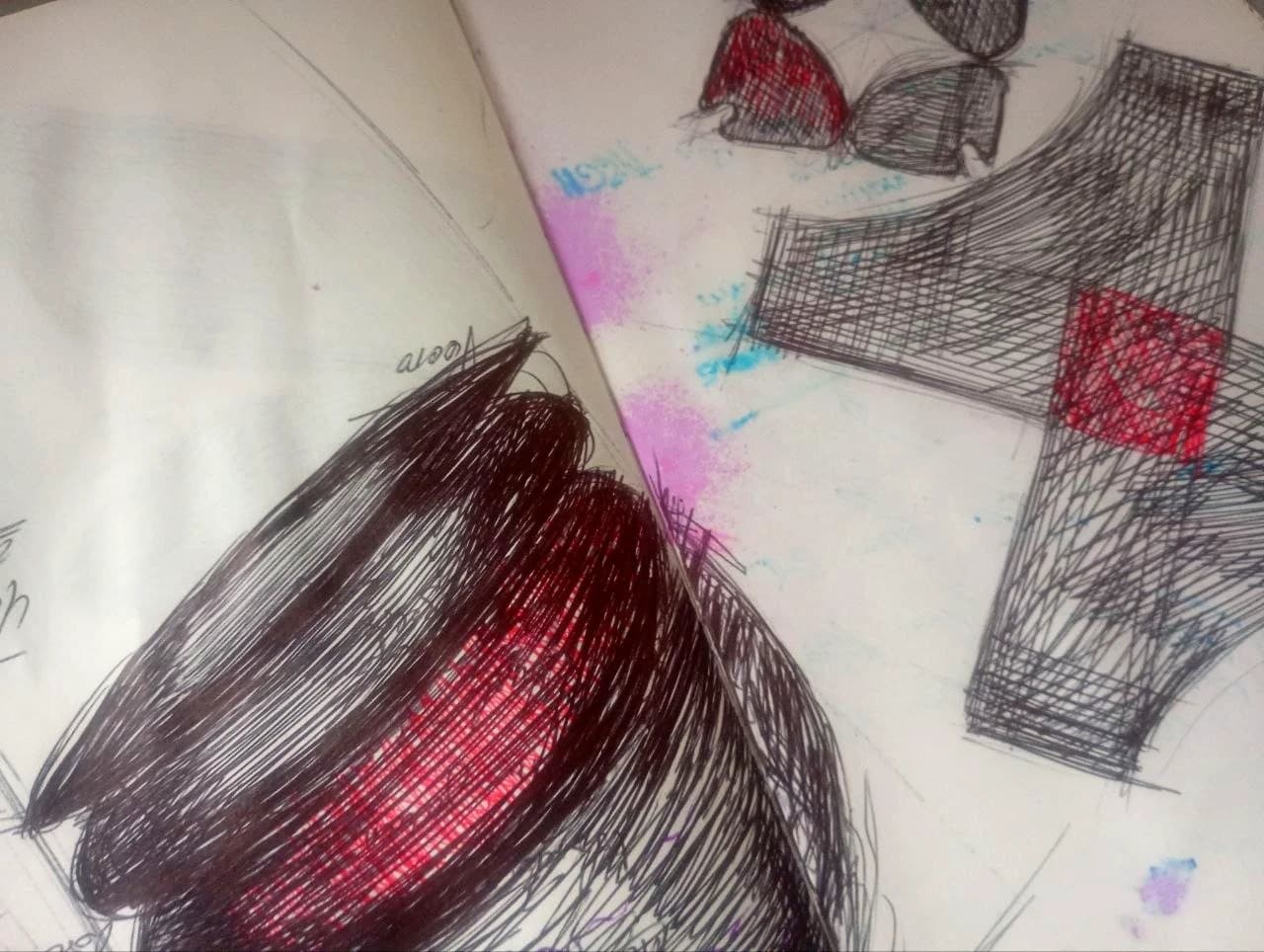
Cover artwork by Anton Biletskyi-Volokh, from an unpublished reusable sketchbook in progress. Other work from my sketchbook practice.
A thematic selection of translated notebook fragments.
A compulsion is a way of regulating yourself. It can be either an action or a thought.
Genuine care for a child and everyday incapacitation — “sit there, I’ll do everything” — are opposite processes.
Our consciousness has a thinking part and a proving part. Whatever the thinking part thinks, the proving part will prove.
Terror is instinct prevailing over reason. Fight and flee instead of think and talk. Negotiating is harder, but its results are easier to live with.
Beyond the perverse act, in all those dances past the limits of transgression, what opens up is not a brave new world, but emptiness and the desert of the real.
I remember a psychiatric anecdote about a woman who went to a doctor to complain about voices in her head. During the conversation, it turned out they were thoughts.
Our capacity to adapt was shaped by a long evolutionary process. Yet through lifestyle, thinking and accumulated unresolved problems, we manage to disrupt what millions of years of selection created.
Embarrassment is a natural reaction in the pre-contact phase. Toxic shame comes not from contact itself, but from every encounter with the fact that the imagined ideal image is not real.
Both a constantly high mood and a constantly low one reduce resilience to stress. A constantly high mood underestimates real and potential threats; a constantly low one brings reduced motivation and dejection.
Consciousness emerged to increase adaptability, but often reduces it instead. No cat could invent as many worries and problems for itself as a human can.
“If I can’t have everything my way, I’ll find a therapist. Perhaps they have techniques for putting pressure on reality until everything turns out the way I imagined.”
Consciousness emerged to expand our capacity to adapt. Yet it can create such frightening pictures of the future and oppressive pictures of the past that, sooner or later, those mental rides begin to undermine adaptation.
The ideal image as a shield against meeting your real self. The real self is alive, vulnerable, unable to handle everything, weak. Perfection as clanking armour, telling life it will not defeat you so easily.
Uncompensated personality traits can look endearing in youth: you imagine that learning and gradual compensation lie ahead. With age, that charm fades as you realise that both learning and compensation passed the person by.
Can you go beyond your established model of adaptation? To some extent, yes: with motivation, a meaningful goal and regulation through meaning. The other question is what physical and psychological resources that departure will cost.
Chaotic bursts of activity take a great deal of energy and produce much less than consistent action. Their temptation is to create the greatest appearance of action in place of actual action: “But I tried so hard and did so much.”
I do not know a single story in which someone facing difficult circumstances took refuge in excessive use and, just like that, the circumstances actually became easy. I do know many stories of people who believed it would turn out differently.
Wherever we go, we find familiar stories, because we take ourselves along.
Rebellion in youth is understandable: the body has plenty of energy, while experience and understanding of consequences are limited. Rebellion later in life suggests that, for some reason, adaptation has not happened and energy is still being squandered.
If a person lives without any ideals, life answers with boredom. If a person lives only by ideals, life answers with endless blows. Ideals need balance.
Psychology Notebook is a translated personal archive of observations, study and lecture notes, paraphrases, quotations and remembered ideas. A fragment’s presence here does not establish exclusive authorship or scientific consensus. These are notebook fragments, not clinical guidance.
About Psychology Notebook · Fragments from a Therapist’s Notebook