
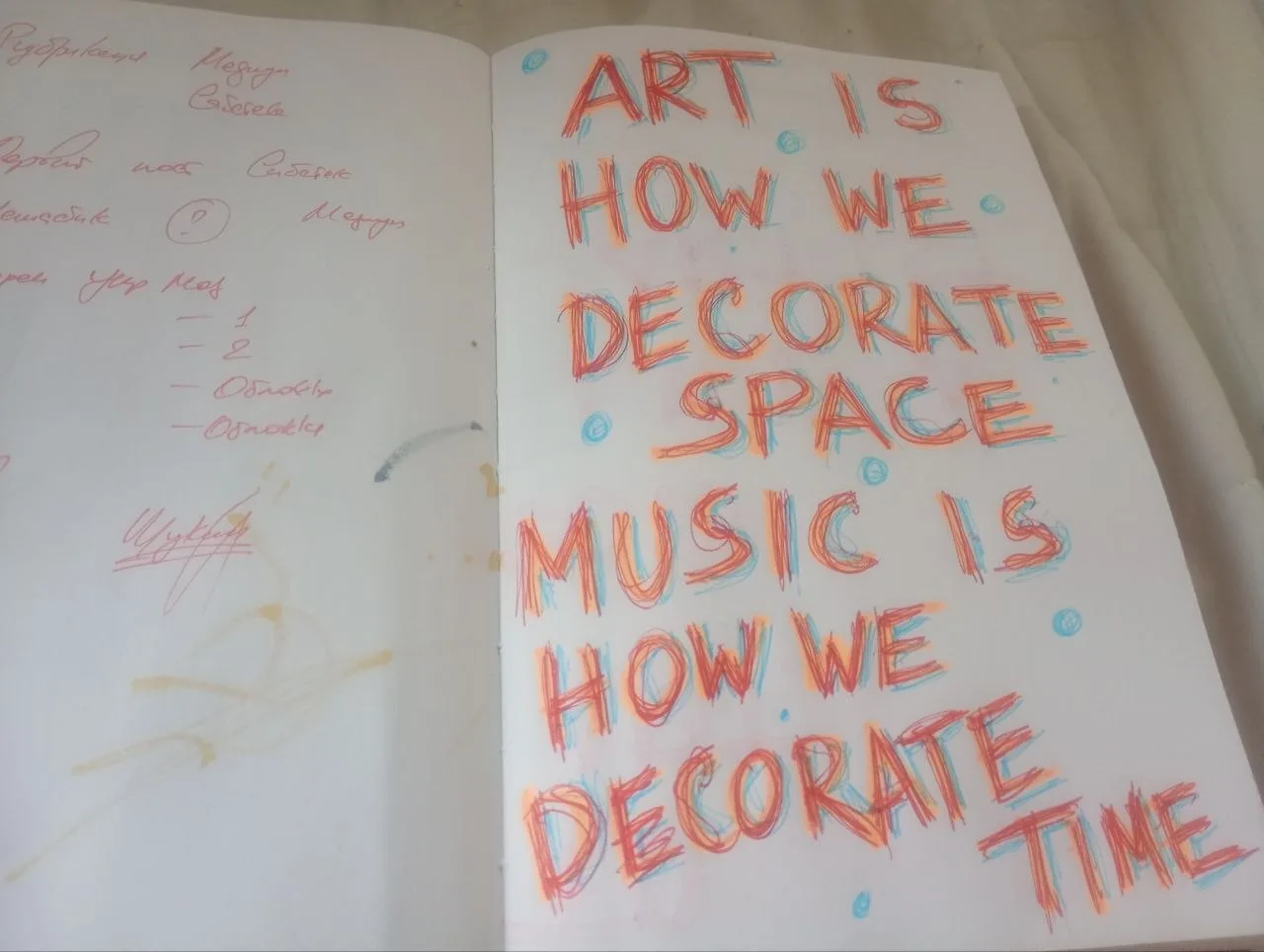
Cover artwork by Anton Biletskyi-Volokh, from an unpublished reusable sketchbook in progress. Other work from my sketchbook practice.
A thematic selection of translated notebook fragments.
Records: automatic thoughts, inner monologues that keep playing in our heads and that we often fail to notice. What matters is that these records are the voice of our particular way of getting enjoyment.
Understanding is certainly important. But trying to understand everything is often just another neurotic record on repeat, like repetitive negative thoughts.
Belief in justice is the hope that the world is symmetrical.
The best antidote to information warfare is critical thinking and the habit of checking information.
The person with the better connection to reality wins. The first rule in a situation like this: information hygiene.
There's an idea that when you change yourself, everything around you changes too.
It's a good idea, and in a sense that's what happens. After working through an inner conflict, for example, we stop fleeing life's troubles by rushing headlong into the same old traps and begin to act in more varied ways.
But when the idea is taken to mean that if you've changed and you're okay, another person will change too — and become exactly who you need them to be — that's an example of magical thinking.
The less adapted someone is to reality, the more they want reality to think better of being so complicated and freeze into something clear and unambiguous.
While you're absorbed in the idea that you're not okay, it's hard to notice how okay or not okay other people are.
An important skill therapy develops: critically assessing how realistic your idealisations are. The reality of ideality.
The larger the illusion, the harder people cling to it, and the longer it takes to recover when it collapses.
A scandal is a way of instantly revealing the true state of affairs.
Everyone is interesting. Either they have a brain and it's stimulating, or they don't, and reading about their adventures is interesting.
Even the most brilliant and carefully thought-out plan won't work if it's based on fantasies, wishes and imaginings rather than the actual state of affairs.
Reality testing is one of the most valuable skills of our time.
alternative rené descartes: i have never thought. yes yes i exist.
The right to make mistakes broadens your interests and brings curiosity back to life. If you only do things you can't get wrong, the world around you becomes terribly boring.
In a battle between a fool and a fool, the winner is predictable. A fool always wins.
The downside is that a fool's victory is always a loss for everyone in the battle, and sometimes for the people around them too.
Understanding and seeing cause-and-effect relationships isn't the same as forgiving. Forgiving isn't the same as normalising or permitting.
Acknowledging reality hurts in the moment, but frees you in the long run.
The idea of perfection severely limits your ability to tackle difficult things. The harder the task, the longer you'll spend not getting it right.
Another one on omnipotence. The idea that you should be able to do something to a high standard straight away makes it hard to begin and learn difficult things. As long as I don't start or try, I can potentially do anything.
Psychology Notebook is a translated personal archive of observations, study and lecture notes, paraphrases, quotations and remembered ideas. A fragment's presence here does not establish exclusive authorship or scientific consensus. These are notebook fragments, not clinical guidance.