
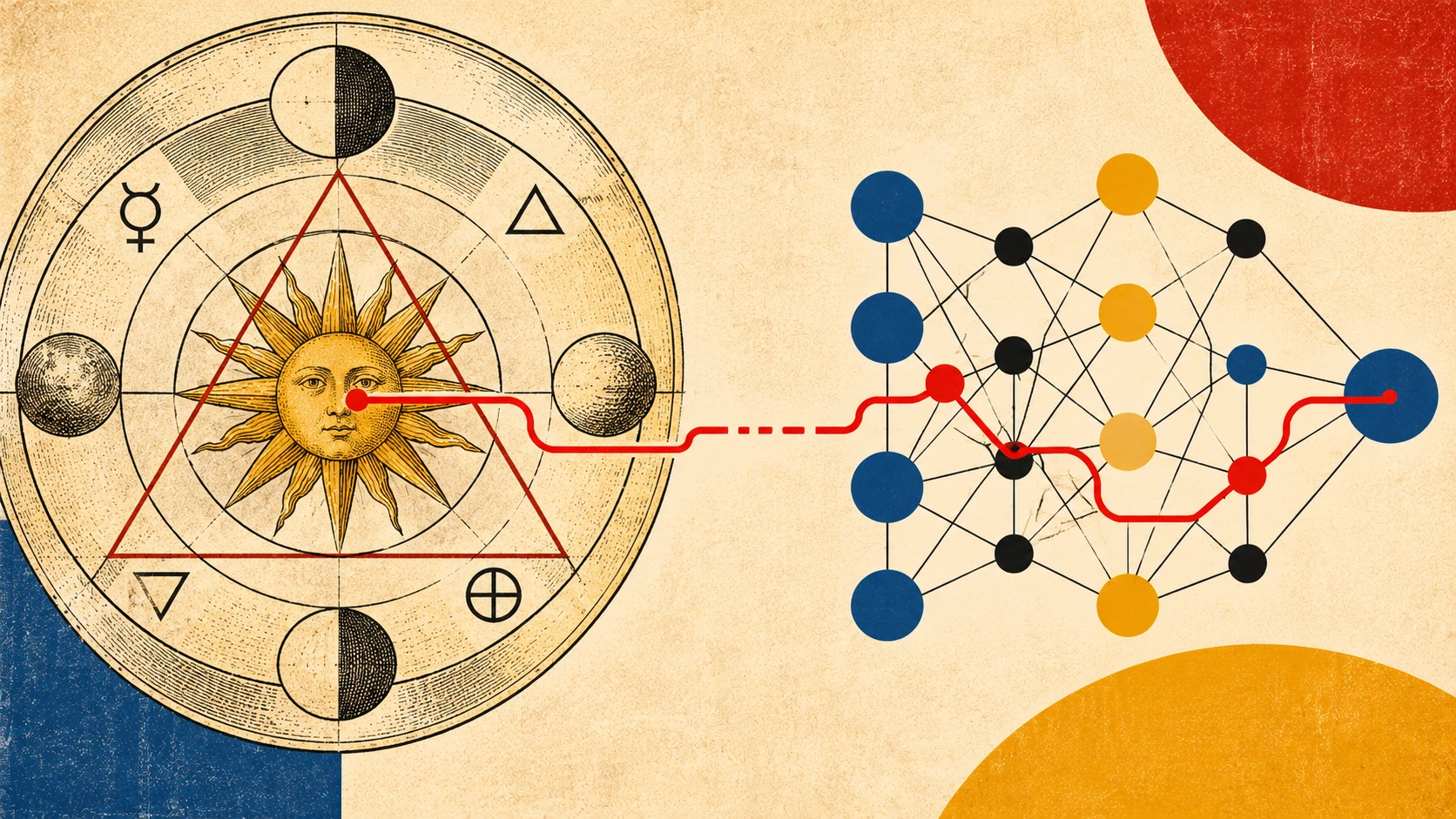
An essay traces artificial intelligence back through Newton's alchemy, Renaissance magic, Leibniz's binary arithmetic and Victorian spiritualism. The history is fascinating. The conclusion is considerably more debatable.
There's a rather entertaining theory about artificial intelligence.
Forget the computer scientists.
Forget the GPUs.
Forget the Transformer architecture, neural networks and the enormous amounts of electricity being converted into increasingly convincing conversations.
Apparently, AI is the latest chapter in a five-hundred-year-old occult tradition.
Alchemists wanted to transform lead into gold.
Mystics wanted to discover the secret language of the universe.
Victorian spiritualists tried to communicate with invisible intelligences.
And Silicon Valley now wants to create a digital superintelligence and upload everyone into the cloud.
Same ambition.
Different hardware.
At least, that's the argument presented by Matei Cananau in his September 2026 essay, The Occult History of AI.
It's a fascinating piece of writing.
Not necessarily because I agree with its central conclusion.
I don't.
But because it connects several genuinely interesting episodes in intellectual history and asks a question that deserves considerably more attention.
Why does a field supposedly devoted to engineering keep producing promises that sound suspiciously like religious prophecy?
Newton was apparently the last magician
The essay begins with Isaac Newton.
An excellent choice.
If you want to demonstrate that the boundary between science and mysticism hasn't always been particularly clear, Newton is a magnificent example.
We remember him for mathematics, physics, gravity and optics.
But Newton also spent an extraordinary amount of time studying alchemy, biblical chronology and religious questions.
In 1936, John Maynard Keynes acquired a substantial collection of Newton's manuscripts.
And what emerged from those papers helped challenge the familiar picture of Newton as an entirely modern, rational scientist.
Keynes subsequently described him as the last of the magicians.
Not simply a man who had escaped the medieval worldview, but someone whose intellectual life still belonged partly to it.
This is historically interesting.
And it challenges our convenient habit of dividing history into two neat periods.
First, everyone believed in magic.
Then science arrived.
Everybody became reasonable.
The end.
Unfortunately, intellectual history is rather less tidy.
Alchemy and early chemistry developed alongside one another.
Natural philosophy included questions that we'd now classify as religious, philosophical and scientific.
And some of the people who helped establish modern science were perfectly comfortable exploring subjects that contemporary scientists would regard as esoteric.
But there's a distinction worth preserving.
Newton's interest in alchemy doesn't mean that gravity was discovered through magic.
Nor does it establish that contemporary physics is secretly an occult project.
A person's intellectual influences can be complicated without every part of their work becoming an expression of the same underlying belief.
This is where Cananau's essay begins to become more ambitious than the historical evidence necessarily allows.
The Renaissance was rather more magical than we remember
The next stop is Renaissance Europe.
Cananau traces the revival of Hermeticism, a body of philosophical and religious writings associated with the legendary Hermes Trismegistus.
These texts emerged in the Greco-Egyptian world of late antiquity.
They explored divine knowledge, humanity's relationship with the cosmos, spiritual transformation and the possibility of understanding reality through hidden principles.
During the Renaissance, they attracted considerable attention.
In 1463, Marsilio Ficino translated the Corpus Hermeticum into Latin at the request of Cosimo de' Medici.
That's a real and important episode in Renaissance intellectual history.
The texts were believed to contain extremely ancient wisdom.
And their revival influenced philosophical, religious and esoteric thought.
Cananau takes this further.
He argues that the Renaissance wasn't primarily a recovery of Greek logic, but a revival of Hermetic magic.
That's where I'd become more cautious.
The Renaissance involved a vast collection of developments.
Classical scholarship.
Art.
Mathematics.
Humanism.
Natural philosophy.
Theology.
And yes, esoteric traditions.
Reducing that complicated intellectual transformation to one hidden source is appealing storytelling.
But it isn't particularly satisfying history.
Still, the Hermetic connection becomes much more interesting when the article turns to the mechanical organisation of ideas.
Because now we encounter something that looks remarkably familiar to anyone interested in computing.
The medieval philosopher who wanted to mechanise thought
In the thirteenth century, Ramon Llull developed a system known as the Ars Magna, or Great Art.
It involved symbolic combinations of concepts, represented through letters and rotating diagrams.
The ambition was extraordinary.
Could reasoning be organised into a formal system?
Could combining a limited set of basic concepts generate useful propositions?
Could intellectual questions be approached through systematic operations rather than entirely informal argument?
Now we're getting somewhere.
Llull wasn't building a language model.
His objectives were rooted in medieval philosophy and Christian theology.
But the resemblance to later ambitions in symbolic logic and mechanical reasoning is genuinely interesting.
A finite collection of symbols.
Rules for combining them.
And the possibility of generating conclusions through an organised procedure.
Several centuries later, Giordano Bruno developed elaborate memory systems involving rotating wheels, symbolic imagery and combinations of concepts.
Bruno's interests included Hermetic philosophy and the relationship between human cognition and the structure of the cosmos.
Cananau compares these systems with modern language models.
And as a metaphor, the comparison is delightful.
Take many symbols.
Combine them through an elaborate system.
Produce new arrangements that appear meaningful.
An early conceptual cousin of the machine that now confidently explains quantum mechanics and occasionally invents a nonexistent reference.
But there's a problem.
Bruno's symbolic memory wheels and modern neural networks don't operate according to the same principles.
One involves consciously organised symbols and mnemonic relationships.
The other learns statistical representations through numerical optimisation.
Similar ambitions don't establish identical mechanisms.
Still, I think there's a real intellectual continuity worth exploring.
The desire to make human thought systematic, representable and mechanically reproducible is much older than computers.
And that's a more defensible observation than claiming that the Transformer is essentially a magical wheel with better funding.
Leibniz: let us calculate
Then comes Gottfried Wilhelm Leibniz.
And here the historical connection becomes particularly compelling.
Leibniz wanted to develop a universal symbolic language capable of representing ideas and enabling reasoning through calculation.
Instead of endlessly arguing about whether a statement was true, people might eventually express the disagreement formally and compute an answer.
An extraordinary ambition.
And one that still resonates with logic, computer science, formal verification and automated reasoning.
Leibniz also developed binary arithmetic, using zero and one.
His 1703 paper connected this system to the hexagrams of the Chinese I Ching.
And here Cananau introduces another mystical thread.
Binary representation becomes associated with the theological contrast between existence and nothingness.
Creation and nonexistence.
One and zero.
It's an appealing story.
And Leibniz really did explore theological interpretations of binary numbers.
But the chronology matters.
He developed binary arithmetic independently before encountering the Chinese hexagram arrangement through correspondence with the Jesuit Joachim Bouvet.
The I Ching didn't simply teach Leibniz how to invent modern binary computing.
And modern computers aren't binary because engineers inherited an ancient mystical doctrine.
They use binary representations because they have extraordinarily useful mathematical and engineering properties.
Nevertheless, the historical episode reveals something interesting about Leibniz himself.
He didn't regard mathematics, metaphysics and theology as entirely separate intellectual territories.
He looked for relationships between them.
An attitude that would probably make many contemporary research-funding committees rather nervous.
Victorian spiritualists invented prompting. Sort of.
This is probably my favourite analogy in the entire essay.
Victorian automatic writing.
During the nineteenth century, spiritualist mediums claimed to receive messages from nonhuman intelligences.
A practitioner might enter a trance-like state.
Then begin writing.
The words supposedly came from somewhere beyond ordinary conscious thought.
An invisible intelligence.
A spirit.
A mysterious source of knowledge.
Now compare that with a modern AI chatbot.
You enter a prompt.
An opaque computational system produces a stream of coherent text.
Sometimes surprising.
Sometimes insightful.
Sometimes completely wrong.
And occasionally so confident that people begin attributing considerably more intelligence and intention to it than the evidence justifies.
The similarity is rather amusing.
The Victorian medium had a pencil.
We have a text box.
Their invisible intelligence was said to inhabit another plane of existence.
Ours operates through model parameters, inference infrastructure and computation.
Of course, the difference is fundamental.
A language model is not a supernatural entity.
Its outputs have a technical explanation, even when the details of its internal representations are difficult to interpret.
But the analogy says something interesting about human psychology.
When language appears without an immediately visible human author, people become remarkably willing to imagine an independent mind behind it.
Sometimes that imagination is justified.
Sometimes it isn't.
And historically, we have repeatedly developed cultural frameworks for explaining apparently intelligent speech whose source we don't fully understand.
That makes automatic writing a useful comparison.
Not because Victorian mediums invented language models.
But because the human tendency to interpret mysterious text as communication from an intelligence has a very long history.
Heidegger enters the data centre
The essay then moves into twentieth-century cybernetics and the philosophy of Martin Heidegger.
This is where its argument becomes more serious.
Cybernetics helped establish ways of understanding machines, organisms and organisations through information, feedback and control.
Heidegger, meanwhile, warned against treating technology as merely a neutral collection of tools.
In The Question Concerning Technology, he explored how technological thinking can change our understanding of reality itself.
Nature becomes a resource.
Human activity becomes something to organise and optimise.
The world increasingly appears as material available for calculation and use.
He called this framework Gestell, commonly translated as enframing.
And this seems particularly relevant to AI.
Consider the language of contemporary business transformation.
Human knowledge becomes training data.
Experience becomes a dataset.
Creativity becomes an output.
Human attention becomes a resource to optimise.
Relationships become interactions.
And entire organisations are analysed as systems of processes that can be measured, redesigned and automated.
There is genuine value in some of this.
I'm certainly not against optimisation.
I spend a considerable amount of my own time building and improving automated processes.
But the philosophical question is legitimate.
Does our ability to represent something computationally change how we value it?
And do we sometimes confuse a useful representation of human activity with the full meaning of that activity?
I think those questions deserve more attention than another debate about whether the next model will score three points higher on a benchmark.
Then Silicon Valley becomes a religion
Now we arrive at the central argument.
According to Cananau, today's AI industry is continuing the ambitions of Hermeticism and Gnosticism.
The promise of knowledge that transcends ordinary human limitations.
The transformation of humanity.
The creation of superior intelligence.
The defeat of death.
Perhaps even the achievement of a kind of technological divinity.
And, to be fair, he isn't inventing all these ideas.
Some prominent technology figures have spoken seriously about radical life extension.
Mind uploading.
Artificial superintelligence.
The singularity.
And futures in which biological human limitations might be overcome through technology.
Certain strands of transhumanism explicitly explore these ambitions.
There is also a genuinely religious quality to some AI rhetoric.
Salvation is coming.
The new intelligence will solve our problems.
Material scarcity will disappear.
Disease will be conquered.
Humanity will transcend its limitations.
We simply need to build the necessary computing infrastructure first.
And perhaps raise another hundred billion dollars.
I can see why someone with an interest in religious history would find this fascinating.
But there's a distinction I'd insist upon.
The existence of quasi-religious ideas within AI culture doesn't mean AI engineering itself is a religious movement.
Most researchers working on model architectures, optimisation methods, robotics or machine learning are not attempting to achieve spiritual immortality.
They're solving technical problems.
And the history of computing includes many intellectual traditions that don't fit the Hermetic narrative.
Mathematical logic.
Statistics.
Electrical engineering.
Neuroscience.
Information theory.
Linguistics.
Control theory.
The modern AI industry emerged from interactions between these fields, not from one uninterrupted esoteric lineage.
Some technological ambitions echo ancient religious ideas.
That doesn't make the technology a direct descendant of a particular religion.
A metaphor is not a genealogy
This, for me, is the central weakness of the essay.
It repeatedly moves from resemblance to historical causation.
The alchemist seeks transformation.
The AI researcher seeks transformation.
Therefore, they're pursuing the same underlying project.
Bruno combines symbols.
A language model processes tokens.
Therefore, the latter continues the former.
A spiritualist produces writing attributed to an invisible intelligence.
A chatbot produces text through an opaque computational process.
Therefore, one is the spiritual prototype of the other.
These comparisons are stimulating.
But they don't all establish historical continuity.
To show genuine intellectual descent, we'd need to trace specific ideas, documents, influences, mathematical methods and developments.
Sometimes the article provides parts of such a chain.
Llull, Bruno and Leibniz are a particularly interesting example.
Elsewhere, the resemblance is primarily philosophical or metaphorical.
And that's fine.
Metaphors can illuminate.
They can help us recognise old ambitions inside new technologies.
But they become misleading when presented as proof that two very different systems are secretly the same thing.
Otherwise, almost any human effort to overcome a limitation could be described as the continuation of some ancient mystical tradition.
Medicine.
Aviation.
Telecommunications.
Space exploration.
Even central heating, if we're sufficiently imaginative.
The interesting work is distinguishing genuine historical influence from the recurring human desire to achieve something previously considered impossible.
The theological conclusion is the real destination
There's another reason the structure of Cananau's essay matters.
Its conclusion is explicitly theological.
The author contrasts technological transcendence with the Eastern Orthodox Christian understanding of the human person.
He invokes St. Maximus the Confessor and the concept of theosis, spiritual transformation through participation in divine life.
From this perspective, the ambition to escape the human body through technology misunderstands what human beings are.
The body is not merely defective biological hardware.
Material existence is not simply an obstacle to be overcome.
And spiritual transformation isn't achieved by uploading consciousness into a server.
That's a coherent religious position.
One can agree with it.
Disagree with it.
Or simply find it intellectually interesting.
But it's important to recognise that the essay isn't merely a neutral investigation into the history of AI.
It's also an argument about what it means to be human.
The historical narrative serves that larger purpose.
And I think the article becomes easier to understand once you recognise this.
Its author isn't primarily trying to explain how neural networks were invented.
He's trying to explain why certain technological ambitions appear spiritually misguided from his philosophical and religious perspective.
That's a different question.
And a perfectly legitimate one to explore.
Provided we don't confuse theological interpretation with established technological history.
The question I find more interesting than the answer
Despite all these reservations, I genuinely enjoyed reading the essay.
Partly because it introduces historical figures and intellectual connections that are easy to overlook.
Partly because it challenges the idea that technological development takes place in a philosophical vacuum.
And partly because I think there is an important observation buried beneath the grand theory.
We keep inventing technologies that extend our capabilities, and then imagining that those technologies might finally release us from the limits of being human.
We wanted machines that could calculate.
Then machines that could reason.
Then machines that could learn.
Now some people imagine machines capable of becoming something superior to humanity itself.
This progression isn't necessarily mystical.
But our interpretation of it can be.
And the more powerful AI becomes, the more tempting it is to treat technical achievement as evidence of a much larger historical destiny.
The problem is that technological capability and philosophical meaning are not the same thing.
A model that solves difficult mathematical problems isn't necessarily conscious.
A system that generates remarkably good language isn't necessarily a person.
An AI that discovers new scientific results doesn't automatically prove that human creativity has become obsolete.
And the possibility of simulating aspects of human cognition doesn't establish that a human mind can be transferred into a computer.
These remain separate questions.
Some scientific.
Some philosophical.
Some deeply personal.
AI may help us investigate them.
But it won't necessarily settle them simply by becoming more capable.
Perhaps the magic was never in the machine
There's something almost comical about the fact that we keep returning to these questions.
Five centuries ago, scholars investigated hidden correspondences between symbols, numbers and the structure of reality.
Today, researchers train enormous mathematical systems that discover patterns in information at scales no human can inspect directly.
The methods are different.
The underlying theories are different.
The practical results are certainly different.
But the fascination feels familiar.
We want to discover order inside complexity.
We want knowledge that extends our abilities.
We want to understand things that previously seemed inaccessible.
And sometimes we want rather more than understanding.
We want mastery.
Transformation.
Perhaps even immortality.
I don't think that makes modern AI an occult religion.
But I do think it makes the history of esoteric thought an unexpectedly interesting mirror in which to examine some contemporary technological ambitions.
Cananau's essay is most valuable, to me, when read in that spirit.
Not as a convincing demonstration that large language models descend directly from Renaissance magic.
But as an invitation to question the promises surrounding them.
What are we actually trying to achieve?
Better tools?
More reliable knowledge?
A more prosperous society?
Or something considerably more ambitious that we haven't entirely admitted to ourselves?
Because there's a difference between building a machine capable of performing extraordinary tasks and convincing ourselves that the machine will finally answer the oldest questions about human existence.
AI may have nothing supernatural inside it.
But some of the promises we make about it are positively medieval.
And that, I think, is a much more interesting story than discovering that the data centre is secretly an alchemist's laboratory.
Further reading
This article is an independent critical review. The historical connections, theological interpretations and claims about AI's spiritual meaning are distinguished from documented facts about computing and intellectual history.