
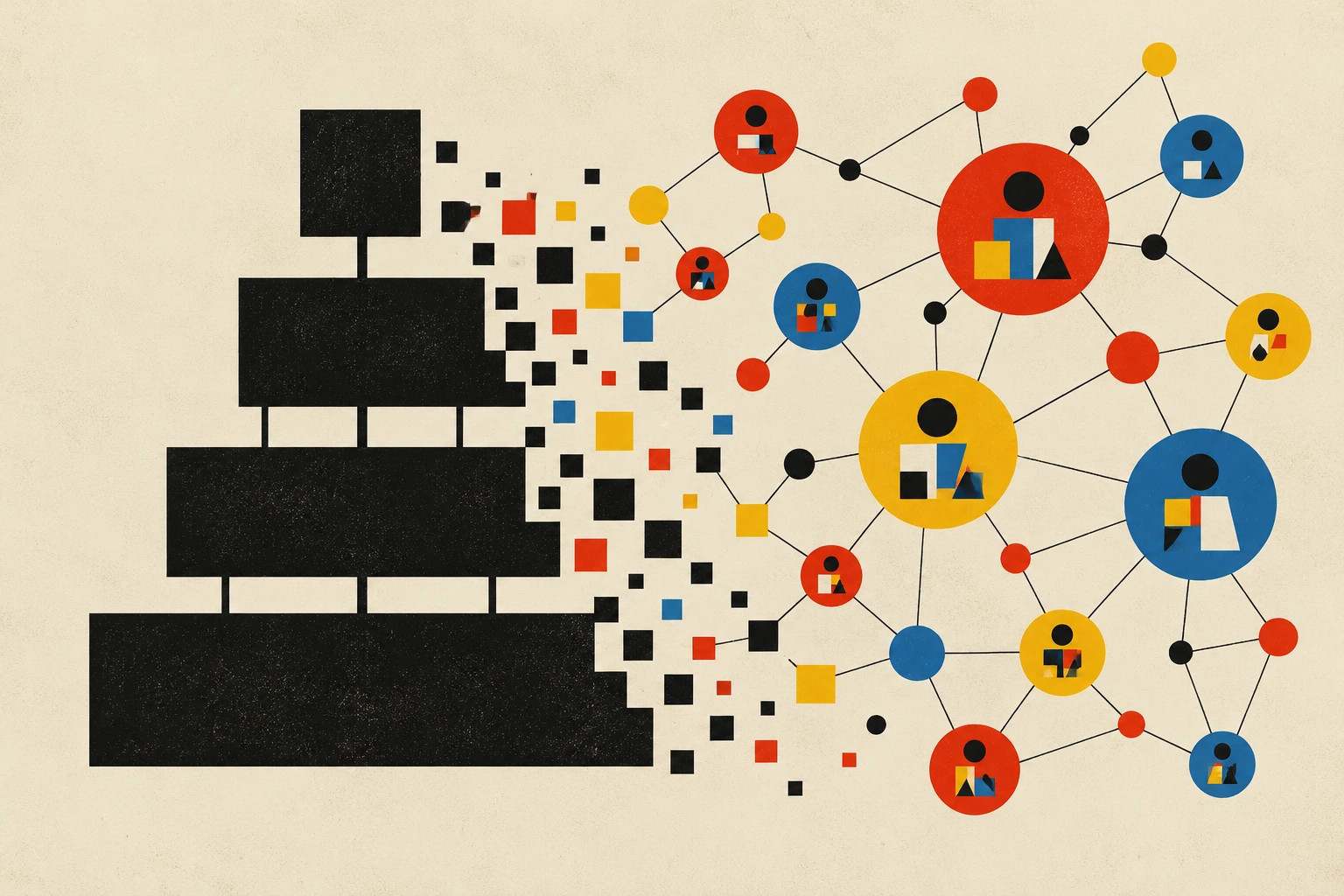
An a16z essay about Databricks asks what companies will look like twenty years from now. Its most interesting prediction isn't that AI will replace employees. It's that managing work will become everyone's job.
For years, we've been hearing that AI will turn everyone into a programmer.
Designers will write applications.
Accountants will build their own dashboards.
Marketing specialists will automate entire campaigns.
And somewhere, presumably, a software engineer will finally have enough free time to read the documentation.
It's an attractive vision.
But I recently read a much more interesting prediction.
AI won't necessarily make everyone a programmer. It may make everyone a manager.
Not a manager in the traditional sense, with a corner office, quarterly performance reviews and seventeen meetings about why there are too many meetings.
A manager in the functional sense.
Someone who defines a task, delegates the execution, evaluates the result, makes decisions and improves the process.
And if that's where we're heading, AI is about to change something much more fundamental than the software companies use.
It may change how companies are organised.
Twenty years? In AI? How terribly old-fashioned.
Ben Horowitz and Michael McGuiness have published a substantial essay at Andreessen Horowitz called Databricks & the Future of the Firm.
It's about Databricks, obviously.
But it's also about the nature of companies, the role of management, organisational knowledge and what people might actually spend their working days doing over the next twenty years.
Twenty years.
A wonderfully unfashionable timescale in an industry where people routinely announce the end of civilisation before lunch and a new technological era by Thursday.
But I think the longer horizon makes sense.
AI models may improve dramatically over a year or two.
Large, established organisations rarely change quite so quickly.
A company isn't just a collection of tasks waiting to be automated.
It's a system of responsibilities, incentives, information flows, informal relationships, accumulated knowledge and permission structures.
You can introduce a new technology overnight.
Changing how an organisation makes decisions is another matter entirely.
And this is where the essay becomes interesting.
Two revolutions are happening. One isn't technological.
The authors begin with two changes.
The first is familiar.
Agentic automation.
Instead of a person manually performing every step of a process, AI agents increasingly execute tasks, interact with software, gather information and produce results.
Describe what needs to happen.
Give the agent the necessary tools and context.
Let it do the work.
At least, that's the ambition.
The second change receives much less attention.
Employee empowerment.
People closer to a problem can increasingly investigate it, propose a solution and take action without sending every decision through multiple levels of management.
At first glance, these seem like separate developments.
One concerns technology.
The other concerns organisational culture.
But the central insight is that they depend on one another.
Imagine giving every employee a team of extraordinarily fast digital assistants.
They can analyse data, generate reports, write software, investigate anomalies and coordinate processes.
Wonderful.
Now imagine that the employee still needs approval from three managers, a project committee and the IT department before doing anything useful with the results.
Congratulations.
You've automated the work and preserved the bottleneck.
Possibly even made it worse, because the system can now produce requests for approval considerably faster.
This is the part of the essay I find most convincing.
Automation without decision-making authority doesn't necessarily create a more capable organisation. It can simply create a faster bureaucracy.
The spreadsheet didn't eliminate the hierarchy
Companies have been dealing with versions of this problem for decades.
Computers made information easier to store.
Databases made it easier to retrieve.
Enterprise systems made business processes more consistent.
But information and authority didn't necessarily become equally accessible.
A sales representative might know something important about a customer.
A customer-support employee might notice a recurring product failure.
A logistics specialist might recognise a wasteful procedure.
Yet turning that knowledge into action could require navigating the hierarchy.
File a report.
Tell the supervisor.
Wait for the department head.
Arrange a meeting.
Request an IT change.
Wait for the next planning cycle.
By the time the organisation acts, the original problem may have become part of the furniture.
The a16z essay connects this to a much older question.
Why do firms exist in the first place?
In 1937, economist Ronald Coase argued that companies help reduce the transaction costs of coordinating economic activity.
Instead of negotiating a separate market transaction every time something needs to happen, organisations establish continuing relationships, shared resources and management structures.
But internal coordination has costs too.
As companies grow, more people must exchange information, reconcile decisions and manage dependencies.
Eventually, the organisation can spend a remarkable amount of time coordinating itself.
AI could lower those costs.
But only if the company changes how people are permitted to act.
Otherwise, it merely adds another expensive tool to the existing hierarchy.
The database is becoming part of the organisational chart
This brings us to Databricks.
The company has evolved from distributed data-processing technology into a platform that combines analytical data, operational databases, AI tools and systems for managing access and governance.
The essay traces this evolution through Apache Spark, the lakehouse architecture, Lakebase and agent-oriented infrastructure.
That technical history is interesting.
But I think the organisational implication matters more.
Traditionally, much of the information required to run a company lives in different places.
Customer records in one system.
Financial data in another.
Operating procedures in documents.
Product information somewhere else.
Critical exceptions in employees' heads.
And the real explanation for why a particular process works the way it does?
Quite possibly in the memory of somebody who retired three years ago.
This is manageable when humans constantly interpret the gaps.
It's considerably less manageable when thousands of AI agents need to act autonomously.
An agent can't make a responsible business decision simply because it has access to a spreadsheet.
It also needs to understand what the information means, what it's allowed to do and how success should be evaluated.
The authors describe Databricks' ambition to become a system of record for agents.
In practical terms, that means maintaining not just business data, but the organisational context needed to use it.
Definitions.
Relationships.
Permissions.
Decision rules.
Feedback.
And records of what actually happened.
This is an important distinction.
A company doesn't become AI-ready merely by making its data searchable. It needs to make its decisions understandable and its actions governable.
Four questions every useful agent must answer
I particularly like the framework underlying this part of the essay.
An enterprise AI system needs answers to four basic questions.
What is true?
What information do we currently have? Which records reflect the actual state of the business?
What does it mean?
What is revenue? How is a customer classified? Which exceptions matter? Why do two departments use different numbers for apparently the same thing?
What am I allowed to do?
Can this agent read customer information? Change a price? Approve a refund? Contact a supplier? Modify a production system?
Did it work?
Was the action successful? Was the decision appropriate? Did it introduce a new problem? Should the process change next time?
Databricks is developing products around these capabilities, including Genie, Lakebase, governance infrastructure and tools for building and evaluating agents.
The article reports that agents now generate more queries on Databricks than humans and launch more than 17 million databases per day.
Those are striking platform activity figures, although they shouldn't be mistaken for evidence that millions of complete business processes are already running autonomously.
Creating an isolated database for an experiment is not the same thing as safely running a bank.
But the underlying direction is significant.
The infrastructure of companies may increasingly be built not only for people using software, but for agents continuously reading, updating and experimenting within controlled systems.
That has implications far beyond database engineering.
It affects who gets to make decisions.
From employee to manager of digital employees
Now we arrive at my favourite part.
The authors describe what they see as a second managerial revolution.
In the twentieth century, large organisations developed a professional managerial class.
Managers coordinated work, interpreted information, assigned responsibilities and ensured that different parts of the organisation operated together.
This structure was partly necessary because moving information around a large company was expensive.
Someone had to collect reports.
Someone had to interpret them.
Someone had to decide.
Someone had to communicate those decisions to everyone else.
AI could change this arrangement.
A software engineer already provides a useful example.
Instead of writing every line of code personally, the engineer can define tasks for coding agents.
Several agents work in parallel.
The engineer reviews their output, requests corrections, tests the result and integrates the acceptable changes.
That's no longer purely the work of someone producing code.
It's the work of someone managing a production process.
And the same shift could spread.
A marketing specialist might coordinate agents that investigate customer segments, analyse campaign results and propose experiments.
A supply-chain specialist might direct systems that identify shortages, evaluate alternatives and prepare orders.
A financial analyst might create a recurring investigation that monitors anomalies and recommends responses.
The person still needs professional expertise.
Possibly more than before.
Because assigning a task is relatively easy.
Recognising a subtly incorrect answer is another matter.
The specialist increasingly becomes responsible for defining what good work looks like.
Which sounds suspiciously like management.
Not everyone gets a promotion
Of course, there's a trap in the phrase everyone becomes a manager.
It doesn't mean that every employee receives a management title.
Or a salary increase.
Or a team of humans reporting to them.
And it certainly doesn't mean that everyone suddenly becomes competent at managing work.
Delegation is a skill.
So is evaluation.
So is designing a reliable process.
And anyone who has encountered an AI agent producing a beautifully formatted but completely incorrect result knows that supervision isn't optional.
In fact, AI can make weak judgment more dangerous.
A person might make one mistake while manually processing an order.
An automated system might repeat the same mistake ten thousand times before anyone notices.
So the future described in the essay isn't simply about giving everybody more automation.
It's about distributing responsibility for defining, supervising and improving automated work.
And that requires changes to skills, permissions, accountability and incentives.
This is where I think many corporate AI transformation programmes will struggle.
It's relatively easy to purchase software.
It's much harder to persuade a management hierarchy to surrender some control over information and decisions.
Especially when controlling information has historically been part of how that hierarchy maintained its importance.
Managers won't disappear. Their information monopoly might.
One of the useful distinctions in the article concerns management itself.
Jack Dorsey, discussing the organisational transformation of Block, argues for reducing the hierarchy that currently moves information through companies.
Databricks CEO Ali Ghodsi takes a more cautious position.
The organisational chart and the information flow are not necessarily the same thing.
A company may still need managers to develop people, establish priorities, resolve conflicts and handle difficult human situations.
But it may need fewer managers whose primary role is collecting, relaying and interpreting routine information.
I think that's an important distinction.
Management as a professional skill isn't going away simply because AI can produce a report.
People still need guidance.
Teams still have conflicts.
Unusual situations still require judgment.
And somebody must remain accountable for consequential decisions.
But the monopoly on coordinating work could weaken considerably.
The person who understands a problem may increasingly have the information and tools to organise its solution directly.
Without first persuading an entire chain of intermediaries.
That's a meaningful change in how organisations operate.
And potentially a much bigger one than giving everybody access to a chatbot.
Your competitive advantage isn't the AI model
There's another argument in the essay that deserves attention.
If every company can rent essentially the same capable AI models, where does competitive advantage come from?
Not simply from having the model.
Your competitors can rent it too.
The authors suggest that advantage increasingly comes from the organisation's accumulated knowledge and learning processes.
Consider two businesses using AI to make operational decisions.
The first asks an agent for a recommendation.
Receives an answer.
Makes a decision.
And moves on.
The second records the context of the recommendation.
Why it was accepted or rejected.
What happened afterwards.
Which assumptions were wrong.
What the human specialist corrected.
And how the process should change next time.
A year later, the second company has something the first doesn't.
An accumulated record of experience.
Not merely data.
Organisational memory connected to actual decisions and outcomes.
When a better AI model arrives, the company can replace the technology while preserving what the organisation has learned.
This is the logic behind the essay's notion of a sovereign firm.
A company shouldn't become entirely dependent on an external AI provider for its knowledge of how its own business works.
I find this argument particularly persuasive.
The durable value isn't necessarily in an individual model or agent.
It's in the system that allows an organisation to improve its decisions continuously.
The agent can change.
The accumulated knowledge should remain.
The management problem nobody can solve with a prompt
Of course, this is still a rather optimistic vision.
And we should remember who's presenting it.
Andreessen Horowitz is an investor in Databricks.
The essay is both a serious exploration of organisational change and an argument for why the company's technology could become enormously important.
That doesn't make the ideas wrong.
But it does mean we should separate what already exists from what the authors hope will happen over the next twenty years.
There are obvious unresolved problems.
Data quality.
Security.
Access control.
Incorrect automation.
Unclear accountability.
Employee resistance.
And management cultures that reward obedience more consistently than initiative.
The technical layer might improve quickly.
The organisational layer may not.
You can give a customer-support specialist an AI system that identifies a recurring failure.
But if nobody has authorised that specialist to change the process, the organisation hasn't become more intelligent.
It's merely become better informed about its own dysfunction.
And perhaps the most difficult part of AI transformation will be getting executives to accept that better technology sometimes requires them to make fewer routine decisions themselves.
A rather uncomfortable sales pitch for the people signing the purchase orders.
The future company might not look smaller. It might look different.
The essay also avoids one overly simple prediction.
AI doesn't necessarily mean that every company becomes tiny.
Lower coordination costs can help small teams do things that previously required large organisations.
But they can also allow large companies to manage greater complexity.
A small company may suddenly operate across many markets with relatively few employees.
A multinational business may coordinate activities that were previously too complicated to handle efficiently.
Both outcomes are possible.
The interesting question isn't simply how many people remain on the payroll.
It's what those people do.
How quickly the organisation learns.
How effectively information turns into action.
And how much administrative effort is required to coordinate everything.
A company with hundreds of agents and ten employees might be extraordinarily productive.
Or it might be ten exhausted people desperately trying to supervise hundreds of systems they barely understand.
The difference is management.
Which brings us right back to the beginning.
AI transformation is a management revolution wearing a technology company's jacket
That's why I enjoyed this article.
Databricks provides the concrete technical example.
The discussion of databases and enterprise infrastructure explains how agents might become capable of operating inside real organisations.
But the larger question is managerial.
Who has access to information?
Who has authority to act?
Who decides what matters?
Who evaluates the results?
And how does the organisation learn?
These questions existed long before generative AI.
AI simply makes avoiding them increasingly expensive.
I suspect many companies will spend the next few years buying agents and wondering why their productivity hasn't improved nearly as much as promised.
They'll discover that automating a dysfunctional process doesn't necessarily make it functional.
And that giving employees new tools without changing their authority is a rather limited form of empowerment.
The companies that benefit most may not be those with the largest collections of AI applications.
They may be those willing to rethink how decisions are made.
How knowledge is shared.
And how much initiative people are actually allowed to exercise.
So perhaps the most important AI skill of the next twenty years won't be writing prompts.
Or programming.
Or memorising the names of increasingly complicated agent frameworks.
It will be the ability to identify a problem, design a process, delegate work and recognise whether the result is any good.
In other words, management.
Not necessarily management of people.
Management of work.
And increasingly, management of intelligent systems.
Congratulations. You're a manager now.
Unfortunately, the company still has to give you permission to do anything.
Further reading
- Ronald Coase — The Nature of the Firm (1937)
- James Burnham — The Managerial Revolution (1941)