
The gap between what artificial intelligence can do and what organizations are capable of doing with it may be the defining management problem of the next decade.
We live in an absolutely ridiculous time.
And I don't mean that in the usual sense of politicians, markets, or the price of a decent cup of coffee.
I mean the speed at which our understanding of what's technologically possible becomes obsolete.
Not the technology itself.
Our understanding of it.
There's an increasingly enormous difference between people working at the AI frontier and practically everyone else.
And what's interesting is that this gap doesn't necessarily exist because the others are stupid, lazy, or resistant to change.
Many of them are intelligent, experienced professionals.
They read the news.
They use ChatGPT.
Their companies have AI strategies.
Some even have impressive presentations explaining how thoroughly artificial intelligence has been integrated into the business.
Unfortunately, the frontier has moved again.
And the strategy may already be describing a world that no longer exists.
Imagine AI stopped improving tomorrow
Here's a useful thought experiment.
Suppose AI development suddenly slowed down.
No dramatic new capabilities.
No major leaps in reasoning or agentic automation.
Just gradual improvements to the technology we already have.
What would happen?
For a while, there would still be a substantial gap between the companies using AI effectively and those barely using it.
But gradually, the laggards would catch up.
Employees would learn the tools.
Managers would understand where they belong.
Software vendors would integrate the technology into existing products.
Companies would redesign their workflows.
Consultants would produce methodologies, training programmes, certifications, and probably several thousand PowerPoint presentations.
Eventually, many of today's AI advantages would become ordinary operating practices.
Much as spreadsheets, databases, email, and cloud software eventually did.
You wouldn't gain a meaningful competitive advantage simply because your accountants knew how to use Excel.
Everybody else's accountants would know too.
AI could follow a similar path.
The technology would diffuse throughout the economy, and its benefits would become increasingly standardised.
Except that isn't what's happening.
The technology isn't waiting for us
AI capabilities keep advancing.
And every meaningful improvement changes the range of economically useful tasks that can be performed.
A year ago, something might have required constant human supervision.
Today, perhaps an agent can handle most of it.
Six months ago, an automation might have been too expensive to justify.
Today, a more efficient model may make it practical.
A task that previously failed because the model couldn't retain enough context might now be manageable.
A complicated workflow that once required several specialised tools may become straightforward when those capabilities are incorporated into a single system.
The point isn't that every model release changes everything.
Some updates are incremental.
Some are disappointing.
Some introduce new problems.
And some impressive benchmarks produce very little practical value.
But the cumulative movement is difficult to ignore.
If you redesigned your workflows three or six months ago, you shouldn't automatically assume that the design is still optimal.
Not because it was badly designed.
But because the assumptions behind it may have changed.
And this is an extraordinarily uncomfortable situation for organisations.
Companies usually expect technologies to remain reasonably stable while they learn how to use them.
With AI, the learning process and the technology's development are happening simultaneously.
It's rather like learning to drive while somebody keeps replacing the engine, dashboard and gearbox.
And then discovering that the vehicle no longer needs a driver for half the journey.
The real problem is organizational absorption
I recently came across a diagram by Suhit Anantula titled The AI Adoption Gap: A Question of Organizational Absorption.
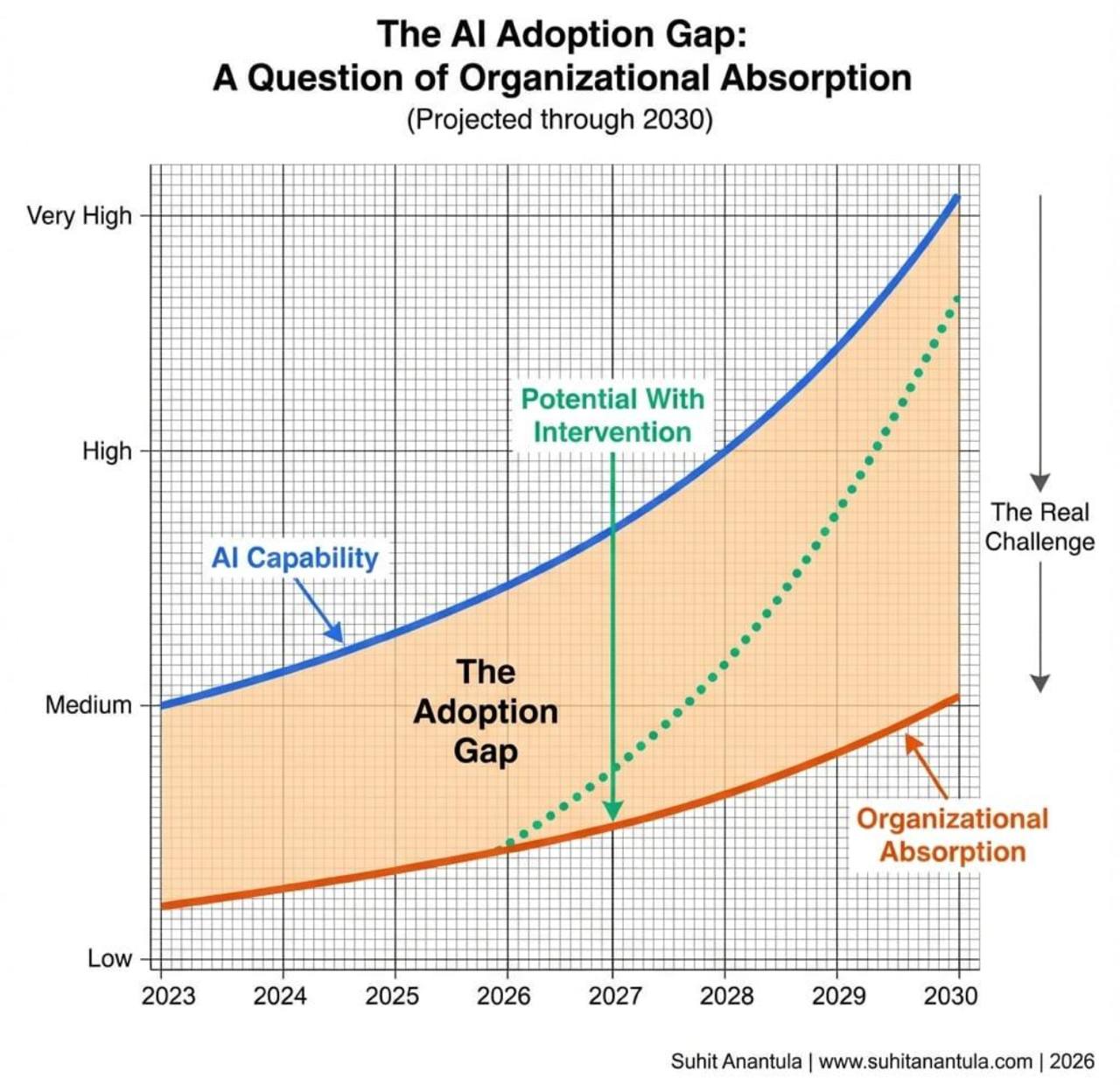
Suhit Anantula, The AI Adoption Gap: A Question of Organizational Absorption (2026). Conceptual projection through 2030, not an observed dataset.
It illustrates the problem rather neatly.
AI capability rises quickly.
The ability of organisations to absorb those capabilities rises much more slowly.
Between the two curves is a widening gap.
Not because the technology doesn't work.
But because organizations cannot change at the same speed.
I wouldn't treat the exact shape of these curves as a prediction.
Nobody knows precisely how AI capabilities or corporate adoption will evolve between now and 2030.
But as a description of the underlying tension, the illustration is useful.
Technological capability and organisational capability are not the same thing.
You can have an astonishingly capable AI system and a company that doesn't know how to make productive use of it.
The company has its hierarchy.
Its approval processes.
Its legacy software.
Its compliance requirements.
Its internal politics.
Its people.
Its organisational memory.
And its deeply established beliefs about how work is supposed to happen.
AI doesn't magically eliminate any of those things.
It simply introduces new possibilities into the existing system.
Which the system may or may not be capable of absorbing.
Eighty percent feel more productive. Where is the business impact?
The gap isn't purely theoretical.
McKinsey's 2026 global AI survey reports that 80% of respondents believe AI has improved their individual productivity.
But only 37% report that AI use has contributed at least some positive impact to their organisations' operating profit.
These aren't directly comparable experimental measurements, and they don't prove that the other companies achieved no benefit.
But the contrast is revealing.
Individual productivity can improve without automatically producing a corresponding improvement in organisational performance.
Someone writes reports faster.
Wonderful.
But are those reports actually necessary?
A developer produces code faster.
Excellent.
But can the company test, deploy and maintain that code efficiently?
A marketing team generates twenty campaign concepts instead of five.
Fantastic.
But can the business execute, measure and learn from twenty experiments?
Or has it simply become much more efficient at producing unfinished work?
This is where the organisational bottleneck becomes visible.
AI accelerates one part of a process.
But the rest of the process remains unchanged.
And the resulting advantage becomes trapped.
AI adoption is not AI transformation
I think we're going to spend quite a few years confusing these two things.
Adoption means using the technology.
Transformation means changing how the organisation operates because the technology exists.
They're not the same.
Giving everyone access to an AI assistant is adoption.
Redesigning a process so that routine analysis, execution and verification can happen automatically is transformation.
Allowing employees to generate reports with AI is adoption.
Reconsidering why those reports exist, who needs them and which decisions could happen without them is transformation.
Introducing coding agents is adoption.
Rebuilding software development around automated implementation, testing, review, deployment and recovery is transformation.
And here's the problem.
The second category is much harder.
It requires changes in authority.
Responsibility.
Skills.
Processes.
Measurement.
And sometimes the elimination of activities that have existed for years.
You can purchase technology.
You can't simply purchase organisational willingness to change.
At least, not reliably.
The AI-native advantage
This is why I think AI-native companies have such an interesting advantage.
They don't have to spend years convincing an existing organisation that work can be done differently.
They begin with that assumption.
The business is designed around the available technology.
A small team may coordinate several agents.
Processes can be built around automation from the beginning.
Information can be structured for machine access.
Verification can be part of the workflow rather than added later.
And when AI capabilities change, the team may be able to revisit its assumptions relatively quickly.
This doesn't make AI-native companies automatically successful.
They still need customers.
A viable business model.
Reliable systems.
Good decisions.
And sufficient expertise to recognise when their agents produce nonsense.
An established corporation may also possess enormous advantages in distribution, trust, regulatory access and specialised knowledge.
But the AI-native organisation has one structural benefit.
It doesn't have to dismantle as much of yesterday's operating model before it can adopt tomorrow's.
That can matter enormously when tomorrow keeps arriving every few months.
The hardest part is changing your own expectations
There's another problem, and it's not limited to corporations.
Our brains aren't particularly good at updating their assumptions continuously.
We learn that something is difficult.
We try it.
Perhaps we fail.
We establish a mental rule.
AI can't do that reliably.
And then we move on.
Six months later, the rule may be wrong.
But we don't necessarily know it.
We haven't tried again.
Why would we?
We already know the answer.
Except the answer belongs to an earlier generation of technology.
I think this is one of the most interesting practical challenges of the current period.
We need to revisit tasks that we previously classified as impossible, impractical or too expensive.
Not once a year during a strategic review.
Continuously enough that important changes don't pass unnoticed.
A previously unreliable automation may become useful.
A prohibitively expensive workflow may become affordable.
A task that needed a specialist might now be partly delegated.
And something that required human attention at every step might finally be safe to run with automated verification.
This doesn't mean blindly trusting every new model.
It means treating our assumptions as temporary.
Which is rather difficult for people whose professional expertise is built around knowing how things work.
A company needs a system for discovering that it is wrong
I've been thinking a lot about this in connection with agentic systems.
It's not enough to build a reliable automation.
You also need to know when a better automation becomes possible.
And when your existing one should be redesigned.
Imagine an organisation with a catalogue of processes.
Some are automated.
Some require human approval.
Some are entirely manual.
Some were previously tested with AI and rejected because the technology wasn't capable enough.
Ordinarily, those rejected ideas disappear into a backlog.
Perhaps somebody remembers them a year later.
Perhaps nobody does.
But what if the company treated them differently?
What if every rejected automation had a recorded reason?
Too unreliable.
Too expensive.
Insufficient context.
Unable to use a required tool.
Inadequate verification.
Unacceptable risk.
Then, when a relevant AI capability improves, the organisation could revisit the task.
Not by starting the entire discussion again.
But by testing whether the original obstacle still exists.
That's a much better way to learn.
It also connects directly to something I've written about recently: trust in AI agents.
Autonomy doesn't become useful simply because the model gets smarter.
It becomes useful when the system around it can guide, observe, verify and contain its behaviour.
And those surrounding systems need to evolve alongside the model.
What I would change in corporate AI planning
I think conventional AI transformation programmes risk becoming outdated before they're completed.
A company commissions an audit.
Selects technologies.
Approves a budget.
Creates a roadmap.
Runs a pilot.
Conducts training.
Negotiates security requirements.
Begins implementation.
And eventually rolls out the system.
Eighteen months have passed.
Meanwhile, the technology that shaped the original decisions may have changed several times.
This doesn't mean companies should abandon planning.
Large organisations can't responsibly reinvent themselves every Thursday.
But they need a different rhythm.
Long-term objectives should remain relatively stable.
The methods used to achieve them should be much more flexible.
Instead of treating AI implementation as a project with a beginning and an end, companies should establish a continuous capability-review process.
What has changed?
Which assumptions no longer hold?
Which previously rejected tasks are now possible?
Which safeguards are still necessary?
Which systems have become redundant?
And, crucially, which improvements actually produce measurable business value?
Not every new model deserves an immediate migration.
Sometimes changing models creates more risk and cost than benefit.
But every significant capability change deserves the possibility of being evaluated.
That's the difference between endlessly chasing new technology and systematically learning from it.
The big corporations have a difficult choice
I don't think established corporations are doomed.
They have advantages that new AI-native companies can only dream about.
Customers.
Capital.
Brands.
Physical infrastructure.
Licences.
Operational experience.
Distribution.
Historical knowledge.
But these advantages can become liabilities if the organisation treats its existing way of working as something that must be preserved at all costs.
The challenge isn't simply installing AI into yesterday's processes.
It's being willing to ask whether those processes should still exist.
And that is a management question.
Not primarily a technology question.
The largest companies may be capable of investing billions in AI.
But money alone doesn't make an organisation adaptable.
Some may successfully use their resources to transform themselves.
Others may spend enormous amounts of money defending workflows that a small new competitor no longer needs.
And the difference may depend less on the intelligence of the models they buy than on the flexibility of the people and institutions using them.
Learning is becoming an operating requirement
There's a well-known thought from Eric Hoffer that feels particularly relevant.
Writing in Reflections on the Human Condition in 1973, he argued that during drastic change, those who continue learning inherit the future, while people relying only on established knowledge may find themselves prepared for a world that has disappeared.
That distinction has rarely felt more practical.
The critical skill isn't simply knowing how to use today's AI tools.
It's recognising when what you know about those tools has become outdated.
And then being willing to learn again.
For individuals, that means revisiting assumptions about the tasks they can perform, the tools available to them and the value of their existing skills.
For businesses, it means creating processes through which technological learning actually changes the organisation.
Not just another internal newsletter announcing a new model release.
Not another presentation about innovation.
But a repeatable way to turn changing technological capability into better work.
The real competitive advantage may increasingly belong to organisations that can shorten the time between three events:
A new capability becomes possible.
The organisation recognises its relevance.
The organisation changes how it works.
That's the gap I would be measuring.
Not simply the number of AI tools installed.
Or the percentage of employees who attended an AI training session.
But the time it takes for a new capability to become a reliable part of the business.
The uncomfortable conclusion
We're used to thinking of technological transformation as a journey.
You start somewhere.
You implement the new system.
You train everybody.
You arrive at the future.
Then you enjoy the benefits.
But what if there is no comfortable arrival?
What if the technology keeps moving fast enough that the organisation must continuously reconsider what it is capable of doing?
Then adaptability stops being a temporary project.
It becomes a permanent operating discipline.
And the question changes.
It's no longer simply:
How do we implement AI?
It's:
Can we learn and reorganise fast enough to benefit from what AI becomes next?
I don't know whether the largest corporations will manage this particularly well.
Some probably will.
Others will struggle.
And there will be plenty of opportunities for smaller, more adaptable businesses in the gaps they leave behind.
But I do think one thing is becoming clear.
The ability to use AI today is valuable.
The ability to keep changing how you use it may be much more valuable.
Because the frontier isn't waiting for anyone.
The most dangerous words in an AI strategy may no longer be “we can't do that.”
They may be “we already tried that.”
Related ABVX essays: Congratulations. You're a Manager Now. So Is Everyone Else., The Software Engineering Premium Was Never a Lifetime Subscription, and Today's Monopoly Is Tomorrow's Newspaper.
Further reading
- Eric Hoffer, Reflections on the Human Condition (1973), Section 32.