
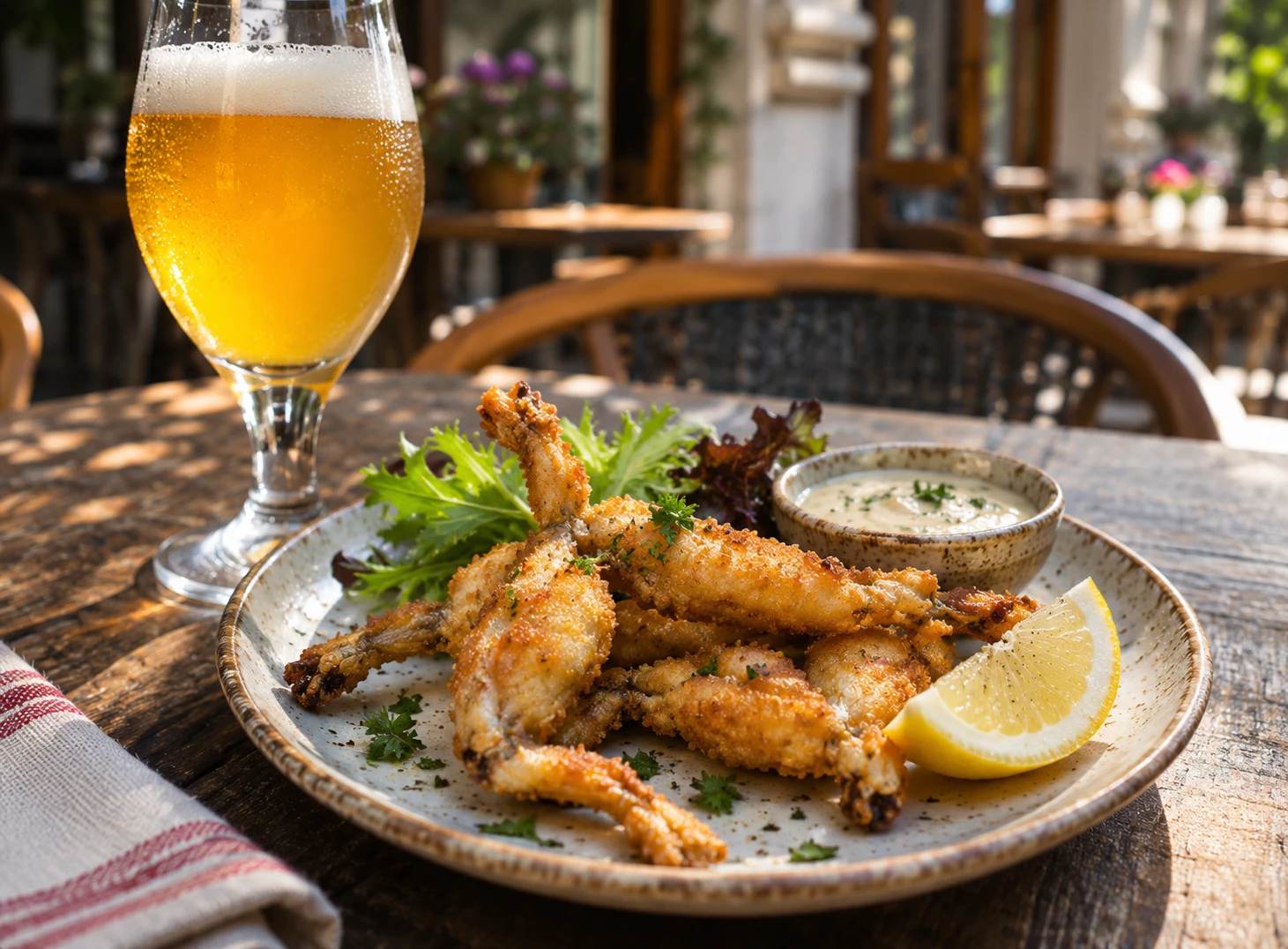
From a wonderful little restaurant in Odesa to the Ukrainian Venice and a Carpathian village with a French culinary legend, this is the story of a food my country supposedly doesn't eat.
Cover illustration: crispy frog legs with wheat beer; not a documentary photograph from Olivier or the author’s travels.
Every culture has a rather complicated collection of rules about what people are supposed to eat.
Some are religious.
Some are practical.
Some concern safety.
And some seem to exist largely because everybody has agreed not to question them.
Take pork.
For many Europeans, it's a perfectly ordinary food.
Pork chops.
Sausages.
Bacon.
Roast pork.
Nothing particularly controversial.
But in Jewish and Islamic dietary traditions, pork is prohibited.
The animal hasn't changed.
The meat hasn't changed.
The cultural and religious context has.
Now consider frogs.
For many Ukrainians, the idea of eating a frog produces roughly the same reaction as suggesting that somebody fry their aquarium fish.
Good grief. Why would you eat that?
Frogs belong in ponds.
They catch insects.
They make noises at night.
And occasionally appear in fairy tales.
They do not belong on a dinner plate.
Unless, of course, you're French.
Or Vietnamese.
Or Chinese.
Or, as it turns out, Ukrainian.
Because Ukraine has its own traditions of eating frogs.
And one of my favourite things about this story is that you can travel across the country without ever encountering them.
Then arrive in a small town where everybody knows exactly what to do with a frog.
My first frog was French. And Ukrainian.
I first tasted frog legs in Odesa.
Not in some obscure country restaurant or exotic market.
In a small, rather sophisticated café called Olivier.
It stood on French Boulevard, near the old winery.
I remember it extremely fondly.
The restaurant wasn't cheap.
But the food was excellent.
It served a contemporary interpretation of French cuisine, with some Odesa influences.
The kind of place where the chef was interested in what he was cooking, rather than simply filling plates.
And one of the dishes I particularly loved was frog legs.
Deep-fried.
Covered in a beautiful, crisp breadcrumb coating.
Golden.
Crunchy.
With delicate, tender meat inside.
Absolutely delicious.
And they had Hoegaarden.
Cold Belgian wheat beer.
Now, if you've never tried crispy fried frog legs with a glass of chilled wheat beer, I can only say that you're missing a rather enjoyable combination.
The crisp coating.
The delicate meat.
The freshness of the beer.
Wonderful.
I ordered the dish repeatedly.
In fact, I liked it so much that it became one of the reasons I returned to the restaurant.
Years later, when I began looking into the history of frog consumption in Ukraine, I discovered something particularly amusing.
Olivier had actually been mentioned in an Odesa restaurant guide for its frog legs.
And the guide identified them as coming from Vilkove.
A Ukrainian town.
Not France.
Not Southeast Asia.
Ukraine.
Which brings us to the first of our two unusual culinary destinations.
The Ukrainian Venice has a taste for frogs
Vilkove is a remarkable little town in southern Ukraine.
It's situated in the Danube Delta, close to the Romanian border.
People sometimes call it the Ukrainian Venice.
And for once, the comparison isn't entirely invented by an enthusiastic tourism department.
Historically, parts of the town were connected by canals.
People moved between houses and gardens in boats.
The waterways weren't simply decorative.
They were part of everyday life.
Vilkove also has its own distinctive food culture.
Danube fish.
Local fish soup.
Seasonal produce.
Strawberries grown on the islands.
And frogs.
Yes.
Frogs.
For many people in Ukraine, frogs are not food.
But in Vilkove, frog legs became a local speciality.
People cooked them.
Restaurants served them.
And visitors interested in regional gastronomy came specifically to try them.
It's exactly the kind of contradiction I love.
You don't need to travel halfway around the world to discover a supposedly exotic ingredient.
Sometimes you only need to travel to another part of your own country.
When French gastronomy came shopping in the Danube Delta
There's another layer to the story.
Vilkove's frogs weren't merely a local culinary curiosity.
For decades, frogs from the Ukrainian Danube Delta were caught commercially.
And exported.
Including to France.
According to historical accounts of the trade, commercial harvesting of green frogs in the Ukrainian delta took place extensively during the 1960s and 1970s.
Annual catches were reported at around 70–80 tonnes.
France was a principal destination.
The commercial operation ended in the early 1980s.
Think about that for a moment.
Here was a product that many Ukrainians wouldn't consider eating.
Yet animals collected in Ukraine were being exported to one of the countries most famously associated with eating them.
Somewhere in France, people were enjoying a recognised delicacy.
And part of its supply came from the wetlands around Vilkove.
Wonderful.
There's even a story I've encountered about a specialist Parisian restaurant supposedly named after the Vilkove frog.
A rather prestigious place, according to the telling.
I haven't found reliable evidence confirming that particular restaurant, so I'm keeping it in the category of intriguing culinary legends.
But the export trade itself is documented.
And that is already interesting enough.
The problem with eating too many frogs
There was, unfortunately, a less attractive side to the business.
Frogs aren't an unlimited resource.
Like many wild animals, they can be vulnerable to intensive harvesting.
Their populations also depend on the condition of wetlands, water quality, habitat and breeding opportunities.
I remember encountering the explanation that the once-abundant Vilkove frogs had been heavily depleted by commercial collection.
That certainly fits the history of large-scale harvesting in the region.
But it would be too simple to attribute every subsequent decline to a single cause without local ecological evidence.
More broadly, the international frog-leg trade has raised serious conservation concerns.
France continues to consume substantial quantities of frog legs, and much of the European market depends on imports.
In recent decades, major suppliers have included Indonesia, Vietnam and other countries.
As a result, the familiar image of a French chef preparing a traditional local delicacy can conceal a surprisingly international supply chain.
And an uncomfortable question.
Is the animal being sourced sustainably?
In Vilkove, I have also heard accounts of restaurants using imported frozen frog legs as local supply became more difficult.
I wouldn't assume that every restaurant uses the same source, particularly since suppliers and conditions change.
But the distinction between a local culinary tradition and the geographical origin of its ingredients is an important one.
You can preserve a recipe long after the original supply chain has disappeared.
Sometimes that's a sensible adaptation.
Sometimes it creates entirely new environmental problems elsewhere.
Food culture can survive even when its underlying ecology changes.
And that, too, is worth remembering.
Now let's cross Ukraine to a very strange French village
Our second destination is almost at the opposite end of the country.
The Carpathians.
Zakarpattia.
Near Uzhhorod, in the area historically associated with Perechyn, there's a village called Tur'yi Remety.
And this village has a rather extraordinary culinary reputation.
Frogs.
Again.
In a region where many people would never consider eating them, the inhabitants developed a local tradition of catching and preparing frog legs.
The tradition is sufficiently well known that residents have been nicknamed zhabliari.
Frog people, more or less.
I think that's a wonderful nickname.
Especially for a village whose speciality is something the rest of the country may regard as faintly horrifying.
But why frogs?
And why here?
The local explanation involves French soldiers.
And Napoleon.
Naturally.
The French soldiers who allegedly never went home
According to a longstanding local account, French soldiers or Bonapartist military personnel ended up in this region during or after the Napoleonic Wars.
Some versions connect their arrival with the aftermath of Napoleon's defeat at Waterloo in 1815.
The men supposedly remained in the area, established families and brought elements of their culinary traditions into the village.
Including eating frogs.
It's a wonderfully appealing story.
French military men.
A remote Carpathian settlement.
Local women.
A new generation.
And an enduring taste for frog legs.
But the details vary considerably between retellings.
Some accounts describe prisoners or exiles.
Others describe soldiers who stayed behind.
The dates aren't always consistent.
And certain particularly elaborate versions add improbable characters and incidents.
So I wouldn't present every detail as established history.
What we can say is that the village's association with frog consumption is real and has been documented repeatedly.
And the French origin story forms part of how the community explains that tradition.
Sometimes a culinary legend tells us as much about local identity as it does about the exact circumstances of an event two centuries earlier.
The village that remembered France through its food
The French association, at least in the stories I've encountered, doesn't end with frogs.
I've also heard accounts of Easter ham and other preparations in Tur'yi Remety being associated with French culinary influences.
In particular, there are descriptions that reminded me of jambon blanc, the French tradition of cooked ham.
The exact connection deserves further historical investigation: an Easter ham tradition doesn't automatically prove French origin, and jambon blanc isn't simply a generic term for every baked ham.
But it's an interesting direction to explore.
Because this is how food history can work.
People move.
They settle somewhere new.
They marry.
Raise children.
Bring recipes.
Modify them.
Replace unavailable ingredients.
And gradually the foreign dish becomes local.
Eventually, the descendants may no longer think of it as foreign at all.
It's simply what their families cook.
And that's precisely why I find the story of Tur'yi Remety so attractive.
A preparation commonly associated with France became, according to local tradition, part of the identity of a small Ukrainian village.
It survived not as a museum exhibit, but as something people actually ate.
A much better form of cultural preservation, if you ask me.
Apparently, even the frogs have a season
Older reports from Tur'yi Remety describe a particular season for catching frogs.
Early spring.
The period when the weather becomes warmer and the animals begin appearing in the local waterways.
Some villagers regarded frogs caught before the first major spring thunderstorms as particularly suitable for cooking.
There were local methods.
Family traditions.
Different preparations.
Frog legs cooked in egg batter.
Fried dishes.
Other recipes adapted to local tastes.
These weren't necessarily copies of conventional French restaurant dishes.
The ingredient may have arrived through French influence, but the cooking became Ukrainian.
Which is exactly what should happen when a culinary tradition travels.
It stops belonging exclusively to its place of origin.
And acquires a new life.
The French may have introduced a taste for frog legs.
But after two centuries, Tur'yi Remety's recipes belonged to the people who continued preparing them.
And what do frogs actually taste like?
This is where people usually expect a very dramatic answer.
Surely something as unusual as a frog must have an equally unusual flavour.
Something swampy.
Strange.
Perhaps a little aquatic.
The sort of thing that makes you immediately think of a pond.
Unfortunately for anyone hoping for a horror story, frog legs are usually rather delicate.
The meat can remind you of poultry.
But that comparison doesn't completely capture the texture.
It's tender.
Light.
And, when cooked well, very pleasant.
My favourite version remains the one I discovered at Olivier in Odesa.
Crisp breadcrumbs.
Hot oil.
Tender meat.
A cold wheat beer.
Simple.
And excellent.
I've eaten frog legs elsewhere since then, including in Burgundy, where they're part of regional French culinary traditions.
But my first experience in Odesa remains particularly memorable.
Perhaps because I wasn't expecting something associated with French cuisine to become one of my favourite dishes in a Ukrainian restaurant.
Or perhaps because the chef simply prepared them exceptionally well.
Either way, I never understood why so many people found the idea disgusting.
Especially those who happily eat chicken wings.
The frog leg is hardly a more disturbing concept.
It's just less familiar.
The old manuscript even explained how to undress a frog
When I originally wrote this chapter for my unfinished book about strange food, I included a section on preparing a whole frog.
And naturally, I couldn't resist making jokes.
Skinning a frog, I wrote, was surprisingly straightforward.
I even compared removing the skin to taking off a stocking.
An elegant metaphor.
Or at least I thought so at the time.
The manuscript then moved on to cleaning the animal and treating the meat much as one might treat poultry.
Because once the animal was prepared, there were numerous familiar culinary possibilities.
Frying.
Roasting.
Stewing.
And various sauces.
Looking at the old text now, though, I'd distinguish the culinary observation from a practical recommendation.
Wild amphibians aren't automatically safe to handle, prepare or eat.
Species identification matters.
Parasites and other biological hazards matter.
Legal restrictions and conservation status matter.
And proper sourcing and professional processing are essential.
So rather than provide a casual guide to collecting and skinning frogs from the nearest pond, I'll leave that part of the manuscript as an illustration of my younger self's enthusiasm.
For anyone actually interested in cooking frog legs, the sensible starting point is a legally sourced product intended for human consumption, handled and fully cooked according to appropriate food-safety guidance.
The culinary possibilities remain interesting.
But we needn't turn dinner into an amateur wildlife-processing expedition.
France doesn't have a monopoly on frogs
There's another misconception worth addressing.
People frequently talk about frogs as if they were exclusively a French speciality.
They're not.
Frog dishes also appear in various Asian cuisines, as well as regional traditions elsewhere in Europe.
Northern Italy, for example, has its own frog preparations.
So do some communities in Portugal, Spain and southeastern Europe.
And Ukraine has its own examples.
That doesn't mean frogs are everyday food throughout any of these countries.
Often, quite the opposite.
They're highly regional.
Sometimes seasonal.
Sometimes connected to specific communities and historical circumstances.
Which is exactly what makes them interesting.
Food cultures are rarely as homogeneous as national stereotypes suggest.
There isn't one universal Ukrainian menu.
Or French menu.
Or Italian menu.
There are regions.
Families.
Minorities.
Local resources.
Historical migrations.
And traditions that survive in one village long after disappearing somewhere else.
Sometimes the most surprising thing about a supposedly foreign food is discovering that your own country has been eating it for generations.
The difference between strange and unfamiliar
The more I explore unusual foods, the less useful I find the word strange.
Not because there aren't genuinely unusual ingredients.
There certainly are.
But because strangeness is so dependent on perspective.
A person who grew up eating frog legs in Tur'yi Remety may find them perfectly ordinary.
A person from another Ukrainian region may react with horror.
Neither reaction changes the meat.
The same thing happens with insects.
Or offal.
Or blood sausages.
Or fermented foods with smells that could reasonably be mistaken for an industrial accident.
People learn what belongs on a plate.
And once they've learned it, the distinction feels natural.
Even when it's historically accidental.
Of course, this doesn't mean that anything people eat must automatically be safe, ethical or environmentally sustainable.
Those questions deserve separate attention.
And the history of the frog trade shows why.
But it does suggest that our immediate feeling of disgust isn't a particularly reliable guide to culinary possibility.
Sometimes it tells us more about our upbringing than about the ingredient.
A frog, a Ukrainian restaurant and a cold Belgian beer
Looking back, I find the geography of this story delightful.
A French-style café in Odesa introduced me to frog legs.
Some of those frogs were associated with a Ukrainian town on the Danube that had once exported them to France.
Another Ukrainian village, far away in the Carpathians, preserved its own frog-eating tradition, explained locally through the arrival of French soldiers.
And years later, I ate frog legs in France itself.
The circles are rather satisfying.
But the strongest memory isn't historical.
It's culinary.
A little restaurant on French Boulevard.
A plate of golden, crispy frog legs.
A glass of cold Hoegaarden.
And the discovery that something my culture was supposed to consider inedible was, in fact, absolutely delicious.
Which leaves me with a question.
If frogs aren't Ukrainian food, why did I have to go to a Ukrainian restaurant to fall in love with them?
Perhaps the answer is simple.
There is no single Ukrainian menu.
And there never was.
Adapted from my unfinished Strange Food manuscript, with historical details revisited and uncertain traditions distinguished from documented events.