
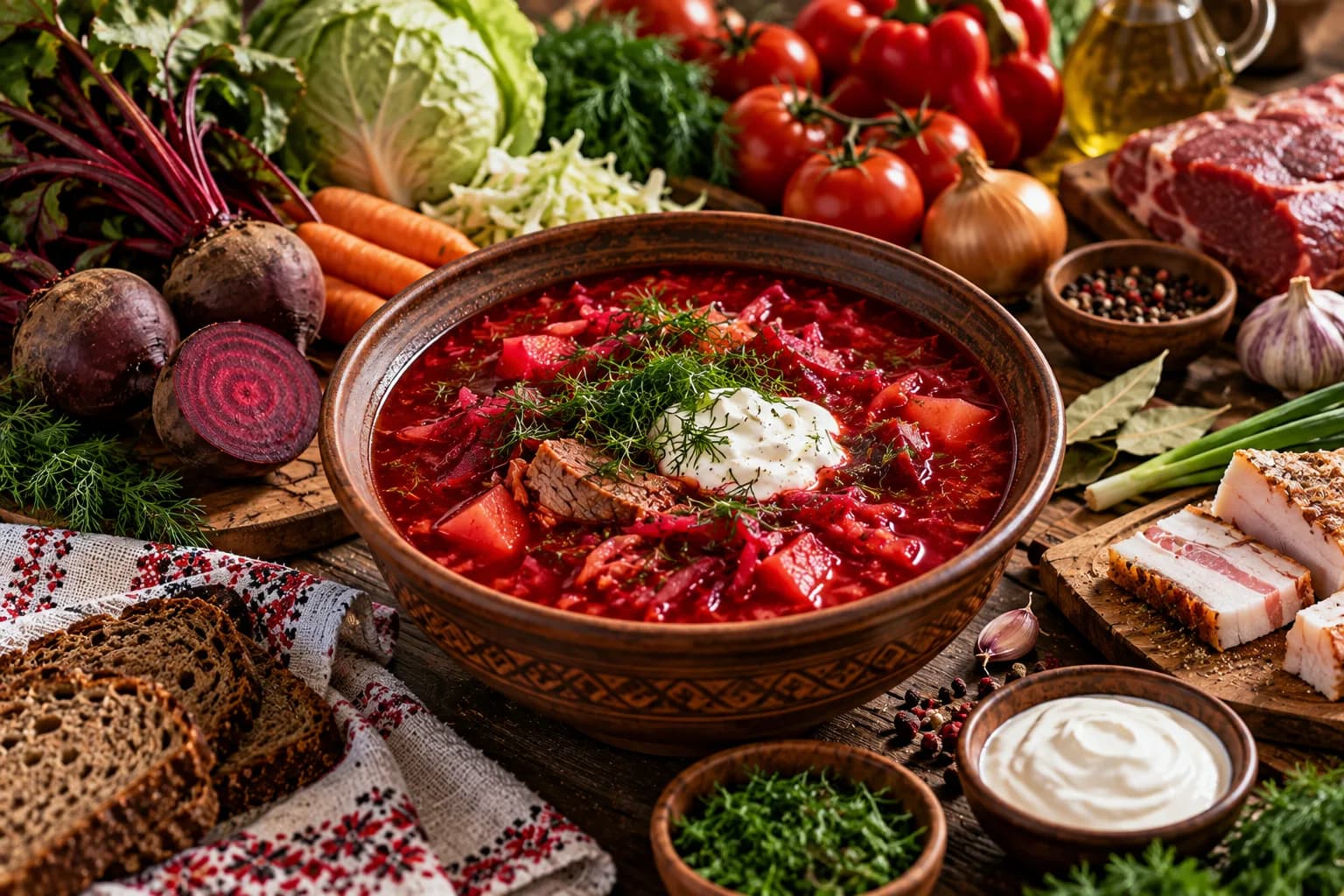
I made a technical specification for modern Ukrainian red borscht. It turns out the national dish is rather more flexible than most people are willing to admit.
There is one thing you should never do at a Ukrainian family dinner.
Tell someone they're making borscht incorrectly.
You can criticise their car. Their job. Their political opinions. Possibly even their children.
But suggest that their grandmother used the wrong amount of beetroot, and you're entering dangerous territory.
Every Ukrainian family has its own borscht recipe.
Every region has its own variations.
And somehow, everybody is convinced that their particular version is the correct one.
I've never been particularly comfortable with that approach.
I grew up in Mykolaiv, where borscht was typically rich in tomatoes and bell peppers, sometimes with surprisingly little beetroot.
I've eaten borscht with fried Black Sea gobies in Odesa family cooking.
I've tried Donetsk borscht made with canned sprats in tomato sauce.
I've tasted Poltava-style borscht with crucian carp dried on straw in a traditional stove.
And I once made a recognisable Ukrainian borscht almost entirely from canned food, including French sauerkraut with pork and Mexican chili con carne.
It was ridiculous.
It was also delicious.
Which raises an interesting question.
How much can you change borscht before it stops being borscht?
I decided to approach the problem the way I often approach business processes.
I made a technical specification.
Yes.
For soup.
Before the beetroot, there was hogweed
Here's something that surprises people unfamiliar with the history of borscht.
Originally, borscht wasn't necessarily red.
And it didn't necessarily contain beetroot.
Or tomatoes.
Or potatoes.
In fact, its name is generally traced to borshchivnyk, hogweed, a plant once used in preparing sour soups.
Older Slavic cooking traditions used young edible hogweed shoots and leaves, including fermented preparations that provided the characteristic sourness.
That sourness is important.
Long before tomato paste appeared in every supermarket, fermentation was one of the ways people preserved ingredients and built flavour.
And the name of the dish survived even as its ingredients changed.
There is an important botanical distinction here. The historical culinary use of particular hogweed species should not be confused with dangerous invasive species such as Sosnowsky's hogweed, whose sap can cause serious skin reactions. This is culinary history, not a suggestion to gather roadside plants.
But the historical connection is fascinating.
What we now think of as an essential beetroot dish once belonged to a much broader family of sour soups.
In spirit, those early preparations may remind us more of today's green borscht with sorrel than of the familiar red version.
That doesn't mean modern green borscht is an unchanged medieval recipe.
It means the culinary tradition is much older than its most familiar contemporary ingredients.
And those ingredients have had quite a journey.
Then beetroot arrived. And eventually the Americas.
The development of red borscht is not a neat story involving one brilliant chef and a single revolutionary recipe.
It happened over generations.
Beetroot and fermented beet preparations became central to many Ukrainian versions.
Other dishes also existed within the same culinary world of meat, fermentation and sour liquids.
One particularly interesting relative is vereshchaka, a traditional Ukrainian pork dish prepared with beet or bread kvass.
I like imagining these traditions gradually meeting in the kitchen.
The sour soup.
The beet-based dishes.
Meat cooked in fermented liquids.
And eventually, something recognisably close to modern red borscht.
It's a pleasing culinary family tree.
But I wouldn't claim that vereshchaka is a proven direct ancestor of red borscht. The relationship is better understood through overlapping ingredients and cooking traditions than through a documented parent-and-child recipe.
Then Europe began adopting ingredients from the Americas.
Tomatoes.
Potatoes.
Two things that now seem almost inseparable from everyday Ukrainian borscht, yet were not part of its earliest history.
Potatoes became a staple of Ukrainian cooking during the nineteenth century. Tomatoes became widespread as a standard borscht ingredient later.
So whenever somebody insists that a proper borscht must contain potatoes, I find myself wondering what Ukrainian cooks were supposed to have done before potatoes became common.
Apparently, according to this logic, several centuries of people were making borscht incorrectly.
A remarkable achievement.
The technical specification
At some point, I made a four-page document called Red Borscht.
Not a conventional recipe.
No precise quantities.
No instructions involving twelve minutes of frying followed by seven minutes of simmering.
Instead, I listed ingredients and their possible alternatives.
Some essential to my understanding of modern red borscht.
Some strongly recommended.
Others optional.
And quite a few that should only be combined after some serious consideration.
The document is effectively a decision tree.
A cooking architecture.
A way to understand the dish by separating its structure from the particular ingredients used to express that structure.
It isn't an official Ukrainian culinary standard, and I have no intention of appointing myself Minister of Borscht Compliance.
It's my working model.
And it starts with three fundamental components.
The three pillars of my modern red borscht
First: liquid.
Obviously.
Without liquid, we're making something else.
But which liquid?
Water is perfectly acceptable.
So is vegetable stock.
Chicken stock.
Beef stock.
Mushroom stock.
The choice changes the flavour, richness and character of the dish without necessarily changing its identity.
A meatless borscht doesn't become invalid because there isn't a pig somewhere in the background.
Second: beetroot and/or tomato.
This is where my model departs from some stricter definitions.
For the modern red borscht I'm describing, I want at least one of these flavour and colour foundations.
Ideally, both.
But not necessarily in equal proportions.
In some Ukrainian regions, beetroot dominates.
In parts of the south, tomatoes can be much more prominent.
I've known southern versions with very little beetroot, sometimes practically none.
A strongly tomato-based borscht can remain entirely recognisable to me.
You can also change the form of the ingredients.
Boiled beetroot.
Roasted beetroot.
Pickled beetroot.
Fresh tomatoes.
Tomato paste.
Passata.
Fermented tomatoes.
The result will vary, but the basic cooking logic remains understandable.
My original chart even includes sour cherries in this part of the flavour system. Not because cherries are tomatoes, obviously, but because fruit acidity can play an interesting role in a borscht's balance.
This is a culinary model based on function, not botanical classification.
And I should stress that my tomato-only allowance is a personal, southern-Ukrainian understanding of red borscht, not a universally accepted rule. For example, UNESCO's description of Ukrainian borscht places beetroot or fermented beet juice much more firmly at the centre.
Third: cabbage, or something performing a similar role.
In my model, cabbage provides much of the vegetable body and texture.
Ordinary white cabbage is the familiar choice.
Young or mature.
But why stop there?
Savoy cabbage.
Chinese cabbage.
Sauerkraut.
Brussels sprouts.
Even kimchi.
Yes, kimchi.
Before anyone calls the culinary police, I'm not claiming that kimchi borscht is a traditional Ukrainian family recipe.
I'm saying that fermented cabbage can perform a useful function inside the dish.
The same principle explains why my decision map includes sorrel as a leafy alternative.
Botanically, it isn't cabbage.
Culinarily, it changes the soup substantially.
But that's exactly the sort of boundary the model is intended to explore.
These three pillars define the territory of my experiment.
Everything after that is negotiable.
The Red Borscht Decision Map
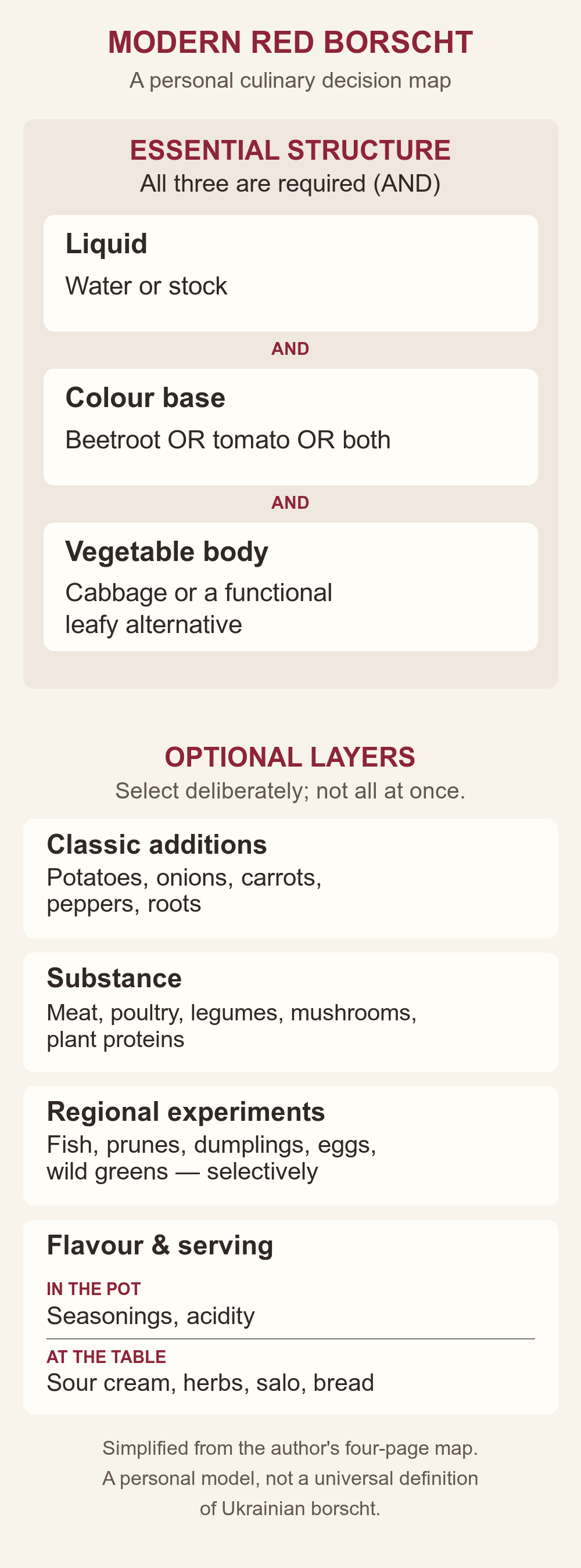
The author's personal model for modern red borscht: all three pillars are required; beetroot, tomato or both supply the colour base. Other layers are chosen deliberately, and table accompaniments remain separate from ingredients cooked in the pot. Simplified from the author's four-page technical map, not an official or universal definition.
Now we start building the familiar borscht
The next layer contains ingredients most people would recognise immediately.
Potatoes.
Bell peppers.
Onions.
Carrots.
Celery root.
Parsley root.
These are the familiar building blocks.
But even here, there are decisions.
Should the onion go into the pot raw?
Or should it be fried first?
The same question applies to carrots.
Do we want the richness and sweetness developed through sautéing, or a lighter flavour from cooking directly in the liquid?
Old potatoes or young potatoes?
Fresh bell peppers or preserved?
The changes may sound small, but together they give different regional and family versions their distinctive personalities.
This is why I prefer thinking in terms of ingredients and functions rather than treating a recipe as an immutable sequence of commands.
The protein department has no shortage of applicants
Then comes the part of the specification concerned with meat.
And the list becomes rather extensive.
Beef.
Pork.
Chicken.
Turkey.
Duck.
Goose.
Different cuts.
Ribs.
Tongue.
Oxtail.
Cheeks.
Offal.
Meatballs.
Pork fat.
Cracklings.
Sausages.
Or no meat at all.
Beans work beautifully.
So do various other legumes.
My chart even includes soy meat and seitan as possible substitutes.
Not because I'm trying to rewrite Ukrainian culinary history around modern dietary preferences.
But because if we're describing the architecture of a dish, we should distinguish between ingredients that define the dish and those that change its nutritional and flavour profile.
Borscht with pork and borscht with beans can be very different experiences.
They're still both borscht.
And once we accept that, the range of possibilities becomes enormous.
This is where things get dangerous
The next part of my chart is deliberately labelled:
Regional and personal additions. Combine manually.
Because this is where enthusiasm can become a problem.
Prunes.
Fried aubergines.
Mushrooms.
Fish.
Crayfish.
Dumplings.
Noodles.
Galushky.
Sorrel.
Beet greens.
Wild garlic.
Nettles.
Horseradish.
Eggs.
All potentially interesting.
But not necessarily at the same time.
Nobody needs a borscht containing crayfish, prunes, noodles, nettles, mushrooms, boiled eggs and half a duck simply because a flowchart suggests that each ingredient is theoretically permissible.
That's not recipe development.
That's a cry for help.
The important thing is to understand why you're introducing something.
Fish can change the character of the stock.
Dried fruit can add sweetness and acidity.
Mushrooms can deepen savouriness.
Dumplings change the substance and texture of the meal.
Aubergines introduce yet another combination of flavour and body.
These are decisions, not a shopping list.
And we've already explored some of them in my Kitchen Notes about three regional fish borschts.
Seasoning isn't a mathematical checklist either
My original technical card contains a wonderfully ambitious list of seasonings.
Salt.
Sugar.
Sunflower or olive oil.
Bay leaf.
Black pepper.
Allspice.
Caraway.
Balsamic vinegar.
Garlic.
Chili.
Cloves.
Mustard.
Herbs.
And even vodka.
I can already hear somebody asking whether all these things are supposed to go into one pot.
Absolutely not.
The chart records possibilities and combinations I've considered, not a recommendation to empty the spice cupboard.
Seasoning is another layer of decisions.
You can make a gentle, sweet-and-sour borscht.
A sharper, more acidic version.
Something spicy.
Something smoky or deeply savoury.
But the ingredients should work together.
A document can list every option.
Only the cook can decide which combination deserves to exist.
And then there's what happens at the table
I separated garnishes and accompaniments from the cooking process.
For a reason.
A finished bowl of borscht can change dramatically depending on how it's served.
Sour cream is the obvious classic.
But you could use yogurt.
Cream.
Even mayonnaise, if that's what you prefer.
Fresh dill.
Parsley.
Green onions.
Garlic.
Hot pepper.
A little salted salo on the side.
Dark rye bread.
Croutons.
Or proper garlic pampushky.
Some traditional meals might also include a little horseradish vodka or another spirit.
Entirely optional.
And certainly not a structural requirement for the soup.
The point is that the experience doesn't end when the pot leaves the stove.
What goes into the bowl, and what accompanies it, can be as personal as the cooking itself.
One dish. An enormous number of possible configurations.
This is the part I find fascinating.
At first glance, borscht looks like one recipe.
Then you begin removing assumptions.
Must it contain pork?
No.
Must it contain meat at all?
No.
Does the liquid have to be beef stock?
No.
Must the beetroot dominate?
Not in every version I've eaten.
Can the cabbage be fermented?
Certainly.
Can fish be involved?
I've eaten three excellent regional examples.
Can you use ready-made ingredients?
I've gone considerably further than most people would consider respectable.
And yet the dish remains recognisable within the traditions and flavour relationships that hold it together.
Of course, there are limits.
Replace enough ingredients, change the preparation completely and eventually you'll make another soup.
But that boundary is more interesting than simply declaring every deviation from one family recipe a culinary offence.
That's why I made the chart.
Not to establish one correct borscht.
But to understand how a dish can change while retaining its identity.
This is only red borscht
One final qualification.
This entire exercise concerns modern red borscht.
Not every soup in the wider borscht family.
Green borscht is another story.
White borscht belongs to another set of traditions.
There are also raw-food experiments, cold versions and other preparations worth discussing separately.
And historically, as we've seen, the very name borscht reaches back to a culinary world that looked quite different from the familiar red soup.
So my diagram isn't a universal taxonomy of everything called borscht.
It's an attempt to describe the structure of one particularly widespread modern family of recipes.
There will be other maps.
Other stories.
And, undoubtedly, more arguments.
Perhaps a recipe is more like a language
There's something rather satisfying about thinking of cooking this way.
A language has grammar.
But it also has dialects.
Regional vocabulary.
Borrowed words.
Expressions that make perfect sense in one town and sound completely ridiculous in another.
Borscht works a little like that.
You can change the ingredients and still speak the same culinary language.
Sometimes with a strong regional accent.
Sometimes with rather unconventional vocabulary.
And occasionally, as in my canned-food experiment, with a mixture of Ukrainian, French and Mexican ingredients that probably shouldn't understand one another.
But somehow do.
I don't think this makes traditional recipes less valuable.
Quite the opposite.
The better you understand the structure of a dish, the more interesting its regional variations become.
And the more you appreciate what generations of cooks have discovered through experience.
So no, I haven't written the definitive recipe for Ukrainian red borscht.
I've drawn a map.
A map of possibilities.
And after a lifetime of eating and cooking borscht, I rather like the idea that there are still plenty of routes I haven't explored.
The question isn't how to make the one correct borscht.
It's how many different ways you can make a good one without losing what makes it borscht.
And that, I suspect, is a much more interesting culinary adventure.