
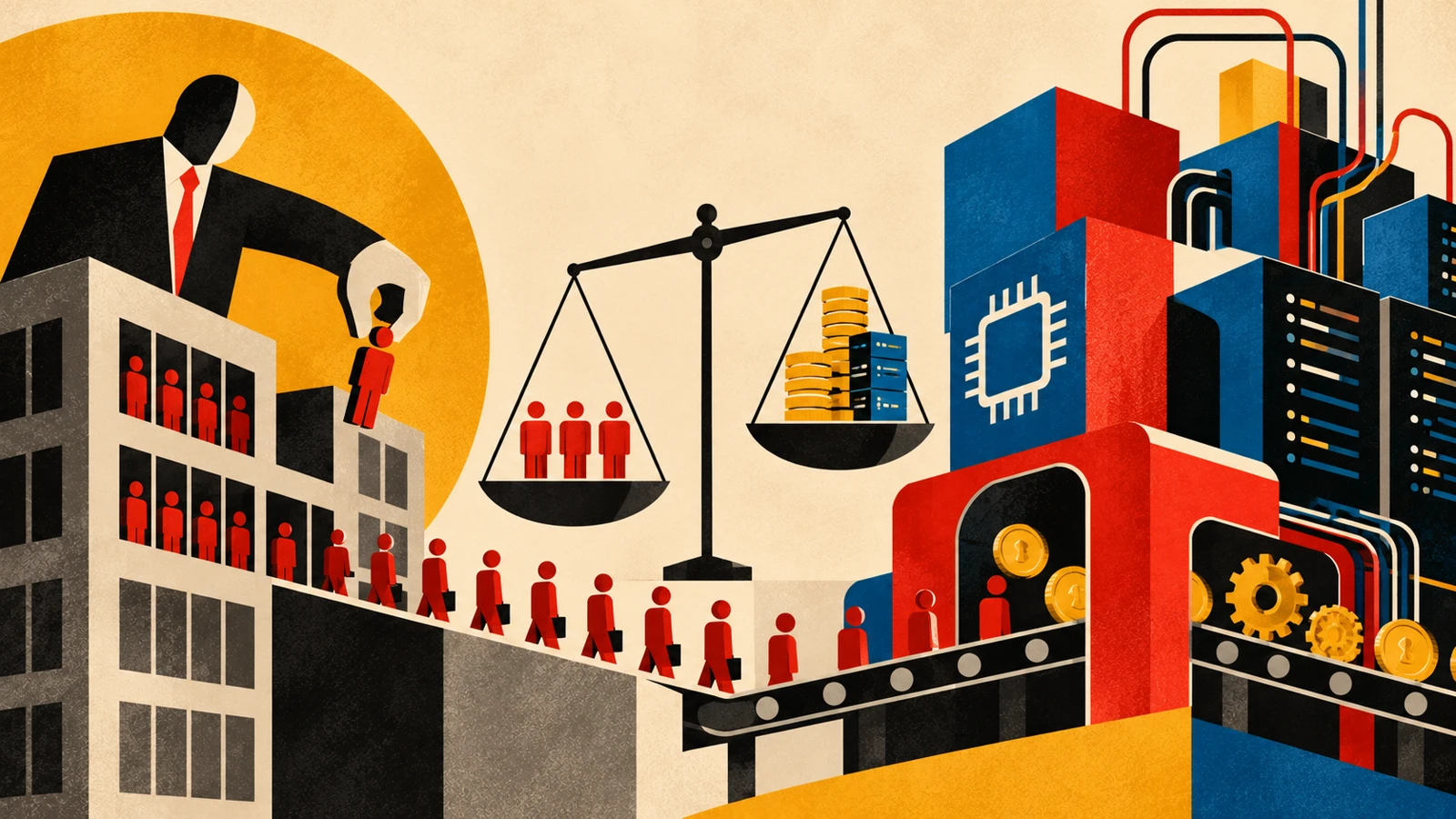
AI transformation is supposed to make companies more productive. So why do so many executives seem to think its main purpose is to make the payroll smaller?
I've had this post sitting in my notes for quite some time.
But between the latest corporate announcements, media speculation, conversations with people in different businesses, and even a discussion with my neighbour today, I decided it was finally time to publish it.
Because I keep encountering a rather peculiar interpretation of AI transformation.
A company announces that it's embracing artificial intelligence.
Wonderful.
The executives start talking about efficiency.
Excellent.
Then somebody produces a PowerPoint slide explaining how many employees can be eliminated.
Ah.
So that's what we mean by transformation.
Apparently, we've spent billions developing astonishing new technology so that the finance department can finally get rid of another 15 percent of the payroll.
What an inspiring vision of the future.
And what a spectacular misunderstanding of where the real economic value might lie.
The magical AI-powered redundancy machine
I've noticed a recurring pattern in business discussions.
A company has financial problems.
Margins are under pressure.
Growth has slowed.
The organisation has accumulated unnecessary complexity.
Perhaps it hired too aggressively during the pandemic.
Perhaps its operating model hasn't adapted to changing market conditions.
Perhaps the business simply needs a serious restructuring.
Then somebody discovers AI.
Suddenly, the discussion changes.
We're not cutting costs because the old business model has become inefficient.
We're undertaking an AI transformation!
We're not reducing headcount because management failed to respond to market conditions.
We're becoming an AI-first organisation!
And we're not eliminating positions because the company needs to improve its financial performance.
We're unlocking unprecedented productivity!
Marvellous.
The technology hasn't necessarily changed how the company operates yet.
But it has already improved the language used in the boardroom.
To be fair, there is a legitimate economic argument for AI-assisted productivity.
A skilled employee equipped with good tools may accomplish substantially more than before.
Some repetitive tasks can be automated.
Some processes genuinely require fewer manual steps.
And some organisations will eventually need fewer people in particular functions.
I'm not disputing any of that.
What I dispute is the assumption that reducing headcount is the natural starting point for AI transformation.
Because that's often where the interesting economics begin to go wrong.
We may need more productivity because we're running out of workers
There's an additional irony.
Many developed economies are facing demographic pressure.
Their populations are ageing.
The share of working-age people is expected to decline.
And businesses in certain sectors already struggle to find enough qualified workers.
According to the OECD's 2025 Employment Outlook, the working-age population across OECD countries is projected to decline by approximately 8 percent by 2060, with substantially larger declines in several countries.
These trends vary considerably by country and industry, of course.
But the broader challenge is clear.
In many places, fewer economically active people will need to support more economic activity.
Against that background, the idea of giving an employee tools that allow them to accomplish more is entirely sensible.
Let's call our employee Fedya.
Yesterday, Fedya performed a particular collection of tasks.
Today, equipped with AI systems and improved processes, perhaps he can complete work that previously required several people.
Wonderful.
That might help address labour shortages.
It might allow the company to grow without hiring proportionally more staff.
It might free employees to perform work that previously remained undone.
But here's the odd part.
If the economic problem is a shortage of productive labour, why is the first instinct to eliminate the people who have just become more productive?
Of course, there can be legitimate reasons to reduce staffing in specific areas.
Automation can eliminate particular tasks.
Demand can decline.
An organisation can have redundant roles.
But improving labour productivity and cutting labour costs are not the same objective.
They can overlap.
They don't have to.
And treating them as identical can lead to some very expensive mistakes.
Fedya can work for three. Unfortunately, his digital colleagues also need a budget.
Now let's look at the cost side.
The popular story usually goes something like this.
We have five employees.
AI allows one employee to handle the work of three.
Therefore, we can dismiss two employees and enjoy the savings.
The arithmetic is delightful.
Unfortunately, the business isn't a school mathematics exercise.
Fedya doesn't receive unlimited free artificial intelligence.
There are subscriptions.
API tokens.
Compute costs.
Storage.
Integrations.
Monitoring.
Security.
Testing.
And, depending on the task, a surprisingly large amount of human supervision.
If the company wants a few employees to use an AI assistant, the software bill may be relatively modest.
But if it wants agents operating continuously across production systems, the economics become more complicated.
A system processing thousands of tasks needs more than a monthly chatbot subscription.
It needs infrastructure.
Reliable access to data.
Controlled permissions.
Observability.
Verification.
Recovery procedures.
And people capable of maintaining all of that.
In some demanding workflows, the combined cost of the tools, infrastructure and additional operational support can become comparable to a significant part of an employee's compensation.
In others, it may be dramatically cheaper.
There's no universal ratio.
The important thing is that you don't calculate the savings from AI by subtracting salaries while pretending the automation costs nothing.
And that's before we discuss the cost of implementing it.
The most expensive part may be everything surrounding the AI
Let's imagine a medium-sized company decides to become AI-native.
A noble ambition.
First, it discovers that its data is scattered across eleven systems.
Half the documentation is outdated.
Different departments use different definitions for the same metrics.
Nobody is entirely sure which CRM fields can be trusted.
Several critical processes depend on spreadsheets maintained by employees who understand their logic but have never written it down.
And a few essential integrations work only because some very tired engineer keeps repairing them.
No problem.
We have AI.
Except AI needs access to the right information.
And reliable processes.
And clear responsibilities.
And systems in which actions can be performed safely.
Which means the company now has to invest in the things it probably should have addressed years ago.
Data quality.
Process documentation.
Integration architecture.
Security.
Testing.
Governance.
Training.
New technical expertise.
And, quite possibly, a different management culture.
The AI component may be impressive.
But the rest of the project looks suspiciously like a substantial organisational transformation.
Because that's exactly what it is.
And substantial transformations cost money.
Especially when you're attempting to retrofit them into a business that has accumulated twenty years of technical and organisational debt.
You wanted to save salaries. Congratulations, you've bought another operating budget.
This is where the financial reality starts becoming uncomfortable.
The company expected to reduce payroll.
Instead, it has hired expensive specialists.
Introduced new infrastructure.
Purchased software.
Started training employees.
Reorganised departments.
And allocated management attention to a programme whose benefits may take considerable time to become visible.
Meanwhile, the old business still has to operate.
Customers still need service.
Products still have to be delivered.
Invoices still have to be paid.
Legacy systems cannot simply be switched off because the transformation roadmap looks attractive.
So for a while, the organisation effectively operates two sets of costs.
The existing business.
And the business it's trying to become.
This is normal in serious transformation programmes.
But it's a very unpleasant surprise if the original promise was immediate cost reduction.
The money you expected to save on payroll may simply move into technology, integration, training and operational support.
And in the early stages, the total bill can increase.
That doesn't make the investment wrong.
It makes the original financial expectations wrong.
The real value usually appears somewhere else
Here's what I find particularly frustrating.
AI can create meaningful economic value.
But that value often appears in places considerably more interesting than payroll reduction.
Lead time, for example.
How long does it take to move from a customer request to a delivered result?
If a process previously required three weeks and now requires three days, that's valuable.
Not necessarily because you've dismissed the people involved.
But because you can deliver sooner.
Learn sooner.
Invoice sooner.
And potentially handle more business.
Then there's decision-making.
How quickly can the organisation identify a problem, understand it and act?
If AI reduces the delay between information becoming available and a useful decision being made, the value may be enormous.
There's also inventory.
Working capital.
Customer service.
Product development.
Time to market.
Error reduction.
Capacity utilisation.
Sales conversion.
And the ability to test ideas that previously weren't economical to test.
A company might use AI to make the same amount of money with fewer employees.
But it might also use AI to make considerably more money with roughly the same number of employees.
Or to improve service quality.
Or to enter a new market.
Or to eliminate an operational bottleneck that has constrained the business for years.
These aren't merely technical improvements.
They're changes in business economics.
And in many cases, they're a much more interesting objective than reducing the payroll.
The difference between productivity and actual business performance
This isn't just my impression.
McKinsey's August 2026 global survey on AI reports that 80 percent of respondents believe AI has improved their individual productivity.
But only 37 percent attribute some positive impact on their organisation's operating profit to AI use.
These are survey responses, not controlled measurements of causality, and the two percentages describe different outcomes.
Still, the contrast is revealing.
People can become more productive without the company becoming substantially more profitable.
Why?
Because the relationship between individual work and business value isn't automatic.
Imagine a marketing team that can now produce ten times more reports.
Excellent.
Does the organisation need those reports?
Can anyone act on them?
Do they improve customer acquisition?
Or has AI simply made the company extraordinarily efficient at producing documents nobody reads?
A software team may generate code much faster.
But if testing, architecture reviews, deployment and integration remain bottlenecks, the improvement may not translate into faster delivery.
An analyst may complete research in minutes.
But if the decision still waits six weeks for a management committee, the organisation hasn't become six weeks faster.
Automating a task is not the same as improving the process containing that task.
And improving a process is not automatically the same as improving the business.
You have to connect all three.
The AI-native startup and the twenty-year-old corporation are playing different games
This is another distinction that frequently gets lost.
A small startup can build its operating model around AI from day one.
It doesn't need to migrate an enormous legacy infrastructure.
It doesn't need to renegotiate decades of internal responsibilities.
It doesn't have thousands of employees trained to work according to established procedures.
It can start with automated processes, machine-accessible data and a relatively small team coordinating AI systems.
That doesn't guarantee success.
Startups have plenty of other ways to fail.
But they have one structural advantage.
They don't have to rebuild quite so much.
For a medium-sized or large established company, the situation is different.
Every significant change touches existing systems, people, contracts and customer expectations.
And the larger the organisation, the greater the coordination challenge.
That's why I don't believe in quick, comprehensive AI transformation for most established businesses.
Successful pilots can happen quickly.
Individual workflows can improve quickly.
Some specialised transformations may produce early returns.
But changing the operating model of an entire established company is a longer exercise.
It requires a different approach to management, not merely a new set of tools.
Before becoming AI-native, perhaps become data-driven
There's a particularly awkward discovery awaiting some organisations.
They want to become AI-native.
But they aren't even data-driven.
They don't have consistent definitions of their important business metrics.
They can't reliably trace a customer interaction across systems.
They don't know the actual cost of performing certain operations.
Their processes exist in people's heads.
And decisions are often based more on habit or seniority than evidence.
Then they ask AI to optimise everything.
Optimise what?
Against which objective?
Using which information?
And how will we know whether the result is better?
It's perfectly possible to use AI to help fix these problems.
Indeed, that's one of its most useful applications.
But AI doesn't eliminate the need to understand the business.
If anything, it makes that understanding more important.
Because a poorly defined process, once automated, may produce errors much faster than before.
A human can make a mistake once.
A well-scaled automated system can make the same mistake ten thousand times before lunch.
Progress.
Of a sort.
Then comes the disappointment
Here's the scenario I keep worrying about.
A company has been underperforming for several years.
Its cost structure is no longer appropriate.
Perhaps the market has changed.
Perhaps demand has weakened.
Perhaps the business overexpanded during the pandemic.
Perhaps management delayed decisions that should have been made long ago.
But instead of confronting the operating model, the company searches for a shortcut.
And discovers AI transformation.
Consultants arrive.
Budgets are approved.
New systems are introduced.
Specialists are hired.
Employees attend training sessions.
Management announces ambitious productivity targets.
And the board is told that the company is entering a new technological era.
Six months pass.
Perhaps a year.
There are promising pilots.
People can demonstrate some genuinely useful improvements.
But the financial statements aren't behaving quite as expected.
The savings are smaller.
The implementation costs are larger.
The organisation remains complicated.
And the underlying business problems are still there.
Now the company has an additional problem.
Management has already committed publicly to a transformation story.
And the board is expecting results.
So what happens next?
Quite possibly, another restructuring.
This time with actual layoffs.
Which are described as the result of AI-driven efficiency.
Even when the financial pressure may have been building for years before the AI programme began.
Now, I'm not suggesting that every AI-related layoff announcement is dishonest.
Some companies are genuinely replacing tasks and reorganising work.
Others have multiple overlapping reasons for reducing staff.
And there are cases where automation does reduce the number of employees required.
But an AI-related explanation isn't, by itself, proof that AI created the financial savings or caused the workforce reduction.
That distinction deserves far more attention than it usually receives.
The people you dismiss may be the people you need
There's another danger.
When management becomes disappointed with the economics of transformation, it may begin cutting precisely the people required to make the transformation work.
Engineers.
Data specialists.
Infrastructure teams.
Process owners.
People who understand the legacy systems.
Sometimes even the AI specialists hired to lead the project.
These employees can be expensive.
But their cost has to be considered alongside the knowledge and capabilities they provide.
If your automated systems depend on people who understand the underlying business, removing those people prematurely may leave you with a very impressive technological platform and nobody who knows how to maintain it properly.
Or worse, nobody who understands what it's supposed to accomplish.
This is particularly dangerous when much of the organisation's knowledge hasn't been documented or transferred into reliable systems.
A consultant can build you a dashboard.
A model can produce a beautiful explanation.
But if the business relies on undocumented decisions, unusual customer requirements and years of operational experience, somebody still needs to understand those details.
The goal should be to capture and improve that knowledge.
Not eliminate its owners before the process is complete.
So what should an actual AI transformation optimise?
I'd start with a different set of questions.
What is the business trying to improve?
Not which model should we purchase.
Not how many agents can we deploy.
And certainly not how many employees can we dismiss.
What is the business outcome?
Faster delivery?
Higher margins?
Better conversion?
Lower error rates?
Reduced working capital requirements?
More customers served without a proportional increase in staffing?
A shorter time between discovering an opportunity and acting on it?
Once the objective is clear, examine the entire process.
Identify the bottlenecks.
Understand the real costs.
Determine which tasks can be automated reliably.
Calculate the full cost of the new operating model, including implementation, compute, security, supervision and maintenance.
Then test the result against actual business metrics.
And only then decide what happens to staffing.
Sometimes the company will need fewer people.
Sometimes it will need different people.
Sometimes it will be able to grow substantially without additional hiring.
And sometimes it will discover that the most profitable thing to do is give existing employees better tools and let them produce more value.
The answer depends on the business.
Which is precisely why beginning with an arbitrary target for headcount reduction is so unhelpful.
One question I'd ask the board
There's a simple test I'd like to introduce into more AI transformation discussions.
Would we still need to restructure this business if AI didn't exist?
If the answer is yes, then perhaps the organisation has a restructuring problem.
That's a legitimate management problem.
And it deserves an honest strategy.
AI may help.
It may enable a better operating model.
It may reduce the cost of certain activities.
But it shouldn't become a convenient explanation for every difficult financial decision.
Conversely, if the business is healthy and the primary opportunity is to increase output, why assume the gains should immediately be converted into redundancies?
Perhaps there are more customers to serve.
More products to develop.
More markets to enter.
More inefficiencies to remove.
And more valuable work that employees can perform once routine tasks are automated.
Those possibilities deserve consideration before the redundancy spreadsheet becomes the centre of the strategy.
I'm not against AI transformation. Quite the opposite.
I use AI extensively.
I experiment with agents.
I build automation.
I look for ways to remove repetitive work from my own processes.
And I'm fascinated by what becomes possible as the technology improves.
I believe AI can fundamentally change how companies operate.
That's precisely why I find the simplistic cost-cutting narrative so irritating.
The technology deserves better than being marketed as a magical redundancy machine.
A genuine AI transformation is an investment in a different way of operating.
It requires discipline.
Data.
Process design.
Measurement.
Training.
Appropriate infrastructure.
And, perhaps most importantly, management willing to question the assumptions on which the business was built.
That can produce extraordinary results.
But it won't necessarily produce them next quarter.
And it certainly won't rescue a company from every bad strategic decision made during the preceding five years.
You can't preserve an obsolete operating model, add a chatbot, dismiss a percentage of the workforce and expect a fundamentally different business to emerge.
At least, not a better one.
The real opportunity is to make the organisation more productive, adaptable and economically effective.
Payroll may eventually become part of that calculation.
But it shouldn't be the entire ambition.
AI can make your employees more productive.
It can't make your management decisions intelligent by itself.
And if your business model is broken, firing the people who understand it while buying more AI is a particularly expensive way to discover that.
Related on ABVX
- Your AI Strategy Is Already Outdated. So Is Mine.
- AI Agents Don't Scale Until Trust Does
- Congratulations. You're a Manager Now. So Is Everyone Else.
- Today's Monopoly Is Tomorrow's Newspaper
Further reading
This is an opinion piece about corporate transformation strategy. The organisational examples are illustrative, not allegations about specific companies.