
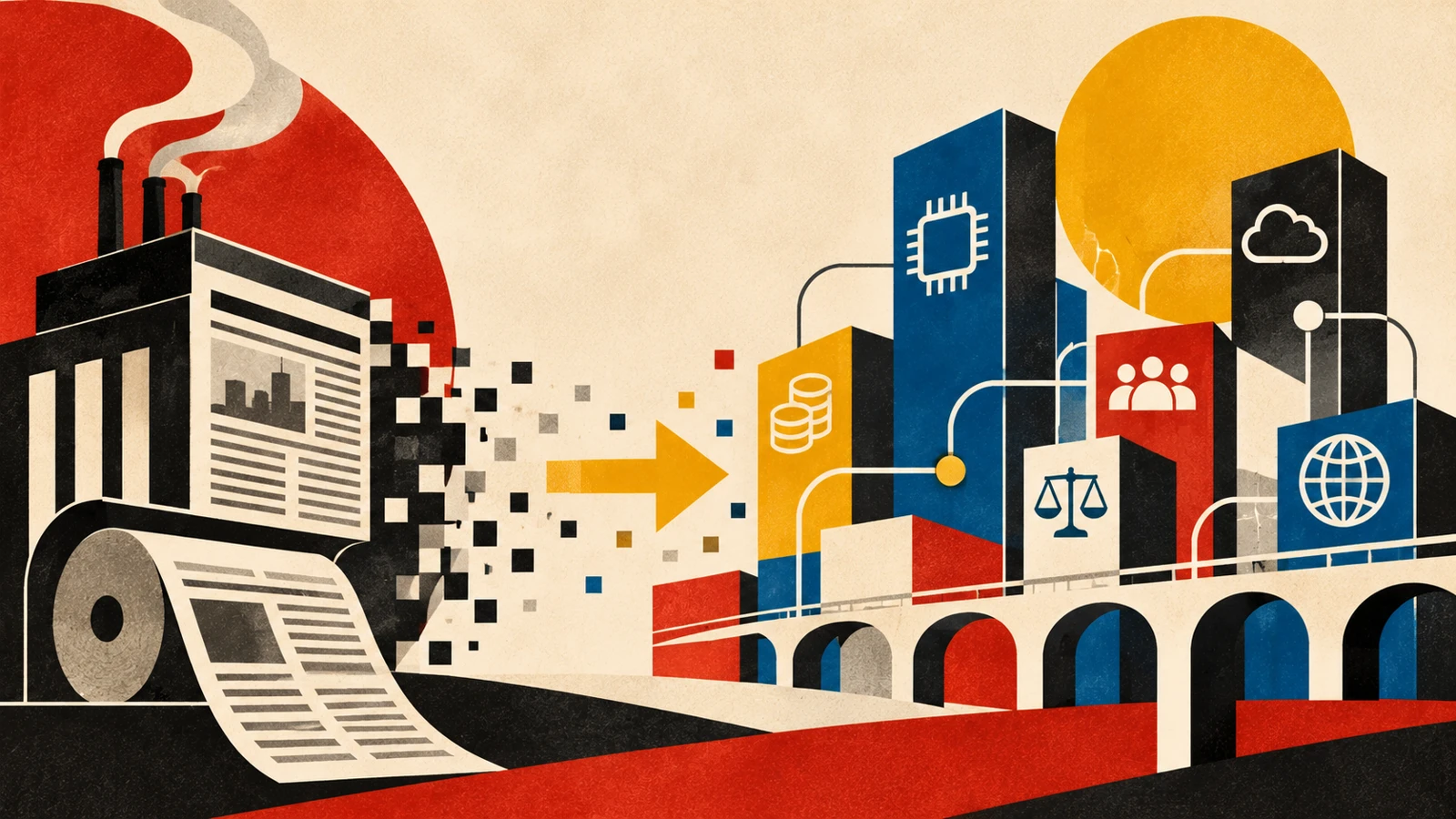
I read The Commanding Heights, a massive essay about AI, economic power and the future of capitalism. Its most useful warning isn't about which AI model will win. It's about owning the wrong business when the rules change.
In 1984, Warren Buffett described the economics of a dominant local newspaper as one of the most attractive businesses imaginable.
And he had a point.
If you owned the principal newspaper in an American city, you controlled something extraordinarily valuable.
Access to the local audience.
Advertisers needed you.
Classified advertisements needed you.
People selling houses, cars, furniture and practically anything else needed you.
The newspaper didn't necessarily have to be brilliant.
It needed to be the place everyone went.
A rather wonderful business.
Then the internet arrived.
Search engines.
Online classifieds.
Social networks.
Digital advertising platforms.
And the newspaper's magnificent local monopoly became considerably less magnificent.
The audience moved.
The advertisers followed.
The economic power migrated elsewhere.
Buffett continued buying newspapers well into the internet era. In his 2012 shareholder letter, he reported acquiring 28 daily newspapers for $344 million over the preceding fifteen months.
In 2020, Berkshire Hathaway sold its newspaper operations to Lee Enterprises for $140 million.
The figures aren't a complete investment-return calculation. The businesses generated revenue in the intervening years, and the sale involved a separate, substantial financing arrangement.
But the direction of the industry was unmistakable.
One of the best business models of the previous era had lost control of the thing that made it valuable.
I kept thinking about this example while reading The Commanding Heights, an enormous essay published on October 29, 2026, by Will Manidis and Joe Roberts.
It's an ambitious attempt to understand where economic power will migrate as artificial intelligence spreads through the global economy.
And, more importantly, who will collect the money.
Lenin had a point about infrastructure. Unfortunately.
The title comes from Lenin.
Which isn't the opening I normally expect from a contemporary investment thesis about artificial intelligence.
During the New Economic Policy in the early Soviet Union, Lenin defended allowing certain forms of private enterprise while keeping control of the economy's strategic foundations.
The commanding heights.
Major industry.
Transport.
Infrastructure.
The essential parts of the system through which everything else had to pass.
You could allow other people to trade.
But if you controlled the indispensable infrastructure, you retained enormous power over the economy.
The authors borrow the term, not necessarily the political programme.
Their argument is that every major technological era creates its own commanding heights.
Positions of economic control that remain scarce even as the underlying technology becomes widely available.
Railroads.
Telecommunications.
Search distribution.
Financial networks.
And now, potentially, the infrastructure through which AI will become useful to billions of people.
The important thing isn't simply inventing a powerful technology.
It's controlling a position through which an expanding amount of economic activity must pass.
Preferably while collecting a small fee every time it does.
The AI labs may not capture the biggest prize
Today, the AI industry is dominated by some very visible businesses.
Model laboratories.
Chip manufacturers.
Cloud providers.
Data centres.
Enormous infrastructure investments.
And a seemingly unlimited supply of financial presentations explaining why the next GPU cluster will be even more valuable than the previous one.
The numbers are astonishing.
But the essay makes an interesting distinction between the place where a technology originates and the place where the greatest wealth eventually accumulates.
The people who invented the locomotive didn't necessarily become the wealthiest people in the railroad economy.
The people who developed early internet technologies didn't necessarily capture the largest share of the resulting economic value.
And the companies building today's frontier AI models may not ultimately retain the most attractive positions in the economy that those models make possible.
Why?
Because intelligence itself may become increasingly abundant.
Models improve.
Older capabilities become cheaper.
Open models catch up with capabilities that were previously exclusive.
Competition squeezes margins.
And businesses built entirely around selling access to intelligence may discover that their product is becoming less scarce.
This doesn't mean frontier laboratories will stop being important.
Some capabilities may remain expensive, strategically restricted or difficult to reproduce.
But the authors' central prediction is that the most durable profits may migrate beyond the model laboratories.
Towards the organisations that control how intelligence reaches the rest of the economy.
The model may become the cheap part. The route to the customer may become the expensive part.
That's an interesting inversion of the current AI investment narrative.
The new commanding heights are the rails
What does it mean to control the route through which AI enters the economy?
Consider a few possibilities.
A distribution network with billions of users.
A payment system used by autonomous agents.
A financial infrastructure layer through which AI-enabled commerce is settled.
A regulated platform that carries responsibility for transactions.
A business system deeply embedded in the operations of thousands of companies.
Or an organisation capable of transforming established businesses by making AI part of how they actually operate.
These examples don't all have the same economics.
And not every useful intermediary becomes a monopoly.
But they share a characteristic.
They occupy positions between a technological capability and the economic activity that capability enables.
A good illustration is payments.
Suppose AI agents eventually negotiate contracts, purchase services, move money and coordinate international transactions.
Somebody still needs to settle the payments.
Somebody needs to verify identities.
Somebody needs to manage permissions, compliance and liability.
And somebody owns the network through which the transaction travels.
The essay places particular emphasis on dollar-denominated stablecoins.
Its authors see them as a potential mechanism for extending the American dollar's economic reach into an increasingly automated global economy.
A kind of digital-dollar infrastructure for AI-driven transactions.
That's a provocative geopolitical thesis.
Not an inevitable outcome.
But the underlying business question is entirely practical.
If intelligence becomes cheap and widely distributed, which services remain necessary every time that intelligence performs economically valuable work?
Those are the positions worth studying.
Not necessarily because they'll all become spectacular businesses.
But because scarcity and control may matter more than technological novelty.
A university degree is becoming a less reliable promise
The essay then moves into considerably less comfortable territory.
Employment.
Education.
And social mobility.
For generations, a familiar promise supported the development of the professional middle class.
Study hard.
Get into a good university.
Earn a qualification.
Find a respectable job.
Build a career.
Perhaps move to a richer country if opportunities at home are limited.
It was never a guarantee.
But for many people, particularly in developing economies, it was a plausible route towards a better life.
AI puts pressure on that arrangement.
Especially at the beginning of a career.
Why hire a large intake of junior employees if experienced staff equipped with AI agents can handle much of the work those juniors traditionally performed?
And here's a particularly nasty complication.
The disruption may initially look less like mass unemployment and more like hiring that simply doesn't happen.
A company may retain its experienced employees.
Improve productivity.
Increase margins.
And quietly stop recruiting graduates.
Nobody receives a dramatic dismissal letter.
The jobs simply stop appearing.
The authors pay particular attention to India's technology and business-services industries.
Their argument is that the outsourcing model, which helped create millions of professional opportunities, is especially vulnerable when routine digital work becomes cheap to automate.
This is a plausible risk.
But I wouldn't go as far as declaring that education has ceased to be a social elevator.
Education still matters.
Expertise still matters.
And new technologies can create occupations that previously didn't exist.
The more defensible conclusion is that education may become less sufficient as an entry ticket to employment.
A diploma signals knowledge.
It doesn't automatically establish that an employer needs another person performing that role.
And for young professionals, that is already an uncomfortable distinction.
Perhaps the answer is to create work, not merely find it
This is where I find the discussion particularly relevant to career planning.
If established organisations need fewer people for established tasks, young professionals may have to become much more entrepreneurial.
Not necessarily by founding venture-backed startups.
That would be an absurd requirement for everybody.
But by finding customers, identifying unmet needs and assembling services or products with the tools now available.
In other words, creating a professional role rather than waiting for an employer to advertise one.
An individual with access to capable AI systems can potentially do work that previously required a small team.
That's an opportunity.
It is also a shift of responsibility and risk onto the individual.
Finding customers is not the same as completing a university assignment.
Selling a useful product is not the same as demonstrating that you understand how to build it.
And creating a sustainable business is considerably harder than generating something impressive with an AI model.
Still, the direction matters.
The old assumption was that institutions would organise the work and individuals would compete for a place inside those institutions.
AI may increasingly allow individuals to organise parts of the work themselves.
Whether that produces widespread opportunity or simply greater economic insecurity is one of the major unanswered questions.
Citizenship may become a more valuable asset
Another uncomfortable argument concerns immigration.
Historically, moving from a poorer country to a richer one could transform a person's economic prospects.
The same skills could command very different compensation depending on where they were used.
The authors suggest that AI may weaken this route.
If wealthy countries can automate more of the work they previously imported, either physically through immigration or digitally through outsourcing, they may have less economic incentive to admit some categories of workers.
Meanwhile, existing citizens may retain access to stronger institutions, public services, labour protections and the wealth generated within their national economies.
Citizenship becomes a form of economic protection.
A valuable asset that cannot simply be acquired through professional competence.
It's a powerful argument.
Although I think the essay pushes the prediction further than the evidence currently justifies.
Rich countries have ageing populations.
They still need workers in many sectors.
Migration policy depends on politics, demographics, institutions and much more than the technical feasibility of automation.
And not every European economy will respond in the same way.
Still, the possibility is worth considering.
A passport may increasingly determine access not only to a labour market, but also to the legal protections and economic benefits surrounding AI-enabled production.
Which creates another potential dividing line between those already inside wealthy societies and those hoping to enter them.
Not a particularly cheerful prospect.
But a strategically important one.
Your company's data may be valuable. For now.
There's another idea in the essay that I found especially interesting.
Proprietary data.
Today, model developers and AI companies may pay substantial amounts for unusual datasets.
Historical records.
Specialised professional information.
Years of accumulated transactions or operational decisions.
Data that isn't easily available on the public internet.
For some companies, this creates an unexpected opportunity.
An asset accumulated as a byproduct of ordinary operations suddenly becomes valuable to the AI industry.
But the authors argue that this window may not remain open indefinitely.
Once a dataset has been licensed and absorbed into training processes, its scarcity can diminish.
Models may also become better at continuous learning from ongoing interactions.
And some historical datasets may lose value as more current information becomes available through the systems already used by customers.
The essay makes the sharp observation that certain historical data marketplaces may offer little more than a one-time sale.
I wouldn't generalise that to all proprietary data.
A continuously updated dataset with exclusive access, reliable provenance and legally defensible rights could retain considerable value.
In fact, some such assets may become more important as AI spreads.
But the distinction is useful.
Owning historical data is not the same as controlling the continuing flow of valuable new data.
The latter may be a much more durable position.
So if I were running a business with a valuable archive, I'd be asking some fairly urgent questions.
Can the data legally be licensed?
Who would pay for it?
Is it genuinely difficult to reproduce?
Does its value come from the historical snapshot or from continued access to the underlying process?
And am I holding a scarce asset, or something that will become a commodity once everybody has purchased a copy?
Those are better questions than simply announcing that data is the new oil.
We've had quite enough of that phrase.
Inequality may grow even among the wealthy
The essay also makes an interesting argument about inequality.
We usually discuss inequality as the gap between employees and the owners of capital.
And that gap may remain important.
But a technological transition can create another divide.
Between the owners of yesterday's valuable assets and the owners of tomorrow's.
Both groups may be wealthy.
Both may have businesses, investment portfolios and substantial property.
But the returns from their assets may diverge dramatically.
One person owns a business whose market position is strengthened by AI.
Another owns an established company whose previous advantages are disappearing.
One has control over a rapidly expanding distribution network.
Another owns a once-profitable intermediary that customers no longer need.
The distinction isn't simply rich versus poor.
It's which kind of wealth you own.
We can already see the scale of capital formation around major AI and technology companies.
SpaceX completed its IPO in June 2026, in one of the largest offerings in market history.
OpenAI and Anthropic have attracted enormous valuations, with their potential public-market futures receiving intense attention.
Such events can create extraordinary wealth for a relatively small number of founders, early employees and investors.
But the number of billionaires isn't really the important part.
It's the changing distribution of ownership over strategically valuable infrastructure.
The owners of the next commanding heights may capture an outsized share of the economic expansion enabled by AI.
While the owners of previously dominant businesses discover that their assets are no longer quite so dominant.
Which returns us to Warren Buffett.
And his newspapers.
Buffett bought a great business. The business changed underneath him.
The newspaper example is particularly effective because Buffett is not exactly famous for failing to understand business economics.
In 1984, he could explain with remarkable clarity why dominant local newspapers were attractive.
They had powerful distribution.
Strong relationships with advertisers.
Limited competition.
And a position in local commerce that was difficult to bypass.
These weren't imaginary advantages.
They were real.
Then technological change undermined them.
People no longer needed the local newspaper to discover houses for sale.
Or cars.
Or jobs.
Or local businesses.
The advertising business moved towards platforms that offered better search, targeting, measurement and increasingly global reach.
The critical economic position shifted.
Google and other digital intermediaries became the places advertisers needed to be.
The newspaper remained a newspaper.
It still had reporters.
Readers.
Printing presses.
An editorial tradition.
But much of its former economic power had moved elsewhere.
And this is what makes the example so useful.
A business can remain operationally competent while losing the structural advantage that once made it extraordinary.
The mistake isn't necessarily running the business badly.
It's assuming that yesterday's market structure will persist indefinitely.
Buffett's newspaper investments demonstrate how even a highly sophisticated investor can misjudge the durability of an industry's economics.
Not because the previous analysis was foolish.
But because the source of scarcity changed.
The uncomfortable question for every established business
This brings us to the most practical part of the entire essay.
Suppose you own a successful business today.
A retail network.
A software company.
A professional-services firm.
A media business.
An agency.
A distribution platform.
Something with customers, employees, assets and a familiar operating model.
You probably have a good explanation for why the business is valuable.
Perhaps it's your expertise.
Perhaps it's access to customers.
Your proprietary information.
Your licences.
Your brand.
Your distribution network.
Your operational capabilities.
Now ask a more difficult question.
Which of those advantages will still be scarce when capable AI becomes widely available?
If the value comes mainly from performing work that AI will make cheap, the business may become vulnerable.
If the value comes from something difficult to reproduce, such as trusted distribution, regulated access, long-term relationships, physical infrastructure or control over transactions, the position might be more durable.
But even those advantages need testing.
A licence can lose its exclusivity.
A customer relationship can migrate to another platform.
A distribution channel can become obsolete.
A powerful brand can become irrelevant when the customer's purchasing process changes.
There is no permanent commanding height.
That may be the most important lesson of the newspaper example.
Today's monopoly can become tomorrow's historical curiosity.
What I take from the essay
I don't agree with every prediction.
The authors have a particularly dramatic view of America's AI trajectory, its geopolitical competition with China, the future of labour and the concentration of wealth.
Some of their scenarios are plausible.
Others are far more speculative.
The essay also treats the expansion of AI capabilities and their eventual diffusion into the economy with considerable confidence.
I think we should remain more cautious about the speed, distribution and institutional consequences of that transition.
Technology doesn't determine every political or economic outcome.
And the future isn't obliged to follow a beautifully written investment thesis.
But I find the central analytical framework extremely useful.
Stop looking only at the technology.
Look at the structure of the economy around it.
Ask where value is created.
Where it moves.
Who controls access.
Who carries responsibility.
Who gets paid.
And which advantages remain scarce as everything else becomes easier to produce.
For an entrepreneur, this suggests a simple but demanding approach.
Don't build a business solely around something that is impressive because it's currently difficult.
Build around a problem worth solving, a customer relationship worth maintaining or a position that remains useful as the underlying technology improves.
For an investor, it suggests examining whether a company's competitive advantage belongs to the next economic era or the previous one.
And for someone planning a career, it suggests thinking beyond the job titles that existed when they entered university.
The most dangerous assumption may be that the world will continue rewarding the same skills, businesses and assets simply because it rewarded them yesterday.
Because history is full of excellent businesses whose economic foundations quietly disappeared.
And not every transformation announces itself with a dramatic technological breakthrough.
Sometimes the customers just stop buying newspaper advertisements.
Then, one morning, you discover that the commanding height you owned has become a hill.
The question isn't only where the next great fortune will be made.
It's whether you're still standing on something valuable when the economy moves on.
Related ABVX essays: Congratulations. You're a Manager Now. So Is Everyone Else., AI Agents Don't Scale Until Trust Does, and The Software Engineering Premium Was Never a Lifetime Subscription.