
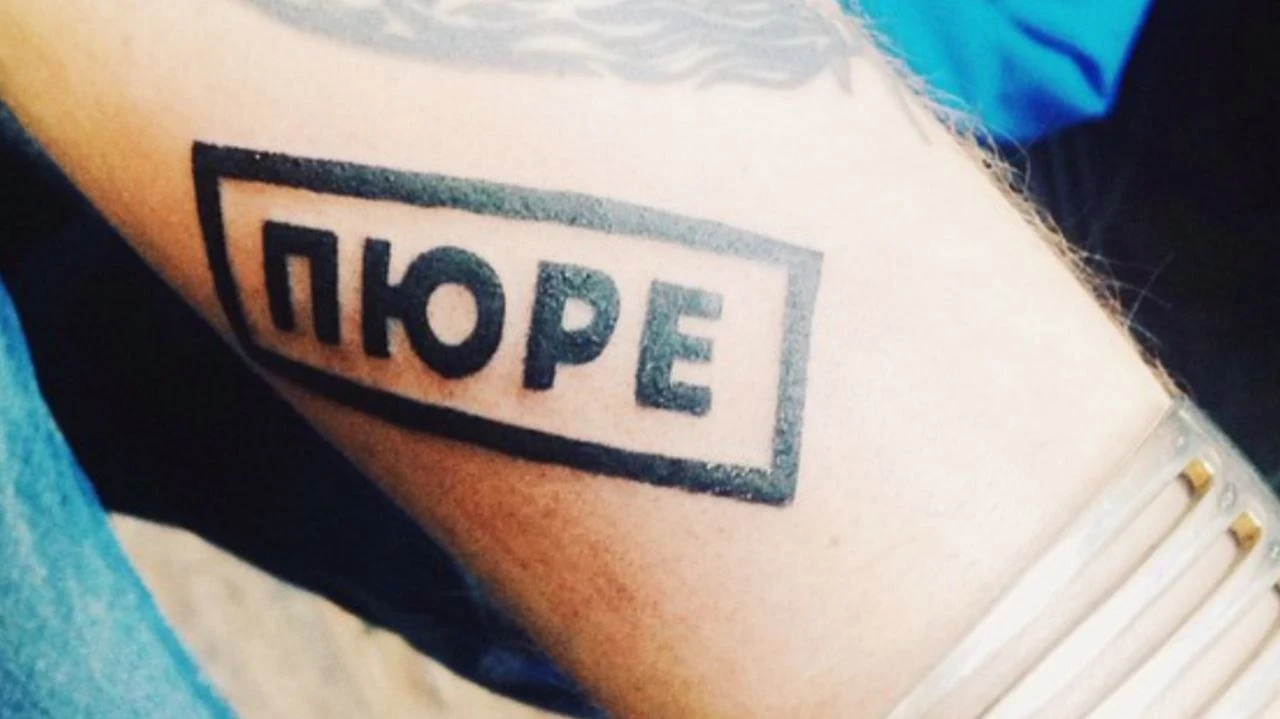
The original Radio Puree logo, tattooed during the first Black Thursday episode.
I have the logo of a radio station tattooed on my arm.
The station no longer broadcasts. The tattoo, on the other hand, has proved remarkably reliable.
And no, this wasn't a drunken mistake at three in the morning. It was part of a carefully planned radio programme.
Which, admittedly, doesn't make it sound much more sensible.
A radio station for people who actually liked music
In late 2013, two experienced Ukrainian radio professionals, Dmitry Tereshkov and Yegor Vedov, launched an internet radio station in Kyiv called ПЮРЕ, or Radio Puree.
Dmitry had been a well-known DJ at Prosto Radio. Yegor was a sound engineer and radio creator who had worked on numerous Ukrainian stations.
Both knew conventional radio rather well.
And both were tired of some of its conventions.
The idea behind Puree was wonderfully straightforward: play excellent music that, for reasons I never quite understood, Ukrainian commercial radio largely ignored.
Not some aggressively experimental underground noise that required a degree in contemporary art to appreciate.
Just fresh, interesting international music. Alternative pop, soul, electronics, jazz, whatever sounded good together.
The kind of music you might hear in a particularly good European café and immediately want to identify.
We wanted music to be the main attraction.
Almost no advertising. Very few jingles. No presenters interrupting every third track to tell you how wonderful the station was.
Even our jingles and commercials were made as little musical pieces rather than something designed to make you reach for the volume control.
It was radio that mostly left the listener alone.
A surprisingly radical idea.

Radio Puree's original visual identity.
Restaurants turned into our distribution network
I joined Puree as a partner in 2014, taking responsibility for distribution and attracting advertisers.
At the time, my main business was restaurants. I was involved in roughly fifteen jointly owned establishments and another thirty-five under management.
That gave me a rather useful advantage.
I had access to a lot of speakers.
Soon, Radio Puree was playing across my restaurant network.
But something interesting had already happened before we pushed distribution seriously.
Some fashionable Kyiv cafés and restaurants had discovered the station themselves and started using it as their permanent soundtrack.
Nobody had paid them to do it.
They simply liked the music.
For me, that was probably the strongest validation of the product.
A restaurant's soundtrack is an important part of its atmosphere. You don't want an obnoxious presenter suddenly shouting about a supermarket promotion while someone is trying to enjoy their coffee.
Puree fitted naturally.
So we expanded through restaurants, cafés and other hospitality venues. My existing relationships made those conversations relatively easy.
We also attracted advertisers who understood the audience.
Kyiv's Street Food Festival, which I've mentioned in other stories, became a regular advertiser. There were alcohol brands, restaurants and other businesses connected to the city's food and nightlife scene.
We weren't trying to fill every available minute with advertising.
The music was the reason people listened.
The advertisers were welcome guests, provided they remembered whose party it was.
What happens after the restaurants close?
There was one obvious limitation to our restaurant distribution strategy.
Restaurants don't generally operate at six in the morning.
Nor do they necessarily want people discussing current affairs over dinner.
So we began experimenting with programmes for the hours when our core hospitality audience wasn't listening.
Some evenings, we would gather in the studio for conversations about whatever seemed interesting that week.
Current events, strange stories, jokes, occasionally something resembling a serious discussion.
These were fairly informal podcasts and live radio shows, often involving friends and guests.
And then I came up with a format that was, by any reasonable broadcasting standard, a little unusual.
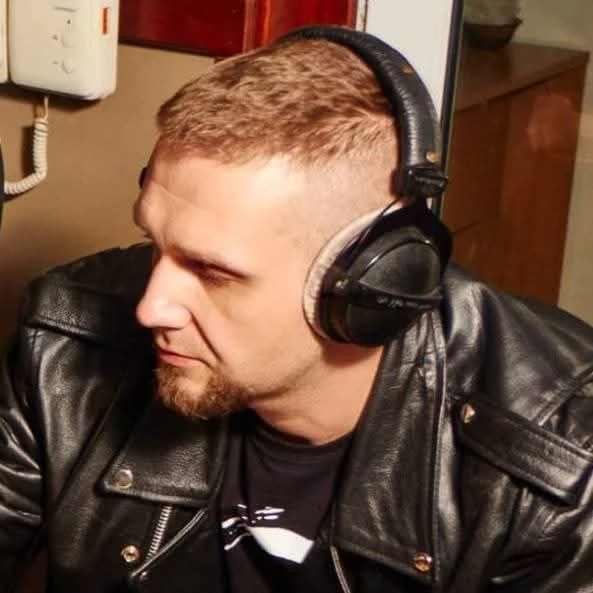
An archival photograph from the Radio Puree years.
Black Thursday
The concept was simple.
Every Thursday, Dmitry and I would go to a partner tattoo studio, Tattoo 2000.
We would record a programme while getting tattooed.
Every Thursday.
For roughly a year.
A new tattoo each week.
We called it Black Thursday.
The tattoo studio provided the sessions in exchange for promotion. We brought the microphones, conversations and a willingness to make increasingly questionable decisions about our own skin.
The first episode was straightforward enough.
We both got the Radio Puree logo tattooed.
There was a certain logic to it. We were partners in the radio station, after all.
But then came the second Thursday.
And the third.
And the tenth.
Normally, people spend weeks or months thinking about a tattoo.
We had a rather different problem.
Wednesday evening would arrive, and someone would ask:
"What are we getting tomorrow?"
Sometimes we'd find an interesting picture online.
Sometimes the tattoo artist would say he had an idea he'd always wanted to try, but nobody had agreed to it.
"Want to see?"
"Sure."
"What do you think?"
"Looks good. Let's do it."
Not exactly a rigorous artistic approval process.
But it made for entertaining radio.
The sessions usually lasted an hour or two. We talked, joked and got tattooed while the audience listened.
Other media became interested. Journalists visited, filmed us, and made stories about the show.
It was the sort of thing you could explain in one sentence and people would immediately want to know more.
Two idiots get tattoos every Thursday while making a radio programme.
That's the pitch.
And it worked remarkably well as a creative media format.
At one point, I was in the United States visiting the woman who would later become my wife.
I flew back to Kyiv specifically for a Thursday episode, got my tattoo, and then returned to America.
The tattoos themselves were part of a promotional partnership.
The transatlantic flights, unfortunately, were not.
I also have a tattoo dedicated to Black Thursday itself.
Apparently, I felt the project needed additional documentation.
Music for Running and Sex
Black Thursday wasn't our only experiment.
I also came up with a morning music format.
The idea was to play energetic music with a consistent, fairly fast rhythm. Something suitable for morning exercise, running, or other activities requiring a certain amount of enthusiasm.
We called it Music for Running and Sex.
The reasoning was that both activities could benefit from a similar musical tempo.
I wouldn't describe this as a peer-reviewed scientific discovery.
But it was a good excuse to create a rather enjoyable playlist.
We scheduled it from 6 a.m. to 9 a.m.
Six to nine.
Yes, the scheduling was part of the joke.
We were adults, allegedly.
Not every experiment was entirely successful
Our evening podcasts also produced some memorable accidents.
Once, a friend from Germany was visiting Kyiv while his girlfriend joined my wife and their friends for wedding-related celebrations.
My assignment was to entertain him for the day.
We started at a Ukrainian restaurant around lunchtime.
There was vodka.
Then beer.
Eventually, a bottle of gin became involved, which, in retrospect, was an unnecessary development.
That evening, we took him to the radio studio and invited him to join our podcast.
Dmitry asked provocative questions. Our guest answered enthusiastically, sometimes in German.
It was a lively recording.
Until our guest became spectacularly ill and threw up over the radio mixing console.
The next morning, after listening to the recording, he became convinced he'd said things about his military work that he shouldn't have discussed publicly.
I have no idea whether any actual secrets were involved.
But I can confirm that the mixing desk suffered considerably more than its manufacturer had anticipated.
Not every piece of audience participation is worth encouraging.
The project that wasn't really a business
Radio Puree remained active through much of the period from 2013 to 2017, although the people and projects around it gradually changed.
Ukraine's internet radio scene expanded. More stations appeared, with their own formats, personalities and audiences.
Meanwhile, our other businesses and commitments demanded more time.
Eventually, Puree faded away.
We never turned it into some enormous commercial radio operation.
And that was never really the point.
It was partly a business, partly a creative laboratory and largely a project built by people who genuinely enjoyed music and experimenting with media.
We discovered that a carefully curated soundtrack could find its own distribution through restaurants.
That advertisers were willing to support a station with a distinctive audience.
That unusual programmes could attract attention without enormous production budgets.
And that a tattoo studio, a pair of microphones and two people willing to get inked every Thursday could become a perfectly respectable piece of media programming.
Well, respectable might be overstating it.
But memorable? Certainly.
I still think about Puree with enormous affection.
Dmitry and Yegor went on to work on other radio projects. My own career took me elsewhere.
And there are probably more efficient ways to develop a brand than permanently engraving it on your body.
But I can't imagine many that are quite as difficult to forget.
The radio is gone.
The logo is still on my arm.
That's brand retention for you.
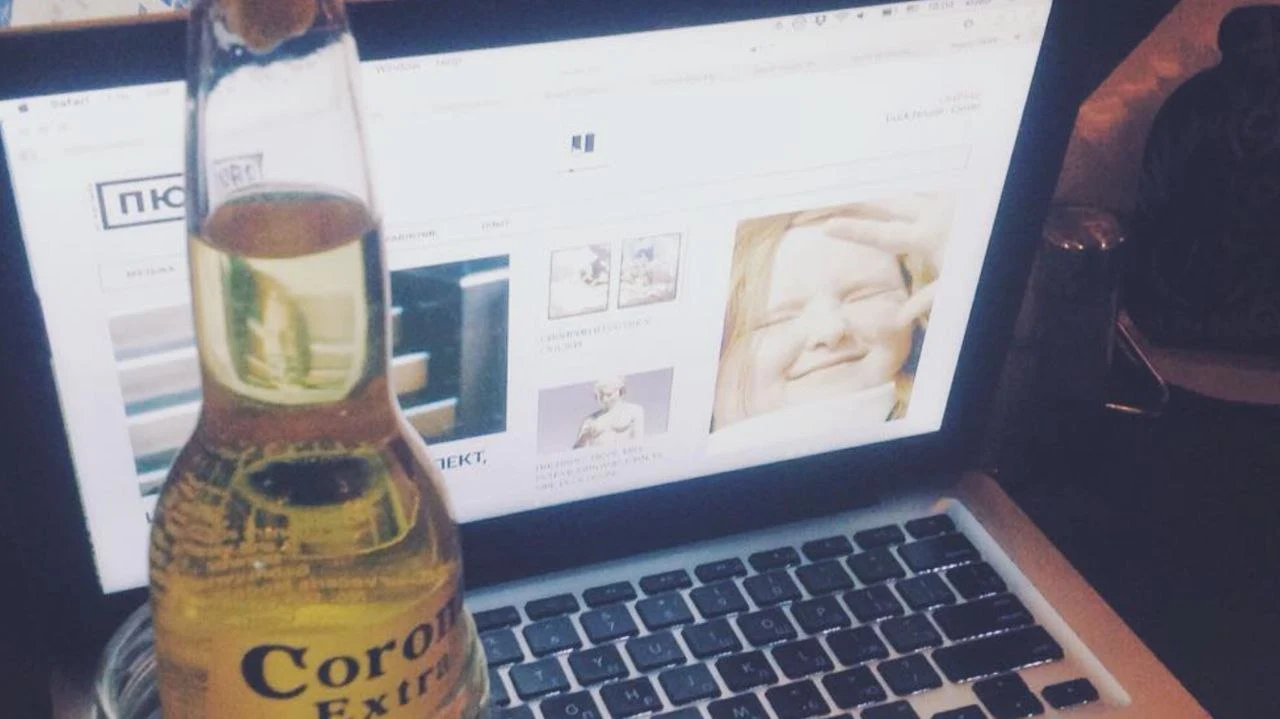
Radio Puree on a laptop, back when the station was broadcasting.