
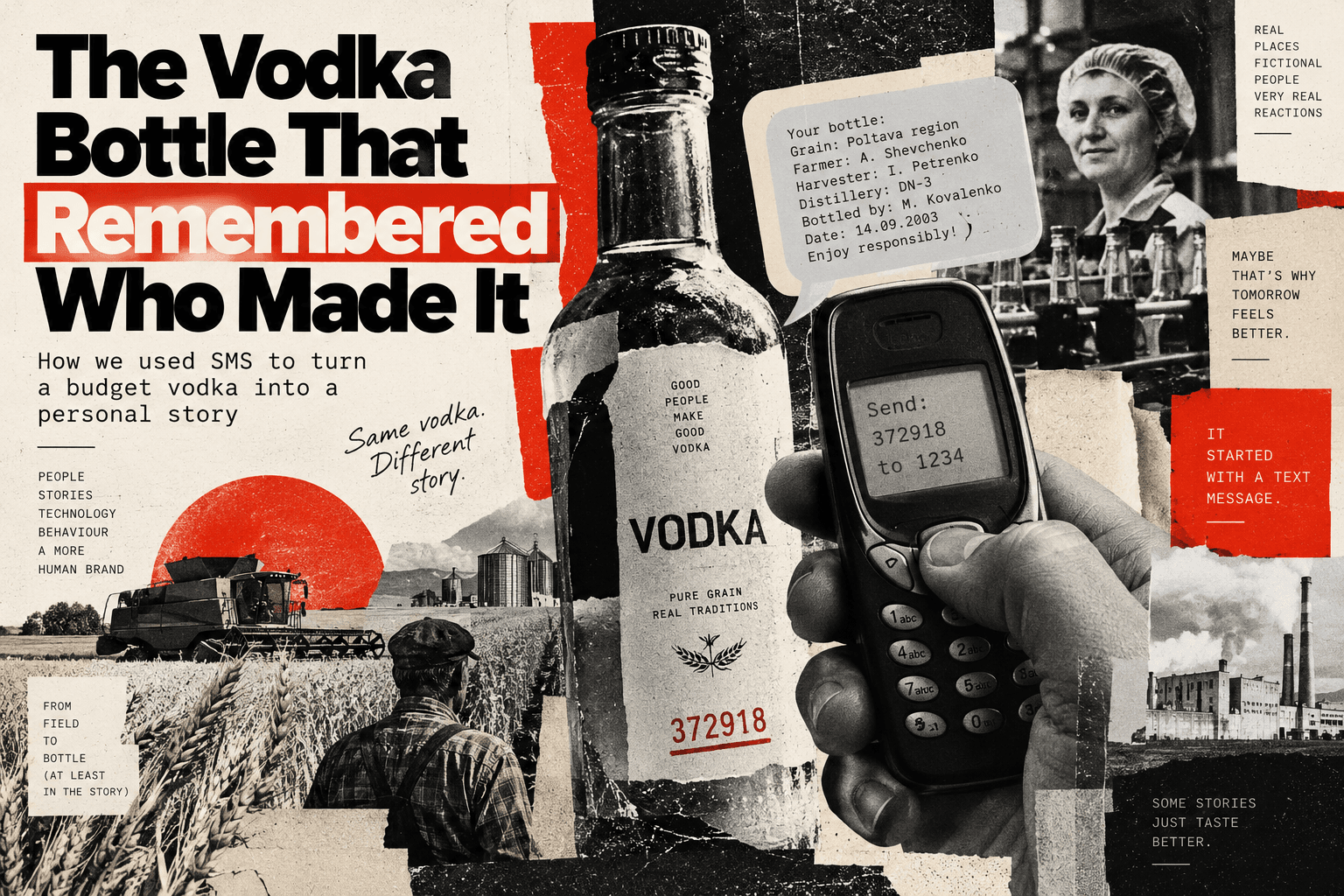
How we used SMS to give budget vodka bottles fictional biographies, and what one supermarket customer taught me about consumer psychology.
More than twenty years ago, I watched a man in a Ukrainian supermarket carefully examine several bottles of inexpensive vodka.
He picked up one bottle, looked at the label, typed something into his mobile phone and waited.
Then he put it back.
Picked up another.
Typed again.
Waited.
Eventually, his friend asked him what he was doing.
The answer, as I remember it, was approximately this:
"I've bought this vodka many times. It's pretty good. But I've noticed that when I get a bottle filled by this particular woman, I have much less of a hangover. I'm trying to find another one of hers."
I stood nearby, listening.
Because I was the person who had invented the system that told him which woman had supposedly filled his bottle.
And there was one small detail.
That woman didn't exist.
Or, more precisely, she existed only as a character in a story we had created for the bottle.
This was one of my earliest experiments in interactive marketing.
And it taught me something about consumer psychology that I still find useful today.
Before smartphones, there was SMS
To understand the project, we need to go back to the early 2000s.
Social media had not yet become part of everyday life.
There was no Instagram, no TikTok, no smartphone in everyone's pocket.
But mobile phones had become increasingly common, and SMS messaging was everywhere.
People sent short text messages constantly.
It was simple, familiar and available without an internet connection.
At the time, I was working as a consultant on digital technology and innovation with an IT agency.
One of its clients had launched a new vodka brand.
It was a budget product. Perfectly ordinary vodka, competing against dozens of other products in a crowded market.
The brand positioning focused on natural ingredients, traditional production methods and careful quality control.
How much of that was independently verifiable is another question. These were the attributes the manufacturer wanted to communicate.
The problem was that almost every competitor was saying something similar.
Everyone had a beautiful wheat field
If you looked at vodka advertising in Ukraine at the time, you could easily conclude that the entire industry consisted of exceptionally honest farmers growing wheat beside pristine rivers.
Everyone had natural ingredients.
Everyone had pure water.
Everyone had traditional recipes.
Everyone had some impressive filtration process.
The advertising was full of fields, blue skies, grain, water droplets and reassuring statements about quality.
Our client could produce the same advertising.
But why would anyone notice?
The budget was relatively small. There was no realistic opportunity to compete through a massive media campaign.
We needed something that would make a relatively ordinary product memorable without substantially increasing its cost.
And we wanted to communicate the idea of natural production without creating yet another picture of a wheat field.
So I started thinking about the production process itself.
What if, instead of telling people that the vodka was made carefully, we introduced them to the people who supposedly made it?
Not the company.
The people.
Every bottle gets a biography
Grain-based vodka passes through several production stages.
Someone grows the grain.
Someone harvests it.
The grain is processed.
Alcohol is produced and rectified.
The product goes through further preparation and filtration.
Eventually, it reaches the bottling line.
There are people involved at every stage.
Farmers.
Combine operators.
Production workers.
Technicians.
Bottling-line employees.
Normally, the customer knows nothing about them.
You buy a bottle, and all that remains visible is the brand.
I suggested changing that.
What if every bottle had its own personal production story?
A story with names, places, dates and specific people.
Not another generic description printed on the back label.
Something that appeared to belong to one particular bottle.
The idea was to create the feeling that the customer could follow the product from the field to the moment the bottle was closed.
We had no intention of building a complicated tracking system. We didn't have the budget, the infrastructure or any real commercial reason to implement one.
But we could build a storytelling system.
And SMS was the perfect interface.
Real factories, fictional people
Here is an important detail about how the project actually worked.
The production stories were fictional.
We used real agricultural companies, real farms, real processing facilities and real distilleries connected to the manufacturer's business.
Their participation in the campaign had been agreed upon.
The geography was real.
The production ecosystem was real.
But we did not track individual batches of grain through the entire manufacturing process.
We couldn't tell which specific field supplied the grain for one particular bottle.
And the names of the individual farmers, combine operators and bottling-line employees were invented.
We created a database of narrative elements.
Different agricultural regions.
Different farms.
Different harvesting crews.
Different production stages.
Different dates.
Different fictional employees.
These elements could be assembled into plausible production biographies.
One bottle might describe grain grown in Ukraine's Poltava region.
Another might mention a farm in the Vinnytsia region.
One story might introduce a combine operator named Ivan Petrenko.
Another might end with a bottling-line worker named Maria Kovalenko.
The point was not to document actual product provenance.
It was to transform an industrial production process into a collection of personal stories.
In retrospect, I would make one important change to this approach: I would explicitly tell consumers that these were fictional stories inspired by real production partners.
We did not make that distinction sufficiently clear at the time, and customers could reasonably interpret the biographies as factual records of their particular bottles.
That was an ethical weakness of the concept.
But it also makes the psychological result particularly revealing.
We were giving essentially identical products different fictional identities.
And consumers started treating those identities as meaningful.
One bottle. One number. One SMS.
The technical implementation was straightforward.
Every bottle received a unique number printed on its label.
There was also a telephone number and a short instruction.
Send the bottle's number by SMS to discover its story.
The customer sent the message.
Our system processed the identifier, found its associated narrative and returned an SMS describing the bottle's supposed journey.
Where the grain came from.
Who harvested it.
Where it was processed.
Where the alcohol was produced and prepared.
Who supposedly worked on the bottling line.
The result was a short, personalised story delivered directly to the customer's phone.
No application.
No registration.
No internet connection.
No website.
Just a mobile phone and a text message.
For the early 2000s, this was a remarkably accessible form of interactive packaging.
And the whole experience was built around technology that people already understood.
I have always liked that principle.
You don't necessarily need to teach customers a new behaviour.
Sometimes you just need to give an existing behaviour a more interesting purpose.
Turning production into entertainment
There was something wonderfully absurd about the whole idea.
Vodka production is not generally considered entertainment.
Agriculture, rectification, filtration and bottling are industrial processes.
There is nothing particularly romantic about a combine harvester.
And yet, once you attach people and individual stories to those processes, they become much more interesting.
A field is no longer just a field.
It belongs to a particular farmer.
A harvesting operation becomes the work of a named person.
A bottling line suddenly has an employee with a personality, even if that personality exists only in a fictional narrative.
The customer is no longer simply receiving information about manufacturing.
They are exploring a little world behind the product.
And the unique bottle number makes the experience feel personal.
That was the essential trick.
We didn't change the vodka.
We changed what the customer could imagine about it.
What I learned standing in a supermarket
The product entered retail distribution.
The company also used conventional in-store promotion, including promoters working with customers.
I occasionally visited supermarkets myself.
I have always found it useful to observe what people actually do around a product rather than rely exclusively on presentations explaining what customers are supposed to think.
A marketing report tells you what the campaign was designed to achieve.
Standing near a shelf sometimes tells you what really happened.
About two months after the launch, I visited a large supermarket belonging to a Ukrainian retail chain.
I stood near the vodka section and watched people choosing bottles.
That's when I encountered the man searching for a particular bottling-line employee.
He already knew the product.
He had bought it several times.
He had used our SMS system.
And somewhere along the way, he had developed a theory.
According to his personal experience, bottles supposedly filled by one particular woman gave him a milder hangover.
He was now using our system to find another bottle associated with her.
I remember being genuinely fascinated.
We had created a fictional employee.
He had turned her into a quality indicator.
And he was now making purchasing decisions based on that belief.
There was no evidence that the imaginary worker, or any actual bottling employee, could influence his hangover.
The relationship existed entirely in the customer's interpretation.
But it was real enough to affect his behaviour.
Customers began inventing their own criteria
That wasn't the only interesting reaction.
I encountered other consumers who had developed preferences based on the information they received.
Some were interested in particular agricultural regions.
Others paid attention to production dates.
Some seemed to prefer certain processing facilities.
They were effectively building their own little classification systems.
One location was better.
One date was more trustworthy.
One imaginary employee was preferable to another.
We had never designed the system to produce those exact conclusions.
We had simply provided a set of details.
The customers supplied the meaning.
This is the point where the campaign became particularly interesting to me.
The product was standardised. The experience was personalised.
And the personalised experience made people perceive differences between products that were not necessarily different in any meaningful physical sense.
The SMS campaign operated for roughly six months.
The client considered it successful, and the consumer engagement we observed was encouraging.
I don't have reliable historical figures for sales uplift or campaign ROI, so I won't invent them.
What I remember much more clearly is how actively some people interacted with the system.
They weren't just sending one message out of curiosity.
They were coming back.
Comparing bottles.
Developing preferences.
Creating their own explanations.
The system had become part of the purchasing experience.
We accidentally created something resembling a ritual
Looking back, I think this was the most important psychological effect.
Consumers were not simply receiving a story.
They were using the story to create rituals.
A particular region.
A particular production date.
A particular person.
Something they could search for and recognise.
The customer who preferred one fictional bottling-line employee had effectively created a small personal superstition around the brand.
And because the information came from an interactive system linked to individual bottle numbers, it probably felt more significant than an ordinary advertising slogan.
A slogan is something the manufacturer says.
A personalised SMS feels like information you have discovered.
That distinction matters.
People often give more weight to conclusions they believe they have reached themselves.
Even when the underlying information was designed by somebody else.
This mechanism is closely related to subjects I have explored in my work on Gestalt Marketing, particularly how unresolved expectations, associations and perceived patterns influence consumer decisions.
We didn't tell the customer that one bottling-line employee was better than another.
We didn't even imagine that somebody would make that comparison.
We simply created enough detail for the customer to begin constructing his own explanation.
And apparently, he found an explanation he liked.
Personalisation before personalisation became an industry
Today, this kind of campaign would probably be described using a collection of fashionable terms.
Interactive packaging.
Consumer engagement.
Product storytelling.
Digital experience.
Personalisation.
Perhaps even gamification.
Back then, we didn't need a particularly elaborate vocabulary.
We had unique numbers and SMS messages.
That was enough.
And I think this is one of the more useful lessons from the project.
The sophistication of a customer experience has very little to do with the sophistication of the technology behind it.
You can build a complicated application that nobody wants to use.
You can spend a fortune on an interactive campaign that produces nothing more than a few screenshots for an agency presentation.
Or you can connect a simple technological mechanism to a psychological behaviour people already have.
Curiosity.
The desire to discover something.
The desire to feel that an ordinary object is somehow special.
The desire to find patterns.
And suddenly, a cheap bottle of vodka has a story worth investigating.
Would this work today?
I think it could.
Possibly even better.
The technology has changed enormously, but the underlying psychological mechanisms are still familiar.
Today, instead of SMS, we could use QR codes, messaging platforms, mobile applications or AI-powered conversational interfaces.
Imagine scanning a code on a product and entering a small interactive world.
You could explore the region where the ingredients were produced.
See photographs of actual farms.
Meet real employees.
Watch videos from the production facility.
Learn how the product is manufactured.
Or explore fictional characters and narratives inspired by the production process, clearly identified as storytelling rather than verified product history.
With modern AI, the experience could become conversational.
Instead of receiving one predefined SMS, a customer could ask questions.
Follow different characters.
Explore different parts of the story.
Discover details that interest them personally.
For products with genuine batch-level traceability, the same interface could provide verified supply-chain information.
For products without it, the experience could be an openly fictional narrative built around the brand's real world.
The important thing would be to distinguish those two approaches.
Modern technology makes that distinction easier, not harder.
A customer should be able to enjoy a good story without being misled about where the actual product came from.
And there is no reason why the entire experience should end when the package is opened.
An interactive story could continue after purchase.
It could become a collection of characters, locations or episodes.
It could connect different products.
It could develop into a small brand universe.
Twenty years ago, the entire experience had to fit into a few text messages.
Today, the possibilities are considerably wider.
But I suspect the most effective version would still be surprisingly simple.
Because the interface was never the most important part.
The product was ordinary. The story wasn't.
I sometimes return to this case when thinking about how brands create value.
We had a budget product in a crowded market.
No exceptional technological advantage.
No enormous advertising budget.
No obvious functional differentiation.
And we gave it a fictional biography.
That biography didn't make the product physically better.
It didn't change the recipe.
It didn't change the manufacturing process.
It didn't change the alcohol inside the bottle.
But it changed the way some customers perceived and selected it.
The most memorable customer wasn't choosing between different vodka brands anymore.
He was choosing between different stories belonging to the same brand.
He wanted the bottle associated with one particular woman because he believed she somehow made his experience better.
That woman was fictional.
His preference was real.
And the preference was strong enough to make him stand in a supermarket, sending multiple SMS messages while his friend wondered what on earth he was doing.
More than twenty years later, I still find that fascinating.
We set out to demonstrate that there were people and places behind an ordinary industrial product.
Instead, we discovered how readily consumers could turn a story into a personal belief.
We gave identical bottles different biographies.
The customers gave those biographies meaning.
And that was where the marketing actually happened.