
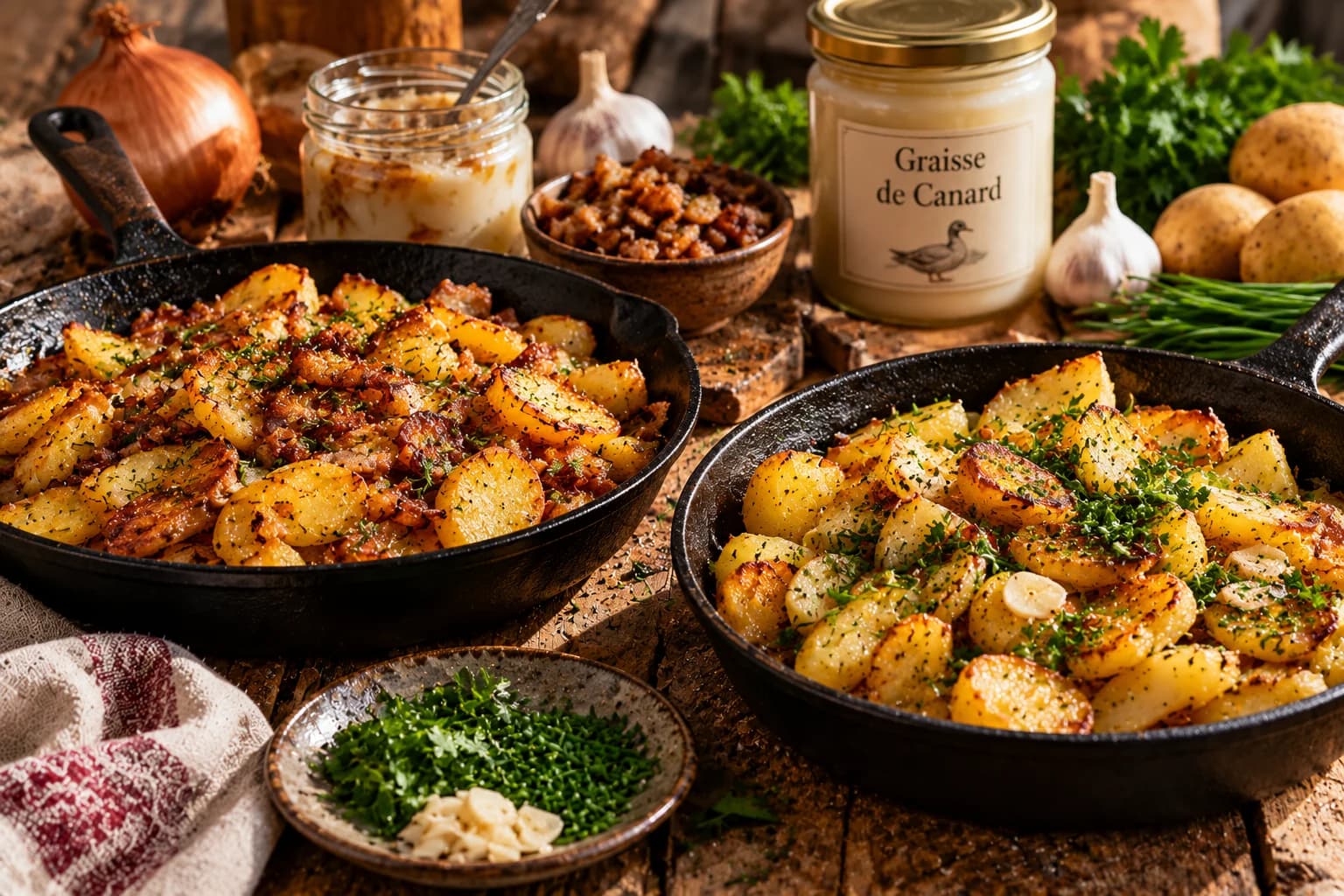
I used to think I knew everything worth knowing about frying potatoes. Then I moved to France and discovered that duck fat comes in jars.
There's a rather important ingredient in cooking that people sometimes treat as if it barely deserves mentioning.
Fat.
Not the fat in a nutritional chart.
The fat in the frying pan.
The thing you use to cook the onions, brown the potatoes or give a piece of meat that wonderful golden crust.
Open almost any recipe and you'll find a casual instruction.
Heat a little oil in a pan.
Which oil?
Why that oil?
What if I use something else?
Apparently, these questions aren't always considered terribly interesting.
I disagree.
Because sometimes changing the cooking fat changes the entire character of the dish.
I've known this since Ukraine, where I loved frying things in pork fat.
But France introduced me to another rather magnificent possibility.
Duck fat.
And now I have some very strong opinions about fried potatoes.
My weakness for animal fats
I have nothing against vegetable oils.
Sunflower oil.
Rapeseed oil.
Olive oil.
They all have their uses, and I use them regularly.
But when I want a particular depth of flavour, I often prefer animal fats.
Butter, for example.
Living in western France has only made that preference stronger.
Breton butter is wonderful.
And in many dishes, I like combining butter with a little neutral vegetable oil.
It gives me a different cooking medium and flavour balance, although it doesn't magically prevent the milk solids in butter from burning at high temperatures.
If I really need the properties of butterfat without those milk solids, clarified butter is a better solution.
But temperature isn't the most interesting part of this discussion.
Flavour is.
Butter tastes like butter.
Rendered pork fat tastes different.
Chicken fat has its own character.
Duck fat is another story entirely.
And when you understand those differences, the choice of fat becomes part of the recipe rather than something you pour into a pan without thinking.
Which brings us, once again, to borscht.
Because apparently I can't stay away from that subject.
There's another borscht made with salo
I've already written about a traditional borscht made with old, aged salo.
In that version, a substantial piece of dried, cured pork fat goes into the pot early and cooks for a long time.
The idea is to extract its flavour into the broth.
I remember eating a version of it in my grandmother's kitchen in Belarus, and years later I recreated something remarkably similar using Spanish jamón bones.
But there's another approach to cooking borscht with pork fat.
One that produces a rather different result.
Borscht with shkvarky.
Pork cracklings.
And to understand that version properly, we first need to talk about smalets.
First, you need a pig. Or at least some of its fat.
Traditionally, rural households in Ukraine preserved a substantial amount of pork.
A pig might be slaughtered during the colder part of the year, and the family would prepare food intended to last for months.
Some meat became sausages.
Some was cured, dried or otherwise preserved.
Some of the pork fat was salted and stored as salo.
And some was rendered.
The process is wonderfully straightforward.
You take pork fat.
Cut it into small pieces.
Put it in a heavy pan or cauldron.
And heat it slowly.
The fat begins to melt.
Liquid fat gradually collects around the remaining pieces.
Those pieces become smaller.
Darker.
Crispier.
Eventually, you have two useful products.
The first is rendered pork fat — smalets, or lard.
The second is shkvarky, the little browned pieces left behind after rendering.
Cracklings.
Wonderful things.
You can eat them as a snack.
You can add them to other dishes.
Or you can store them together with the rendered fat.
Some people strain the liquid fat into jars, keeping the cracklings separately.
Others put the cracklings into the jars as well.
Either way, you've turned raw pork fat into something with several culinary uses.
And in the second case, you have a jar containing what is essentially a ready-made flavour bomb.
Borscht with cracklings
Imagine making a fairly ordinary vegetable borscht.
No meat in the broth.
No beans.
Potatoes.
Cabbage.
Beetroot.
Tomatoes.
The familiar ingredients.
Then, instead of preparing the vegetable dressing in sunflower oil, you take a generous amount of smalets with cracklings.
Heat it in a frying pan.
And use it to cook the onions, carrots, beetroot and other vegetables.
The fat carries that characteristic flavour of fried pork.
The cracklings add their own toasted, savoury notes.
And when you transfer the entire dressing into the pot, the borscht acquires a completely different character.
Every so often, you also encounter a little piece of crackling.
It's delicious.
Now, strictly speaking, this isn't vegetarian borscht, despite the absence of ordinary meat.
There's still pig in it.
Quite a lot of the flavour, in fact, comes from the pig.
But the recipe doesn't require a piece of beef or pork simmering for hours in the broth.
The richness comes from the frying fat.
And that distinction is important.
Old-salo borscht builds its flavour by simmering cured fat. Crackling borscht builds much of its flavour in the frying pan.
Two different techniques.
Two different results.
And both very much worth trying.
I used to make it myself
I cooked this kind of borscht quite often when I lived in Ukraine.
Sometimes somebody would give me a jar of homemade smalets with cracklings.
That was always welcome.
My grandmother made clean, rendered smalets without the cracklings, but the version with cracklings was particularly interesting to me.
When I had it, I used it for the vegetable dressing.
And sometimes I didn't even wait for somebody to give me a jar.
I'd buy or use some pork fat and render it specifically for the borscht.
First, make the cracklings.
Then use the resulting fat to fry the vegetables.
A little more work, certainly.
But the flavour was worth it.
I also liked using the same method in borscht that contained meat.
And sometimes beans too.
Because there is no law requiring me to choose only one delicious ingredient at a time.
Although eventually there has to be room left in the pot for the soup.
Since moving to France, I haven't really continued this particular habit.
I've made other versions of borscht, adapted to the ingredients and preferences of my family here.
But the flavour of those pork-fat dressings is something I remember very well.
And it leads directly to another great use for cracklings.
Potatoes.
Fried potatoes and pork cracklings
I think fried potatoes must be one of the world's great culinary achievements.
Not because they're difficult.
Quite the opposite.
You take an extremely ordinary ingredient.
Cut it into pieces.
Put it in a hot pan.
And, with a little patience, turn it into something golden and magnificent.
But I particularly love fried potatoes made with rendered pork fat.
Here's the method I used.
First, cut the pork fat into small pieces.
Render it slowly until the fat has melted and the pieces have become browned, crispy cracklings.
Then remove the cracklings from the pan.
This matters.
If you leave them there while the potatoes cook, they can become excessively dark and eventually burn.
So I take them out.
The rendered pork fat stays in the pan.
Then the potatoes go in.
And now they're cooking not in neutral vegetable oil, but in delicious pork fat.
They develop a wonderful flavour.
Golden edges.
That familiar richness of fried salo.
And when the potatoes are nearly ready, the cracklings can return.
So you get the potatoes and the little crunchy pieces together.
A simple dish.
No expensive ingredients.
No complicated technique.
And absolutely wonderful.
I loved cooking potatoes this way in Ukraine.
But there was another animal fat I'd occasionally encountered.
One that was much less convenient to obtain.
Chicken fat.
And, even more interestingly, duck fat.
The problem with chicken and duck fat in Ukraine
If you buy a whole chicken or duck, you can sometimes trim away a little excess fat.
Then render it.
And use it for cooking.
I used to do this.
Especially when I had a particularly fatty bird.
But there was an obvious limitation.
How much fat are you really going to collect from the trimmings of a single chicken?
Not very much.
Enough for a small cooking experiment, perhaps.
Not enough to treat it as your everyday frying fat.
Duck fat was especially interesting, but I rarely had enough of it.
And then I moved to France.
Where I discovered something rather wonderful.
You can simply buy a jar of duck fat.
Just like that.
No need to buy an entire duck.
No need to trim anything.
No need to spend the afternoon rendering scraps.
Go into a supermarket.
Find the duck fat.
Buy it.
Take it home.
Civilisation, once again, has delivered.
The first time I fried potatoes in duck fat
I don't remember exactly what inspired me to try it.
Perhaps it was simply the fact that the jar was sitting there, looking like something that ought to be useful.
But I took some duck fat.
Put it in a frying pan.
And made potatoes.
Good grief.
They were fantastic.
I'd always loved potatoes fried in pork fat.
But duck fat brought something different.
A rich, distinctive flavour that seemed particularly well suited to potatoes.
The outside browned beautifully.
The inside remained soft.
And the whole dish tasted more interesting than the same potatoes cooked in ordinary vegetable oil.
I was delighted.
And naturally, having discovered a new favourite ingredient, I began wondering what else I could do with it.
Could I use it for the vegetable dressing in borscht?
Of course.
And I tried that too.
It was good.
But I still preferred the pork-fat version for borscht.
The flavour of duck fat worked, but for my taste it wasn't quite the same marriage of ingredients.
However, for potatoes?
Duck fat was extraordinary.
And then I tried it with beef steak.
Duck fat and steak
I love a good beef steak.
And while there are plenty of ways to cook one, the choice of fat can change the experience.
So at some point I tried frying ordinary beef steaks in duck fat.
And discovered another combination I absolutely loved.
The duck fat added its own character to the browned surface of the meat.
The result tasted different from a steak cooked in vegetable oil or butter.
Not necessarily better for every possible steak.
But for me, it was another level.
A flavour I found deeply satisfying.
I had originally bought the fat because I wanted to experiment with potatoes.
Now I was using it for beef as well.
This is how an innocent supermarket purchase turns into a personal culinary doctrine.
And then I found frozen potatoes already covered in duck fat
French supermarkets have one further trick.
In the frozen-food section, alongside the chips and other potato products, you can sometimes find potatoes already prepared with duck fat.
The pieces are coated in fat.
You take them out.
Put them into a frying pan.
The fat melts as they heat.
And the potatoes finish cooking in the very fat with which they were prepared.
It's almost offensively convenient.
You don't even need to buy the duck fat separately.
Everything is already there.
And they're delicious.
Especially when the mixture also contains a little garlic.
Finely chopped parsley.
Perhaps a small amount of onion.
Or chives — ciboulette, those delicate little green stems with their wonderful mild onion flavour.
Not a mountain of herbs.
Just enough to add freshness and aroma to the richness of the potatoes.
This combination is fantastic.
A few simple ingredients.
Almost no preparation.
And a result that can taste like something you've spent much more time cooking.
I like that.
A lot.
Apparently, the French knew about this already
Later, I became more familiar with a regional French preparation called pommes de terre sarladaises.
Potatoes cooked in duck or goose fat with garlic and parsley.
A speciality associated with Sarlat and the Périgord region of southwestern France.
Which means the French had already worked out this excellent idea long before I started getting excited about supermarket jars of duck fat.
Typical.
You discover something that seems revolutionary.
Then learn that an entire region has been cooking it for generations.
Still, it was a wonderful discovery for me personally.
And it made perfect sense.
In Ukraine, rendered pork fat and cracklings were part of the traditional way of using and preserving pork.
In southwestern France, duck and goose fat are closely connected to a culinary tradition built around those birds.
Different products.
Different regional histories.
But the same fundamental understanding.
The fat left over from preparing an animal isn't just waste.
It can be one of the most interesting ingredients in the kitchen.
Three things I still like making with animal fats
I don't use exact measurements for these. They're techniques rather than carefully calibrated recipes.
1. Ukrainian borscht with pork cracklings
Render small pieces of pork fat slowly until you have liquid lard and browned cracklings.
Use some of the rendered fat, with the cracklings, to prepare your usual onion, carrot and beetroot dressing.
Add tomatoes or tomato paste as you normally would.
Transfer the dressing to a vegetable borscht and finish cooking.
The same approach can also add extra richness to a meat-based borscht.
2. Fried potatoes with pork cracklings
Render pork fat until the cracklings are brown and crisp.
Remove the cracklings before they burn.
Fry the potatoes in the remaining fat until properly cooked and golden.
Return the cracklings towards the end.
Season to taste.
Eat while hot.
Preferably before somebody else discovers what you're cooking.
3. French-style potatoes in duck fat
Melt a little duck fat in a frying pan.
Add dry, sliced or diced potatoes.
Cook until the potatoes are tender inside and golden outside, adjusting the heat and turning as needed.
Near the end, add a little finely chopped garlic.
Finish with parsley or chives.
Salt and pepper to taste.
Or, if you're feeling particularly efficient, buy the frozen potatoes already prepared with duck fat and cook them according to the package instructions.
There is absolutely no shame in that.
The fat isn't just there to stop things sticking
That's what I've come to appreciate most.
People often treat cooking fat as a technical necessity.
Something between the food and the frying pan.
But in many traditional cuisines, it's much more than that.
It carries aroma.
It contributes flavour.
It changes the character of the ingredients.
Sometimes it even provides the defining flavour of the dish.
A vegetable borscht made with sunflower oil won't taste the same as one whose vegetables were fried with pork cracklings.
Potatoes cooked in butter won't taste the same as potatoes cooked in duck fat.
And a steak browned in duck fat has a character of its own.
None of this means that animal fats are inherently better or healthier than vegetable oils.
They aren't interchangeable from a nutritional perspective, and I wouldn't pretend otherwise.
This is a discussion about cooking and flavour.
About using ingredients deliberately.
And about recognising that something as apparently mundane as the choice of frying fat can be a genuine creative decision.
Two countries, one very useful lesson
I find it rather satisfying that some of my favourite culinary discoveries in France have reminded me of things I already knew from Ukraine.
When I was younger, a jar of homemade smalets with cracklings was something worth getting excited about.
I could make a wonderful borscht with it.
Or fry potatoes that tasted completely different from the usual version.
Years later, in France, I found jars of duck fat on supermarket shelves.
And discovered another way to make wonderful potatoes.
Different countries.
Different animals.
Different traditions.
But the same idea.
The best cooking ingredient isn't always the most expensive cut of meat or the most spectacular vegetable.
Sometimes it's the thing left behind when something else is prepared.
A little rendered pork fat.
Some cracklings.
A spoonful of duck fat.
And suddenly an ordinary potato becomes something worth remembering.
Ukraine taught me to respect the cracklings. France taught me to respect the duck.
The potatoes have benefited enormously from both.