
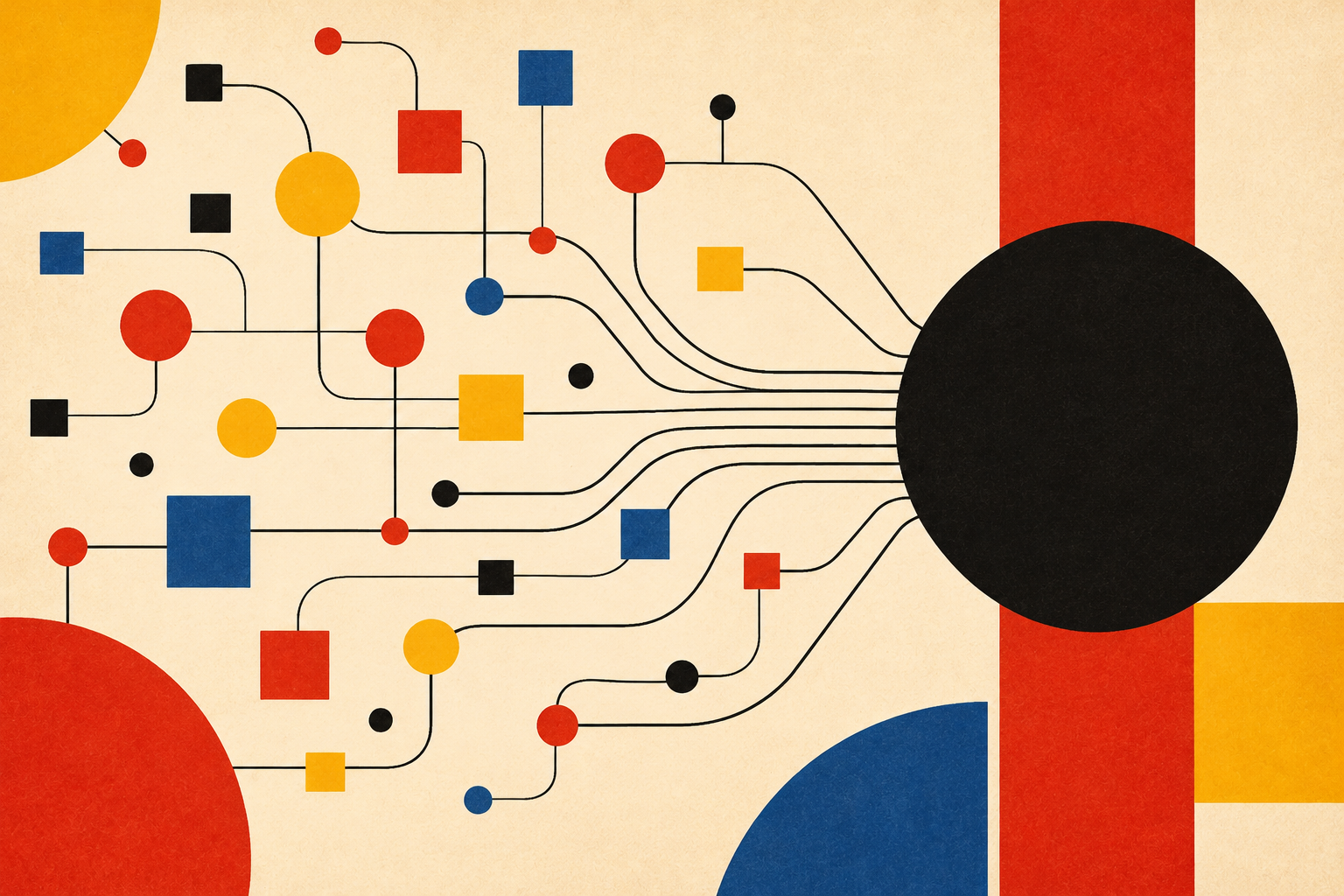
For decades, digital technology promised to distribute power among individuals. Artificial intelligence may deliver extraordinary personal capabilities while concentrating economic and political control in fewer hands than ever before.
When I started writing this blog, I spent a considerable amount of time thinking about cryptography, blockchain, and decentralised technologies.
The idea was simple and rather attractive.
The internet gave individuals access to information and markets. Cryptography allowed them to control their own identities and assets. Blockchains offered ways to organise economic relationships without relying entirely on trusted intermediaries.
A person with a private key could exercise a kind of control that previously required a bank, an institution, or a government.
The underlying expectation was that technological progress would gradually distribute power.
More independent participants.
Fewer gatekeepers.
Less dependence on central authorities.
A world in which individuals could coordinate without asking permission from an organisation that controlled the infrastructure.
I still find that vision compelling.
But I've become increasingly interested in a possibility that points in the opposite direction.
The most likely long-term consequence of artificial intelligence may be a new era of extraordinary centralisation.
Not because AI necessarily makes individuals less capable.
Quite the opposite.
AI could make an individual dramatically more productive, informed, and technically competent.
The problem is that the same technology can make large organisations dramatically more capable of coordinating and controlling everything around them.
And the advantage may not be distributed symmetrically.
A person gains an assistant.
A corporation gains the ability to coordinate thousands or millions of assistants.
A government gains the ability to manage complex systems at a level of detail that would previously have required enormous bureaucracies.
The individual becomes more powerful.
But the centres of power may become more powerful much faster.
That is the paradox.
Decentralisation Was Often a Technical Limitation
We tend to imagine decentralisation as something societies deliberately choose.
Sometimes they do.
Political systems can distribute authority through constitutional arrangements. Markets can allocate decisions among independent firms. Communities can develop institutions that protect local autonomy.
But historically, much decentralisation existed because centralisation was difficult.
Distance mattered.
Communication was slow.
Information was expensive.
Transport was limited.
A ruler could issue an order, but implementing that order across a large territory required an enormous network of administrators, local authorities, intermediaries, and institutions.
And those intermediaries inevitably acquired some independence.
An emperor might claim absolute authority over an enormous territory.
That did not mean he could monitor every transaction, supervise every official, or coordinate every decision in real time.
Geography placed limits on power.
So did the cost of information.
So did the difficulty of coordinating large numbers of people.
Even in the industrial era, capital remained tied to physical assets distributed across the world.
Factories.
Ports.
Mines.
Railways.
Warehouses.
Workers.
A corporation could own assets across several continents, but managing them required increasingly complex organisational structures.
Managers needed managers.
Departments needed reporting procedures.
Decisions moved through hierarchies.
Information was incomplete, delayed, and frequently distorted along the way.
Centralised ownership was possible.
Perfectly centralised coordination was not.
Technology has repeatedly reduced these barriers. Railways, telegraphs, telephones, computers, and the internet all made large-scale organisations easier to manage.
But AI may affect a different part of the problem.
Not simply moving information faster.
Interpreting information, making decisions, assigning work, monitoring execution, and coordinating the entire process.
That changes the economics of organisation itself.
Why Isn't There One Company That Owns Everything?
This is a useful question.
Why doesn't one corporation simply employ millions of people and dominate every profitable market?
Some corporations already employ more than a million workers, of course. Size alone is not unprecedented.
The more interesting question is why corporations cannot expand indefinitely, absorbing market after market until most economic activity is managed inside a single organisation.
The standard economic answer goes back to Ronald Coase.
In his 1937 paper The Nature of the Firm, Coase asked why companies exist in the first place.
If markets can coordinate economic activity through prices, why do we need organisations in which managers direct the work of employees?
His answer involved transaction costs.
Using the market is not free.
Finding suppliers takes time.
Negotiating contracts takes effort.
Monitoring performance involves uncertainty.
Sometimes coordinating activities inside a company is cheaper than arranging repeated transactions with independent market participants.
That explains why firms exist.
But it also creates another question.
If internal coordination has advantages, why don't firms continue expanding forever?
Because internal coordination also becomes more expensive as organisations grow.
Information becomes harder to manage.
Decision-making becomes slower.
Incentives become misaligned.
Managers make mistakes.
Hierarchies accumulate bureaucracy.
Eventually, organising another activity internally may cost more than obtaining the same service through the market.
This creates an economic limit on the size of the firm.
And this is precisely the limit artificial intelligence may change.
AI Is Not Just Task Automation. It Is Coordination Automation.
Most discussions of AI focus on individual tasks.
Writing software.
Preparing documents.
Analysing data.
Answering customer questions.
Designing advertisements.
Translating text.
Automating accounting.
These capabilities are important.
But I suspect they are not the most consequential part of the technology.
The deeper transformation is the automation of coordination.
Imagine a corporation operating across manufacturing, logistics, retail, finance, and media.
Today, each activity requires specialist teams.
Managers establish objectives.
Departments communicate.
Employees collect information.
Projects are reviewed.
Resources are allocated.
Conflicts are resolved.
Results are evaluated.
Then the cycle begins again.
Now imagine increasingly capable AI agents performing much of that coordination.
An organisation could assign objectives to thousands of specialised systems.
Those systems could break the objectives into smaller tasks, distribute work, monitor progress, compare results, identify failures, and report exceptions.
Human management would not necessarily disappear.
But the number of activities a small management team could oversee might increase dramatically.
This is still a technological scenario, not an accomplished fact.
Current agents remain unreliable in important ways. Complex workflows require supervision, verification, security controls, and organisational integration.
But the economic direction is significant.
If the cost of internal coordination falls sharply, the efficient size of a company may increase.
A corporation that previously needed separate management structures for each business could potentially coordinate many more activities through a shared AI infrastructure.
And the advantages of scale would remain.
Capital.
Distribution.
Customer relationships.
Data.
Legal resources.
Brand recognition.
Access to computing infrastructure.
The cost of organising additional activities might decline while many of the advantages of controlling a larger organisation continued to accumulate.
This raises an uncomfortable possibility.
AI may not simply help companies replace employees.
It may help companies replace the organisational limits that previously prevented them from becoming even larger.
The Million-Agent Corporation
Consider a hypothetical company with one million AI agents.
They are not necessarily humanoid robots.
Most might be software systems performing specialised functions.
Some analyse markets.
Others develop products.
Others manage marketing campaigns, customer relationships, inventory, procurement, compliance, and internal reporting.
A smaller number coordinate the work of other agents.
The organisation continuously measures performance and reallocates resources.
It launches products.
Closes unsuccessful experiments.
Expands into adjacent markets.
Acquires competitors.
Integrates their operations.
And repeats the process.
The central question is no longer how many human managers are required to supervise a million employees.
It becomes how reliably a coordination system can organise a million computational workers.
This does not eliminate every obstacle to expansion.
Physical production still requires materials, energy, infrastructure, and logistics.
Different businesses still face different regulatory environments.
Organisational goals can conflict.
Bad decisions can spread more quickly through automated systems.
And centralised control can create systemic vulnerabilities.
A million agents all acting on a flawed objective may produce something considerably worse than a million employees occasionally ignoring their managers.
But those are different constraints from the ones that shaped the traditional corporation.
The relevant limit may shift from the number of people an organisation can effectively supervise toward the amount of computation, capital, reliable data, and operational authority it can control.
If that happens, the structure of markets could change substantially.
The Concentration Is Already Visible at the Infrastructure Layer
There are early signs that AI's economic foundations favour concentration.
According to the Stanford AI Index 2026, industry produced more than 90% of the notable frontier AI models released in 2025.
Building the most advanced systems requires extraordinary investments in computing infrastructure, specialised hardware, engineering, electricity, and research.
The OECD's 2026 report on competition in AI markets identifies structural concentration risks across hardware, cloud infrastructure, data, and other critical inputs.
The report also notes that the foundation-model market remains competitive in several respects, with changing technological leaders and declining prices.
These two observations are not contradictory.
Competition between a handful of powerful companies can be intense.
And the infrastructure on which they compete can still be highly concentrated.
A market does not need to become a literal monopoly to create substantial dependence.
It may be enough for most participants to rely on a small group of providers for essential capabilities.
A developer may choose among several models.
But all those models may depend upon a limited number of chip manufacturers, cloud providers, and large-scale data centres.
An entrepreneur may build a business using AI.
But their cost structure, operating limits, and access to critical capabilities may be determined by infrastructure they do not control.
This is a different kind of centralisation.
Not necessarily one corporation owning every company.
But a small number of companies controlling the infrastructure through which countless other companies operate.
The distinction matters.
Economic activity can become highly decentralised at the surface and highly centralised underneath.
Millions of independent applications.
Millions of businesses.
Millions of AI agents.
But a much smaller number of organisations controlling the models, compute, data infrastructure, distribution channels, and access permissions.
The interface looks decentralised.
The dependencies are not.
The Counterargument: AI Also Makes Small Companies Stronger
There is an obvious objection.
AI lowers the cost of starting and operating a business.
A small team can now perform work that previously required a much larger organisation.
An individual can write software, produce content, analyse markets, and automate processes with tools that would once have been available only to well-funded companies.
Why shouldn't this create more competition?
It might.
And this is the strongest argument against the centralisation scenario.
AI can lower barriers to entry.
Open-weight models can reduce dependence on individual providers.
Cheaper inference can make advanced capabilities available to smaller organisations.
The OECD finds that the effects of AI on competition are mixed, with opportunities for smaller firms alongside advantages for established businesses.
So why am I concerned?
Because reducing the cost of production is not necessarily the same as reducing the cost of control.
A small company may become ten times more productive.
A giant corporation may also become ten times more productive.
But if the giant additionally reduces its internal coordination costs, it may gain an advantage that the smaller company cannot reproduce.
The critical variable is not simply how cheap AI becomes.
It is whether AI reduces the cost of coordination more effectively within large organisations or across independent market participants.
If independent businesses can coordinate just as cheaply through open protocols, markets could become more decentralised.
If the strongest coordination systems remain proprietary, deeply integrated, and controlled by large organisations, the opposite may happen.
This is an open question.
But it is a much more important question than whether AI allows one person to build a website in an afternoon.
The Second Centralisation: Government Finance
The corporate implications are substantial.
The political implications may be even more significant.
Modern states depend upon economic activity.
People work.
Companies employ them.
Income is earned.
Goods and services are purchased.
Taxes are collected.
Governments use the revenue to maintain public services, infrastructure, social protection, and institutions.
The precise composition of taxation differs across countries.
But labour income taxes and social contributions remain major components of government revenue.
Now imagine an economy in which machines and AI systems produce a growing share of economic value.
The economic output may increase dramatically.
But the distribution of income may change.
Human labour might account for a smaller share of production.
A larger share of the returns could accrue to owners of models, infrastructure, intellectual property, automated production systems, and capital.
If this happens, governments may need to redesign their fiscal systems.
Instead of collecting much of their revenue through taxes associated with employment, they could become more dependent on profits, capital income, consumption taxes, and other sources.
This possibility is already being examined by economists.
In Public Finance in the Age of AI: A Primer (2026), Anton Korinek and Lee Lockwood explore how transformative AI could affect the foundations of taxation.
The IMF has also examined scenarios involving erosion of labour-related tax bases and growing pressure to capture revenue from capital and economic rents.
None of this proves that workers will disappear or that labour taxes will necessarily collapse.
AI may complement human workers, create new activities, and expand the overall economy.
But the fiscal possibility is serious enough to consider.
And it introduces a political asymmetry.
What Happens When the State Needs Fewer Taxpayers?
Historically, states have depended upon large populations for economic production, taxation, military service, administration, and political legitimacy.
That dependence has often created opportunities for negotiation.
Citizens demand representation.
Workers organise.
Businesses lobby.
Communities resist.
People possess influence partly because their participation is necessary for the system to function.
This relationship has never been simple.
Taxation did not automatically produce democracy.
And governments with substantial tax revenue have not always been accountable.
But there is an important historical and political-economic idea here: the fiscal relationship between rulers and citizens can influence accountability.
If a government depends on revenue collected from a broad population, that population may possess leverage through its economic participation and its ability to demand accountability.
Research on taxation and accountability provides evidence that people can demand greater scrutiny when public revenue is understood to come from their own economic contributions.
Now imagine that a state collects an increasing proportion of its revenue from a relatively small number of highly automated corporations.
The state still needs citizens.
It still needs legitimacy, consumers, public institutions, social stability, and a functioning political system.
But its direct fiscal dependence upon mass human employment could weaken.
The government may be able to finance substantial activities through the taxation of automated production and capital.
And at the same time, a growing number of citizens may depend upon public transfers because their opportunities to earn income from labour have changed.
The resulting relationship could become increasingly asymmetric.
The state relies less directly on the economic contribution of each individual.
The individual relies more heavily on the distribution of resources organised by the state.
This does not automatically destroy democracy.
Public transfers can increase freedom, reduce poverty, and strengthen people's ability to reject exploitative employment.
A universal social dividend could make individuals less dependent on employers.
The result depends on the ownership of productive assets, the design of fiscal institutions, and the distribution of political rights.
But the centralisation risk is clear.
If production becomes concentrated and access to the resulting income is mediated by the state, economic independence may become increasingly dependent upon political decisions.
And this could alter the practical relationship between citizens and governments.
The Third Centralisation: Political Power
Democratic systems are not simply mechanisms for counting votes.
They also depend upon organised social and economic influence.
Workers have bargaining power.
Businesses control investment.
Civil society organisations mobilise people.
Communities influence local institutions.
Independent media shape public debate.
Citizens can participate in political life through many channels beyond elections.
These forms of influence often depend on people being economically and organisationally necessary.
AI could change that relationship.
If production requires fewer workers, some forms of labour bargaining may weaken.
If large organisations can coordinate more efficiently, they may need fewer intermediaries and fewer independent partners.
If governments acquire powerful AI systems for administration, surveillance, and policy implementation, they may gain new capacities that were previously constrained by limited bureaucratic resources.
But those capacities can also improve public services, detect fraud, increase accessibility, and reduce administrative costs.
The technology is not inherently authoritarian or democratic.
Its political effects depend upon institutions and the distribution of control.
The concern is the asymmetry between capabilities.
A government with powerful AI systems may become much more efficient at administering a society.
But individual citizens will not necessarily become equally effective at scrutinising, challenging, and influencing the decisions made by those systems.
An automated bureaucracy can process millions of cases.
Can millions of citizens obtain equally effective explanations, appeals, and independent oversight?
A state can use AI to analyse economic activity.
Can citizens use independent systems to examine how public money is spent?
Political participation may become easier through AI-assisted research and communication.
But will the information and infrastructure needed for meaningful accountability remain independently accessible?
These are not questions about whether AI is good or bad.
They concern who can use it, who controls it, and who can challenge its decisions.
The outcome may depend less on how intelligent the systems become than on the rights and institutions surrounding them.
Three Forms of Centralisation That Reinforce One Another
The most concerning scenario is not simply a world with a few dominant AI companies.
It is a world in which three kinds of centralisation reinforce each other.
First, economic concentration.
AI reduces the cost of internal coordination and potentially allows very large organisations to expand across more activities and markets.
Second, fiscal concentration.
A greater share of economic value accrues to automated production and capital, potentially shifting the sources of government revenue toward a smaller set of major economic actors.
Third, political concentration.
Governments acquire stronger administrative capabilities while some citizens become more economically dependent upon state-mediated access to the benefits of automated production.
These mechanisms could interact.
Large corporations control essential AI infrastructure.
Governments depend upon the economic output and taxation associated with that infrastructure.
Citizens depend upon both public redistribution and private platforms for access to services, work, and technological capabilities.
The corporations need regulatory permission, public infrastructure, and political stability.
Governments need technological capability and fiscal revenue.
Citizens need access to the systems controlled by both.
This need not involve a conspiracy.
Nobody has to sit in a secret room and design a centralised future.
The structure can emerge through ordinary economic incentives.
Companies seek efficiency.
Investors seek returns.
Governments seek reliable revenue.
Administrations seek lower operating costs.
Consumers seek convenient services.
Each decision can make sense in isolation.
Together, they may produce a system in which enormous power is exercised through a relatively small number of institutions.
And because the system provides increasingly useful services, dependence upon it may feel less like a restriction than a convenience.
That is one of the most interesting aspects of technological centralisation.
It does not always arrive by removing capabilities.
Sometimes it arrives by providing capabilities that become difficult to live without.
A Million Personal Agents, Five Infrastructure Providers
Consider a future in which everyone has an AI assistant.
The assistant helps with work.
It manages finances.
Handles administrative tasks.
Organises education.
Searches for employment.
Negotiates purchases.
Prepares legal documents.
Coordinates healthcare appointments.
And perhaps participates in economic activity on the user's behalf.
That sounds empowering.
And in many ways it would be.
But imagine that most of these agents depend upon a small number of infrastructure providers.
They may have different interfaces.
Different personalities.
Different specialised functions.
But their access to models, computation, identity systems, payments, and distribution remains controlled by a few organisations.
The individual may possess extraordinary capabilities while remaining dependent upon institutions that determine the terms under which those capabilities can operate.
This is a familiar pattern in the history of the internet.
A person can create and publish content almost instantly.
But reaching an audience may depend upon a small number of platforms.
A developer can build an application.
But distribution may depend upon a marketplace.
A business can operate globally.
But payments, advertising, hosting, and customer access may depend upon several large intermediaries.
AI could make this pattern more extensive.
Not merely platforms controlling where products are distributed.
But infrastructure controlling the intelligent systems through which products are designed, decisions are made, and activities are coordinated.
That would be a significant change.
The gatekeeper would no longer sit only at the entrance to the market.
It could become part of the machinery used to operate within the market.
The Decentralisation Counterforce
None of this is inevitable.
The same technologies creating new forms of centralisation can also support new forms of independence.
Open-weight models may allow organisations to operate AI without sending every request to a proprietary service.
Local inference may become more practical as hardware and models improve.
Open protocols may let independently owned agents coordinate without requiring one organisation to control them.
Cryptographic identities and verifiable records can support systems in which people retain control over assets, permissions, and transactions.
Public digital infrastructure can reduce dependence on proprietary intermediaries.
Competition policy can challenge exclusionary arrangements around compute, distribution, and data.
And new ownership structures could allow individuals to share in the economic returns from automated production.
These are serious alternatives.
But they do not emerge automatically from the existence of AI.
They require technical architecture, economic incentives, institutions, and political choices that preserve contestability.
There is a reason I remain interested in cryptography and decentralised systems.
Their importance may actually increase in an AI economy.
Not because blockchains will magically solve every concentration problem.
They will not.
A private key cannot manufacture semiconductors.
An open protocol cannot automatically provide affordable electricity.
And decentralised software can still depend upon highly centralised hardware.
But cryptography, interoperability, and open infrastructure can help preserve something essential.
The ability to verify.
The ability to switch providers.
The ability to coordinate without a single controlling authority.
And, perhaps most importantly, the ability to exit.
A system in which everyone has an intelligent assistant is not necessarily decentralised.
A system in which people can independently control, inspect, replace, and coordinate those assistants has a much stronger claim to that description.
The Question Is Not How Intelligent AI Becomes
We spend enormous amounts of time discussing how capable AI systems will become.
Will they replace programmers?
Scientists?
Lawyers?
Managers?
Will they outperform human experts?
Will they transform education, medicine, and industrial production?
These are legitimate questions.
But I suspect the distribution of power may depend on a different set of questions.
Who owns the infrastructure?
Who sets the objectives?
Who can coordinate the agents?
Who controls access to the data?
Who receives the economic returns?
Who can audit the decisions?
Who can challenge the system?
And who can leave it without losing access to the economic and social capabilities on which they have come to depend?
The distinction is fundamental.
Having access to intelligence is not the same as having control over the institutions that deploy it.
A society can become extraordinarily intelligent in aggregate while becoming increasingly concentrated in its decision-making.
And individual productivity can increase at the same time as individual bargaining power declines.
There is no contradiction in that outcome.
The internet taught us that access to information does not automatically produce equal influence over the systems distributing information.
AI may teach us that access to cognitive capability does not automatically produce equal control over the systems organising economic activity.
The Great Centralization
When I began writing about decentralised technologies, the basic idea was that the digital world could reduce dependence on central authorities.
Cryptographic ownership.
Open networks.
Permissionless innovation.
More independent participants.
More distributed power.
AI may ultimately reinforce some of those possibilities.
But it may also create the opposite result.
The largest corporations could become capable of managing activities on a scale that was previously impractical.
Governments could become less dependent upon human labour as a source of fiscal revenue while citizens become more dependent upon the distribution of automated economic output.
And political influence could become increasingly concentrated around those who control the infrastructure, capital, and institutions through which AI operates.
This is not a prediction that one company will own the world.
Nor is it a claim that democracy must collapse.
It is a structural possibility arising from changes in the cost of coordination, the ownership of productive assets, and the relationship between economic participation and political influence.
The strongest argument against it is that AI can also make independent coordination cheaper.
That is the competition that matters.
Will AI make it easier for millions of independent actors to cooperate?
Or will it make it easier for a handful of organisations to coordinate millions of actors under central control?
Both futures involve extraordinary technological progress.
Both could produce more wealth and more capable systems.
But they would distribute power very differently.
And perhaps that is the real question behind the next stage of the digital revolution.
Not whether AI will make each of us more powerful.
It almost certainly can.
But whether the capabilities it gives individuals will grow faster than the power it gives those who coordinate them.
We may be approaching a world in which intelligence is abundant and control is scarce.
A world with millions of autonomous agents and very few autonomous owners.
A world in which everyone can do more, while fewer people decide what gets done.
That is the Great Centralization.
And it would be a remarkable irony if the technology that finally made individual intelligence extraordinarily cheap also made concentrated power extraordinarily efficient.
The future of freedom may depend less on how many intelligent tools we possess than on how many institutions we can operate without asking someone else's permission.
Sources
- Ronald Coase, The Nature of the Firm (1937)
- Stanford HAI, AI Index Report 2026
- OECD, Artificial Intelligence Markets (2026)
- OECD, Competition in the Age of AI (2026)
- OECD, Financing of Social Protection (2026)
- Anton Korinek and Lee Lockwood, Public Finance in the Age of AI: A Primer (2026)
- IMF, Fiscal Policy Can Help Broaden the Gains of AI (2024)
- Ingrid Hoem Sjursen, Accountability and Taxation: Experimental Evidence (2023)
- OECD, Digital Government Outlook 2026