
Everyone knows that absurd amounts of money are going into AI.
That part is not particularly interesting anymore.
What I wanted to know was something more useful:
Which kinds of AI companies are actually getting funded?
Not which categories people are talking about on X. Not which AI products happen to be fashionable this week. I wanted to see where investors are putting money, which AI use cases are attracting more deals, and which sectors are accelerating year over year.
Normally, this sounds like the sort of research project that requires a small analyst team, several expensive databases and an unpleasant number of spreadsheets.
Instead, I opened Claude.
Then I connected it through MCP to Anysite.io.
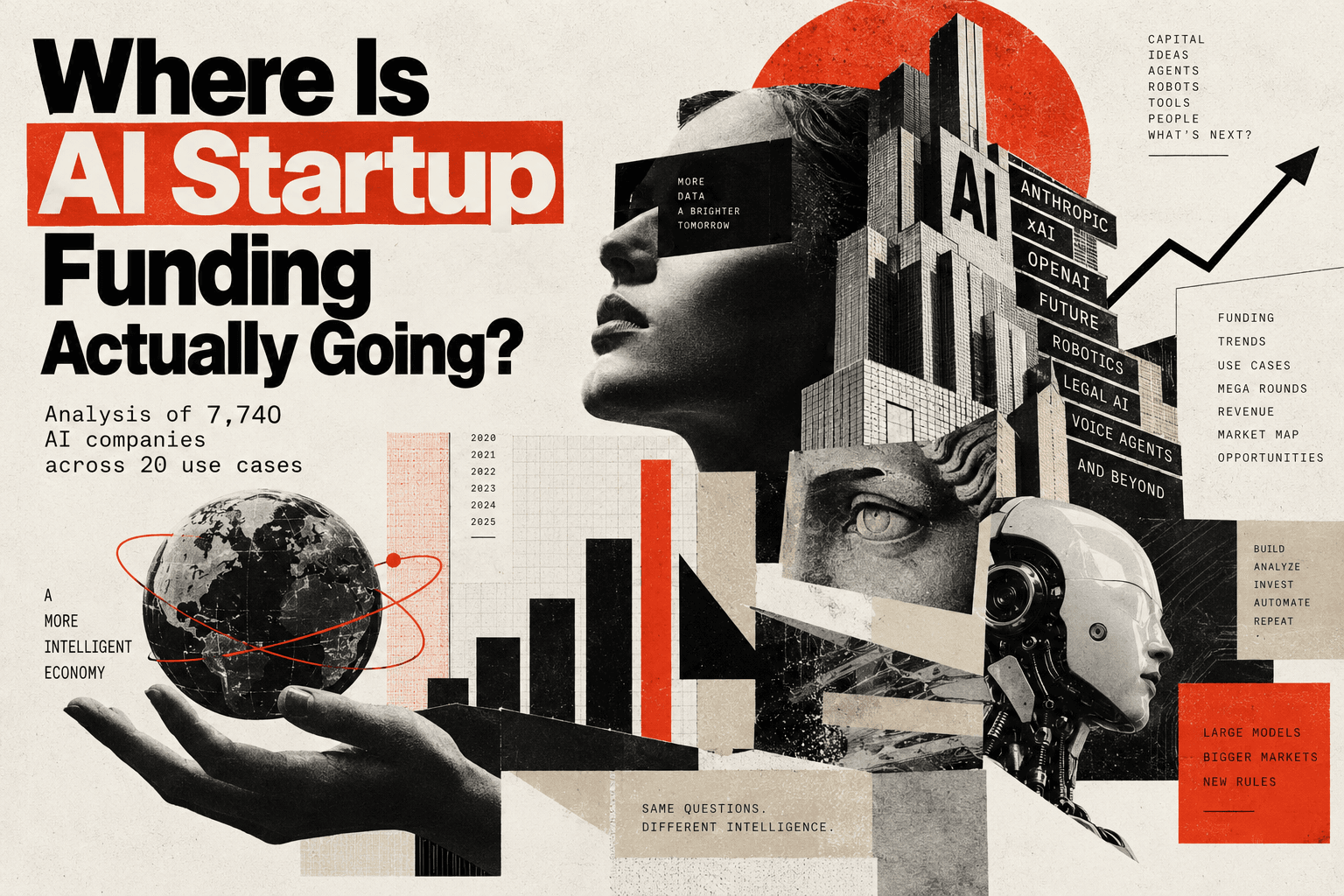
A few hours later, I had an analysis of 7,740 AI startups across 20 different use-case categories.
Welcome to research in 2026.
7,740 AI startups, 20 use cases
The idea was fairly simple.
Rather than group every company under the uselessly broad label of "AI startup", I wanted to classify companies according to what they actually do.
Voice generation.
AI agents.
Legal AI.
Robotics.
Developer tools.
Healthcare.
Sales.
Video.
And so on.
Then I wanted to compare funding activity across those categories: number of deals, total capital raised and year-over-year changes.
Claude handled much of the analysis.
Anysite provided access to company, funding and web data through MCP, including sources such as Crunchbase and public news coverage.
This is where things became interesting.
A huge amount of AI funding is concentrated at the top
The first result is probably the least surprising, but the scale still looks slightly ridiculous.
In my dataset, Anthropic, xAI and Project Prometheus accounted for $138 billion in funding combined.
That represents roughly 43% of all capital raised by the AI startups in the dataset since 2020.
Three companies.
Forty-three percent.
This is useful context whenever somebody says that "AI startup investment is booming."
It is.
But the boom is not distributed evenly.
An enormous amount of capital is being absorbed by a very small number of companies attempting to build models, infrastructure and systems at a scale where a billion-dollar funding round apparently counts as a normal Tuesday.
Remove the mega-rounds and the picture becomes considerably less insane.
AI funding doubled. The number of deals didn't.
The second result is more revealing.
In 2025, total capital going into AI companies in the dataset roughly doubled year over year.
The number of deals increased by only around 20%.
That tells a very different story from simple "AI investment is growing."
Investors did not suddenly start funding twice as many companies.
They started writing much larger cheques.
Capital is concentrating into bigger rounds and bigger perceived winners.
That matters if you are building an AI startup.
The market may contain more money than ever, while simultaneously becoming harder for an ordinary company to access.
Both statements can be true.
Voice agents and robotics are winning on deal count
Looking at deal activity rather than total dollars produces another picture.
Among the fastest-growing categories in my analysis were:
- Voice agents: +59% in deal count
- Robotics: +41%
Voice is particularly interesting.
For years, voice AI was one of those technologies that was permanently "almost there." The demos were impressive, but putting it into an actual customer interaction often exposed latency, reliability and conversational problems very quickly.
That has changed.
Models are faster.
Speech generation is better.
Real-time APIs are better.
The economics are improving.
And suddenly voice is moving from demo technology into customer service, sales, appointment booking, support and operational workflows.
Investors appear to have noticed.
Robotics is perhaps even more important long term because it represents AI escaping the browser.
Software intelligence is beginning to acquire hands.
That tends to make markets considerably larger.
Legal AI had the most extreme funding growth
The category that surprised me most was Legal AI.
Investment in the category increased by approximately 423% year over year in the dataset.
That is an extraordinary jump.
And, in retrospect, it makes sense.
Legal work has several characteristics that are almost suspiciously suitable for current AI systems:
enormous quantities of text,
expensive human labour,
repetitive document analysis,
research,
contract review,
structured procedures,
and customers who can justify paying significant amounts of money if the software saves expensive professional time.
AI does not need to replace lawyers for Legal AI to become a very large business.
It merely needs to remove enough work from the expensive parts of the process.
Apparently, investors are making the same calculation.
Revenue data is still surprisingly bad
One of the stranger parts of the research was trying to connect funding with actual revenue.
Public revenue information was available for only about 30 companies in the dataset.
Thirty.
Out of 7,740.
That tells you something about how opaque private technology markets remain, even while we discuss company valuations almost daily.
Among the companies where usable public figures could be found, the numbers were enormous. The dataset included figures around $65 billion annualized for Anthropic and approximately $4 billion for Cursor.
These figures should be treated carefully because private-company revenue numbers are frequently reported as ARR, run rate, projections or estimates rather than audited annual revenue.
But even with that caveat, the direction is obvious.
Some AI companies are scaling at a speed that would have looked completely absurd for software companies only a few years ago.
The part I find more interesting than the numbers
The funding data is useful.
But I think the more important story is how I produced it.
I did not assemble a research team.
I did not spend two weeks manually exporting Crunchbase tables.
I did not spend my weekend merging CSV files and developing a complicated emotional relationship with Excel.
I opened Claude.
Connected an MCP service.
Described what I wanted to investigate.
Iterated on the research.
And had something resembling a small investment-fund research project within a few hours.
This is the part of the AI transition that is still easy to underestimate.
We keep discussing whether AI can write an email better or generate a prettier image.
Meanwhile, the cost of investigation itself is collapsing.
A founder can do market research that previously required analysts.
A salesperson can map a market before starting outbound.
A product team can inspect thousands of competitors.
A small company can build a GTM dataset that would previously have required buying research from someone else.
That may end up being considerably more consequential than another chatbot feature.
The stack I used
For this experiment, the workflow was essentially:
Claude → MCP → Anysite.io → company databases + web/news sources → analysis
I used Anysite because it exposes the research layer through MCP rather than forcing me to manually jump between databases and browser tabs.
Beyond company and funding research, it can also be used for things like social-data collection, finding business emails and building GTM or outbound research workflows.
If you want to reproduce this kind of research, Anysite currently offers a seven-day free trial.
The promo code ANYCC also provides a month of free access to its $30 MCP plan.
The useful part, however, is not the specific tool.
It is the workflow.
Once an AI agent can access structured databases, web sources and external services directly, the question changes from:
"Can AI answer this?"
to:
"What dataset should I give it access to?"
That is a much more interesting question.
Research is becoming cheap
A few years ago, analysing thousands of startups across twenty market categories would have sounded like a project.
Now it can be an afternoon.
That does not mean the result should be trusted blindly. Data still needs to be cleaned. Categories need to make sense. Outliers need to be checked. Private-company numbers are messy. Mega-rounds can completely distort an aggregate.
AI has not abolished methodology.
It has abolished a very large amount of the labour surrounding methodology.
And that changes who can afford to ask ambitious questions.
For me, that is the most interesting result of this entire experiment.
Not that Legal AI funding grew 423%.
Not that voice agents are attracting more deals.
Not even that three companies absorbed an absurd percentage of all the capital.
It is that research which once looked like the work of an investment fund can now begin with one person opening Claude after lunch.
Research source and related reading
The figures above come from my research using Anysite.io, connected to Claude through MCP. They describe the dataset used for this experiment; funding totals and private-company revenue figures should not be read as a complete census of the AI market.
For the tools behind this workflow, see Anysite MCP and its current plans and trial terms.
For related work on this site:
- AI-native development systems: the systems and interfaces I build around AI-assisted work.
- Workflow and orchestration: context, checkpoints and reviewable execution.
- Protocols and decision systems: how structured procedures support decisions.
- How I work with AI agents in 2026: the orchestration and review practices behind my AI-assisted work.