
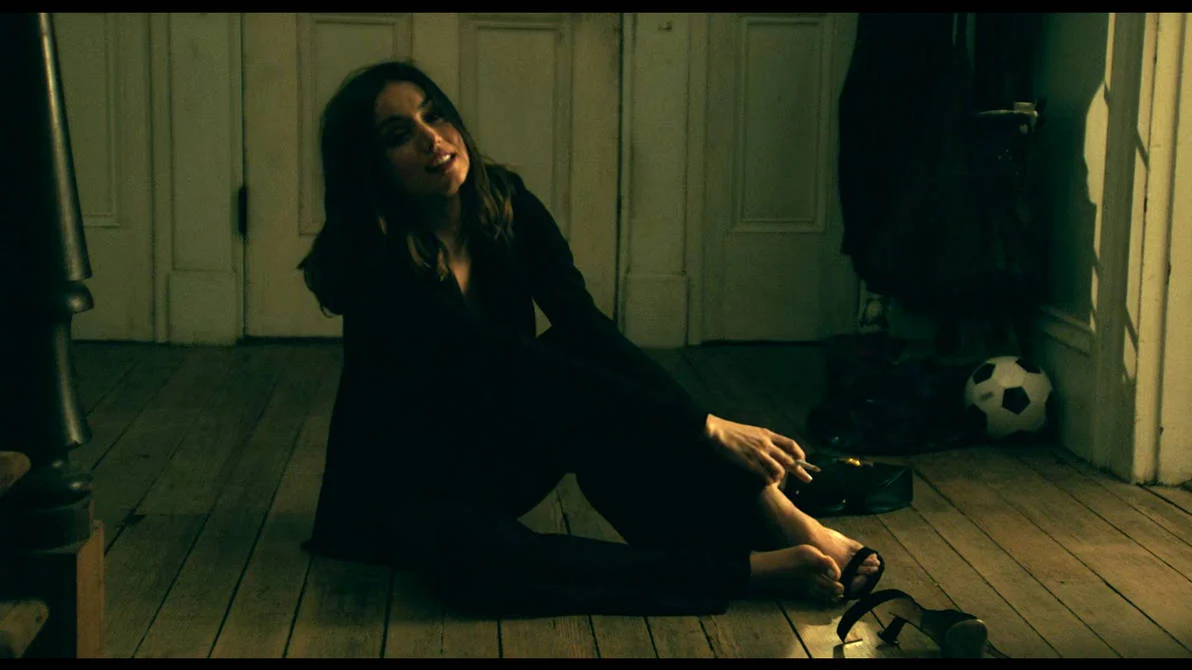
Cover image supplied from the owner-authorized Psychology Notebook reserve.
Zen Buddhism, Survivor's Guilt, and the Psychology of Trying to Control Chance
Imagine surviving a plane crash.
Everyone else dies. You walk away.
Most people would probably call you extraordinarily lucky.
But there's a rather unpleasant question hiding behind that description.
Why me?
Why did I survive when everyone else didn't?
Was there a reason? Did I deserve it? Does it mean something?
And, perhaps most disturbingly, will my luck eventually run out?
Spanish director Juan Carlos Fresnadillo takes this uncomfortable relationship with chance and builds an entire universe around it in his 2001 film Intacto.
In this universe, luck is not merely something that happens.
It's something you possess.
Something you can accumulate, steal, lose, and gamble with.
Which sounds wonderful until you realise that possessing something valuable also means spending the rest of your life worrying about losing it.
The lucky people in Intacto aren't particularly happy. They're terrified of becoming unlucky.
And this is where the film begins to look less like a supernatural thriller and more like a rather dark essay about the human mind.
The Casino at the End of the World
At the centre of the story is Samuel Berg, played by Max von Sydow.
A Holocaust survivor who has become the ultimate master of luck.
He lives in an isolated casino surrounded by volcanic landscapes, presiding over an underground world where extraordinarily fortunate people compete in increasingly dangerous games.
His former protégé, Federico, once possessed the ability to steal other people's luck through physical contact.
After losing that ability, Federico discovers Tomás, the sole survivor of an aircraft disaster, and decides to use him to challenge Samuel.
There's also Sara, a police officer who survived a car accident that killed her family.
Everyone seems to have escaped death.
Nobody seems to have escaped the consequences of surviving.
The film's central fantasy is wonderfully disturbing.
Imagine if good fortune could be taken from another person.
Every handshake could become suspicious.
Every encounter would involve a calculation.
Every relationship would carry the possibility of loss.
In a world where luck is a limited resource, even human contact becomes a competitive transaction.
Which, admittedly, isn't an entirely unfamiliar description of modern professional networking.
The Psychology of Being the One Who Survived
There's a particular psychological experience known as survivor's guilt.
It can occur when someone survives a disaster, war, accident, or other traumatic event in which others die.
The person may feel responsible, even when they had no meaningful control over what happened.
Why did they die while I survived?
Could I have done something?
What gives me the right to continue living?
Of course, survivor's guilt doesn't affect everyone who survives a traumatic event, and it doesn't always develop into a psychiatric disorder.
But when it does occur, the mind can become preoccupied with trying to explain something that may not have a satisfying explanation.
Fresnadillo makes this psychological problem literal.
His survivors are not simply people who happened to live.
They're people whose survival appears to prove that they possess a special power.
And if survival was a demonstration of power, perhaps it can be repeated.
Tested.
Controlled.
Proved again.
The terrifying accident becomes the beginning of a lifelong experiment.
Instead of asking how to live after surviving, they become obsessed with proving that they can survive again.
A person may escape death and still remain psychologically imprisoned by the moment they escaped it.
The Extraordinary Human Need to Control Chance
Psychologist Ellen Langer described a phenomenon called the illusion of control.
Her experiments showed that people can behave as though they have influence over outcomes largely governed by chance.
Give someone a choice of lottery ticket and they may value it more highly than a randomly assigned one.
Introduce familiar elements or opportunities for involvement into a game of chance, and confidence in controlling the outcome may increase.
It's a familiar human weakness.
We know perfectly well that dice don't care how confidently we throw them.
But we throw them confidently anyway.
In Intacto, this illusion becomes reality.
The characters actually can manipulate luck.
Yet instead of liberating them from uncertainty, the ability makes them increasingly obsessed with it.
Samuel has accumulated extraordinary power over chance.
And what does he do with this magnificent achievement?
He isolates himself in a casino and continues gambling with death.
Apparently, even supernatural good fortune isn't enough to make someone comfortable with being alive.
There's a useful psychological distinction here.
Having influence over some outcomes is genuinely valuable.
But needing to control every possible outcome is another matter.
One expands our freedom.
The other can organise our entire existence around the fear of losing control.
Zen Has Some Bad News About Your Luck
Zen Buddhism approaches the problem from a very different direction.
One of the central Buddhist insights concerns impermanence.
Everything conditioned changes.
Pleasant experiences end.
Unpleasant experiences also change.
Our bodies age, relationships evolve, circumstances shift, and the world refuses to remain arranged according to our preferences.
Much of our suffering comes not merely from change itself, but from clinging to what we want to preserve and resisting what we cannot control.
Zen doesn't suggest that danger is imaginary or that we shouldn't protect ourselves.
Nor does it teach that catastrophes are deserved punishments or that victims have somehow earned their suffering through bad karma.
It invites a different relationship with uncertainty.
We can act carefully.
We can prepare.
We can protect what matters.
But we cannot transform existence into a permanent guarantee of favourable outcomes.
The characters in Intacto have made precisely that guarantee their ultimate objective.
They don't simply want to be lucky.
They want to be certain that they are lucky.
And certainty is a remarkably demanding possession.
Because once you believe your survival depends on maintaining perfect fortune, every ordinary moment becomes another opportunity to lose it.
Running Blindfolded Through Life
One of the film's most memorable sequences involves contestants running blindfolded through a forest.
They cannot see where they're going.
The trees remain exactly where they are.
And the contestants run anyway, trusting that luck will prevent a catastrophic collision.
It's an extraordinary image.
People racing towards an unknown outcome while deliberately giving up the ability to see what lies ahead.
And it's difficult not to recognise something of ourselves in it.
We make ambitious plans.
We choose careers, partners, countries, and identities.
We imagine futures we cannot possibly predict.
Then we become distressed because reality refuses to provide the guarantees we would prefer.
Sometimes we respond by planning more.
Sometimes by avoiding decisions.
Sometimes by taking extraordinary risks, as though enough courage could finally force uncertainty to surrender.
The psychological problem isn't that we lack perfect information.
It's that we struggle to accept the fact that perfect information isn't available.
Zen doesn't offer a better blindfold.
It invites us to notice what is actually present.
The ground.
The next step.
The conditions we can respond to.
The uncertainty we cannot eliminate.
There is a considerable difference between living attentively with uncertainty and turning uncertainty into another game we absolutely must win.
When Survival Becomes an Identity
Perhaps the most tragic character in Intacto is Samuel.
Not simply because of what he has survived, but because of what survival has come to mean.
His identity is organised around being the one who cannot be defeated by chance.
And once an identity becomes that important, ordinary life begins to look rather inadequate.
What does it mean to have a quiet breakfast when you could be proving your mastery over death?
Why enjoy a conversation when you could be preparing for the ultimate test?
Why risk attachment to another person when your entire world is organised around remaining untouchable?
Psychology offers an interesting perspective here.
After major adversity, people often try to reconcile what happened with their previous beliefs about the world.
They may reconsider ideas about safety, fairness, control, identity, and meaning.
Sometimes this process helps them integrate the experience into a wider personal history.
Sometimes the search for an explanation becomes a source of continuing distress.
There may simply be no answer that makes the event fair.
In the film, luck becomes the explanation that makes everything coherent.
Samuel didn't merely survive.
He must be the luckiest man alive.
And now he has to keep proving it.
Perhaps that's the most painful kind of psychological prison.
When the extraordinary event that happened to you becomes the only way you know who you are.
Acceptance Is Not Surrender
There's a common misunderstanding about Buddhist acceptance.
People imagine it means becoming passive.
Giving up ambition.
Allowing terrible things to happen while calmly observing the universe.
But acceptance isn't the same as approval.
And it certainly isn't the same as helplessness.
You can recognise that the world is uncertain and still act intelligently.
You can acknowledge danger and still protect yourself.
You can mourn what you've lost without inventing a cosmic explanation for why it happened.
The point is not to stop making choices.
It's to stop demanding that every choice come with a guarantee.
From a psychological perspective, this also means learning to distinguish what we can influence from what we cannot.
We can choose how to respond to some situations.
We cannot retrospectively control a catastrophe.
We can build meaningful relationships.
We cannot guarantee that nobody will ever leave.
We can make plans for tomorrow.
We cannot make tomorrow sign a contract.
This is not an invitation to fatalism.
It's an invitation to stop confusing responsibility with omnipotence.
The Difference Between Surviving and Living
There's something especially cruel about the title Intacto.
Intact.
Untouched.
Unbroken.
The characters survive events that destroy other people's lives.
Physically, some emerge almost miraculously unharmed.
But psychologically?
That is another question entirely.
Survival doesn't automatically produce peace.
Nor does it provide a satisfying explanation for suffering.
And having extraordinary luck doesn't necessarily make someone capable of enjoying an ordinary life.
Fresnadillo's characters have discovered a way to turn fortune into power.
Yet they remain bound to the very uncertainty they are trying to conquer.
Zen offers a striking contrast.
We don't have to become invulnerable before we can participate in life.
We don't have to possess perfect certainty before we can act.
And we don't have to justify our survival by demonstrating that it was somehow deserved.
Sometimes being alive is not a prize we have earned.
It's simply the condition in which we find ourselves.
And perhaps the task isn't to become the luckiest person in the world.
It's to stop spending our lives testing whether we're lucky enough to continue living.
Because surviving is something that happens. Living is something we still have to do afterwards.
And if we spend every remaining day trying to guarantee that nothing bad will ever happen again, we may eventually discover that we have survived everything.
Except our own need to be safe.
Framework and scope
Luck transfer is the film’s supernatural premise, not a psychological mechanism. The Zen parallels are an authorial reading, not a claim about Fresnadillo’s Buddhist intentions. Survivor’s guilt is neither inevitable after trauma nor a general explanation for repeated risk-taking; no clinical diagnosis is assigned to a fictional character. Holocaust survival establishes neither moral worth nor deserved fortune or karmic reward. Illusion of control is a documented phenomenon, not a complete account of these characters. Meaning-making varies and may never yield a satisfying explanation. Non-attachment is not passivity, indifference or fatalism.
References
- Juan Carlos Fresnadillo (2001), AFI FEST catalogue, American Film Institute: Intacto
- Sorina Diaconescu (2002), director interview, Obsession's Outcome: A Film Examining the Nature of Chance
- Ellen J. Langer (1975), The Illusion of Control
- Murray, Pethania & Medin (2021), Survivor Guilt: A Cognitive Approach
- Stanford Encyclopedia of Philosophy, Japanese Zen Buddhist Philosophy
- Crystal L. Park (2010), Making Sense of the Meaning Literature