
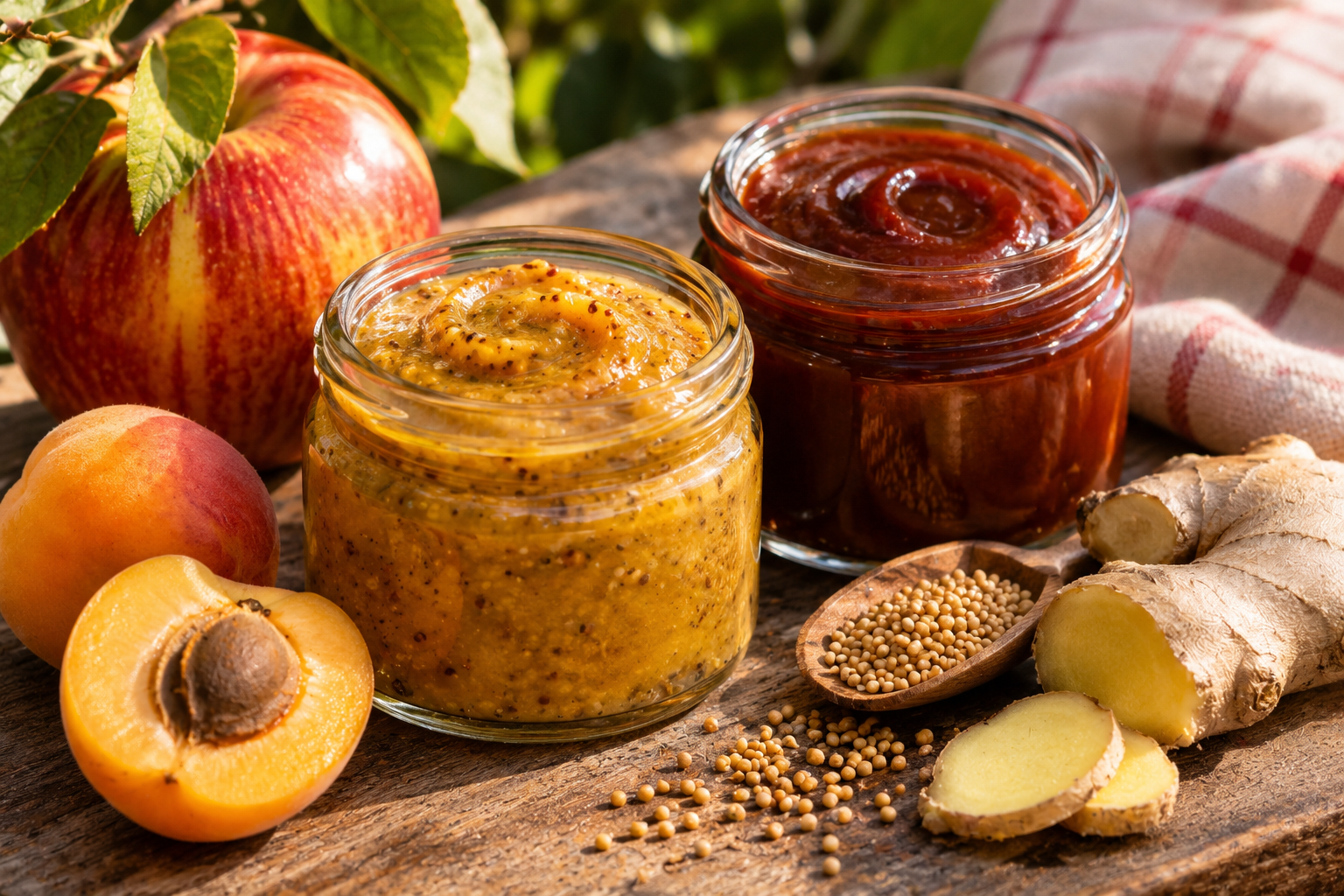
From the baked apples of my childhood to homemade fruit mustard and a Korean-style BBQ sauce, this is how a few ordinary pots of apple, apricot, or mango purée became some of the most useful ingredients in my kitchen.
I have loved apple purée for as long as I can remember.
When I was a child, my mother used to bake apples for me.
Nothing particularly complicated. Just apples in the oven until they became soft, sweet, and almost creamy inside.
I loved eating them like that.
Later, when I was older and living in Ukraine, I continued baking apples myself.
And eventually I discovered that they were useful for considerably more than dessert.
One of my favourite discoveries was apple mustard.
Not mustard served alongside apples.
Mustard actually made with apple purée.
I liked it so much that, given the choice, I often preferred it to ordinary mustard.
The fruit softened the sharpness, added body, and produced a much more interesting balance of sweetness, acidity, and heat.
Then I moved to France.
And discovered that the French had made the whole business of preparing fruit purée almost embarrassingly easy.
The French have already done the hard work
Walk into almost any French supermarket and you'll find shelves filled with little pots of fruit purée.
Compote de pommes.
Apple compote.
Except that the versions I usually buy are smooth purées, without large pieces of fruit.
They come in small plastic pots, rather like yoghurt.
And the French seem perfectly happy to eat them at almost any age.
Children eat them.
Adults eat them.
They're sold in multipacks.
Some are plain apple. Others combine apples with different fruits. There are also apricot, mango, pear, and various other versions.
For someone who grew up baking apples to make purée, this was a rather convenient discovery.
The apples had already been cooked.
The purée had already been made.
All I had to do was open a pot.
Naturally, I began putting it into things.
Not just desserts.
Marinades.
Sauces.
Mustard.
And quite a few dishes where fruit purée would not be the first ingredient most people would think of.
The important thing is to choose the right product.
For savoury cooking, I generally prefer unsweetened fruit purée, ideally with no added flavourings.
You can always add sugar later.
Removing it is considerably more difficult.
Fruit purée is more useful than it looks
There are several reasons I like using fruit purée in savoury cooking.
First, it provides body.
A spoonful of smooth apple purée can make a sauce thicker and more cohesive without requiring flour or starch.
Second, it adds sweetness.
Not the blunt sweetness of adding a large quantity of sugar, but something integrated into the fruit's own flavour.
Third, it contributes acidity, depending on the fruit.
And finally, it brings its own aroma.
Apple works particularly well when you want something relatively restrained.
Apricot is more expressive.
Mango can create a richer, more tropical profile.
These differences make fruit purées surprisingly versatile.
I often add apple or apricot purée to meat marinades, particularly for game.
Venison, wild boar, and other strongly flavoured meats can work beautifully with fruit.
The purée adds a little sweetness and acidity, helps the marinade cling to the meat, and contributes flavour that works with the meat's own character.
I wouldn't claim that fruit purée magically tenderises everything. The result depends on the meat, acidity, time, and cooking method.
But as a flavour component, it can be excellent.
And then there are the desserts.
The forty-minute apple tart
One of the simplest things I make with these little pots is a quick apple tart.
In France, this is almost ridiculously easy because ready-made refrigerated pastry is everywhere.
I usually buy puff pastry.
It comes rolled up in baking parchment, often as a circular sheet.
I unroll it directly onto a baking tray, keeping the parchment underneath.
Then I fold and pinch the edges slightly inward to create a shallow border.
I prick the centre with a fork.
Open a couple of small pots of apple purée.
Spread the purée over the pastry, rather like spreading tomato sauce over a pizza.
Then I take a couple of fresh apples, remove the cores, and slice them thinly.
I arrange the slices in overlapping circles, working from the outside toward the centre.
A little brown cane sugar goes over the top.
Not much.
Just enough to encourage a light glaze and some caramelisation.
Then into a preheated oven at around 200–215°C.
Depending on the pastry, the thickness of the apples, and the oven, it usually takes roughly 35–40 minutes.
The result is a thin, juicy apple tart.
The purée creates a soft fruit layer underneath.
The fresh apple slices cook on top.
The sugar gives them a little colour.
And the puff pastry provides the crisp base and edges.
For such a simple dessert, it's remarkably satisfying.
One practical detail: don't use so much purée that the pastry becomes waterlogged. A thin, even layer is enough, and the tart should be baked until the base is properly cooked.
But the tart isn't really what I wanted to write about today.
The two recipes I return to most often are savoury sauces.
And both begin with exactly the same unremarkable little pots of fruit purée.
1. My Apple Mustard, Which Also Works Beautifully with Apricot
I started making this mustard in Ukraine, using apples that I baked myself.
These days, I usually use ready-made purée.
The principle is simple.
Mustard powder provides the heat.
Fruit purée provides body, sweetness, and flavour.
Vinegar provides acidity.
And a few spices bring everything together.
The result is less aggressive than a straightforward mustard paste, but still distinctly mustard.
It works particularly well with meat, sausages, roast pork, game, and cold cuts.
And depending on the fruit and spices, it can take on quite different personalities.
Ingredients
For a generous small jar:
- 50 g mustard powder
- Approximately 200–250 g unsweetened apple purée, usually two small pots
- 2–4 tablespoons apple juice or cooled black tea
- 2–3 tablespoons cider vinegar, preferably around 5% acidity
- 1–2 teaspoons brown cane sugar, optional
- 2 pinches of salt
Optional spices, to taste:
- Ground coriander
- A little freshly grated nutmeg
- Ground ginger
- A pinch of cinnamon
- A little curry powder
You can replace the apple purée with apricot purée.
And you can replace the cider vinegar with a suitable balsamic vinegar.
Both variations work well, although they produce noticeably different results.
If you're starting with fresh apples
Choose two or three apples.
I prefer varieties with some acidity rather than very sweet dessert apples.
Cut and core them, then bake at around 180–200°C until soft, usually about 30 minutes, depending on their size.
Let them cool.
Remove any tough skin if necessary, and blend the flesh into a smooth purée.
That's your base.
But if you have a couple of ready-made pots in the fridge, you can skip the entire process.
Which is one of the reasons I like this recipe.
Making the mustard
Step 1: Wake up the mustard powder
Put 50 g of mustard powder in a bowl.
Add two tablespoons of apple juice or cooled black tea.
Mix thoroughly.
You want the powder to become evenly hydrated, forming a thick paste.
If necessary, add a little more liquid.
Let it stand for about an hour.
This is not fermentation.
The water activates reactions involving compounds in the mustard that help develop its characteristic pungency.
The result depends on the type of mustard powder, temperature, and other ingredients.
I prefer to let that initial flavour develop before adding the vinegar.
Step 2: Add the fruit
Stir in the apple purée.
Start with around 200 g and adjust according to the consistency you prefer.
You want something spreadable.
Not a drink.
Not a solid paste.
A thick, smooth mustard.
Step 3: Add vinegar and seasoning
Add the cider vinegar, salt, and any sugar you think is necessary.
Then add your spices.
I particularly like coriander and nutmeg.
Ground ginger is also excellent, especially with apple or apricot.
Cinnamon can work, but I use it sparingly.
Too much and the mustard starts drifting toward apple pie.
Which is not necessarily a disaster, but it is a different project.
Sometimes I add a little curry powder.
That produces a warmer, more aromatic mustard.
Step 4: Adjust the consistency
Mix everything thoroughly.
Taste.
If it is too thick, add a little apple juice or tea.
If it is too sharp, a little more fruit purée may help.
If the fruit is particularly acidic, a small amount of brown sugar can round things out.
I sometimes add no sugar at all.
Other times, one or two teaspoons make the balance better.
It depends on the fruit.
Step 5: Leave it alone
This is the part I consider essential.
Don't judge the mustard immediately.
Put it in a clean container, cover it, and refrigerate it.
Leave it for about three days.
The flavour changes as the ingredients sit together.
The initial sharpness becomes more integrated.
The fruit, mustard, acidity, and spices begin tasting like one sauce rather than several ingredients competing for attention.
After three days, I find it considerably more enjoyable.
Apple or apricot?
Both are excellent.
Apple produces a more familiar, restrained mustard.
Apricot is fruitier and often a little more aromatic.
I particularly like apricot mustard with roast pork or game.
Apple is perhaps more versatile.
But I wouldn't insist on one being better.
They are different sauces built on the same idea.
And once you understand the proportions, you can adjust them almost indefinitely.
A note on storage
This is a fresh homemade mustard, not a commercially preserved product.
Although vinegar and mustard contribute acidity and antimicrobial compounds, the finished acidity depends on the fruit purée, dilution, and proportions.
I don't treat the recipe as shelf-stable.
I refrigerate it promptly in a clean, covered jar and make relatively small batches.
For a cautious home-kitchen approach, use it within about 3–4 days unless you're following a tested preservation recipe. You can also freeze portions.
I have personally kept versions longer, but that isn't the same as having validated their safety for two weeks.
2. My Fruit-Based Korean-Style BBQ Sauce
The second sauce is a more recent addition to my kitchen.
And it has become one of my favourites.
It's inspired by Korean barbecue sauces, although I don't pretend it's a traditional Korean recipe.
I use fruit purée as the base.
Apple works.
Apricot works.
Mango works too.
Then I add soy sauce, garlic, ginger, sesame oil, vinegar, sugar, and something spicy.
The result is rich, savoury, slightly sweet, and full of flavour.
It works as a glaze, a dipping sauce, or a component of a marinade.
And it is surprisingly quick to make.
Ingredients
For a small batch:
- 1 small pot of unsweetened fruit purée, approximately 100–125 g
- 4–5 tablespoons good soy sauce
- 3–4 tablespoons water or appropriately diluted dashi
- 2 tablespoons brown cane sugar
- 1 tablespoon toasted sesame oil
- 3–4 garlic cloves, crushed
- A 2–3 cm piece of fresh ginger, finely grated
- 2 tablespoons rice vinegar or cider vinegar
- Approximately 2 teaspoons gochujang or sriracha, adjusted to taste
- 1 teaspoon black sesame seeds, preferably lightly toasted
- Freshly ground black and white pepper
Optional additions:
- A little finely chopped fresh chilli
- A couple of pinches of smoked paprika
The smoked paprika is not traditional, but it adds a pleasant hint of smokiness.
And sometimes that's exactly what I want.
The dashi question
I often use a Japanese stock concentrate instead of plain water.
The name you may be looking for is dashi, or sometimes shiro dashi when sold as a seasoned concentrate.
Dashi is widely used in Japanese cooking, including as a base for miso soup.
It adds umami and depth.
Depending on the product, it may contain kombu, bonito, soy sauce, salt, and other seasonings.
This is why I don't automatically add extra salt to the sauce.
Between the soy sauce and the dashi, there's usually plenty.
One important detail: commercial dashi concentrates vary enormously in strength.
If the label says to dilute it, follow that guidance.
Three or four tablespoons of undiluted concentrate could make the sauce far too salty.
The aim is to add savoury depth, not create a liquid salt mine.
Plain water works perfectly well too.
Making the BBQ sauce
Step 1: Prepare everything
Crush the garlic.
Finely grate the fresh ginger.
Measure the soy sauce, fruit purée, sugar, sesame oil, and liquid.
If you're using fresh chilli, chop it finely.
This sauce cooks quickly, so it's easier to have everything ready.
Step 2: Combine the base
In a small saucepan, combine:
- Fruit purée
- Soy sauce
- Water or diluted dashi
- Brown sugar
- Sesame oil
- Garlic
- Ginger
- Gochujang or sriracha
- Any additional chilli or smoked paprika
Stir thoroughly.
The mixture should be fairly fluid at this stage.
Don't worry.
It will thicken.
Step 3: Simmer
Place the saucepan over medium-low heat.
Bring the mixture to a gentle simmer.
Cook for approximately 7–10 minutes, stirring regularly.
The sauce should reduce slightly and become more cohesive.
The garlic and ginger will soften.
The fruit will blend into the savoury ingredients.
The sugar will help round out the flavour.
You don't need to boil it aggressively.
A gentle simmer is enough.
Step 4: Finish with vinegar
Remove the saucepan from the heat.
Let the sauce cool slightly.
Then stir in the rice vinegar or cider vinegar.
I prefer adding it toward the end because it preserves a brighter acidic note.
Taste and adjust.
More vinegar if it needs brightness.
A little water if it is too concentrated.
More chilli if you want additional heat.
And perhaps a little extra fruit purée if the soy sauce has become too dominant.
Step 5: Add the sesame
Toast the black sesame seeds lightly if they aren't already toasted.
Stir them into the sauce.
Add a little freshly ground black and white pepper.
And that's it.
You have a glossy, aromatic, sweet-savoury BBQ sauce.
Which fruit works best?
I started with apple.
It is a natural fit.
Apple adds body and sweetness without dominating the soy, garlic, and ginger.
Apricot produces a slightly brighter and more distinctive fruit character.
I particularly like it with pork and strongly flavoured meats.
Mango creates a richer, sweeter, more tropical variation.
It works especially well when I want a sauce with more pronounced fruit flavour.
All three are worth trying.
The basic formula stays the same.
Only the balance changes.
What I use it for
This sauce is particularly good with grilled or roasted meat.
Chicken.
Pork.
Beef.
Game.
It can also work with roasted vegetables or tofu.
For a glaze, I brush it onto the food toward the end of cooking so the sugar doesn't burn.
For a marinade, I may thin it slightly with water or dashi.
And for a dipping sauce, I leave it a little thicker.
If it is used with raw meat, I keep the marinade separate from any sauce intended for serving. Used marinade should not be served without adequate cooking.
The same sauce can therefore serve several purposes.
Which is exactly what I like about it.
One simple base.
Different applications.
Very little effort.
Storage
Because this sauce contains fresh garlic, ginger, fruit purée, and other ingredients, I treat it as a perishable cooked sauce.
After cooking, I cool it promptly and refrigerate it in a clean, covered container.
For ordinary home use, I aim to finish it within 3–4 days.
If I make more than I need, I freeze small portions.
The vinegar and soy sauce add acidity and salt, but they do not automatically make the mixture safe for weeks of storage.
The Smallest Ingredient Can Change the Whole Recipe
What I like most about these two sauces is how little effort they require.
Neither involves complicated equipment.
Neither needs rare ingredients.
And the most important component is something that costs very little and sits on an ordinary supermarket shelf.
A little pot of fruit purée.
That's it.
I started with baked apples because my mother made them when I was a child.
Then I discovered that those apples could become mustard.
Later, in France, I discovered that I didn't even need to bake them.
And now I regularly use the same basic ingredient in marinades, tarts, mustard, and BBQ sauces.
There is something satisfying about that progression.
A childhood dessert becomes a cooking technique.
A supermarket convenience product becomes an ingredient for experimentation.
And a sauce that once required baking, cooling, and blending apples can now begin by opening two small plastic pots.
Of course, making purée from fresh fruit is still perfectly worthwhile.
Sometimes I want to control the flavour.
Sometimes I have apples that need using.
And sometimes I simply enjoy the smell of baked apples.
But I don't believe every homemade recipe has to begin with unnecessary work.
If somebody has already cooked and blended perfectly good fruit, I'm quite happy to take advantage of it.
The important part is what happens next.
Apple mustard with ginger and coriander.
Apricot mustard with nutmeg.
Mango BBQ sauce with garlic, sesame, and chilli.
A quick apple tart with puff pastry.
A marinade for game.
All from essentially the same idea.
Fruit doesn't have to remain in the dessert department.
And a purée doesn't have to be something you eat with a spoon.
Sometimes it is simply the easiest way to add sweetness, acidity, body, and flavour to something savoury.
Which brings me back to the little pots in the French supermarket.
I used to see them as a convenient replacement for the baked apples I loved as a child.
Now I see them as something else.
A very useful shortcut.
And an invitation to experiment.
After all, if a pot of apple purée can become a good mustard, and a pot of mango purée can become a rather excellent BBQ sauce, there's probably no reason to stop there.
Although I should perhaps finish the sauces already in my fridge before inventing another one.
Food safety
If a marinade has touched raw meat or poultry, bring it to a boil before using it as a sauce. USDA: Can you reuse meat marinade?