
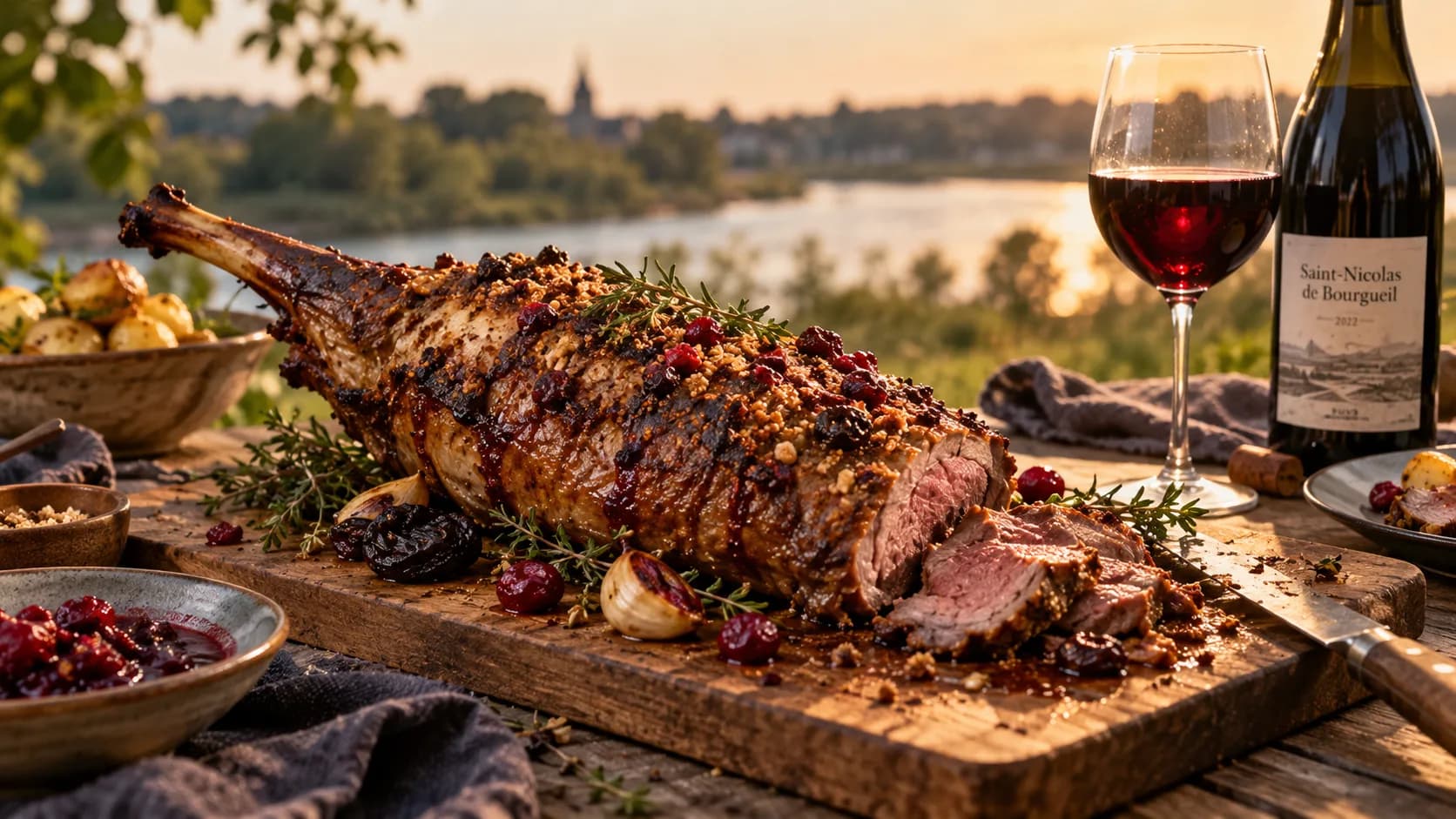
An unexpected exchange of gifts in a small French town, a rather unusual peanut butter and cranberry marinade, and a memorable dinner on the banks of the Loire.
Some of my favourite cooking experiences begin with a carefully selected ingredient.
Others begin with a recipe I've been thinking about for weeks.
And occasionally, dinner begins because somebody gives somebody else a sausage.
This is one of those stories.
My friend Igor and the sausage business
Some time ago, my friend Igor Shchukin came to visit me in France.
Igor is a Ukrainian businessman and the owner of Savin Product, a small sausage producer.
But sausage production wasn't originally his main business.
For years, he'd been involved in supplying the sausage industry with spices, casings and various other materials required to manufacture processed meat products.
He knew the industry from the inside.
Including some of the less appetising details of what can end up inside certain industrial sausages.
And there was a small problem.
He liked sausage.
He wanted to eat good sausage himself. He wanted his children to eat it. And he wanted to be able to offer it to friends without having to explain half the ingredients.
So, together with a friend, he started a tiny sausage production business of his own.
Initially, the emphasis was on good-quality products, including sausages suitable for children.
The business eventually grew, although it remained relatively small.
I've worked with Igor professionally too. He wasn't just a friend but also a client, and there's a separate business story about that relationship.
But today we're not discussing business.
We're discussing what happens when a sausage manufacturer comes to visit.
Naturally, Igor brought gifts.
Including some of his own sausages.
A Chinese tobacconist, a Georgian spirit, and a Ukrainian sausage
At the time, I was living in Thouaré-sur-Loire, a small town just outside Nantes.
I lived right in the centre.
It's the sort of place where an evening walk can easily turn into a conversation with somebody you know.
And that's exactly what happened.
Igor and I went out for a stroll and ran into my acquaintance Victor, a Chinese man who owned the tobacconist's in the town centre.
We stopped to chat.
At some point, I suggested to Igor that it might be nice to give Victor a little present.
Igor's car was parked about ten metres away.
He disappeared for a moment.
And returned with two things.
A bottle of rather expensive Georgian chacha, the grape-based spirit.
And a stick of his own Ukrainian sausage.
Victor was delighted.
We chatted a little longer and eventually went our separate ways.
A perfectly ordinary evening.
Or so I thought.
The next day, Victor had a present for us
The following day, Igor and I were walking through the same part of town.
Victor pulled up in his car.
He had something for us.
Apparently, a hunter friend of his had shot a roe deer that day.
A substantial amount of meat had come Victor's way, and he wanted to share some of it.
Specifically, he offered us a hind leg.
A whole roe deer hind leg.
Which is a fairly impressive return on a bottle of chacha and a sausage.
I knew Victor was aware of my enthusiasm for cooking.
Still, there's something wonderfully unexpected about going for a walk and returning home carrying part of a wild animal.
But I wasn't complaining.
Fresh roe deer.
Beautiful meat.
And a rather interesting culinary challenge.
What on earth do you do with a roe deer leg?
We brought the meat home.
It was very fresh, and I allowed a couple of days before preparing it, then started thinking about what to do.
I wanted to cook the leg whole.
Not cut it into steaks.
Not turn it into a stew.
I wanted a proper roast, but without drying out the meat.
And I didn't particularly want to follow the conventional red-wine-and-juniper route.
I started considering what might work with venison.
Something rich.
Something acidic.
A little sweetness.
Something that would form an interesting crust during roasting.
And eventually, I arrived at a combination that might sound rather strange.
Peanut butter and cranberries.
Yes.
Peanut butter.
The stuff people usually spread on toast.
Or eat directly from the jar while pretending they're only checking whether it's still good.
The peanut butter experiment
First, I took a narrow, sharp knife and made small incisions in the leg.
Into these went pieces of garlic and herbs.
I wanted the flavour to penetrate beyond the surface rather than simply coat the outside.
Then came the marinade.
Or perhaps coating is a better word.
I took peanut butter and mixed it with cranberries mashed with sugar.
Not ordinary jam.
Something more tart, more fruit-forward, with a noticeable acidic edge.
Then I started adding spices.
Dried ginger.
White pepper.
Green pepper.
A little clove.
Some classic bouquet garni herbs.
A bit more garlic.
And whatever else seemed appropriate at the time.
I wasn't following a meticulously calibrated formula.
I was building a flavour combination.
The peanut butter provided fat, richness and a thick coating.
The cranberries brought acidity and sweetness.
The spices added warmth and complexity.
And the whole thing turned into a dense, aromatic paste.
I rubbed it thoroughly all over the venison leg, covering the meat in a substantial layer.
Then I left it in the refrigerator until the following day.
The result looked rather promising.
Although admittedly it didn't look like anything you'd expect to see in a traditional French game cookbook.
Five hours in the oven
The next stage was straightforward.
I wrapped the marinated leg in a couple of layers of baking parchment.
Then several layers of aluminium foil.
The idea was to keep the meat enclosed during the long, slow cooking process.
Into the oven it went.
Low temperature.
Somewhere around 130–150°C, as I recall.
And I left it there for approximately five hours.
No constant turning.
No elaborate basting ritual.
No standing beside the oven anxiously opening the door every twelve minutes.
Just slow cooking.
After five hours, I carefully opened the foil and parchment.
The meat was cooked, tender and coated in its aromatic peanut-and-cranberry mixture.
But I wanted one more thing.
A crust.
So I opened the wrapping completely, increased the oven temperature to approximately 190°C and switched on the convection grill.
The surface began to brown.
And this was where the peanut butter really showed its value.
The coating developed a beautiful roasted colour.
The sugars and the peanut solids contributed to that golden-brown exterior.
The meat underneath remained tender.
And the whole thing smelled absolutely wonderful.
A roe deer on the banks of the Loire
Then came the most important part.
Eating it.
We took the cooked venison down to the banks of the Loire.
Igor was visiting France, and he wanted to experience as much local food and wine as possible.
So we'd chosen a Loire Valley red wine.
A Saint-Nicolas-de-Bourgueil.
A relatively light, pleasant red, exactly the sort of wine I enjoy with an outdoor meal.
And there we were.
By the river.
With a whole roasted roe deer leg.
A bottle of local wine.
And a meal that had begun with a completely accidental exchange of presents in the town centre.
The venison was extraordinarily tender.
The peanut butter hadn't turned it into something resembling a peanut butter sandwich, which I suppose was a legitimate concern.
Instead, it had become part of a rich, aromatic coating.
The tart cranberries balanced the richness.
The ginger and pepper worked beautifully with the game.
And the slow cooking had done its job.
I was delighted.
Igor was delighted.
The Loire was doing what rivers generally do, which is flowing past without expressing any particular opinion about the menu.
An excellent evening.
Then Victor gave us another piece
You'd think that would be the end of the story.
But no.
A day or so later, we ran into Victor again.
And he had another piece of roe deer for us.
Apparently, the hunter had been rather successful.
Naturally, I decided to repeat the experiment.
The same general method.
The same peanut butter and cranberry coating.
Garlic.
Ginger.
Pepper.
Herbs.
Slow roasting, followed by browning.
But this time, I made one additional change.
Prunes.
I cut small pieces of dried plum and inserted them into the meat along with the garlic and herbs.
And that made the dish even better.
The prunes added another layer of sweetness and fruitiness.
Not overwhelming.
Just enough to complement the cranberries and the natural flavour of the venison.
They softened during cooking and became little pockets of concentrated flavour inside the meat.
I preferred this second version.
And if I were making the dish again, the prunes would definitely stay.
The recipe, reconstructed from memory
This isn't an exact laboratory formula.
I cooked the original by eye, adjusting quantities according to the size of the meat and what I wanted the coating to taste like.
But the basic method is easy to reproduce.
Ingredients
- One properly sourced and prepared roe deer hind leg
- Unsweetened peanut butter
- Cranberries mashed with sugar, preferably tart rather than very sweet
- Several garlic cloves
- Dried ginger
- White and green pepper
- A little ground clove
- Bouquet garni herbs or a similar mixture of aromatic herbs
- Salt, as needed
- Optional but highly recommended: pitted prunes
Preparation
1. Prepare the meat. Trim the leg as appropriate. Make small incisions with a narrow knife and insert slivers of garlic, herbs and, in the second version, pieces of prune.
2. Make the coating. Mix peanut butter with the cranberry preparation. Add ginger, peppers, a very small amount of clove, herbs and garlic. Adjust the balance of sweetness, acidity and seasoning.
3. Coat the leg thoroughly. Rub the mixture all over the meat. Leave it covered in the refrigerator to marinate until the following day.
4. Wrap for slow roasting. Enclose the leg in baking parchment and then several layers of foil.
5. Roast gently. My original leg spent approximately five hours in an oven set somewhere around 130–150°C. For a repeatable recipe, the actual cooking time and safe internal temperature need to be checked for the particular cut and size, rather than relying on five hours as a universal rule.
6. Brown the surface. Open the wrapping, increase the oven to around 190°C and use the convection grill briefly to develop a crust. Watch carefully: the peanut and fruit coating can brown quickly.
7. Rest and serve. Let the roast rest before carving.
A practical point about wild game: proper chilling, hygienic handling and thorough temperature verification matter. I wouldn't recommend treating the original resting and oven times as a guaranteed food-safety procedure for every piece of venison.
The best part wasn't really the recipe
I've cooked plenty of interesting things.
Some with unusual ingredients.
Some using rather unconventional techniques.
And some that should probably never be repeated.
But this particular roe deer stayed in my memory for another reason.
The whole thing was completely unplanned.
A Ukrainian friend came to visit.
We met a Chinese friend in a small French town.
A Georgian spirit and a Ukrainian sausage changed hands.
A French hunter, whom we hadn't even met, became indirectly involved.
And somehow, a roe deer leg ended up covered in peanut butter and cranberries in my oven.
Then we ate it beside the Loire with a bottle of Saint-Nicolas-de-Bourgueil.
There was no grand dinner plan.
No special occasion.
No elaborate preparations.
Just people being generous to one another.
And a little willingness to experiment in the kitchen.
I sometimes think these are the best meals.
Not necessarily the most technically impressive.
Not the most expensive.
And certainly not the most predictable.
But the ones that arrive with their own story.
A bottle of chacha. A stick of sausage. Two pieces of roe deer.
And one of the most memorable dinners I've cooked in France.
Not a bad exchange, really.