
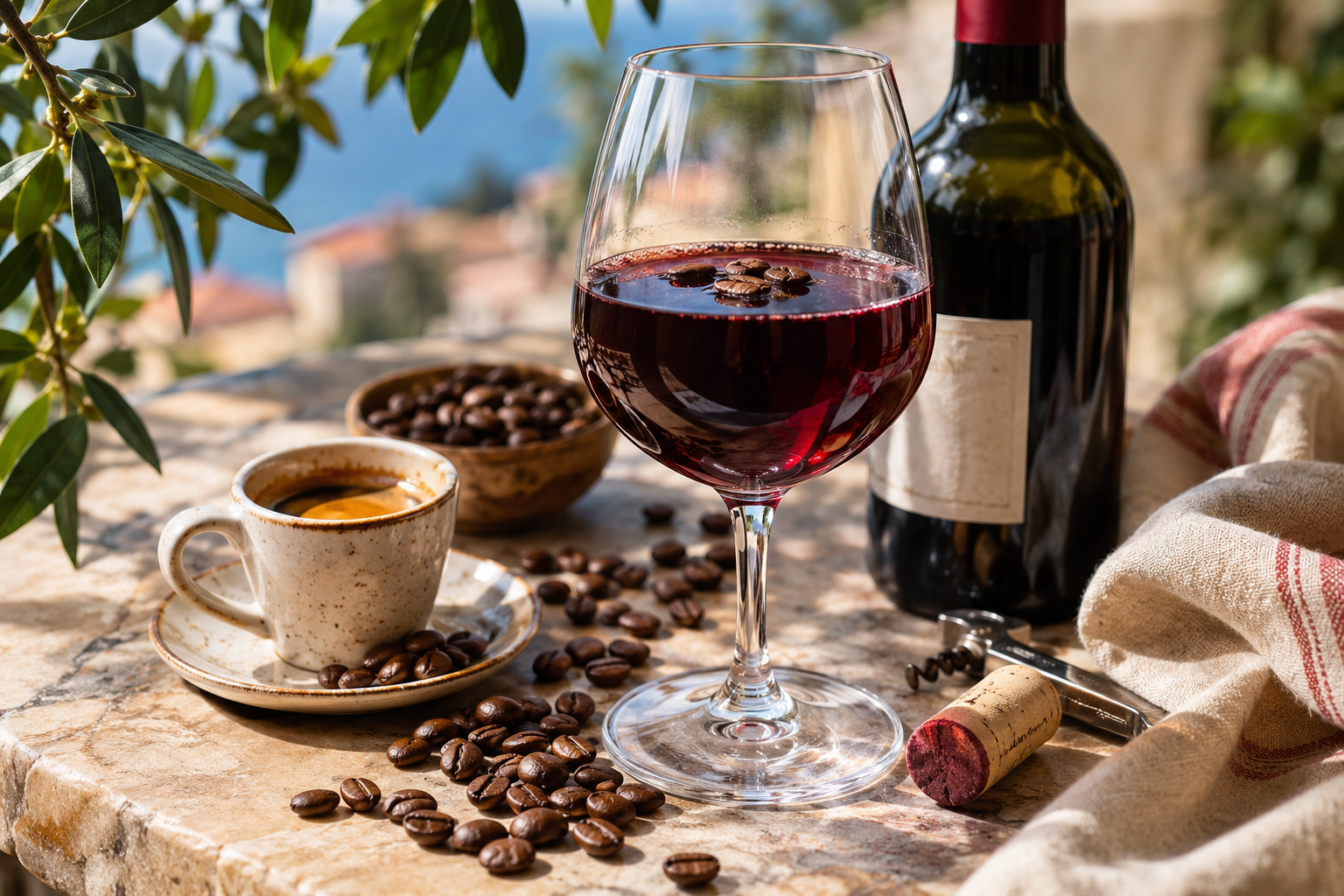
An unexpected whisky cocktail reminded me of a strange canned drink I discovered in Hawaii. That led to coffee-infused Merlot, a Chardonnay experiment, and an attempt to ferment coffee into something resembling beer. Some of these ideas worked remarkably well. One probably didn't deserve a second batch.
A friend dropped by recently with a bottle of perfectly respectable Scotch whisky.
Nothing spectacularly expensive. Just a decent, middle-range Scotch that I already knew and rather liked.
I'd been drinking a dry French red wine that evening. About half a bottle, in fact.
Naturally, I tried the whisky.
It was good.
But something about it made me want to soften the flavour a little.
And since I already had wine in my glass, the obvious solution was to pour some into the whisky.
Well, obvious to me.
I used roughly two parts whisky to one part red wine.
Stirred.
Tasted.
And was rather surprised.
It was excellent.
The whisky retained its character, but the wine rounded off some of the sharper edges. The result felt softer, more balanced, and unusually easy to drink.
Not weaker in any meaningful sense, of course. There's still plenty of alcohol in a glass containing two parts Scotch.
But the flavour was gentler.
I liked it enough to continue drinking that combination through the evening.
And here's the interesting part.
There was a little left over.
The next day, I tasted it again.
Still good.
So it apparently wasn't just one of those late-evening culinary discoveries that seems brilliant after a few glasses of wine and rather less convincing in daylight.
I started wondering whether people regularly mix whisky with ordinary dry wine.
Of course, there are cocktails involving whisky and wine-based ingredients. The Boulevardier uses sweet vermouth, and the New York Sour even includes red wine.
But my combination was much simpler.
No sugar.
No bitters.
No citrus.
Just Scotch and dry red wine.
I'm not claiming to have invented anything. Most combinations involving two alcoholic drinks have probably been attempted by someone, somewhere, at some point in human history.
Still, I liked it.
And it reminded me of another experiment involving a drink that is not usually supposed to contain wine.
Coffee.
Hawaii, pineapple wine, and a strange little can
Years ago, while travelling around the United States, I found myself in Hawaii.
Hawaii is an interesting place for anyone who enjoys trying unfamiliar food and drink.
Among other things, I discovered pineapple wine.
And I don't mean a grape wine with a pineapple aroma.
I mean wine actually made from pineapples.
Some of the examples I tasted were surprisingly good.
A decent dry pineapple wine can have something reminiscent of Sauvignon Blanc, but with a much more pronounced tropical character.
Obviously, the pineapple comes through.
But not necessarily in the sweet, sticky way you might expect.
A good version can be quite elegant.
I remember thinking that in a blind tasting, someone might be surprised to discover what it was made from.
Anyway, I was exploring drinks, as usual, when I encountered something even stranger.
Coffee with white wine.
In a can.
I don't remember the brand now, but I remember the idea very clearly.
Naturally, I bought one.
It was interesting.
Not entirely successful, at least to my taste. There was something in the flavour that reminded me of artificial aromatics, which I didn't particularly enjoy.
But the concept stayed with me.
Coffee.
Wine.
Together.
Why not?
And more importantly, why would you need a factory to make it?
You have coffee.
You have wine.
Surely something can be done with those two ingredients.
First experiment: Merlot instead of water
When I eventually started experimenting at home, I tried different approaches.
One involved filter coffee.
That wasn't particularly successful.
The result seemed too light. The coffee didn't have enough presence, and the combination felt less interesting than I'd hoped.
But then I tried something closer to cold brew.
Except for one fairly substantial modification.
I didn't use water.
I used wine.
I chose a fairly ordinary bottle of dry Merlot.
Nothing aggressively expressive. I wanted a wine with enough body to contribute something, but not such a powerful aromatic character that the coffee would disappear beneath it.
The coffee mattered too.
I used good freshly ground beans, but deliberately avoided anything with particularly pronounced acidity.
Wine already has acidity.
I didn't need the coffee to add an unnecessary amount of it.
The rough proportions were:
- One standard 750 ml bottle of dry Merlot
- Approximately half a glass of freshly ground coffee
- No water, sugar, milk, or other additions
I combined the ground coffee and wine, then left the mixture in the refrigerator for about 24 hours.
Afterward, I filtered it.
Essentially, I had cold-brewed coffee directly in red wine.
And the result was wonderful.
The wine developed a much more intense character.
The coffee was clearly present, but it hadn't simply overwhelmed everything else.
Some of the original wine profile remained.
The coffee brought its own roasted notes, bitterness, and depth.
It was neither ordinary Merlot nor ordinary cold brew.
It was something in between.
A rather unusual drink, but a coherent one.
And that was the part I found most interesting.
It didn't taste like two unrelated liquids that had accidentally ended up in the same glass.
It tasted like they belonged together.
The strange combination of coffee and alcohol
There was another unusual aspect to the drink.
Coffee and wine produce very different subjective effects.
Coffee can make you feel more alert.
Alcohol can produce a feeling of relaxation.
And drinking wine infused with coffee created a strange combination of sensations.
I could perceive the stimulating effect of the coffee alongside the relaxing effect I associated with the wine.
That was part of the novelty.
But it's worth being precise about something.
Caffeine doesn't cancel the effects of alcohol. Feeling more alert does not mean being less impaired.
A coffee-and-wine infusion is not a clever method of drinking while remaining sober, and the caffeine concentration is difficult to estimate without measuring it.
It's an experiment in flavour, not a functional energy drink.
Still, from a sensory perspective, I found the combination fascinating.
The cold infusion had given the wine a completely different personality.
And, unlike the filter version, it was sufficiently concentrated for both ingredients to remain recognisable.
That made me want to try another wine.
Second experiment: Chardonnay and lighter-roasted coffee
The obvious next step was white wine.
I chose Chardonnay.
And since the wine was different, I changed the coffee as well.
This time, I used a lighter roast.
The idea was not to reproduce the Merlot result.
Red wine and white wine have different structures and flavour profiles.
A coffee that works well with one may be completely wrong for the other.
I again preferred the cold-steeping approach.
And once more, the result was good.
Quite different from the red-wine version.
The Merlot combination felt richer and more substantial.
The Chardonnay produced a lighter, different expression of the same basic idea.
It retained more of the character I associate with white wine, while the coffee added an unexpected dimension.
I wouldn't automatically recommend every light roast with every Chardonnay.
A very acidic coffee combined with a particularly sharp white wine could easily become unpleasant.
And a heavily oaked Chardonnay might produce something entirely different.
I didn't systematically test all those possibilities.
I simply found a pairing that worked.
That's an important distinction.
I wasn't developing a commercial recipe.
I was testing whether a rather improbable combination could taste good.
And the answer, in both cases, was yes.
Why cold infusion worked better
Looking back, I think the difference between my experiments came down partly to extraction and balance.
With ordinary filter coffee, the resulting combination felt too light.
With a 24-hour cold infusion, the coffee developed directly inside the wine.
The process gave it time to contribute flavour without requiring a separate finished coffee to be mixed into the drink.
Of course, steeping coffee in wine is not chemically identical to making cold brew in water.
Wine contains alcohol, acids, and many other compounds that can influence what is extracted from the grounds.
So I wouldn't pretend the process is just conventional cold brew with a more entertaining liquid.
But as a practical description, cold-steeped coffee in wine is close enough.
And it worked.
If I were repeating the experiment, I'd pay attention to three things.
First, the wine should have enough character to survive the coffee, but not so much that it completely dominates it.
Second, the coffee should complement the wine's acidity rather than fight it.
And third, the mixture needs enough time to develop.
My successful experiments used approximately 24 hours in the refrigerator.
I'd also use a clean, covered container and filter the finished infusion carefully. It's a refrigerated experiment, not a shelf-stable bottled product.
There are probably dozens of interesting combinations still to try.
Different grape varieties.
Different origins of coffee.
Different roasting profiles.
Different steeping times.
A Pinot Noir might behave very differently from Merlot.
A heavily roasted coffee might dominate a delicate white wine.
And something with pronounced fruity notes might work beautifully with the right grape variety.
Or taste absolutely dreadful.
That's the pleasure of experimenting.
You don't know until you try.
Then I decided coffee should ferment
At some point, another idea occurred to me.
Coffee comes from a fruit.
Coffee beans contain carbohydrates and some sugars.
Microorganisms can ferment sugars.
So could I make a fermented drink from coffee?
Something along the lines of kvass.
Or a very light beer.
But based on coffee rather than the usual grains or bread.
I knew that fermentation plays an important role in coffee processing, but I was curious about a different question: could coffee itself become the base of an interesting finished fermented beverage?
I selected beans that I believed might offer a little more available sugar and tried an experiment.
The result was technically interesting.
Something happened.
The finished liquid was very lightly carbonated.
Barely.
There was no noticeable alcoholic strength, although I didn't measure the alcohol content, so I wouldn't claim it was scientifically alcohol-free.
And the flavour?
Well.
It was a drink.
Just not a particularly interesting one.
The coffee character had become rather weak.
There wasn't enough body.
Not enough of the complexity I'd hoped to develop.
And the tiny amount of carbonation didn't contribute much.
I could drink it.
But I couldn't think of a particularly compelling reason why I should.
It was a slightly disappointing result.
Although not a wasted experiment.
Why fermented coffee didn't impress me
In retrospect, the result makes sense.
The sugars involved in coffee-fruit fermentation are not the same thing as a generous supply of fermentable sugar in an ordinary drink made from roasted beans.
A lot of the easily accessible sugar associated with coffee processing comes from the fruit and mucilage surrounding the seed.
Roasting also changes the chemical composition of the bean.
If you're trying to make a fermented drink from a coffee brew, there may simply not be enough readily fermentable material to create the result you want without adding a separate sugar source.
And, in fact, people do make fermented coffee-based drinks.
Coffee kombucha exists.
There are coffee-based fermentation experiments using added sugar and microbial cultures.
Coffee beer is another category entirely, usually involving coffee alongside a more conventional brewing base.
So my experiment didn't prove that coffee fermentation is impossible.
Far from it.
It demonstrated that my particular approach produced a fairly unremarkable drink.
Which is useful information.
I was trying to discover whether coffee could contribute enough on its own to make the experiment worthwhile.
In my case, not really.
The result lacked the character of the original ingredient.
And if you're going to spend time fermenting something, it would be nice if the finished product offered a reason to exist beyond the fact that fermentation occurred.
Still, I'm glad I tried it.
Not everything has to become a recipe worth repeating.
Sometimes the experiment itself is the interesting part.
Three experiments, two discoveries, and one rather weak drink
Looking back, these experiments have a fairly obvious pattern.
The whisky with red wine worked surprisingly well.
The coffee cold-steeped in red and white wine worked even better than I'd expected.
The fermented coffee was an interesting technical exercise that didn't produce a drink I particularly wanted to make again.
I don't consider that a bad record.
Two genuinely enjoyable discoveries from a handful of unusual ideas.
And one result that taught me something.
What connects them is a habit I've had for years.
I tend to look at familiar ingredients and wonder what would happen if I used them for something other than their intended purpose.
Coffee is supposed to be brewed with water.
Wine is supposed to be drunk as wine.
Whisky has its own traditions.
And coffee beans are generally better known for being roasted and brewed than for being turned into a lightly fizzy fermented beverage.
All perfectly reasonable conventions.
But conventions aren't chemical laws.
Ingredients don't know which category the supermarket has assigned to them.
Coffee is a collection of flavours, aromas, acids, bitter compounds, and other soluble substances.
Wine is another complicated mixture.
Sometimes they clash.
Sometimes they complement one another.
And occasionally, the combination turns out to be much better than either ingredient's reputation would lead you to expect.
I still think the Merlot cold infusion was the most successful of these experiments.
A decent dry red.
Good coffee.
Twenty-four hours in the refrigerator.
Nothing particularly complicated.
Just an entirely different way to experience two familiar drinks.
The Chardonnay version was good enough that I wouldn't hesitate to experiment with it again.
The fermented coffee?
Well, perhaps that one can remain a pleasant memory.
Not every idea deserves a permanent place in the kitchen.
And that's fine.
I don't experiment with food because I expect every experiment to succeed.
I experiment because I want to know what happens.
Sometimes the result becomes a favourite.
Sometimes it becomes an amusing story.
And sometimes you end up with a barely carbonated coffee drink that provides no obvious reason to open a second bottle.
At least now I know.
And if another friend arrives with a bottle of Scotch while I happen to have a glass of red wine nearby, I already know one combination worth revisiting.
Although perhaps next time I'll start with a slightly smaller glass.
Purely in the interests of scientific precision.
More from Kitchen Notes
My Morning Coffee Contains Protein
The Berliner: How My Beer Cocktail Ended Up on a French Bar’s Menu
Sources
The Influence of Maceration and Flavoring on Roasted Coffee