
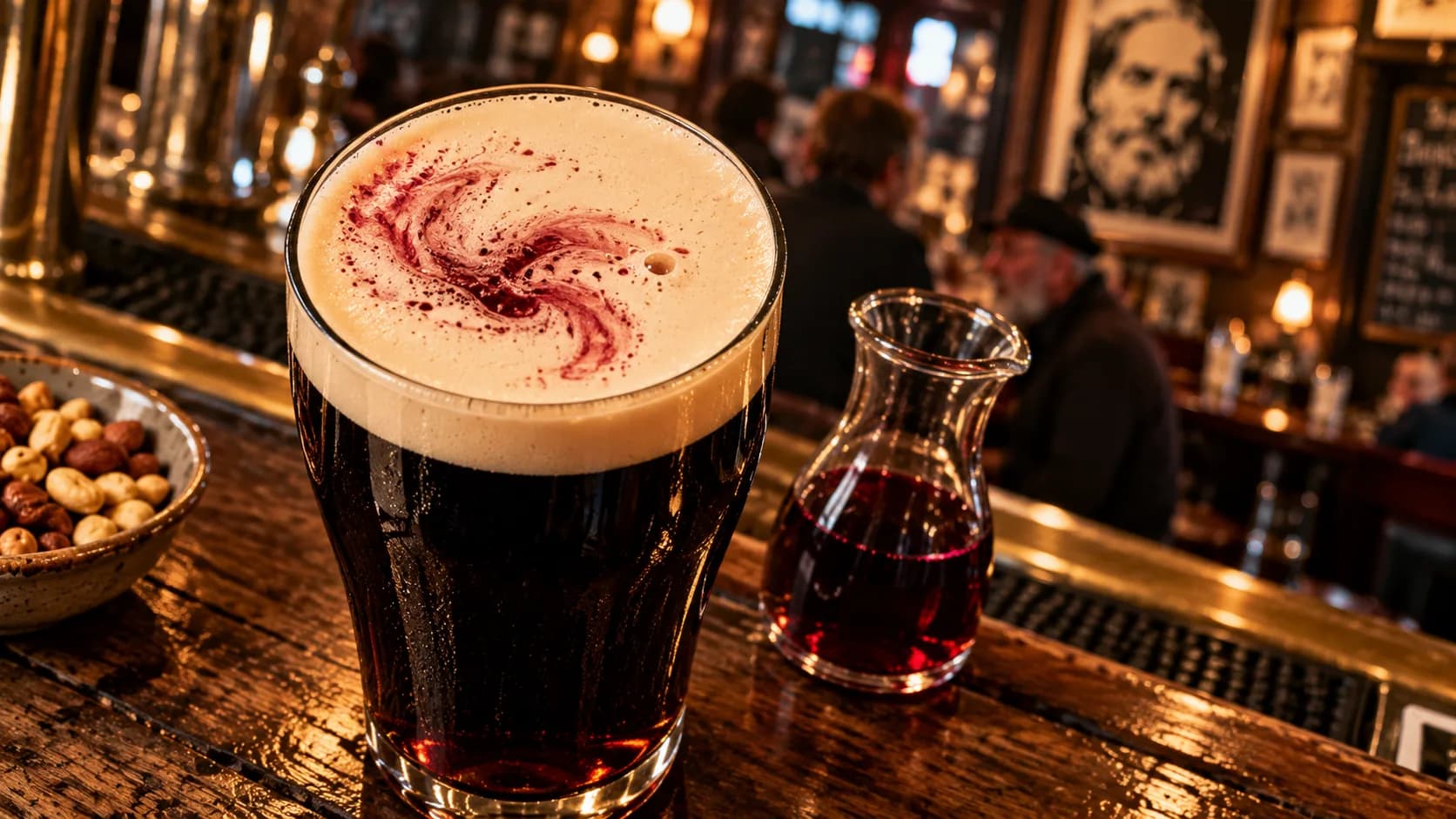
It began with Guinness and port wine in an Irish pub in Berlin. Years later, after several substitutions and a little help from a Chinese tobacconist, it became a regular order in a small bar near Nantes.
For a while, I was something of a local celebrity in a small French bar.
Not a particularly important celebrity, admittedly.
Nobody was requesting autographs or asking me to open supermarkets.
But people knew me for two things.
I drew their portraits.
And I drank something rather unusual.
Eventually, the unusual drink became a permanent item in the bar's cash register.
Which, considering that I hadn't actually invented it, was quite an achievement.
But let's start with the bar.
Two bars, one very small town
I used to live in Thouaré-sur-Loire, a small town just outside Nantes.
Right in the centre.
There were two bars I visited regularly, although for rather different reasons.
One was my favourite place for lunch. It served excellent weekday meals, and I often went there to eat.
The other stood directly beside a tobacconist's shop owned by a Chinese acquaintance of mine called Victor.
Wall to wall.
We called it the sports bar.
Football and other sports on television, betting, beer, the usual collection of people who appear to have been sitting in the same seats for the past twenty years.
France has quite a culture of sports betting.
I don't particularly care for it.
But I do like bars.
Especially small local ones where everybody knows everybody, conversations develop without invitations, and the bartender remembers what you drink.
Since my favourite lunch bar was mainly a weekday destination, I often ended up at the sports bar on weekends.
And that's where I got to know Victor.
The portraits
I'm an artist, and one of the things I can do reasonably well is draw people.
Sometimes with a rather photographic level of detail.
So I began making portraits of the bar's regulars.
Friends.
Acquaintances.
People I saw often enough to recognise their expressions before they even said hello.
Eventually, I drew quite a few of them.
But one portrait became particularly important.
There had been an elderly Corsican gentleman who was a beloved fixture of the bar.
A small, stocky man with an enormous beard.
Something between Santa Claus and a garden gnome.
He had his usual place in a corner at the bar, where he would sit with his drink for much of the day.
He was part of the place.
Then he died.
I drew his portrait.
The bar put a fairly large version on display in a prominent position.
Several of his close friends subsequently asked me to draw portraits for them too.
Which I did.
It was a rather touching experience.
You realise that in a small town, a bar isn't necessarily just somewhere people buy drinks.
It's also a social institution.
And sometimes its regulars become part of its history.
I collected many of these drawings in my Family, Friends, and Thouaré-sur-Loire project on Behance.
But the portraits were only one reason people remembered me.
The other was a drink.
Portraits from the bar
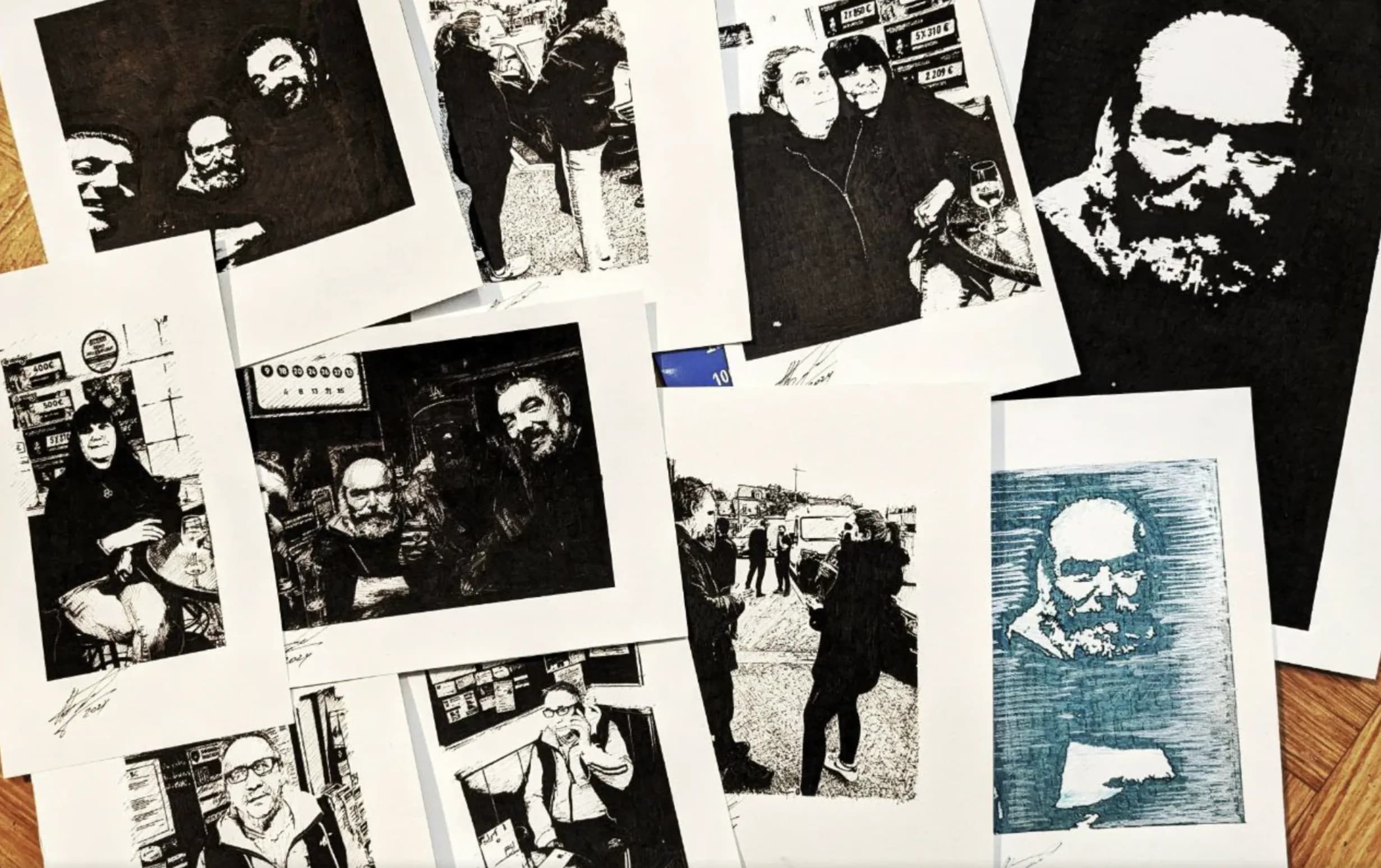
Original portraits of friends and regulars from Thouaré-sur-Loire, by Anton Biletskyi-Volokh.
An Irish pub in Berlin
Some time earlier, my wife and I had been travelling around Berlin.
I like visiting local restaurants and bars when I travel. It's practically compulsory.
But I also have a weakness for Irish pubs.
Irish pubs are an interesting phenomenon.
You can enter one in Berlin, Paris, Kyiv or almost anywhere else, and there's a good chance you'll recognise the furniture, the atmosphere, the beer and half the menu.
They're surprisingly similar around the world.
And yet each country manages to introduce something local.
In France, for example, I've encountered Irish pubs serving œufs mimosa.
Eggs with a mayonnaise-based filling.
A very French addition to the supposedly Irish experience.
And something I happen to love.
In Berlin, however, I discovered something rather more interesting.
A beer cocktail.
Guinness with red port wine.
I can't remember what the pub called it.
But I remember the drink.
A pint of Guinness.
Approximately 50 millilitres of red port.
That's it.
I ordered one.
And thought it was absolutely wonderful.
The dry, slightly bitter character of the stout combined with the sweetness and richness of port wine in a way I hadn't expected.
The alcohol was certainly more noticeable than in an ordinary pint of beer.
But what stayed with me was the flavour.
It was a remarkably good combination.
And I made a mental note to order it again somewhere.
The problem with ordering Guinness in a small French bar
Back in Thouaré-sur-Loire, I decided to reproduce my Berlin discovery.
Unfortunately, there was a small problem.
The bar didn't have Guinness.
In fact, it didn't have a proper dark stout at all.
The darkest beer available was an amber ale.
Now, I could have abandoned the idea.
But that would have been terribly unimaginative.
I asked the bartender whether he had red port.
He did.
Excellent.
Then amber beer and port it would be.
I explained the idea.
He made it.
We tasted it.
And you know what?
Not bad at all.
Different from Guinness, obviously.
The amber beer lacked the roasted bitterness of stout, but the port still contributed sweetness, body and another layer of flavour.
It worked.
I ordered it again on subsequent visits.
And that's how Victor became involved.
Victor wanted to know what I was drinking
Victor, the tobacconist next door, was an extremely sociable fellow.
He knew practically everybody.
One day he noticed my rather unconventional drink.
What was that?
I explained the Berlin story.
Guinness.
Port.
The original cocktail.
And our improvised French version, made with whatever the bar happened to have.
Victor was curious.
He offered to buy me another one.
Then decided he wanted to try it himself.
So we ordered more.
Other people became interested too.
Some liked it.
Some wanted to try different combinations.
And slowly, the drink began acquiring a little following.
Not exactly an international cocktail revolution.
But in a small town, having three or four people regularly order something nobody had heard of before is already an event.
Especially when the bar doesn't actually have the ingredients required to make the original.
Victor’s portrait
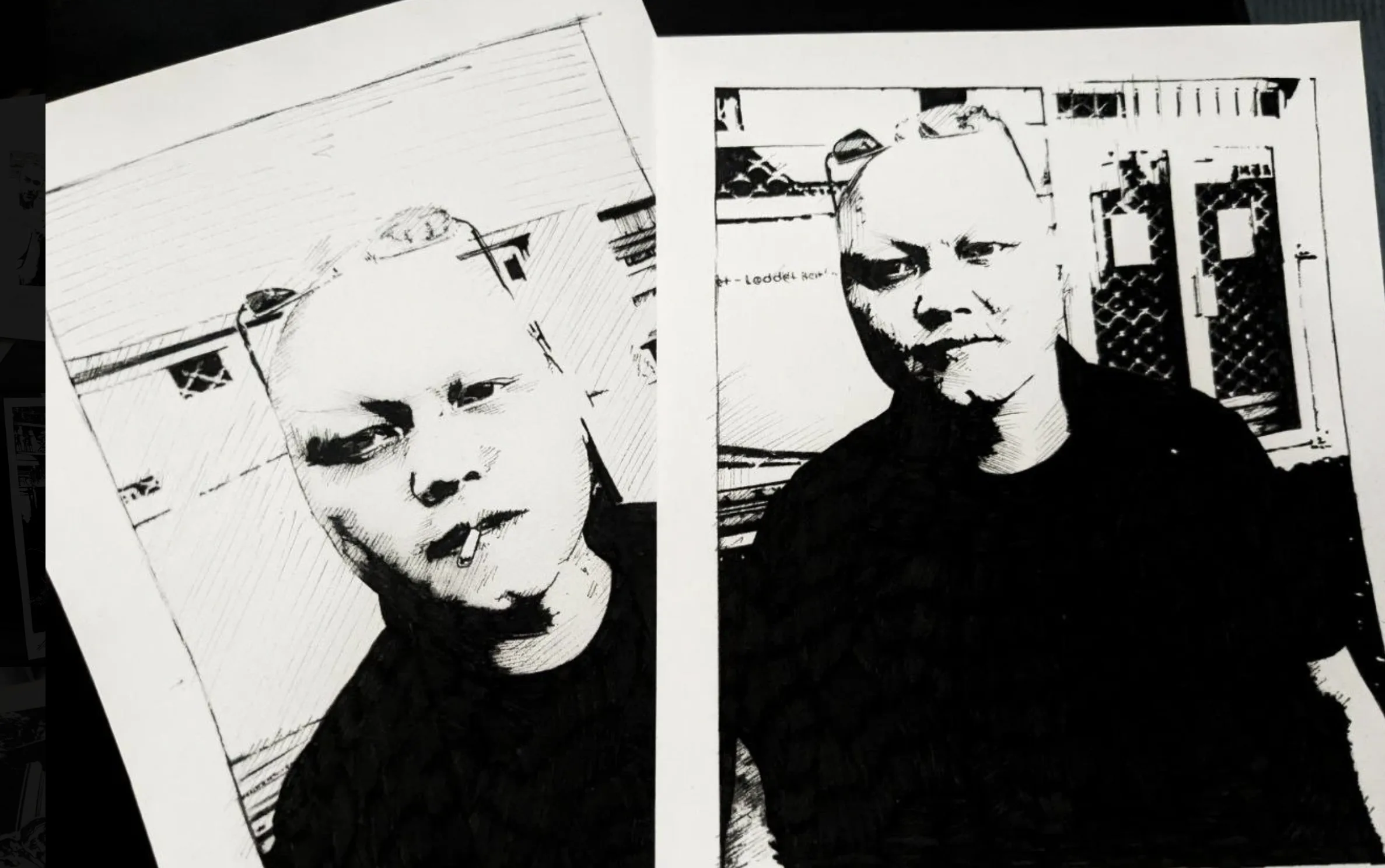
Two original portraits of Victor, the tobacconist in the story, by Anton Biletskyi-Volokh.
The recipe became increasingly theoretical
Here's where things started getting entertaining.
Sometimes there was no port.
"Could we use Martini instead?"
Why not?
Sometimes there was no amber beer.
Only pale lager.
Including Meteor, a French beer.
"Would that work?"
Let's try.
Sometimes there was no port or Martini.
So we'd use another aperitif or bitter that happened to be available.
Not necessarily Aperol.
Just something suitable from behind the bar.
The result wasn't always the same.
Sometimes it was sweeter.
Sometimes more bitter.
Sometimes the beer was darker, sometimes lighter.
But the basic idea survived.
Beer plus a small measure of a stronger, aromatic drink.
Preferably something with enough sweetness or bitterness to make the combination interesting.
It wasn't a carefully standardised cocktail.
It was more like a family of drinks.
United by an increasingly vague memory of a pint of Guinness in Berlin.
And somehow, I kept enjoying the experiments.
The cash register problem
Eventually, the owner approached me with a rather practical concern.
He was also the bartender, so he usually knew what I wanted.
But his wife worked behind the bar too.
And every time somebody ordered my drink while she was working, she had no idea how to charge for it.
There was no such item in the cash register.
So she'd call him over.
He'd work out what had been poured.
Then find some way to enter the order.
Which is an amusing little operational problem if it happens once.
Less amusing when it happens repeatedly.
Finally, he said we needed to give this thing a name.
Something he could enter into the till.
A fixed price.
A recognisable order.
I had spent years working with restaurants and hospitality businesses, so I appreciated the absurdity.
We had somehow developed an actual product without first deciding what the product was.
And now the cash register was demanding a definition.
"What was it called in Berlin?" he asked.
I couldn't remember.
Not a clue.
But I remembered where I'd discovered it.
So I suggested:
"Let's call it the Berliner."
And that was that.
The Berliner was born.
Not in Berlin.
In Thouaré-sur-Loire.
In a sports bar next to a Chinese tobacconist's shop.
And from then on, you could order it by name.
The bartender and the bar
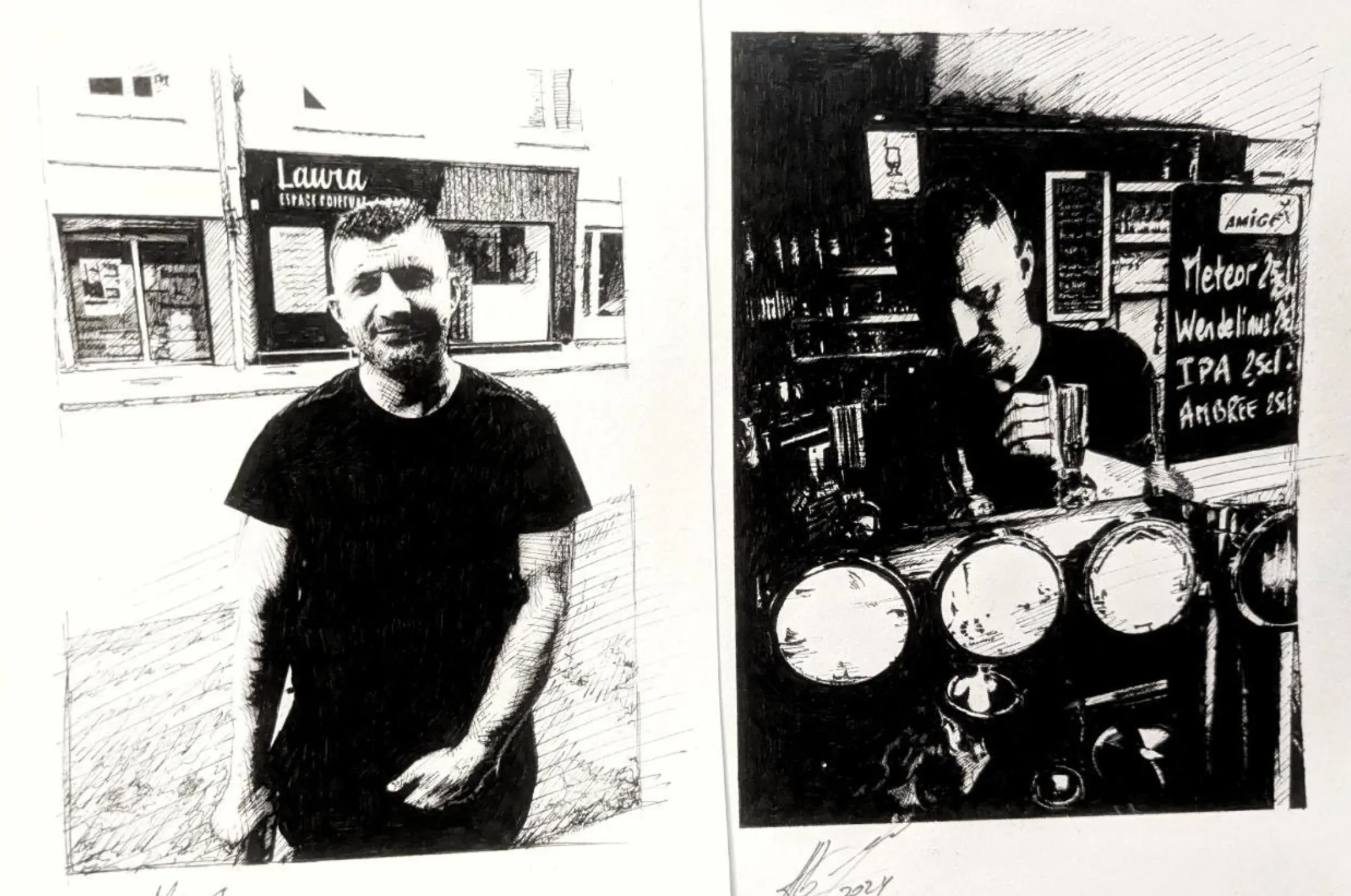
The bartender and the bar in Thouaré-sur-Loire, drawn by Anton Biletskyi-Volokh.
The Berliner, such as it is
If you want to try the drink that started the whole story, the original version is wonderfully simple.
The Berlin inspiration
- One pint of Guinness dry stout
- Approximately 50 ml red port wine
Pour the stout into a pint glass, add the port, and mix gently.
That's the combination I remember enjoying in Berlin.
The Thouaré-sur-Loire version
- A glass of beer, preferably something darker or amber
- A small measure of red port, Martini vermouth or another suitable aromatic aperitif
The bar's version was deliberately flexible.
Amber beer with port became the initial substitute.
Pale lager with port worked too.
Martini produced a different drink again.
And other bitters led to other variations.
I wouldn't claim they're interchangeable in flavour or alcohol content.
They aren't.
But the point was never strict cocktail orthodoxy.
It was finding an enjoyable combination from the ingredients available.
And giving the bartender something he could actually charge for.
A cocktail is also a little piece of local history
What I enjoy most about this story isn't really the drink.
Although I still think Guinness and red port is an excellent combination.
It's how a small, rather ordinary experience became part of the social life of a place.
A trip to Berlin.
An Irish pub.
A remembered flavour.
A French bar without Guinness.
Victor's curiosity.
Other customers joining the experiment.
And finally, a new item appearing in the cash register.
In the meantime, I was drawing portraits of the same people.
The bartender.
Victor.
The regulars.
The old Corsican gentleman whose portrait remained in the bar after he was gone.
Those drawings are records of people and moments.
The cocktail is another kind of record.
You can't hang it on a wall.
Well, you could hang a bottle, but that would be a rather different artistic statement.
Still, it's something that emerged from the people, conversations and circumstances of that particular place.
And I rather like the idea that for a while, in one small French town, you could walk into a sports bar and order a Berliner.
A cocktail that had travelled from an Irish pub in Germany, lost most of its original ingredients, acquired several new ones, and finally found a permanent home in a French cash register.
All because I couldn't remember its real name.
Not bad for a pint of beer with a splash of port.