
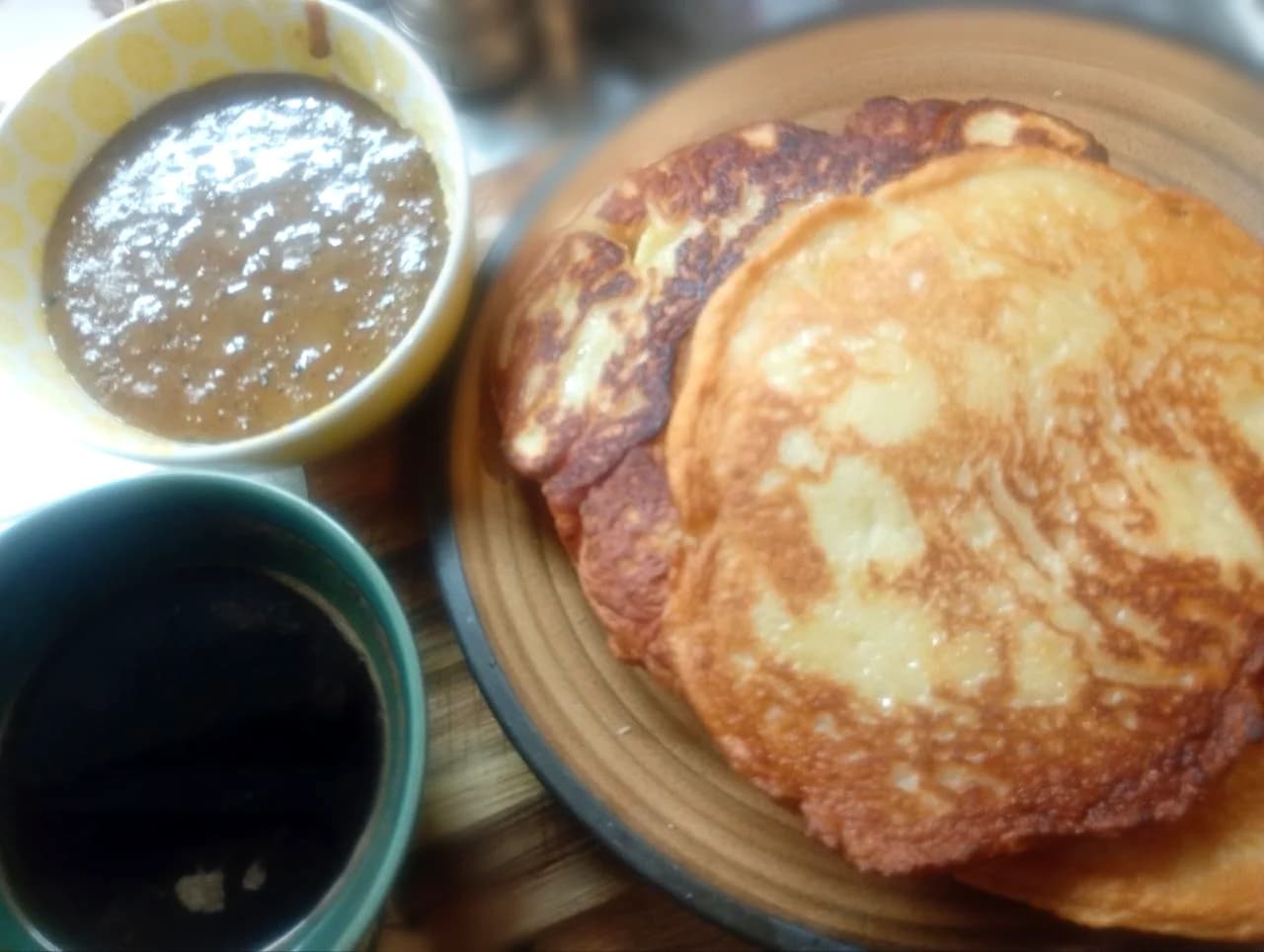
Five litres of Breton yogurt, too much milk, no oven, and an AI recipe that apparently expected me to own an unlimited supply of flour.
I have a small problem with dairy products.
I love them.
Yogurt in particular.
And living in Brittany, or at least close enough to enjoy its dairy products regularly, doesn't help.
Recently, somebody gave me a five-litre bucket of excellent natural Breton yogurt.
Five litres.
That's a lot of yogurt.
Even for me.
I managed to eat somewhere between one and a half and two litres in about a week, which I consider a respectable performance.
But there were still roughly three litres remaining.
And I began to suspect that, unless I developed a more ambitious yogurt consumption strategy, some of it might eventually spoil.
Meanwhile, I had another problem.
There was nothing sweet in the apartment.
I'd been thinking about having something nice with my morning coffee for several days.
And I also had rather too much milk.
About six litres.
At my normal consumption rate of roughly one litre a week, I was well supplied for the foreseeable future.
So I had an idea.
Why not ask AI to suggest something sweet that would use up some yogurt and milk?
A perfectly reasonable request.
What could possibly go wrong?
Cooking in a kitchen that barely exists
I've mentioned before that I'm currently spending quite a lot of my working time in a small serviced apartment.
It has a kitchenette.
And by kitchenette, I mean a cooking space that clearly wasn't designed for somebody who considers making dinner an interesting recreational activity.
There's a hob.
A frying pan.
A microwave.
A few basic utensils.
But no oven.
For another no-oven experiment, see my pan-fried shortbread biscuits.
And my selection of ingredients is rather limited.
No baking soda.
No baking powder.
No yeast.
Plenty of yogurt, though.
And milk.
Also flour, sugar and eggs.
So I opened Gemini.
Yes, Gemini.
I also have a Pro subscription, and occasionally I give ChatGPT the evening off.
I explained the situation.
I wanted something sweet.
Preferably something substantial.
No oven.
No raising agents.
And ideally, something that would consume a respectable amount of yogurt.
Gemini suggested sweet yogurt flatbreads.
Or perhaps pyshki, those thick, doughnut-like fried pieces of dough familiar in Eastern European cooking.
The proposed result would be somewhere between a little bread roll and a doughnut, only flattened to fit into a frying pan.
That sounded promising.
Especially because my frying pan is small enough that a single pancake can occupy practically the entire available cooking surface.
Then I thought about what to eat them with.
Pancakes need something sweet
Ordinarily, I'd use jam.
But the jam was finished.
Which was slightly disappointing.
Then I remembered something.
Condensed milk.
Surely I could make my own?
After all, sweetened condensed milk is essentially milk and sugar with a substantial amount of water removed.
And I had plenty of both.
So I asked Gemini for another recipe.
The answer was encouraging.
Two cups of milk.
About one cup of sugar.
Simmer gently until thickened.
The suggested cooking time was somewhere around forty minutes, depending on the pan and heat.
Excellent.
I'd make condensed milk first.
Then the pancakes.
And by the following morning, I'd have something wonderful with coffee.
That was the plan.
The actual evening developed somewhat differently.
Condensed milk with a completely unnecessary addition
I began with approximately two cups of milk and a little less than one cup of sugar.
My sugar was dark, unrefined cane sugar.
Which meant the milk turned a rather attractive creamy brown as soon as I stirred everything together.
I put the saucepan on the hob.
And while it was heating, I began looking around the kitchenette.
Because plain condensed milk suddenly seemed a little boring.
Then I noticed my matcha.
Oh.
Now that's interesting.
What if I made matcha-flavoured condensed milk?
I had absolutely no reason to do this.
Other than the fact that it sounded delicious.
Which, to be fair, is an excellent reason to do most things in the kitchen.
I took some matcha powder, put it in a bowl and added a little of the hot sweetened milk.
Then I used my matcha whisk to combine everything into a smooth mixture without lumps.
And poured it back into the saucepan.
The colour changed immediately.
My pleasant caramel-coloured milk became something considerably stranger.
A muddy greenish-brown.
Not the bright, cheerful green of a fashionable matcha latte.
More like something recovered from the bottom of a particularly ancient pond.
But it smelled interesting.
And I continued.
Forty minutes, apparently, means ninety
The instructions were fairly straightforward.
Bring everything to a gentle simmer.
Reduce the heat.
Stir regularly.
Allow the water to evaporate.
Wait for the mixture to thicken.
Gemini suggested that this might take about forty minutes.
After forty minutes, I examined my saucepan.
It was still much too liquid.
Sweetened matcha milk, certainly.
Condensed milk?
Not remotely.
So I continued.
And continued.
Occasionally stirring with a wooden spatula.
Watching the colour darken.
Watching the liquid reduce.
Watching the clock.
Eventually, after something closer to an hour and a half, I got what I wanted.
A properly thick, glossy, sweet mixture.
With a wonderfully strange brownish-green colour.
And the flavour?
Excellent.
Rich.
Sweet.
Creamy.
With that distinctive slightly bitter, grassy matcha note balancing the sugar.
I was delighted.
The appearance wasn't going to win any conventional dessert beauty contests.
But the taste more than compensated.
I'd accidentally invented something I was already looking forward to making again.
Now all I needed were the fluffy yogurt doughnuts.
This was where the flour problem began.
How much flour does the dough need? Apparently all of it.
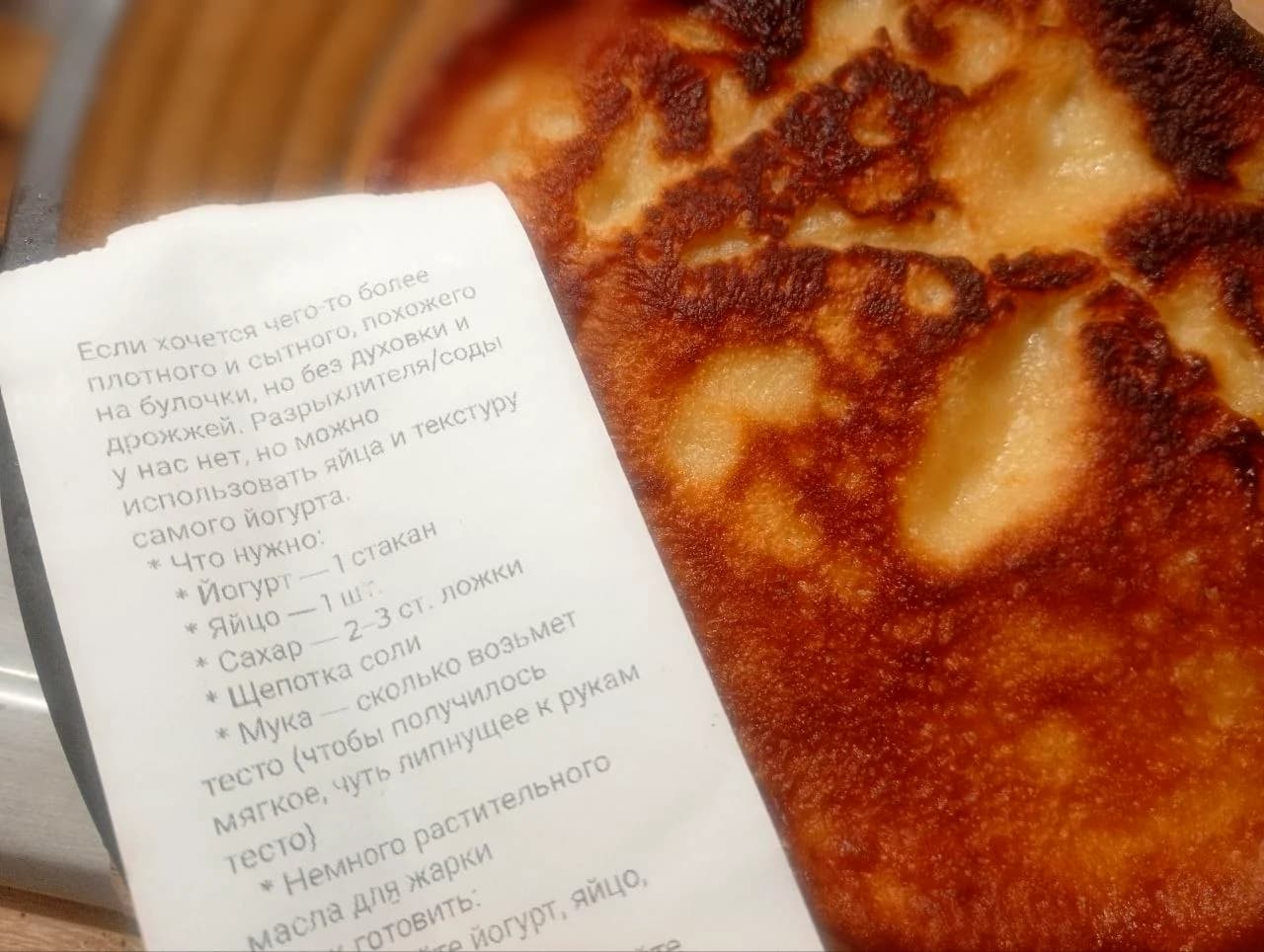
The printed instructions and the actual pancake: the mixture stayed too soft to shape by hand.
For the dough, I used approximately a cup and a half of yogurt, although slightly less in practice.
A cup of warm milk, heated in the microwave.
Two eggs.
Sugar.
A little salt.
Then flour.
The instructions were wonderfully confident.
Add flour gradually until the dough becomes soft, manageable and slightly sticky.
Then take it in your hands, make little balls about the size of mandarins and flatten them.
Lovely.
Except there was one tiny problem.
The dough had absolutely no intention of becoming manageable.
I added flour.
Stirred.
Added more.
Stirred again.
More flour.
Still liquid.
More flour.
Now it was thick.
But not something you'd pick up and roll into a ball.
Unless you wanted to spend the following half-hour removing dough from your fingers.
I continued.
At some point I'd used approximately half a kilogram of flour.
This was becoming ridiculous.
The entire objective had been to use up some yogurt and milk.
Not to sacrifice the national flour reserve.
Eventually, I reached something around 600 grams of flour.
The mixture was thick.
Thicker than ordinary pancake batter.
But still nowhere near the soft, shapeable dough promised by the instructions.
I looked at the flour remaining in the packet.
Perhaps another 100–150 grams.
And decided enough was enough.
No more flour.
If the dough didn't want to become dough, I wasn't going to spend the rest of the evening negotiating with it.
Fine. We'll make pancakes.
I heated the frying pan.
Added a little vegetable oil.
And spooned in some batter.
About two to two and a half generous tablespoons per pancake.
I spread it slightly so it wouldn't be excessively thick.
Covered the pan with a lid.
Waited for the underside to brown.
Then flipped it.
And repeated.
To my surprise, this worked perfectly well.
The pancakes developed a beautiful golden-brown surface.
Some were darker.
Some lighter.
They smelled excellent.
They were substantial.
Very substantial.
But they weren't fluffy.
Not remotely.
Inside, the texture was dense and fairly uniform.
More like thick pancakes than airy doughnuts.
To be fair, there was no yeast, baking powder or baking soda in the mixture. And I'd ended up using a fairly large quantity of flour.
So the absence of miraculous fluffiness shouldn't have been terribly surprising.
Gemini's original idea hadn't quite survived contact with my ingredients, proportions and frying pan.
But I wasn't particularly upset.
Because I'd made something perfectly edible.
Actually, more than edible.
Pretty good.
And then I spread my homemade matcha condensed milk over one.
Well, that worked.
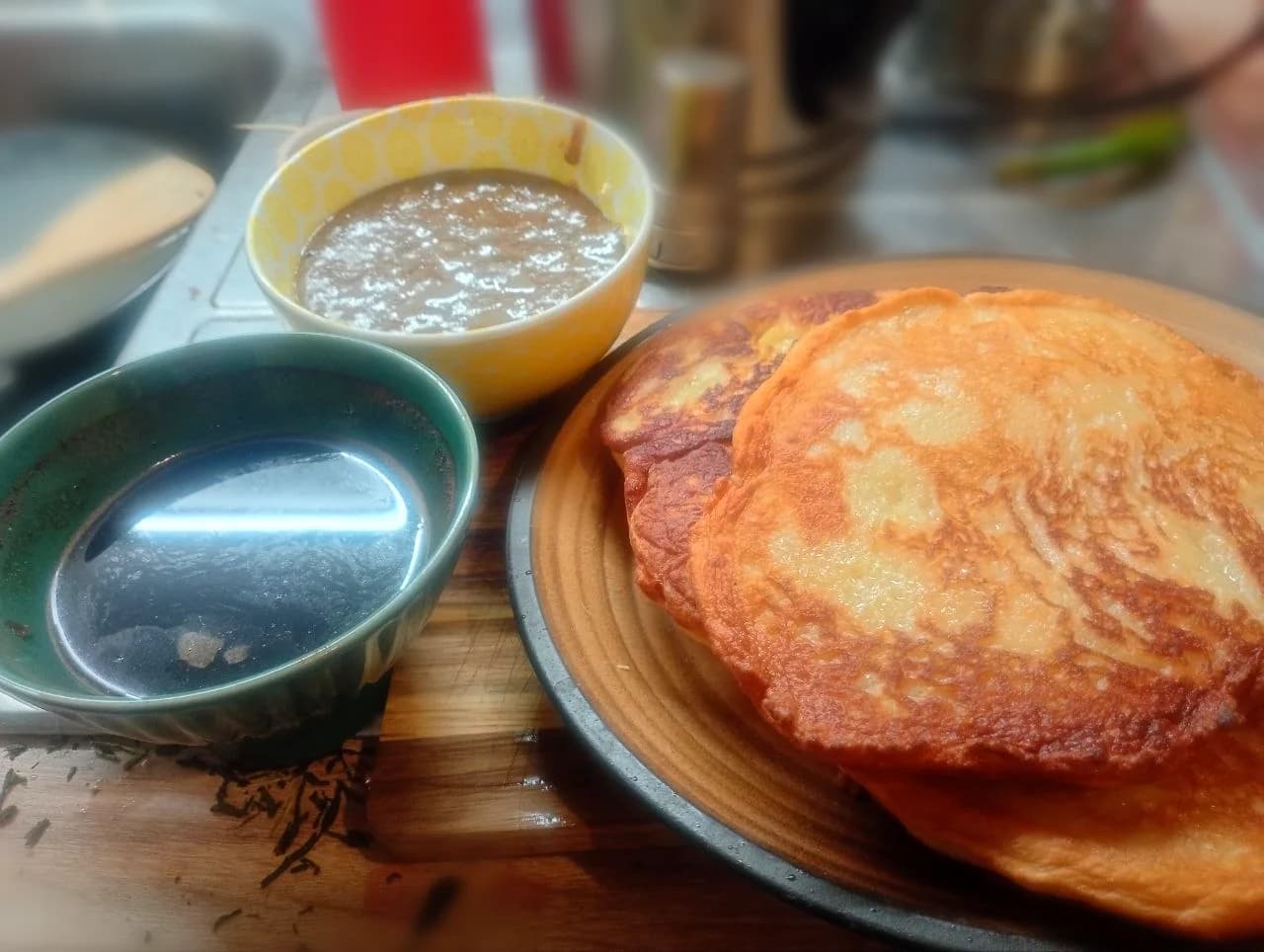
The actual result: dense golden pancakes with homemade matcha condensed milk.
The combination was excellent.
The pancakes were slightly dense and substantial.
The condensed milk was rich, sweet and creamy.
The matcha added an interesting flavour that prevented the whole thing from becoming nothing but sugar.
Together, they made a genuinely satisfying dessert.
Not the dessert we'd originally planned.
But a good one.
And importantly, something I could have with my morning coffee.
Which had been the entire objective from the beginning.
Sometimes I wonder whether half the pleasure of cooking comes from the difference between what you intend to make and what actually appears on the plate.
Especially when you're improvising.
And especially when an AI assistant is involved.
What I actually made
I want to preserve the real proportions here, because there's a considerable difference between the suggested recipe and what happened in my kitchen.
Matcha condensed milk
Ingredients
- About 400–500 ml milk
- Slightly less than one cup of dark cane sugar
- Matcha powder, added to taste
Method
1. Combine the milk and sugar in a saucepan.
2. Heat gently until the sugar dissolves.
3. Mix the matcha separately with a little hot sweetened milk, whisking until smooth.
4. Return the matcha mixture to the saucepan.
5. Simmer uncovered over low heat, stirring regularly, until the liquid reduces and thickens.
6. Allow it to cool; the mixture will thicken further.
Mine took about 90 minutes, not the initially suggested 40.
The final colour was brownish-green, and the flavour was wonderful.
As this is homemade and not commercially sterilised condensed milk, any leftovers belong in the refrigerator.
My accidental yogurt pancakes
Ingredients
- Slightly less than 1½ cups of thick natural yogurt
- 1 cup of warm milk
- 2 eggs
- Sugar, to taste
- A pinch of salt
- Approximately 600 g flour in my experiment
- Vegetable oil for frying
Method
1. Mix the yogurt, warm milk, eggs, sugar and salt.
2. Gradually add the flour, stirring until you have a very thick batter.
3. Heat a lightly oiled frying pan.
4. Add two to two and a half generous tablespoons of batter per pancake, spreading slightly.
5. Cook under a lid until golden underneath.
6. Turn carefully and cook the other side until the centre is fully set.
7. Serve with the matcha condensed milk.
These are the approximate proportions I actually used, not a tested formula for fluffy doughnuts.
The result was dense, golden pancakes.
If I wanted a lighter result next time, I'd change the proportions and use an appropriate raising agent.
But that's a different experiment.
The funny thing about cooking with AI
I've used AI to help with cooking quite a lot.
Sometimes it suggests genuinely good ideas.
Sometimes it gives me a starting point that I modify beyond recognition.
And sometimes it tells me to add flour until the dough becomes manageable, apparently assuming I have access to a commercial bakery.
But I don't mind.
I don't consider an AI recipe to be an immutable instruction manual.
It's something to work with.
A suggestion.
A hypothesis.
Sometimes even a rather optimistic prediction.
Then you get into the kitchen and reality has its say.
The saucepan takes ninety minutes instead of forty.
The dough refuses to become dough.
You run out of flour.
You invent matcha condensed milk.
And at the end of the evening, you have a plate of surprisingly good pancakes.
Did I use up all three remaining litres of yogurt?
Absolutely not.
Did I use a respectable amount of flour?
Unfortunately, yes.
Did I get something sweet for coffee?
Definitely.
And sometimes that's enough.
The AI promised doughnuts. Reality delivered pancakes.
Fortunately, I had invented something rather good to pour over them.