
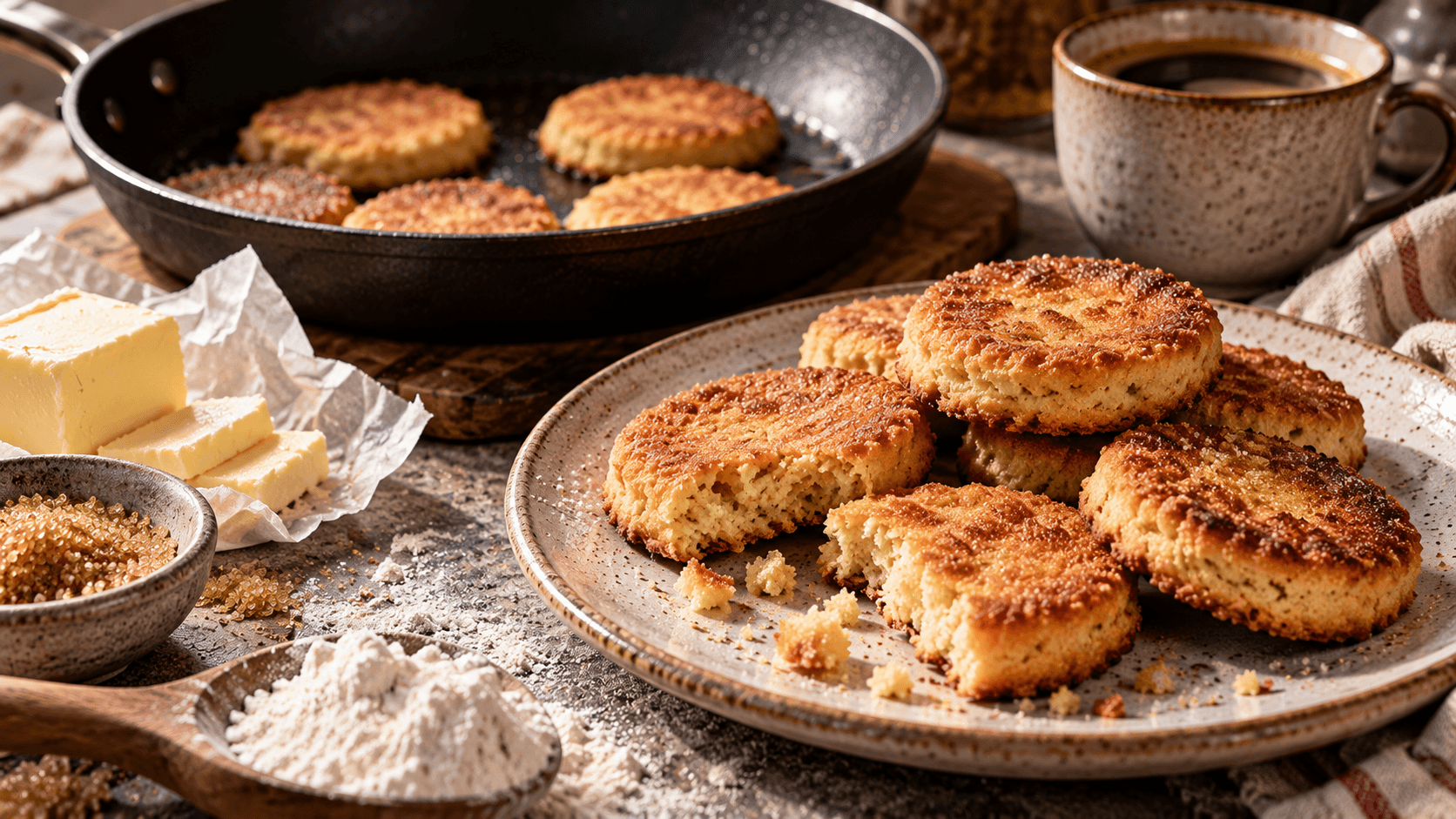
How a temporary kitchen, three basic ingredients, an AI-generated recipe and a complete disregard for precise measurements produced surprisingly good homemade sablés.
Sometimes I get very ambitious in the kitchen.
Complex recipes. Fermentation. Strange combinations of ingredients. Experiments that take several days and occasionally involve microorganisms whose behaviour I can only partially control.
And sometimes I just want a biscuit with my coffee.
This was one of those times.
We had recently moved to a new apartment in France. Unfortunately, the new apartment didn't yet have a stove. The old one had been built into the kitchen of our previous home, and the replacement was taking its time arriving.
The new apartment also had no internet connection.
Which is slightly inconvenient when most of your professional life involves working online.
So I was spending much of my working time in a small apartment we use for short-term accommodation, occasionally staying overnight rather than travelling back and forth.
It had a tiny kitchenette.
A microwave.
A two-burner hob.
A small refrigerator.
A couple of pans.
And a rather random collection of food.
Not exactly the kitchen of a Michelin-starred restaurant.
But sufficient for survival.
One afternoon, while working, I suddenly wanted coffee.
And something sweet to go with it.
I didn't particularly want to go shopping.
I wanted to make coffee, eat something nice and get back to work.
So I opened ChatGPT.
What can I make without an oven?
I explained the situation.
No oven.
A frying pan.
A few basic ingredients.
Some flour.
Sugar.
Butter.
And various other things, including vanilla protein powder.
I asked what I could make.
ChatGPT suggested shortbread cookies.
Not the most revolutionary idea in culinary history, admittedly.
But it was a good one.
The proposed recipe was wonderfully simple:
- 100 g plain flour
- 50 g butter
- 30 g sugar
- A pinch of salt
No eggs.
No baking powder.
Just butter, flour and sugar.
The instructions were equally straightforward.
Soften the butter, combine it with sugar, work in the flour, shape small cookies and cook them slowly in a covered frying pan.
ChatGPT specifically suggested avoiding experiments with protein powder.
Naturally, I ignored that part.
Measuring ingredients is for people with scales
The recipe provided precise quantities.
I had a ceramic bowl and a fairly relaxed attitude toward precision.
So I took some butter.
How much?
Approximately a third of the piece I had in the refrigerator.
Was that 40 grams? 60? Something else?
No idea.
It was good salted Breton butter, which seemed like an excellent starting point.
I left it outside the refrigerator for a while until it softened.
Then I added some dark cane sugar.
No measuring.
Just what looked right.
Then ordinary white flour.
Again, by eye.
And because I had already told ChatGPT about my vanilla protein powder, I decided it would be a shame not to use it.
Half a scoop went into the bowl.
A little extra salt.
And that was the entire recipe.
Three essential ingredients, plus my completely unnecessary protein experiment.
The dough looked like sand
I started working everything together with a fork.
And quickly became suspicious.
This didn't look like dough.
It looked like something collected from a beach.
Dry crumbs.
Loose particles.
No obvious structure.
Nothing remotely resembling the soft, elastic dough you might expect when baking.
My first instinct was to add some milk.
Or water.
Or anything that might persuade these ingredients to acknowledge each other's existence.
But I remembered that shortbread dough is supposed to be crumbly.
So I resisted.
Instead, I picked up some of the mixture and pressed it between my fingers.
And something interesting happened.
It held together.
The butter was doing its job.
I started squeezing and kneading the crumbs with my hands.
Gradually, the beach sand transformed into something resembling modelling clay.
Not elastic.
Not particularly smooth.
But perfectly capable of holding its shape.
Excellent.
We had dough.
Six or seven little hockey pucks
I rolled the dough into a thick sausage.
Then cut it into approximately six or seven pieces.
Each was roughly three or four centimetres in diameter and perhaps a centimetre to a centimetre and a half thick.
Quite substantial little biscuits.
More like miniature hockey pucks than elegant French pastries.
I had a regular thin frying pan with an excellent non-stick coating.
No need for additional butter or oil.
I arranged the cookies in the cold pan, covered it with a lid and switched on the hob.
The temperature control had nine settings.
I started at four.
After approximately five to seven minutes, I checked the cookies and reduced the heat to three.
Another five to seven minutes passed.
Then I tried lifting one.
It broke.
Not a spectacular success.
But I could see that the underside was beginning to cook properly.
The problem wasn't necessarily the recipe.
It was my handling technique.
These cookies were still extremely fragile.
So I found two thin kitchen utensils and started turning them with the kind of concentration normally reserved for defusing explosives.
One by one.
Carefully.
And eventually, all the cookies were upside down.
The cooked sides were already a pleasant golden colour.
Things were looking promising.
The world's slowest biscuits
I left the cookies under the lid at the lower heat setting.
Another ten minutes or so.
Then I checked them again.
The colour was becoming more interesting.
Golden brown.
A little caramelisation.
Not burnt.
Just that beautiful colour you want from good butter-rich shortbread.
I turned them once more, this time without breaking anything.
Another five minutes.
Then I switched off the heat.
And instead of immediately removing the cookies, I moved the frying pan to a cool burner and left everything alone.
For about an hour.
Yes, an hour.
I was working anyway.
The cookies weren't going anywhere.
Once the pan had cooled, I carefully transferred them to a plate and let them rest for another half hour or so.
By this point, my original spontaneous coffee break had evolved into a fairly substantial baking project.
But the cooling was worth it.
While hot, the cookies had been soft and fragile.
As they cooled, the butter-rich dough firmed up.
The texture became beautifully crumbly.
Exactly what I wanted.
And finally, I had my biscuits.
In Nantes, we know a thing or two about biscuits
I live in Nantes.
Historically part of Brittany, and home to the company LU, which began making biscuits here in the nineteenth century.
This part of France takes its biscuits rather seriously.
Breton butter biscuits, galettes and sablés are everywhere.
And I love them.
A proper sablé should have that wonderful buttery, crumbly texture.
It shouldn't behave like bread.
It shouldn't be chewy.
It should almost fall apart in your mouth.
So I was rather pleased when I finally tasted my improvised frying-pan version.
Because it was excellent.
Rich.
Buttery.
Slightly caramelised.
Crumbly.
With a little additional flavour from the dark cane sugar.
And perhaps the faintest hint of vanilla from the protein powder, although I wouldn't pretend it was essential.
Was it an exact traditional Breton recipe?
Absolutely not.
Was it as good as many biscuits I've bought?
To my taste, yes.
And that was a rather satisfying result from a frying pan, a bowl and a handful of ingredients.
The actual recipe, if you prefer measurements
If you want to reproduce the idea without adopting my rather irresponsible measuring habits, start with these proportions.
Ingredients for approximately 6–10 small cookies:
- 100 g plain flour
- 50 g softened butter, preferably salted
- 30 g sugar, white or brown
- A small pinch of salt, optional if using salted butter
- Optional: a little vanilla protein powder, replacing a small portion of the flour
Method:
- Let the butter soften at room temperature.
- Mash it together with the sugar using a fork.
- Add the flour and mix until the ingredients resemble coarse crumbs.
- Press the mixture together with your hands until it forms a cohesive dough.
- Shape into small, preferably fairly thin discs.
- Arrange them in a cold, dry non-stick frying pan.
- Cook covered over very low heat, checking the bottoms regularly.
- Turn carefully once they're firm enough to handle, and cook until golden and cooked through.
- Remove from the heat and let them cool completely before eating.
The exact cooking time will depend on the thickness of the cookies, the pan and the hob.
My unusually thick cookies took considerably longer than the original recipe suggested.
For a more predictable result, I'd make them thinner, around five millimetres.
And I would definitely start with a very low temperature. Butter and sugar can burn surprisingly quickly, particularly in a thin pan.
The important thing is not to rush.
These aren't pancakes.
You want gentle cooking, not aggressive frying.
And don't skip the cooling stage.
That's when the texture really develops.
Sometimes the best kitchen appliance is a little improvisation
What I like about this experience is how little it required.
No oven.
No mixer.
No scales.
No special baking equipment.
Just a frying pan, a lid and three ordinary ingredients.
The AI suggested the basic method.
I improvised the quantities, ignored some advice, changed the cooking process and eventually ended up with a result I genuinely liked.
Which is a fairly accurate description of how I use AI for many things, not only cooking.
It provides a useful starting point.
I experiment.
Something doesn't work exactly as expected.
I adjust.
And sometimes the result turns out better than I anticipated.
The only downside was that by the time the biscuits were ready, my spontaneous afternoon coffee had become a rather late coffee.
But I didn't mind.
I made another cup.
Sat down with my homemade sablés.
And was extraordinarily pleased with myself.
Three ingredients. One frying pan. No oven.
And some of the best homemade biscuits I've had in quite a while.
Thanks, ChatGPT.
Even if I didn't entirely follow your instructions.
Recipe at a glance
Approximately 6–10 cookies, depending on size. Preparation: Approximately 10–15 minutes, plus time to soften the butter. Cooking: Variable; approximately 15–30 minutes depending on thickness and heat. The personal experiment took longer. Cooling: At least until completely cool. I allowed approximately 90 minutes.
Ingredients
- 100 g plain flour
- 50 g softened butter, preferably salted
- 30 g sugar, white or brown
- A small pinch salt, optional if using salted butter
- Optional: a little vanilla protein powder, replacing a small portion of the flour
Method
- Let the butter soften at room temperature.
- Mash it together with the sugar using a fork.
- Add the flour and mix until the ingredients resemble coarse crumbs.
- Press the mixture together with your hands until it forms a cohesive dough.
- Shape into small, preferably fairly thin discs.
- Arrange them in a cold, dry non-stick frying pan.
- Cook covered over very low heat, checking the bottoms regularly.
- Turn carefully once they're firm enough to handle, and cook until golden and cooked through.
- Remove from the heat and let them cool completely before eating.