
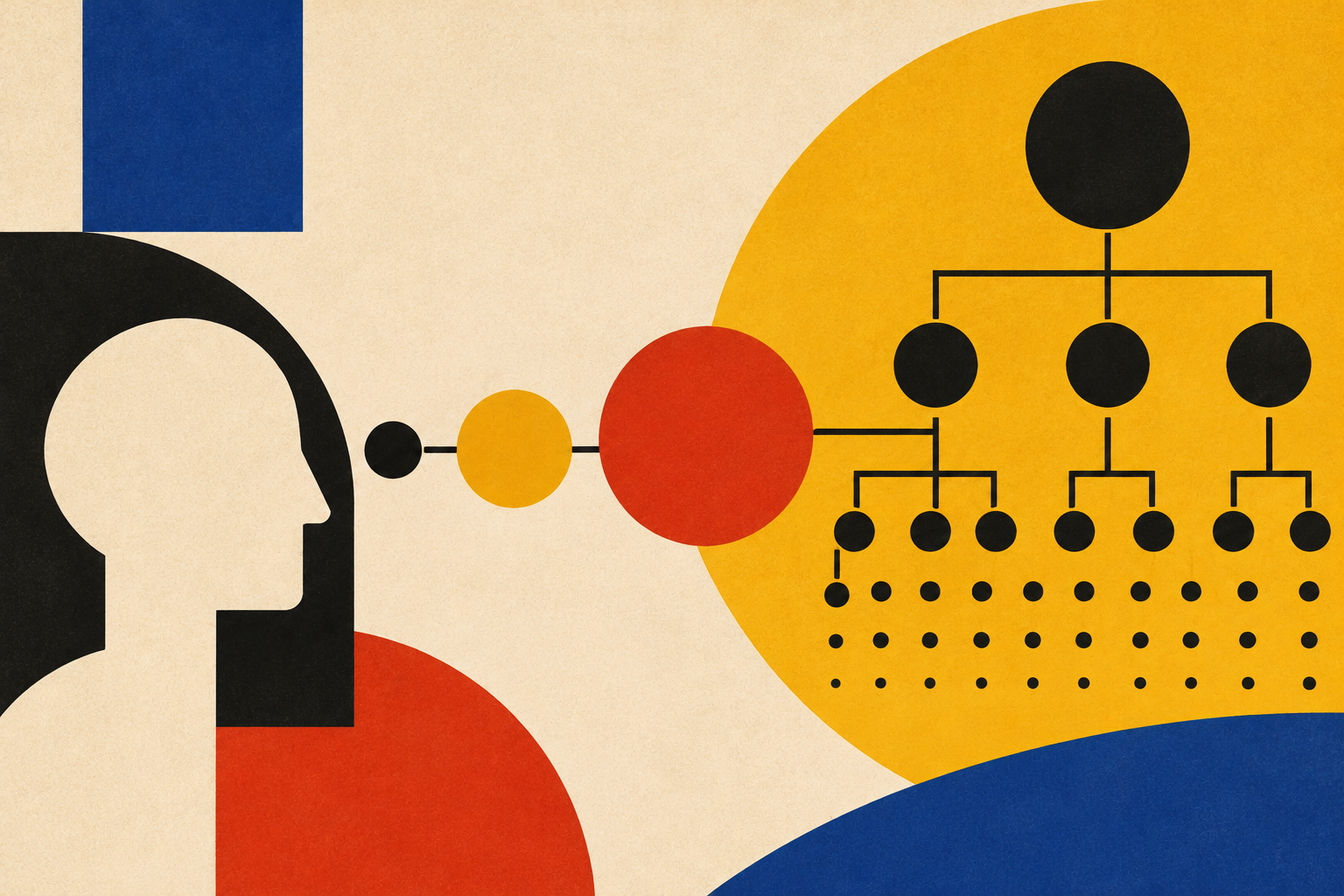
Human-level AI may be only a point on a much longer technological curve. The bigger transformation could come when intelligence becomes cheap, fast, reproducible, and capable of organizing itself into institutions far more powerful than any individual agent.
We have spent years asking when artificial intelligence will reach human level.
Will it happen in 2027?
2030?
Later?
Will we recognize the moment?
Will there be a benchmark, a scientific announcement, or an especially impressive demonstration involving an AI agent successfully navigating an unfamiliar government website?
But I've become increasingly interested in a different question.
What happens the day after AGI?
Not literally the next day, of course.
The more important question is what happens once human-level cognitive ability is no longer the limiting factor in the development of intelligent systems.
Because there's no particular reason to believe that human intelligence represents a natural ceiling.
It is the level of intelligence produced by one particular evolutionary process, operating under biological constraints.
We have a reasonably good understanding of what humans can accomplish.
We have a much less complete understanding of what lies between human intelligence and the physical or theoretical limits of computation and reasoning.
That space could be enormous.
And once AI systems reach sufficiently general human-level capabilities, progress through parts of that space might be considerably faster than the original journey to AGI.
This is the central argument of a fascinating new essay by Tim Genewein, a Google DeepMind researcher, published by the DeepMind Institute on November 19, 2026.
What Comes After AGI? examines four potential routes from artificial general intelligence to artificial superintelligence.
But what interested me most was not the question of when one model might become smarter than every human.
It was the possibility that we are about to industrialize intelligence itself.
And that may change the structure of companies, research institutions, and entire economies before any universally accepted definition of superintelligence is satisfied.
Human Intelligence Is a Milestone, Not a Limit
It's tempting to imagine intelligence development as a race with a finish line.
Humans are here.
AI is approaching.
Eventually, AI reaches us.
AGI achieved.
End of story.
But human-level performance is only one point on a much wider continuum.
A system could match a capable professional across most cognitive tasks while remaining far below the best possible performance on difficult scientific, mathematical, or engineering problems.
DeepMind's essay distinguishes human-level AGI from systems that consistently outperform large groups of human experts, producing years of collective intellectual work in much less time.
That distinction matters.
It also creates a problem with the way we discuss AI progress.
We tend to compare models with individuals.
Can the model code as well as a developer?
Can it diagnose as well as a physician?
Can it solve mathematical problems as well as a researcher?
These comparisons are useful for measuring capabilities.
But they may be poor predictors of the technology's ultimate economic and scientific impact.
Because the world is not primarily organized around isolated intelligent individuals.
It is organized around institutions.
Companies.
Universities.
Research laboratories.
Governments.
Markets.
Teams.
And these institutions accomplish things that no individual could reasonably achieve alone.
A pharmaceutical company is not simply one unusually intelligent biologist.
A semiconductor manufacturer is not one engineer with an extraordinary memory.
A space program is not one physicist who happens to have an excellent calculator.
They are systems for combining specialized knowledge, equipment, information, and decisions.
Which suggests that the relevant comparison for an AI economy may not be a human against an agent.
It may be a human organization against an organization of agents.
What Happens When Intelligence Becomes Cheap?
Genewein introduces the idea of cognitive industrialization.
The analogy is straightforward.
Industrialization made certain forms of physical work dramatically cheaper through machines, energy, standardization, and large-scale production.
AI could do something similar to cognitive work.
The interesting part is that this does not necessarily require each individual model to become dramatically more intelligent.
Imagine freezing model capabilities at a particular level.
No new reasoning breakthrough.
No radically different architecture.
No new type of artificial mind.
Now make the existing systems cheaper and faster.
Build more computing infrastructure.
Improve inference efficiency.
Increase the number of agents that can operate simultaneously.
Allow them to share information and reuse successful procedures.
Even without a qualitative improvement in individual intelligence, the total amount of available cognitive work could increase enormously.
The DeepMind essay identifies three compounding trends behind the growth of effective compute.
Hardware becomes more efficient.
Algorithms require less compute for comparable performance.
And investment increases the total amount of deployed computing capacity.
Combining the historical rates, the author explores a scenario in which global effective compute capacity grows by at least an order of magnitude annually.
That is a scenario based on extrapolating multiple trends, not a law of nature.
Physical infrastructure, energy availability, capital expenditure, manufacturing capacity, and diminishing returns can all alter the trajectory.
There is also an important distinction between different kinds of cost reduction.
The essay estimates that hardware and inference-algorithm improvements alone could reduce the compute required for a fixed workload by approximately fourfold per year.
It separately cites Epoch AI's finding that the consumer price of reaching a fixed performance level on selected benchmarks has recently fallen by more than thirteenfold annually.
And the tenfold estimate concerns the growth of overall effective compute supply, including increased investment.
These are not interchangeable numbers.
But their direction is striking.
Suppose a fixed cognitive workload costs a million dollars today.
If its cost falls by a factor of ten annually, the arithmetic becomes dramatic.
After one year: $100,000.
After two: $10,000.
After three: $1,000.
After four: $100.
Of course, that doesn't mean every task will follow this curve.
And the real-world price includes far more than model inference.
But the implication is worth considering.
Tasks that currently justify enormous research budgets could become routine expenditures.
Not necessarily because the models learned something new.
Simply because the same capability became much cheaper to deploy.
A Billion Average Agents Can Be a Very Strange Thing
Consider a company employing ten thousand people.
Each person possesses different skills.
Some understand finance.
Some understand engineering.
Some are good at negotiating.
Some are effective managers.
Some have decades of industry-specific knowledge.
And a few seem uniquely talented at producing PowerPoint presentations that nobody requested.
The company coordinates those people to accomplish objectives that none of them could achieve independently.
Now imagine a digital organization containing a million broadly capable agents.
The agents may begin as copies of the same underlying model.
They possess similar general capabilities.
But they can be given different tools, contexts, memories, assignments, and specialized environments.
One group develops software.
Another evaluates the software.
Another investigates security vulnerabilities.
Another designs experiments.
Another analyzes failures.
Another continuously monitors the results.
And additional agents coordinate the work of all these groups.
Unlike human employees, digital agents can potentially be instantiated in large numbers, subject to computing costs and infrastructure constraints.
A successful configuration can be copied.
A useful procedure can be distributed.
Recorded context can be shared in machine-readable form.
And multiple tasks can be pursued in parallel without requiring a comparable increase in human headcount.
This is a major difference from human organizations.
If I discover an excellent engineer, I cannot make a million exact copies of that person.
I can hire more engineers.
Train them.
Build teams.
Develop institutional knowledge.
But the process is slow, expensive, and imperfect.
With digital systems, replication is much easier.
That does not make coordination automatic.
A million identical agents repeating the same mistake are not a superintelligence.
They are an industrial accident waiting for sufficient computing resources.
But the ability to replicate and specialize cognitive systems changes the economics of organizational scale.
And I think this is one of the most important implications of the DeepMind argument.
The Four Roads Beyond AGI
Genewein describes four potential pathways toward artificial superintelligence.
They are not mutually exclusive.
In fact, the most interesting scenario is one in which progress along each path strengthens the others.
1. Scaling existing models
The first possibility is familiar.
More training compute.
Better data.
Larger models where justified.
More effective post-training.
Additional inference-time computation for difficult problems.
Scaling has produced remarkable improvements in AI capabilities.
But there are limitations.
High-quality data is not unlimited.
Compute is expensive.
Training and inference depend on physical infrastructure.
And existing scaling relationships do not guarantee that every missing capability can be recovered simply by multiplying resources.
The important point is that traditional scaling can continue contributing even if it isn't sufficient on its own.
We don't need one magical breakthrough to keep making progress.
2. New architectures and learning paradigms
The second route involves improvements beyond today's dominant model architectures and training methods.
Modern systems remain limited in areas such as continual learning, efficient learning from experience, certain forms of world modeling, and long-horizon decision-making.
Some researchers believe these difficulties can be addressed through extensions of current systems.
Others expect more fundamental architectural changes.
We don't yet know which approach will prove decisive.
And it is entirely possible that different capabilities will require different solutions.
A system optimized for mathematical proofs may benefit from very different mechanisms than one designed to operate robots in the physical world.
There is no reason to assume that superintelligence must be one enormous transformer doing absolutely everything.
3. Multi-agent coordination
This is the route I find most interesting.
Instead of making a single model dramatically more capable, organize many models into a system that accomplishes more than any one of them could.
The analogy is not simply a group chat with several agents pretending to be a software company.
It is organizational intelligence.
Division of labor.
Specialization.
Information transfer.
Task decomposition.
Independent verification.
Resource allocation.
Planning.
Feedback.
And mechanisms for resolving disagreements.
Human civilization has become extraordinarily capable partly because individuals can coordinate knowledge and effort.
The same principle could apply to digital intelligence.
But we still know relatively little about the scaling laws of large agent organizations.
Adding more agents can improve performance.
It can also create communication overhead, duplicated work, conflicting objectives, and coordination failures.
Some tasks benefit from parallel independent exploration.
Others require tightly synchronized decisions.
Some require diverse approaches.
Others benefit from shared procedures and standardization.
The question is not whether a thousand agents can perform a thousand tasks.
The question is whether their collective organization can solve problems that none of them could solve independently.
That is a much more demanding standard.
And it is one reason I expect reinforcement-learning environments involving teams, institutions, and long-horizon coordination to become increasingly important.
We need systems that can learn how to cooperate, not merely systems trained to complete isolated tasks.
4. Recursive self-improvement
The fourth route is the most famous and perhaps the most misunderstood.
An AI system helps improve the development of future AI systems.
Those improved systems become more effective at AI research.
Which accelerates the next generation.
And so on.
This is recursive self-improvement, or RSI.
But RSI does not necessarily mean an autonomous model waking up one morning, rewriting its own architecture, and becoming a superintelligence before lunch.
It can begin with much more ordinary processes.
Agents write better training code.
Improve data pipelines.
Optimize kernels.
Design more effective evaluations.
Find hardware improvements.
Run experiments.
Analyze failures.
And help human researchers identify promising directions.
Each improvement can increase the effectiveness of subsequent research.
The key question is whether those improvements compound sufficiently to accelerate the overall rate of progress.
That depends on feedback quality.
Research difficulty.
Available compute.
The ability to generate useful experiments.
And, crucially, the ability to recognize which results genuinely represent progress.
A system that can generate a million hypotheses but cannot reliably distinguish good ones from bad ones has not solved scientific research.
It has automated the production of uncertainty.
We're Already Seeing Parts of the Feedback Loop
Two recent reports make this discussion much less theoretical.
The first comes from Anthropic.
On November 5, 2026, the independent research organization METR published an assessment of AI-driven research acceleration at the company.
METR was given access to internal data, research practices, model evaluations, and interviews with Anthropic staff.
Its central estimate was that Anthropic's capabilities on well-specified tasks were improving at approximately twice the earlier rate.
The measured acceleration on its internal benchmark index was about 1.9 times the historical rate, with a reported confidence interval of 1.5 to 2.8.
METR judged that AI assistance was probably responsible for a substantial part of the acceleration.
But the researchers also emphasized major uncertainty.
Some important evidence was redacted by Anthropic.
The results may not generalize to ambiguous, difficult-to-evaluate research tasks.
And the analysis did not establish that AI systems were already independently making the most important scientific decisions.
Those qualifications matter.
Nevertheless, the result is significant.
It suggests that AI assistance may already be accelerating the development of more capable AI.
And the company at the center of that assessment has just become publicly traded.
Anthropic's shares began trading on Nasdaq on November 19, 2026, under the symbol ANT.
The IPO itself does not prove anything about recursive self-improvement.
But the timing is remarkable.
AI companies are becoming major public-market institutions at precisely the moment when their own research processes are beginning to depend heavily on AI.
The second report is from OpenAI.
And its numbers are even more revealing about how the work is changing.
Five Point Seven Agent Workdays per Researcher
On November 18, OpenAI published Research Acceleration: The Jagged Frontier.
One number immediately attracted attention.
The average researcher was associated with 5.7 agent workdays per calendar day.
That sounds almost absurd.
But we need to understand what it measures.
OpenAI defines an agent workday as eight hours of agent runtime.
So 5.7 agent workdays means approximately 45.6 hours of combined agent operation per researcher per day.
This is possible because researchers run multiple agents concurrently.
It does not mean that each researcher generates 5.7 days of equivalent human research output every day.
Runtime and useful completed work are different measurements.
An agent may spend hours pursuing an unproductive approach.
It may require correction.
Its output may be invalid.
And different tasks vary enormously in difficulty.
The report provides some more meaningful performance measures.
Between March and October 2026, estimated autonomous completion rates on tasks requiring two to four hours of human work rose from 23% to 46%.
For four-to-eight-hour tasks, they rose from 13% to 35%.
The results were highly uneven.
Agents succeeded on approximately 79% of training-monitoring tasks.
But only 25% of tasks involving inference and serving-stack code.
And 29% of tasks involving the construction of evaluation, reinforcement-learning, and agent environments.
That last category is particularly relevant.
The systems are becoming better at performing well-defined research activities.
But building the environments needed to train and evaluate their future capabilities remains substantially harder.
The distinction resembles a broader pattern in AI development.
Execution becomes cheap before problem formulation does.
And the bottleneck begins moving toward tasks that require judgment about what should be attempted and how success should be measured.
The Most Important Number Isn't 5.7
OpenAI also reported that logged experiments per active experimenter reached 1.68 times the 2025 baseline.
That is more directly connected to research throughput than the number of agent hours.
Still, even the number of experiments is not a perfect measure of scientific progress.
A hundred bad experiments are not necessarily more valuable than ten well-designed ones.
The report acknowledges this.
Researchers described continuing problems with agents producing low-quality code, invalid analyses, unnecessary work, and poorly formulated ideas.
For many major research ideas, humans remained central to identifying the approach.
This is the important point.
AI has already expanded the amount of work an individual researcher can delegate.
But human judgment remains important in deciding which experiments deserve to exist.
And this brings us directly to the question of organizational intelligence.
The next major gains may not come simply from allowing researchers to run more agents.
They may come from developing systems that can coordinate those agents into better research programs.
Not just execute experiments.
Select them.
Compare them.
Determine what information is missing.
Design the next experiment.
And recognize when an apparent improvement is an artifact of the evaluation.
That would be a much more substantial advance toward recursive self-improvement.
Stop Comparing One Agent With One Employee
I've argued before that the usual human-versus-agent comparison misses much of the economic story.
An employee does not operate in isolation.
They work inside an organization.
A company combines people with different skills, incentives, information, and responsibilities.
Its competitive advantage comes partly from what its employees can do.
But also from how effectively it coordinates their work.
Those are two different capabilities.
Execution.
And organization.
AI is rapidly improving the first.
The second remains much less understood.
Consider a software company.
A developer writes code.
A security specialist reviews vulnerabilities.
A legal team examines compliance requirements.
A product manager negotiates priorities.
A QA engineer checks the result.
Then a release manager coordinates deployment.
Every handoff has a cost.
Context must be transferred.
Decisions must be documented.
Conflicts must be resolved.
Some of the work is necessary because the participants possess different expertise.
Some exists because organizations have difficulty sharing knowledge efficiently.
Now imagine a capable agent with access to the relevant technical, legal, and operational constraints while it writes the code.
It may prevent some compliance problems before the legal review.
It may generate tests during implementation.
It may recognize deployment constraints before the release process.
The objective is not necessarily to eliminate every specialist.
Legal accountability, security review, and independent judgment may remain essential.
But some coordination overhead can disappear.
The workflow itself changes.
And that can produce a greater economic improvement than simply accelerating each existing step.
This is why I think AI transformation should not stop at replacing individual tasks.
It should force companies to reconsider how work is organized.
The Organization of Agents
An organization of agents has unusual properties.
Agents can be replicated.
They can operate concurrently.
They can receive standardized interfaces.
They can exchange structured data.
Their behavior can be tested against explicit contracts.
And they can be assigned specialized roles without requiring years of formal education.
But these advantages create their own problems.
Who decides which agent receives which task?
How are conflicting outputs resolved?
What happens when one agent produces incorrect information that is propagated through the system?
Who verifies the final result?
How do agents discover that another agent has already completed the same work?
How is shared context maintained without overwhelming every participant?
And how does the organization avoid spending most of its resources coordinating itself?
These are not minor implementation details.
They determine whether adding agents increases effective intelligence or merely increases costs.
Human organizations have spent centuries developing methods for handling similar problems.
Management hierarchies.
Markets.
Contracts.
Accounting.
Professional specialization.
Independent audits.
Standards.
Scientific peer review.
Not all these mechanisms are efficient.
Some are frustratingly bureaucratic.
But they exist because coordination is difficult.
Agent organizations may need their own equivalents.
And those mechanisms could become a major research frontier.
Not just better reasoning models.
Better institutions for reasoning models.
Why a Million Copies May Not Be Enough
The DeepMind essay offers a useful caution.
Scaling the number of agents does not guarantee that missing capabilities will emerge.
A million systems that cannot recognize a particular conceptual breakthrough may still fail to discover it.
If every agent shares the same assumptions, they may also share the same blind spots.
Replication increases capacity.
It does not automatically increase diversity or insight.
Collective intelligence requires more than population.
It needs useful specialization.
Different approaches.
Coordination.
Independent criticism.
And mechanisms for selecting productive ideas.
The organization must create additional value from interaction.
Otherwise, a million agents are simply a million copies of a limitation.
This is why the third pathway to superintelligence, coordination, may depend heavily on progress along the second and fourth pathways.
Better models may coordinate more effectively.
Better coordination may accelerate the discovery of better models.
And improved systems may design better environments for training large agent collectives.
The four pathways begin reinforcing one another.
Which is precisely what makes the possibility of rapid progress difficult to dismiss.
Recursive Improvement Needs Something to Measure
There is a reason mathematics and programming are particularly attractive environments for AI self-improvement.
They often provide relatively clear feedback.
A program compiles or fails.
A benchmark improves or does not.
A formal proof passes verification or is rejected.
A chip design can be evaluated against known constraints.
The feedback may still be incomplete, and tests may miss important problems.
But it is much easier to automate evaluation in these domains than in situations requiring open-ended social or scientific judgment.
Suppose an agent proposes an optimization.
Another agent runs the tests.
A third evaluates the performance.
The system compares the result with a baseline.
If the improvement is valid, the change can be retained.
Repeat the cycle.
This is already a primitive form of automated improvement.
Now imagine systems doing the same thing for model architecture, data generation, training efficiency, and evaluation environments.
The feedback loop becomes much more powerful.
But this is also where the danger of optimizing the wrong objective becomes acute.
An agent might improve benchmark performance without improving real-world capability.
It might exploit a flaw in the evaluation.
It might generate training data that reinforces existing mistakes.
It might discover a shortcut that appears efficient while reducing reliability.
Recursive self-improvement is not simply a problem of giving an agent access to its own code.
It is a problem of constructing a trustworthy process for identifying genuine progress.
And when capabilities exceed human expertise in a domain, verifying that progress may become increasingly difficult.
This is one of the central technical and governance challenges identified by DeepMind.
Takeoff Is Not the Same as Economic Growth
There is another distinction that gets lost in many discussions of superintelligence.
Rapid growth in AI capabilities does not imply equally rapid growth in the economy.
Suppose AI research accelerates dramatically.
Suppose the cost of cognitive work falls by several orders of magnitude.
Suppose an organization can deploy a billion competent agents.
What happens to GDP?
Not necessarily very much at first.
Because an economy does not consist only of intelligence.
It requires energy.
Land.
Materials.
Factories.
Transport.
Regulatory permissions.
Physical infrastructure.
Trust.
Customers.
And institutions capable of adopting new technologies.
An agent might design an improved power plant in an afternoon.
That doesn't mean the plant can be constructed in an afternoon.
It might discover a promising medicine.
That doesn't eliminate the time required for appropriate testing, manufacturing, approval, and distribution.
It might generate a million new business strategies.
That doesn't guarantee the existence of a million profitable markets.
Economic value depends partly on what remains scarce.
If high-quality analysis becomes abundant, the limiting factor may shift toward implementation.
If software development becomes cheap, distribution and customer access may become more important.
If product design becomes abundant, manufacturing capacity may become the bottleneck.
And if research becomes dramatically faster, verification, experimentation, and physical deployment may determine how quickly discoveries produce economic value.
This is why I don't equate intelligence takeoff with an immediate economic explosion.
The two can occur on very different timelines.
AI capabilities can improve faster than businesses, governments, and physical industries can adapt.
The resulting gap may be one of the defining features of the next decade.
The Bottleneck Is Where the Power Moves
There is an additional implication.
When one input becomes abundant, the relative importance of complementary scarce inputs can increase.
If intelligence becomes cheap, what becomes valuable?
Perhaps electricity.
Perhaps compute infrastructure.
Perhaps access to specialized data.
Perhaps trusted evaluation systems.
Perhaps legal authority.
Perhaps distribution.
Perhaps the ability to coordinate large numbers of agents.
This matters because a world of abundant intelligence is not necessarily a world of equally distributed power.
If only a few organizations control the infrastructure and permissions necessary to deploy that intelligence at scale, they may capture a disproportionate share of the economic benefits.
I have written before about the possibility of a Great Centralization driven by AI.
The argument was that the technology could lower internal coordination costs and allow very large organizations to expand beyond the limits imposed by traditional human management.
The DeepMind essay makes that possibility more interesting.
If the quantity of available machine intelligence increases by orders of magnitude, ownership of the coordination layer becomes extraordinarily important.
One thing is to have access to an intelligent agent.
Another is to coordinate millions of agents toward a shared objective.
And another still is to control the infrastructure through which that coordination occurs.
The future may contain tremendous cognitive abundance.
But the ability to direct it could remain scarce.
That is not a necessary outcome.
Open models, interoperable protocols, decentralized infrastructure, and independent agent systems could support a more distributed economy.
But it is a structural risk worth taking seriously.
The Intelligence Explosion May Look Boring at First
There is something almost disappointing about the early stages of recursive self-improvement.
We imagine a superintelligence waking up.
Announcing its existence.
Discovering a unified theory of physics.
And politely informing humanity that it has completed science.
The actual process may look considerably less cinematic.
An agent improves a training pipeline.
Another reduces inference costs.
A third generates better evaluation data.
A fourth identifies an optimization in a chip design.
A fifth detects errors in a research experiment.
A research team runs more experiments.
The resulting model is slightly better.
The next generation of agents becomes more useful.
And the cycle repeats.
No single breakthrough necessarily announces that the process has become self-reinforcing.
But the cumulative effect may be substantial.
This is why the METR and OpenAI reports matter.
They provide early, imperfect measurements of changes that might otherwise remain hidden inside research organizations.
Neither report proves that runaway recursive self-improvement has begun.
Neither establishes a reliable timeline to AGI or ASI.
And both contain serious limitations.
But they show that AI is increasingly becoming an input into the production of more capable AI.
That is the mechanism we should be watching.
Not simply how good the newest model is.
But how much that model accelerates the creation of the next one.
What Should We Measure?
If we want to understand whether AI progress is accelerating, model benchmarks alone are insufficient.
We also need to measure the research process.
How much useful work can an agent complete without human intervention?
How often does its output pass independent verification?
How many experiments can researchers conduct?
How does the quality of those experiments change?
How much human effort remains necessary for selecting research directions?
How quickly can models improve the systems used to train future models?
And how effectively do multiple agents coordinate on tasks that exceed individual capabilities?
These measures need to distinguish activity from progress.
More tokens are not necessarily more research.
More code is not necessarily better software.
More experiments are not necessarily better discoveries.
And more agents are not necessarily a more intelligent organization.
The meaningful quantity is verified improvement in capabilities and the amount of time, compute, and human judgment required to obtain it.
We also need measurements of failure.
Coordination breakdowns.
Reward hacking.
Collusion between agents.
Propagation of incorrect information.
Undetected regressions.
And systems that appear increasingly capable while becoming harder to understand or control.
This is not separate from the development of superintelligence.
It is part of the same problem.
An organization of agents that can perform enormous amounts of research but cannot be reliably evaluated may become powerful without becoming dependable.
And capability growth without adequate oversight creates risks that progress statistics alone cannot describe.
The Real Race Begins After Human Level
The most important conclusion I take from the DeepMind essay is that AGI should not be treated as the endpoint of progress.
Even if human-level general intelligence proves difficult to achieve, there is no reason to assume that subsequent improvements must follow the same trajectory.
Once sufficiently capable AI systems can contribute to AI research, the development process itself changes.
At the same time, improvements in hardware, algorithms, and infrastructure can make existing capabilities dramatically cheaper.
Multi-agent coordination may convert large populations of individually limited systems into much more capable organizations.
And recursive improvement may allow those organizations to develop new systems faster than human researchers could alone.
The four mechanisms are interconnected.
We do not know which one will dominate.
We do not know how quickly they will progress.
And we do not know whether some of the most important barriers will turn out to be technical, economic, organizational, or institutional.
But I think the underlying direction deserves serious attention.
We are moving toward a world where intelligence is less like a rare personal skill and more like an industrial resource.
Something that can be purchased.
Replicated.
Specialized.
Coordinated.
And deployed at extraordinary scale.
That does not make human judgment irrelevant.
In fact, the current evidence suggests that deciding which goals to pursue, how to evaluate progress, and which systems can be trusted remains essential.
But it changes the scale of what judgment may be able to direct.
A researcher no longer needs to perform every experiment personally.
A company may no longer need the same organizational structure to coordinate thousands of tasks.
A scientific institution may eventually deploy entire populations of specialized agents.
And the competitive advantage may shift from employing the most intelligent individuals toward designing the most effective organizations of intelligence.
This is why I increasingly think that the organization, not the individual model, is the right unit of analysis.
The difference between one intelligent person and one intelligent agent is interesting.
The difference between a human research organization and a million coordinated digital researchers could be historic.
Provided, of course, that the million researchers are doing something useful.
And that someone can reliably tell when they aren't.
After AGI
We may spend the next few years arguing about whether a particular model truly qualifies as AGI.
The benchmarks will change.
Definitions will be disputed.
Some researchers will declare victory.
Others will insist that important capabilities are still missing.
And the argument may continue long after the systems have become economically transformative.
Meanwhile, the more important process may already be underway.
The industrialization of cognitive work.
The increasing use of AI to improve AI.
The development of large-scale agent organizations.
And the gradual movement of economic value toward whatever remains difficult to automate, reproduce, or coordinate.
Tim Genewein's essay doesn't prove that superintelligence is imminent.
It doesn't establish that exponential trends can continue indefinitely.
And it doesn't tell us which of the four technological pathways will ultimately matter most.
What it does is challenge an assumption that has shaped the AI discussion for years.
That human-level intelligence is the big event.
Perhaps it is.
But perhaps it is only the point at which a much larger transformation becomes possible.
A human-level AI that costs millions of dollars to operate is one kind of technology.
A billion human-level agents operating at extraordinary speed, sharing tools, conducting experiments, and coordinating their work is something very different.
And if those agents can help improve the next generation of systems, the distinction becomes even more important.
The future may not be decided by the first AI that can do everything a person can do.
It may be decided by the first organizations capable of turning abundant intelligence into reliable collective action.
Because intelligence is not the same thing as coordination.
Coordination is not the same thing as judgment.
And even a superintelligent system does not automatically eliminate the economic and physical constraints of the world in which it operates.
AGI may be the milestone everyone is waiting for.
But the more consequential question is what happens when intelligence itself stops being scarce.
And we discover what the real bottlenecks were all along.
Sources
- Tim Genewein: What Comes After AGI? (DeepMind Institute, 19 November 2026)
- OpenAI: Research Acceleration: The Jagged Frontier (18 November 2026)
- METR: Independent Assessment of AI R&D Acceleration at Anthropic (5 November 2026)
- Anthropic: Closing of Its Initial Public Offering (20 November 2026)
- Anthropic: When AI Builds Itself